
Texas LMFT-S Requirements: Hours, Exams & Step-by-Step Guide
Stop guessing if your categories match Texas requirements. License Trail checks your direct, indirect, and supervision hours against LMFT-S requirements continuously and flags mismatches before you submit.
No credit card required · Free plan available
Quick Requirements Overview
- LMFT-S is a supervisor designation attached to an active Texas LMFT (not a separate license); governed by BHEC / 22 TAC Ch. 801
- Must hold LMFT in good standing before applying for supervisor status
- LMFT prerequisite pathway (Associate → LMFT): 3,000 supervised hours over ≥24 months, incl. 1,500 direct client hours (≥500 couples/families), 200 supervision hours (≥100 individual); ≤750 direct hours via telehealth
- LMFT-S experience requirement: 3,000 hours of LMFT practice over ≥3 years (rule does not further break down hour types)
- Supervisor training (one): 3-semester-hour grad supervision course or 40-hour supervision CE (completed within 90 days) or AAMFT Fundamentals of Supervision
- Apply via BHEC Online Licensing System with fee + documentation (experience + training)
- Supervisor restrictions/obligations: cannot supervise if employed by supervisee or within prohibited family relationships; must maintain a supervision file and ensure rule/ethics compliance
- Supervisor status expires with LMFT license; if license not active, supervision hours may not count; unauthorized supervision is disciplinable
License Details
Procedures
In Texas, “LMFT-S” (Licensed Marriage and Family Therapist Supervisor) is a supervisor designation attached to an existing LMFT license, not a separate license type. The Texas State Board of Examiners of Marriage and Family Therapists, under the Texas Behavioral Health Executive Council (BHEC), governs these requirements through the Texas Administrative Code, Title 22, Chapter 801, and related guidance.
Below is a step‑by‑step guide, with the key hour requirements and the state’s own terminology highlighted.
1. What “LMFT-S” Means in Texas
The Texas Administrative Code defines a Supervisor as:
“An LMFT with supervisor status meeting the requirements set out in §801.143 of this title (relating to Supervisor Requirements).” (txrules.elaws.us)
The rule also specifies the only acceptable titles you may use once approved:
- “Supervisor”
- “Licensed Marriage and Family Therapist Supervisor”
- “LMFT-S”
- “LMFT Supervisor” (txrules.elaws.us)
BHEC further clarifies that:
Supervisor isn’t a type of license; it designates a Texas LMFT approved by the Council to supervise LMFT Associates. (bhec.texas.gov)
So the path is:
- Become an LMFT-Associate.
- Upgrade to independent LMFT.
- Accumulate additional LMFT practice and complete supervisor training.
- Apply for LMFT supervisor status.
2. Baseline: Meeting the LMFT (Independent License) Experience Requirements
To even be eligible for LMFT-S, you must first hold a full, independent Licensed Marriage and Family Therapist (LMFT) license in Texas. That, in turn, requires specific supervised experience as an LMFT-Associate.
2.1 Supervised clinical experience hours (LMFT-Associate → LMFT)
Texas Administrative Code §801.142 sets the supervised experience requirements for LMFT licensure. In summary, an LMFT-Associate must complete at least:
-
Minimum time frame
- At least two years of work experience in marriage and family therapy. (law.cornell.edu)
-
Total supervised clinical practice
- At least 3,000 hours of supervised clinical practice in marriage and family therapy. (law.cornell.edu)
-
Direct clinical services (client hours)
- At least 1,500 hours providing direct clinical services (face‑to‑face or approved technology‑assisted therapy with clients).
- Within those 1,500 hours, at least 500 hours must be direct clinical services to couples or families.
- No more than 750 of the direct clinical hours may be provided via technology‑assisted services (e.g., teletherapy), as approved by the supervisor. (law.cornell.edu)
-
Supervision hours
- At least 200 hours of supervision by an LMFT-S during the 3,000 hours of supervised clinical practice.
- At least 100 of those 200 supervision hours must be individual supervision (i.e., one‑on‑one or two supervisees with the supervisor). (law.cornell.edu)
BHEC’s own licensing FAQ restates this for in‑state candidates:
- “1,500 or more hours of supervised direct counseling practice (at least 500 family or couples)”
- “3,000 or more total hours of supervised practice (direct and indirect combined)”
- “200 hours of direct supervision (at least 100 of which must be individual)”
completed in no less than 24 months. (bhec.texas.gov)
In other words, for standard LMFT licensure in Texas you should think of it as:
- 3,000 total supervised hours, including:
- 1,500+ direct client hours
- 500+ of those with couples/families
- Up to 1,500 “indirect” hours (documentation, consultation, etc.)
- 200 supervision hours total, with at least 100 individual.
2.2 Supervision structure during the Associate period
Some definitions and structural rules matter for counting supervision:
- A “supervision hour” is defined as 50 minutes. (txrules.elaws.us)
- Individual supervision: no more than two supervisees with the supervisor during that supervision hour. (txrules.elaws.us)
- Group supervision: three to six supervisees with the supervisor during that supervision hour. (txrules.elaws.us)
- When providing services, an LMFT-Associate must receive at least one hour of supervision per week, except for good cause shown. (law.cornell.edu)
Once these supervised-experience requirements are met and you complete other upgrade steps (jurisprudence exam, NPDB self‑query, etc.), you can upgrade from LMFT-Associate to full LMFT. (bhec.texas.gov)
3. Additional Clinical Experience Required for LMFT-S Status
To apply for supervisor status, you must already be an LMFT “in good standing.” Texas Administrative Code §801.143 then adds a further experience requirement:
To apply for supervisor status, an LMFT must submit documentation of “the completion of at least 3,000 hours of LMFT practice over a minimum of 3 years.” (regulations.justia.com)
Key points about this requirement:
- These 3,000 hours are LMFT practice hours, not supervised‑associate hours.
- The rule does not divide these into separate categories (e.g., “direct” vs. “indirect” hours or supervision‑of‑others hours); it treats them as total hours of LMFT practice over at least three years.
- In practice, this is generally interpreted as post‑licensure clinical practice as an LMFT (since the rule uses the term “LMFT practice,” not LMFT‑Associate practice), but you should confirm with BHEC if you have non‑traditional work histories.
So, taken together, a typical in‑state pathway looks like:
- 3,000 supervised hours as an LMFT-Associate (with required breakdown of direct, couples/family, and supervision hours) over at least 2 years.
- 3,000 hours of LMFT practice as an independent LMFT over at least 3 years.
- Completion of approved supervisor training (next section).
4. Supervisor Training Requirements
In addition to the 3,000 hours of LMFT practice over three years, §801.143 requires documentation of one of three supervision‑training pathways:
Under 22 TAC §801.143(a)(3), you must provide proof of one of the following: (regulations.justia.com)
-
Graduate‑level supervision course
- Successful completion of a 3‑semester‑hour graduate course in marriage and family therapy supervision from an accredited institution.
-
40‑hour continuing education course in clinical supervision
- Completion of a 40‑hour CE course in clinical supervision that meets detailed standards, including:
- Taught by a graduate‑level licensee with supervisor status issued by the Council.
- Must be completed within 90 days.
- Content must cover, at minimum:
- Defining and conceptualizing supervision and models of supervision (at least 3 hours)
- Supervisory relationship and marriage and family therapist development (at least 3 hours)
- Supervision methods and techniques, including group supervision, multicultural issues, and evaluation (at least 12 hours)
- Supervision and standards of practice, ethics, and legal/professional issues (at least 12 hours)
- Executive and administrative tasks (supervision plans, contracts, record‑keeping, reporting) (at least 3 hours). (regulations.justia.com)
- Completion of a 40‑hour CE course in clinical supervision that meets detailed standards, including:
-
AAMFT-approved supervision training
- Successful completion of an American Association for Marriage and Family Therapy (AAMFT)–approved Fundamentals of Supervision course. (regulations.justia.com)
BHEC’s LMFT Supervisor application instructions specifically note that you must upload “supervisor training documentation” when you apply through the online licensing system and refer applicants back to these board rules to determine what counts. (bhec.texas.gov)
5. Application Process and Ongoing Supervisor Obligations
5.1 Applying for LMFT Supervisor status
BHEC describes the practical application step as follows:
- LMFT supervisor is a designation, not a license class.
- You apply via the Online Licensing System, submitting:
- Supervisor designation application,
- Required fee, and
- Documentation of your supervision training (one of the three pathways above). (bhec.texas.gov)
You must already meet the experience requirement (3,000 hours of LMFT practice over at least three years) at the time you apply. (regulations.justia.com)
5.2 Supervisor–supervisee relationship restrictions
Once approved, §801.143 imposes specific restrictions and duties, including:
-
Employment and relationship boundaries
- You may not be employed by the person you supervise. (regulations.justia.com)
- You may not be related to the supervisee within:
- the second degree of affinity (marriage), or
- the third degree of consanguinity (blood or adoption). (regulations.justia.com)
-
Supervision file requirements
- Within 60 days of starting supervision, you must establish and maintain a complete supervision file for each LMFT-Associate, including:
- Copy of the Supervisory Agreement Form submitted,
- Proof of Council approval of that agreement,
- Record of all practice locations,
- A dated and signed record of each supervision conference that tracks:
- Total supervised experience hours,
- Direct client contact hours,
- Direct client contact hours with couples or families to date,
- A plan for custody and control of supervision records if you die, become incapacitated, or close your practice,
- Any written remediation plan for the supervisee. (regulations.justia.com)
- Within 60 days of starting supervision, you must establish and maintain a complete supervision file for each LMFT-Associate, including:
-
Responsibility and conduct
- Both the LMFT-Associate and the LMFT-S are fully responsible for the associate’s marriage and family therapy activities. (regulations.justia.com)
- You must ensure the Associate knows and adheres to all statutes and rules governing MFT practice. (regulations.justia.com)
- You must maintain objective, professional judgment; dual relationships with supervisees are prohibited. (regulations.justia.com)
- You may only supervise the number of individuals for whom you can provide adequate supervision; there is no fixed numeric cap in the current text (older versions had a hard limit). (regulations.justia.com)
5.3 Status, renewal, and discipline effects
- Expiration
- Supervisor status expires with your LMFT license. (regulations.justia.com)
- Inactive or lapsed license
- If your license status is anything other than “active,” you are no longer an approved supervisor; hours accrued under you after that change do not count unless the Council approves them. (regulations.justia.com)
- Disciplinary orders
- Upon a Council order of probated suspension, suspension, or revocation of your LMFT license with supervisor status, your supervisor status is revoked.
- You must:
- Inform each LMFT-Associate of the order,
- Refund supervisory fees collected after the order date,
- Help each supervisee find alternate supervision. (regulations.justia.com)
- Unauthorized supervision
- Providing supervision without current, approved supervisor status is specifically identified as grounds for disciplinary action. (regulations.justia.com)
6. Hour Requirements – Side‑by‑Side Summary
To answer your request for clear hour breakdowns in one place, here is the core structure under current Texas rules:
A. For full LMFT licensure (from LMFT-Associate)
- Total supervised clinical practice:
- 3,000+ hours in marriage and family therapy, over at least 2 years. (law.cornell.edu)
- Direct clinical services:
- 1,500+ hours of direct clinical services to clients.
- Of these, 500+ hours must be direct services to couples or families.
- No more than 750 of the direct hours may be via technology-assisted services, as approved by the supervisor. (law.cornell.edu)
- Supervision received:
- 200+ hours of supervision by an LMFT-S, of which 100+ hours must be individual supervision. (law.cornell.edu)
So in effect:
- 1,500+ direct client hours, including 500+ couples/family,
- 1,500 or fewer indirect hours,
- 200+ supervision hours (100+ individual),
- All within 3,000+ total supervised hours over at least 24 months.
B. For LMFT-Supervisor designation (LMFT-S)
-
Post‑licensure practice requirement:
- At least 3,000 hours of LMFT practice over a minimum of 3 years.
- No further breakdown (direct vs indirect, etc.) is specified in the rule. (regulations.justia.com)
-
Supervisor training requirement (choose one): (regulations.justia.com)
- 3‑semester‑hour graduate course in MFT supervision; or
- 40‑hour CE course in clinical supervision meeting detailed content/timing requirements; or
- AAMFT‑approved Fundamentals of Supervision course.
Those are the current, board‑defined requirements and hour types for LMFT-S status in Texas, based on the Texas Administrative Code and BHEC’s own published guidance as of late 2025.
Track your LMFT-S hours with confidence
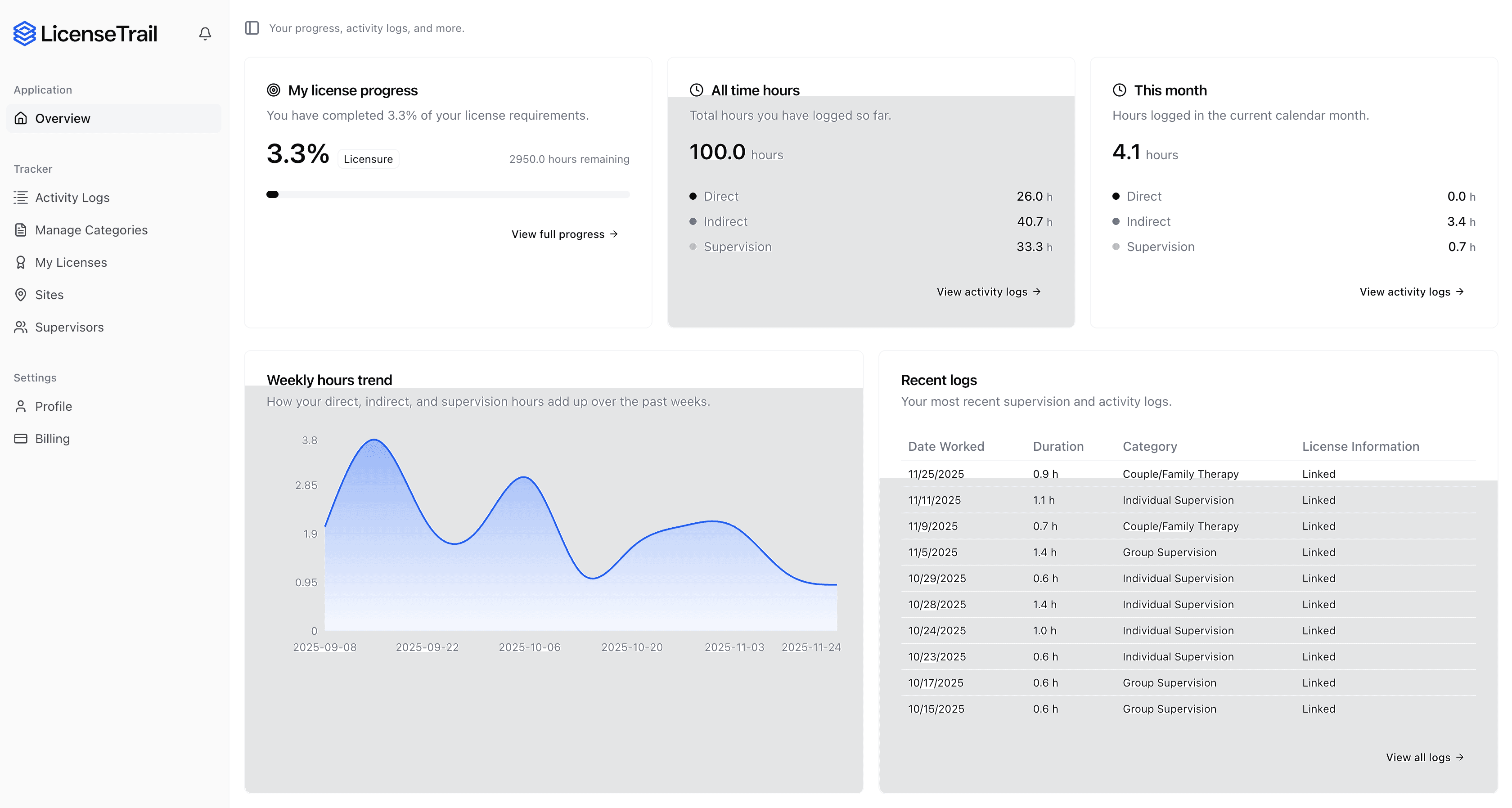
License Trail checks your direct, indirect, and supervision hours against Texas LMFT-S requirements continuously and flags mismatches before you submit.
 Start Tracking for Free
No credit card required · Free plan available
Related Licenses
Is your spreadsheet hiding Texas LMFT-S risks?
Stop guessing if your categories match Texas State Board of Examiners of Marriage and Family Therapists requirements. License Trail checks your direct, indirect, and supervision hours continuously and flags mismatches before you submit.
Import or log
Bring your spreadsheet or start fresh
Upload your existing tracking spreadsheet and we'll map every hour into the right Texas State Board of Examiners of Marriage and Family Therapists categories automatically.
Verify against Texas
Catch mismatches before the board does
License Trail checks your direct, indirect, and supervision hours against Texas LMFT-S requirements continuously.
Export board-ready
One-click clean reports
Generate professional, board-ready reports for supervision meetings and Texas State Board of Examiners of Marriage and Family Therapists submissions in seconds.
No credit card required · Free plan available