
Texas LPC Requirements: Hours, Exams & Step-by-Step Guide
Stop guessing if your categories match Texas requirements. License Trail checks your direct, indirect, and supervision hours against LPC requirements continuously and flags mismatches before you submit.
No credit card required · Free plan available
Quick Requirements Overview
- Earn a counseling/counseling-related graduate degree: 60 semester hours if program began ≥ 8/1/2017; 48 semester hours if begun before 8/1/2017
- Complete required coursework: one 3-SH course in each Board content area (per 22 TAC §§681.82–681.83; added areas for 60-hour programs include addictions, extra ethics, couples/family, psychopathology)
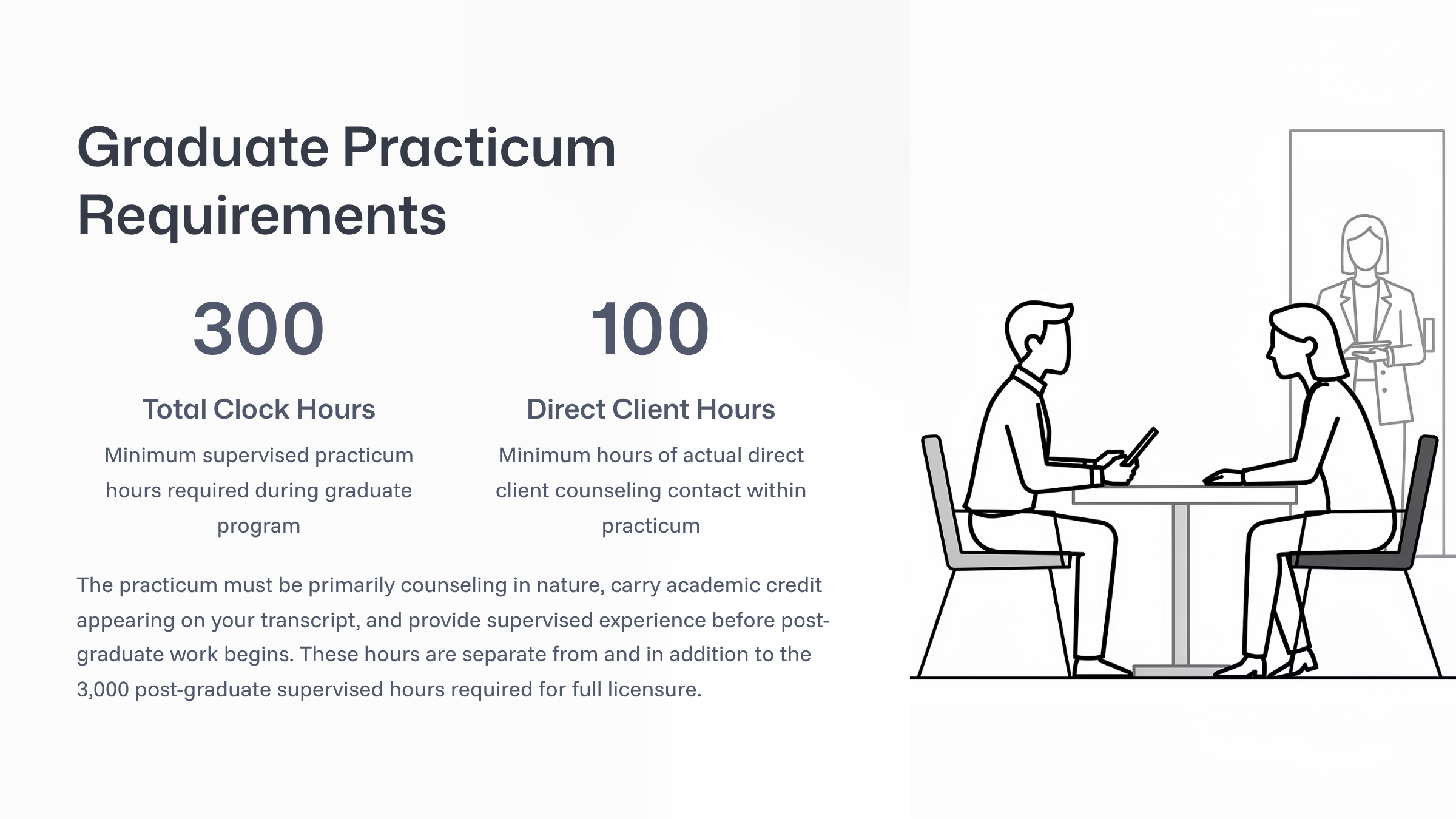
- Complete graduate practicum/internship: 300 clock-hours total, including 100 direct client counseling; must be for academic credit and appear on transcript
- Pass exams: NCE or NCMHCE + TX Jurisprudence Exam (certificate dated within 6 months of application)
- Obtain LPC Associate license before counting post-grad hours; must practice under Board-approved LPC-S supervision (no independent practice)
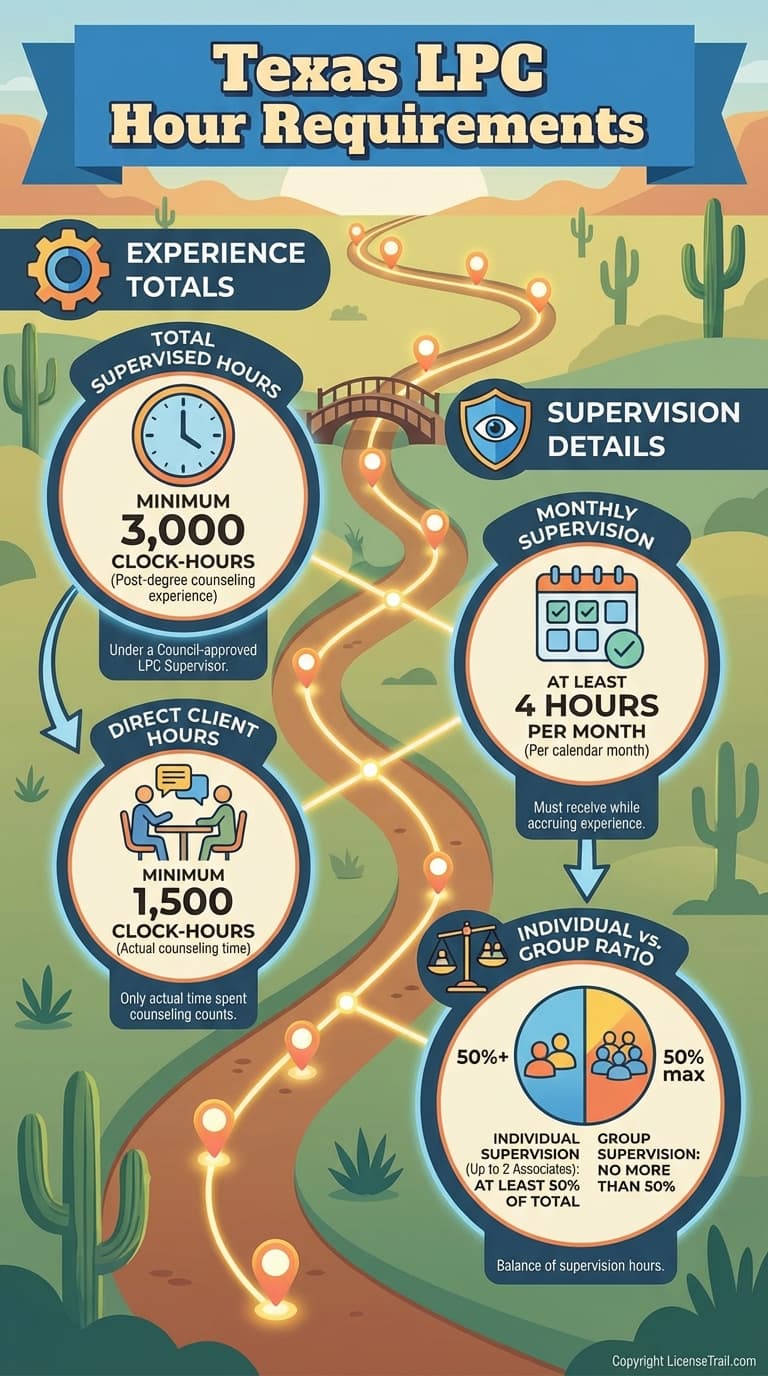
- Post-grad supervised experience (as Associate): 3,000 hours total with 1,500 direct client counseling; must take ≥ 18 months
- Supervision minimums: 4 hours/month; ≤ 50% of supervision may be group; up to 2 supervisors at a time; Associate license expires 60 months (non-renewable)
License Details
Video Overview
Procedures
Becoming a Licensed Professional Counselor (LPC) in Texas is a two-stage process: first you are licensed as an LPC Associate, complete supervised post‑graduate experience, and then you upgrade to full LPC. The Texas State Board of Examiners of Professional Counselors (under the Texas Behavioral Health Executive Council, BHEC) sets detailed requirements in statute and rule.
Below is a structured guide focused on the hours and key definitions the Board uses.
1. Educational foundation
1.1 Graduate degree and credit‑hour requirement
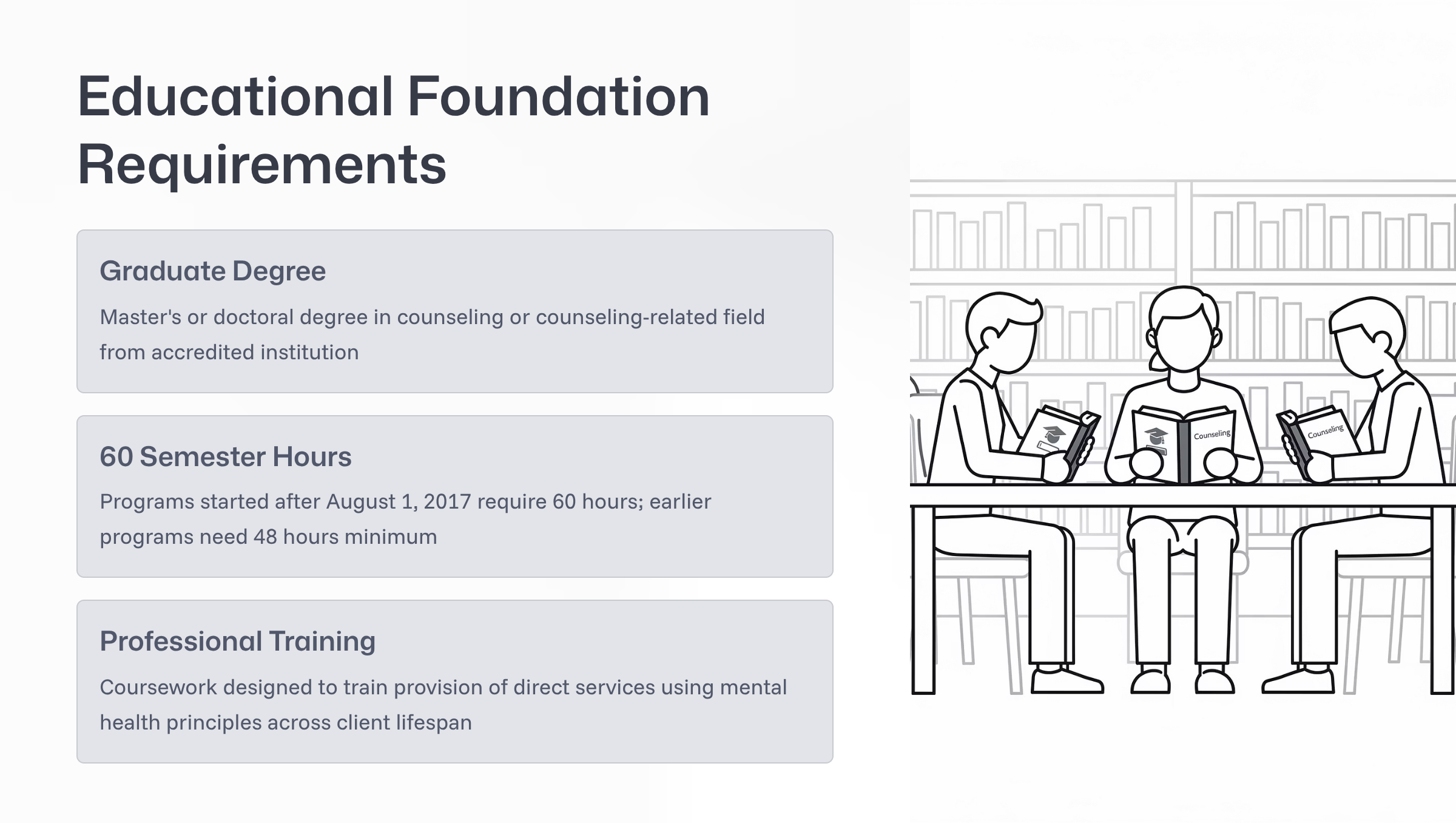
Texas requires a graduate degree in counseling or a counseling‑related field from an accredited institution. The minimum semester‑hour requirement depends on when you started your qualifying program:
If you began your program on or after August 1, 2017:
You must have at least 60 semester hours of coursework in counseling or a counseling‑related field. (regulations.justia.com)
If you began your program before August 1, 2017:
A program with at least 48 semester hours can qualify. (regulations.justia.com)
The 48/60 hours must be “designed to train a person to provide direct services to assist clients in a professional counseling relationship” using mental health and human development principles and techniques across the client’s lifespan. (regulations.justia.com)
1.2 Required academic content areas
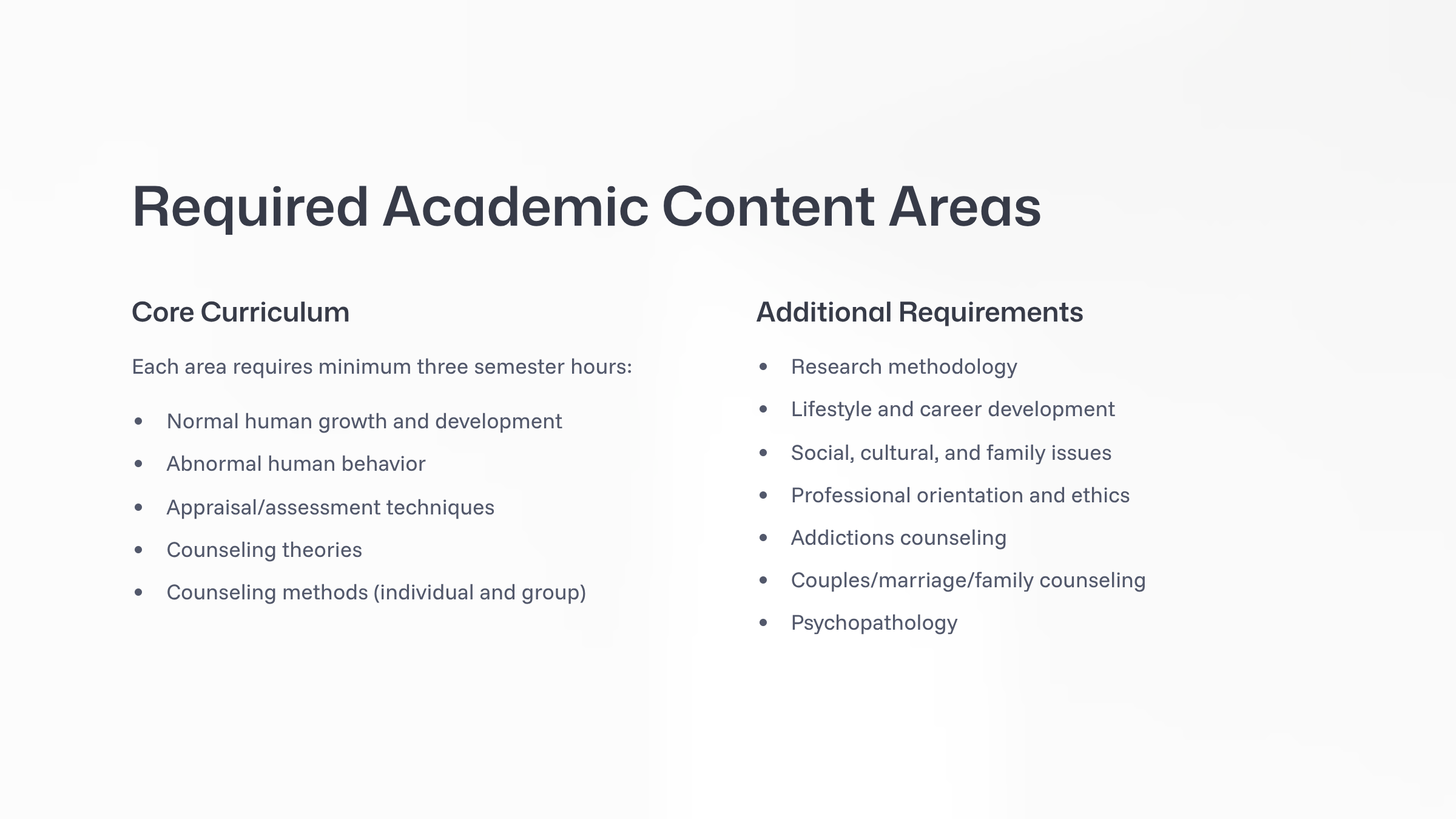
By rule, you must complete at least one three‑semester‑hour graduate course in each of the Board‑specified content areas, including (summarized):
- Normal human growth and development
- Abnormal human behavior
- Appraisal/assessment techniques
- Counseling theories
- Counseling methods/techniques (individual and group)
- Research
- Lifestyle and career development
- Social, cultural, and family issues
- Professional orientation
- Plus, to meet the 60‑hour requirement for modern programs: addictions counseling, an additional counselor ethics course, couples/marriage/family counseling, and psychopathology. (txrules.elaws.us)
These requirements are spelled out in 22 TAC §§681.82–681.83 (Academic Requirements; Academic Course Content).
2. Graduate practicum / internship hours
Texas differentiates between academic practicum hours (completed during your degree) and post‑graduate supervised experience (completed as an LPC Associate). Both sets of hours are mandatory and governed by specific Board language.
2.1 Practicum clock‑hour requirement
Your graduate program must include a supervised practicum or internship that is “primarily counseling in nature” and that meets all of the following: (txrules.elaws.us)
Minimum total practicum:
At least 300 clock‑hours of supervised practicum.
Direct client counseling portion:
At least 100 of those 300 hours must be “direct client counseling” (also described as direct client contact). This is the time you spend actually providing counseling services to clients, not observation or paperwork. (txrules.elaws.us)
Academic credit:
The practicum/internship must carry academic credit or other official acknowledgment, and this must appear on your graduate transcript. (txrules.elaws.us)
These practicum hours are in addition to the post‑graduate 3,000 supervised hours described below.
Run a counseling program? Pracadium tracks practicum & internship hours, supervision, and CACREP evidence — and shows students how their hours map to Texas licensure. From the team behind License Trail.
3. Examinations required for licensure
3.1 National counseling exam
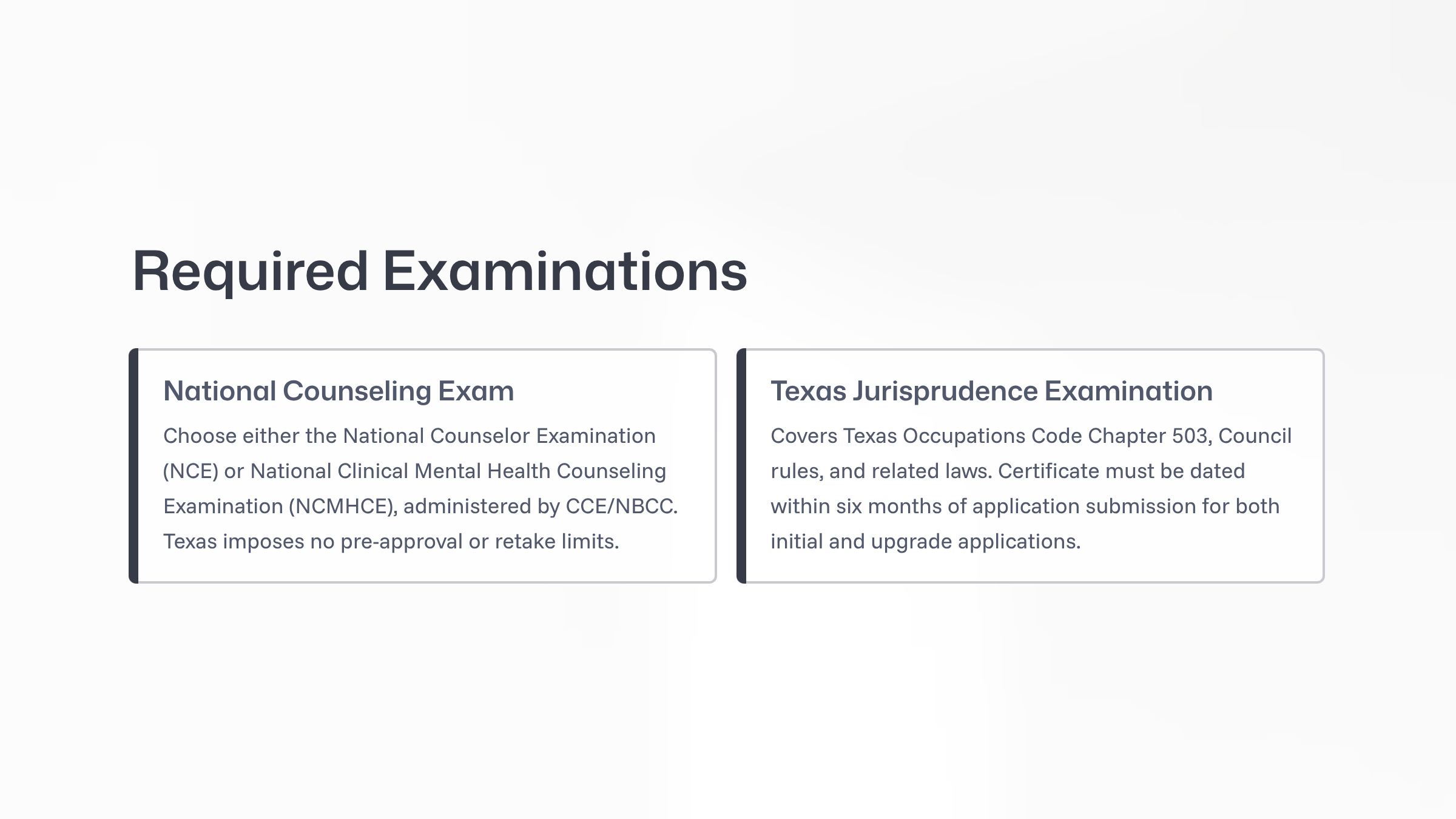
For LPC licensure in Texas, the Board accepts either of the following: (bhec.texas.gov)
- National Counselor Examination (NCE), or
- National Clinical Mental Health Counseling Examination (NCMHCE).
The exams are administered by the Center for Credentialing & Education (CCE) on behalf of NBCC. Texas does not require pre‑approval to sit for the exams, and there is no state‑imposed limit on retakes, though NBCC/CCE policies still apply. (bhec.texas.gov)
3.2 Texas Jurisprudence Examination
You must also pass the Texas Jurisprudence Examination, which covers the LPC statute (Texas Occupations Code Chapter 503), Council rules, and related laws. For applications, your jurisprudence exam certificate must be dated within six months of your application submission. (bhec.texas.gov)
4. Step one license: LPC Associate
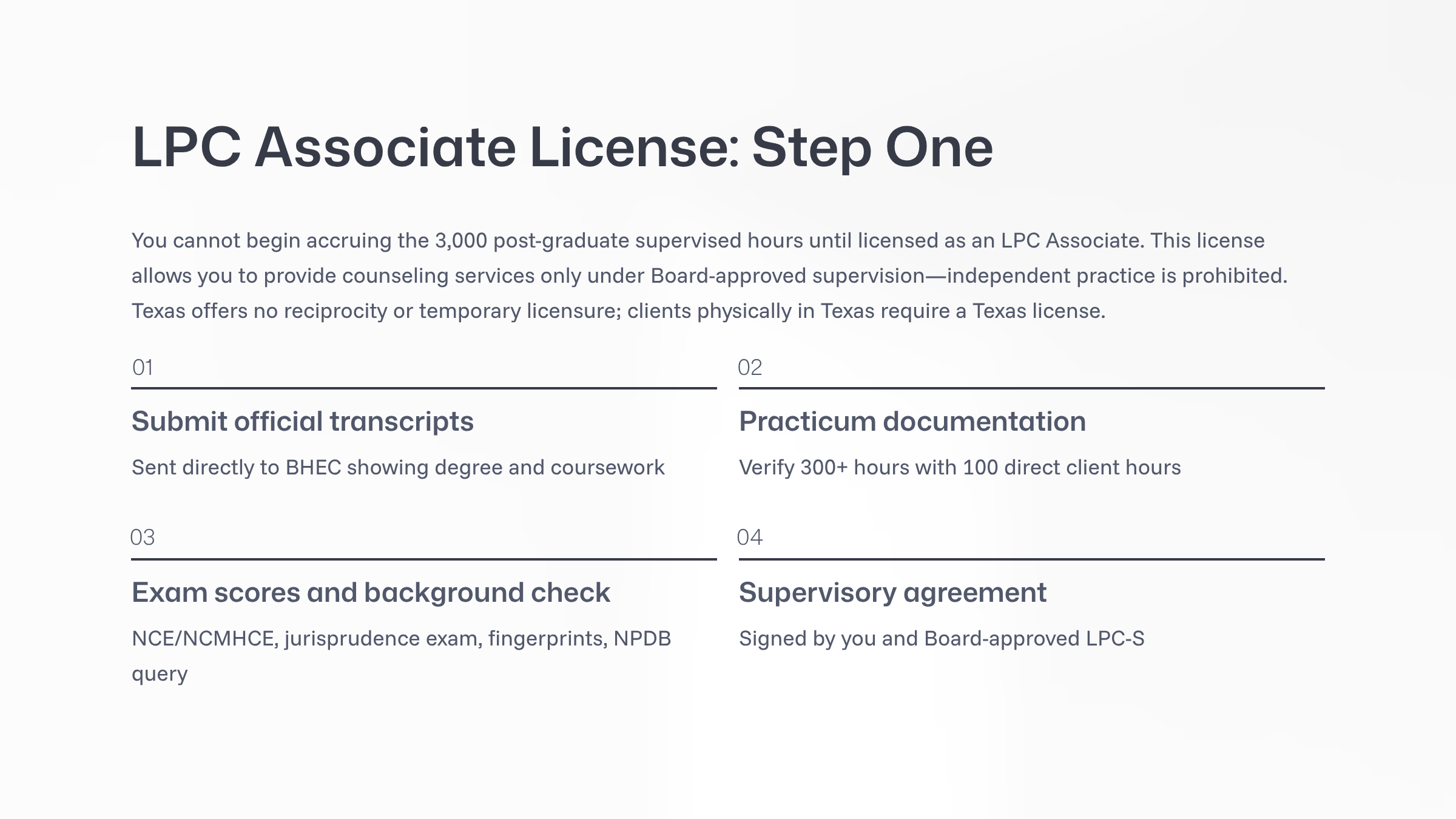
You cannot begin accruing the 3,000 post‑graduate supervised hours toward independent LPC licensure until you are licensed as an LPC Associate (Texas no longer uses the term “LPC Intern” in rules). (bhec.texas.gov)
Key points from the Board’s LPC Associate page: (bhec.texas.gov)
- An LPC Associate may only provide counseling services under the supervision of a Board‑approved supervisor and “is not permitted to practice independently.”
- Texas does not offer reciprocity or temporary LPC licensure; if a client is physically in Texas, you must hold a Texas license at the time of services.
4.1 Core documentation for LPC Associate application
To apply for LPC Associate (after your degree and exams), you must submit, among other items: (bhec.texas.gov)
- Official transcripts showing your graduate degree and required coursework (sent directly to BHEC).
- Practicum Documentation Form, verifying your 300+ practicum hours and at least 100 hours of direct client counseling.
- National exam scores (NCE or NCMHCE) sent directly by NBCC/CCE.
- Texas Jurisprudence Examination certificate, dated within six months.
- Supervisory Agreement Form, signed by you and a Board‑approved LPC Supervisor (LPC‑S).
- Fingerprint‑based background check (instructions emailed after application).
- National Practitioner Data Bank (NPDB) self‑query report.
Once approved, you receive an LPC Associate license and may begin accruing the 3,000 supervised experience hours.
5. Post‑graduate supervised experience requirements (LPC Associate)
This is where the 3,000‑hour requirement and the Board’s specific language about “direct client counseling” and supervision come in.
The controlling rule is 22 TAC §681.92 – Experience Requirements, along with the Board’s supervision FAQs. (txrules.elaws.us)
5.1 Total supervised experience hours
To qualify for independent LPC licensure, you must complete:
- 3,000 clock‑hours of supervised experience in a counseling setting,
- under a Council‑approved supervisor,
- after completion of the qualifying graduate program. (txrules.elaws.us)
These hours must be acceptable to the Council (BHEC) and follow all Board rules regarding supervision and practice.
5.2 Direct client counseling vs. other experience
Within those 3,000 hours, the rule specifies:
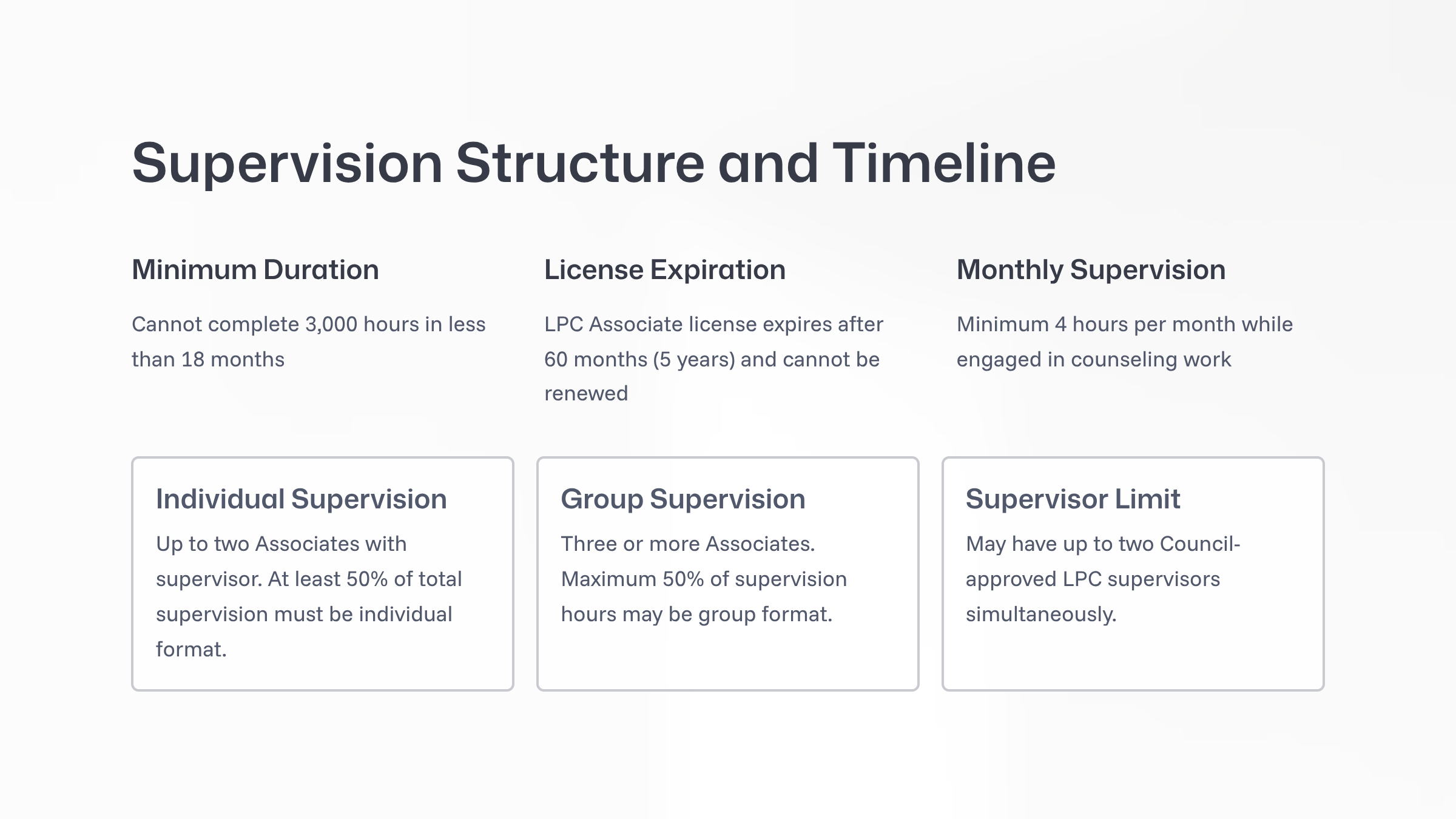
At least 1,500 clock‑hours must be “direct client counseling contact.” (txrules.elaws.us)
The Board defines and clarifies this as:
- “Direct counseling experience” is “providing direct client counseling services.” (bhec.texas.gov)
- “Only the actual time spent providing counseling services to clients can be counted as direct client contact hours.” (bhec.texas.gov)
In practical terms:
Direct hours (minimum 1,500):
Time when you are actively providing counseling interventions to clients (individual, group, couples, family) within a professional counseling relationship.
Remaining hours (up to 1,500):
Other supervised activities in a qualifying counseling setting (e.g., case documentation, treatment planning, consultation, training, indirect client services) that your supervisor accepts as relevant experience under Board rules. The rules don’t list every possible “indirect” activity, but they require that the experience “consist primarily of the provision of direct counseling services” using counseling methods and principles. (txrules.elaws.us)
So, using the kind of breakdown you asked about:
3,000 total supervised hours, of which
- 1,500 hours must be direct client counseling, and
- 1,500 hours may be other supervised counseling experience in an approved setting.
5.3 Time frame for accruing hours
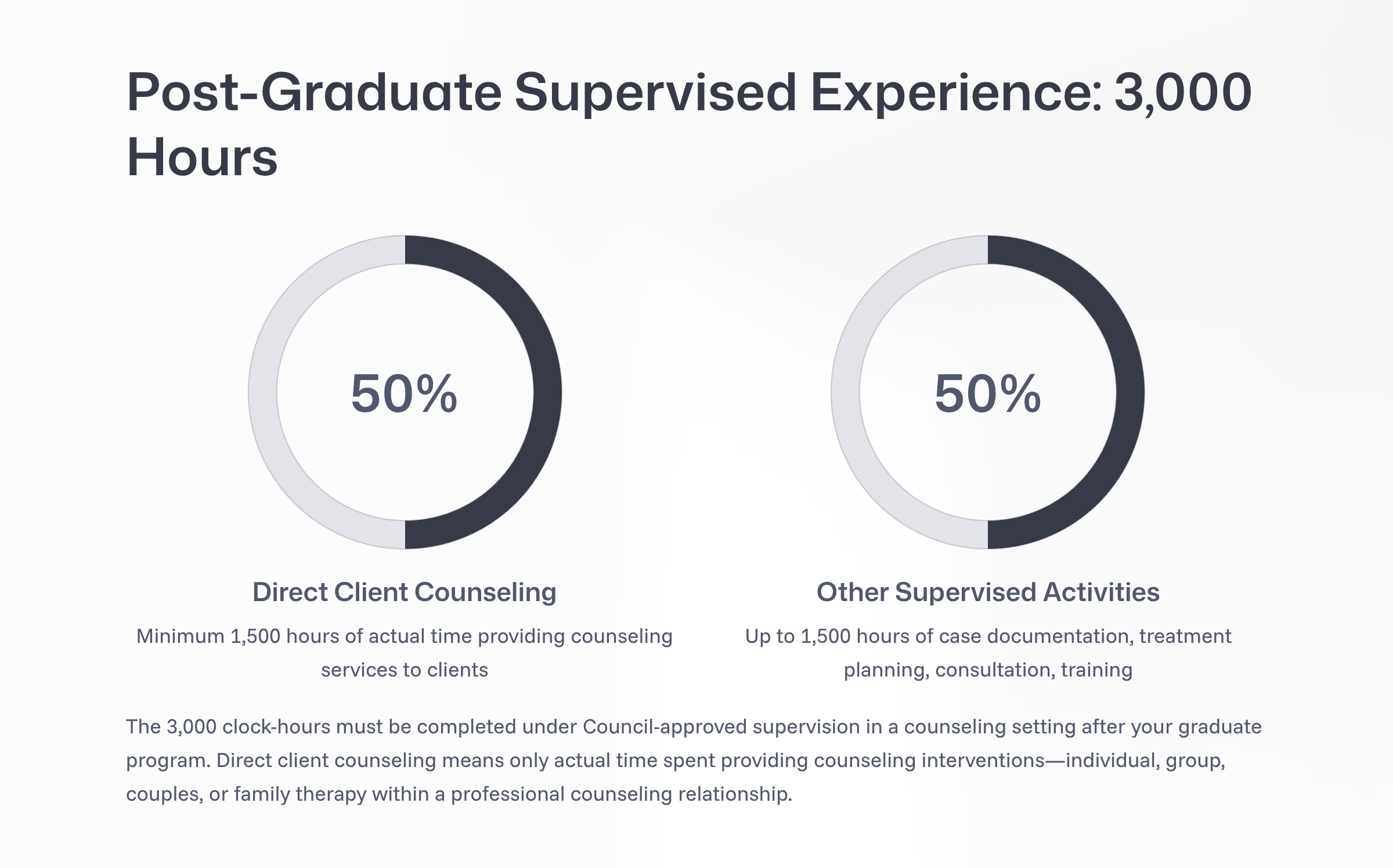
An LPC Associate may not complete the 3,000 hours in less than 18 months. (txrules.elaws.us)
There is no rule‑specified maximum duration for completing the hours, but:
The LPC Associate license expires 60 months (5 years) from issuance and cannot be renewed.
If you don’t finish your hours in that window, you must reapply for licensure; previously earned supervision can still count if properly documented. (bhec.texas.gov)
5.4 Supervision hour requirements and structure
Supervision has its own numeric and structural rules:
Minimum supervision:
The LPC Associate “must receive direct supervision consisting of a minimum of four (4) hours per month of supervision” while engaged in counseling. (txrules.elaws.us)
Individual vs. group supervision:
- Individual supervision is defined as supervision with up to two Associates.
- Group supervision involves three or more Associates.
- No more than 50% of the total supervision hours may be group supervision. (txrules.elaws.us)
Number of supervisors:
An LPC Associate may have up to two Council‑approved LPC supervisors at one time. (bhec.texas.gov)
Supervision format/frequency:
The Board’s FAQ clarifies that the 4 required hours per month may be divided and scheduled throughout the month as agreed by supervisor and associate; they may meet more than four hours if they wish. (bhec.texas.gov)
5.5 Nature of the supervised experience
The rule describes the character of the 3,000 hours:
The experience must consist primarily of providing direct counseling services “within a professional relationship” using counseling principles and techniques to address the client’s mental, emotional, physical, social, moral, educational, spiritual, or career‑related development and adjustment. (txrules.elaws.us)
All internships physically occurring in Texas must be under a Council‑approved supervisor; out‑of‑state settings must use a supervisor licensed or certified in that jurisdiction with appropriate training and experience, and you must document the supervisor’s qualifications. (txrules.elaws.us)
6. Step two license: Upgrading from LPC Associate to full LPC
Once you have completed the 3,000 hours (with at least 1,500 direct client counseling hours and the required supervision) and met all other requirements, you may apply to upgrade to a full Licensed Professional Counselor.
From the Board’s “Upgrade to Full LPC” page: (bhec.texas.gov)
- A Licensed Professional Counselor (LPC) may practice independently.
- All applicants must meet the eligibility requirements in Occupations Code Chapter 503, which explicitly include “at least 3,000 hours of supervised experience” after graduation. (statutes.capitol.texas.gov)
6.1 Documentation for upgrade to LPC
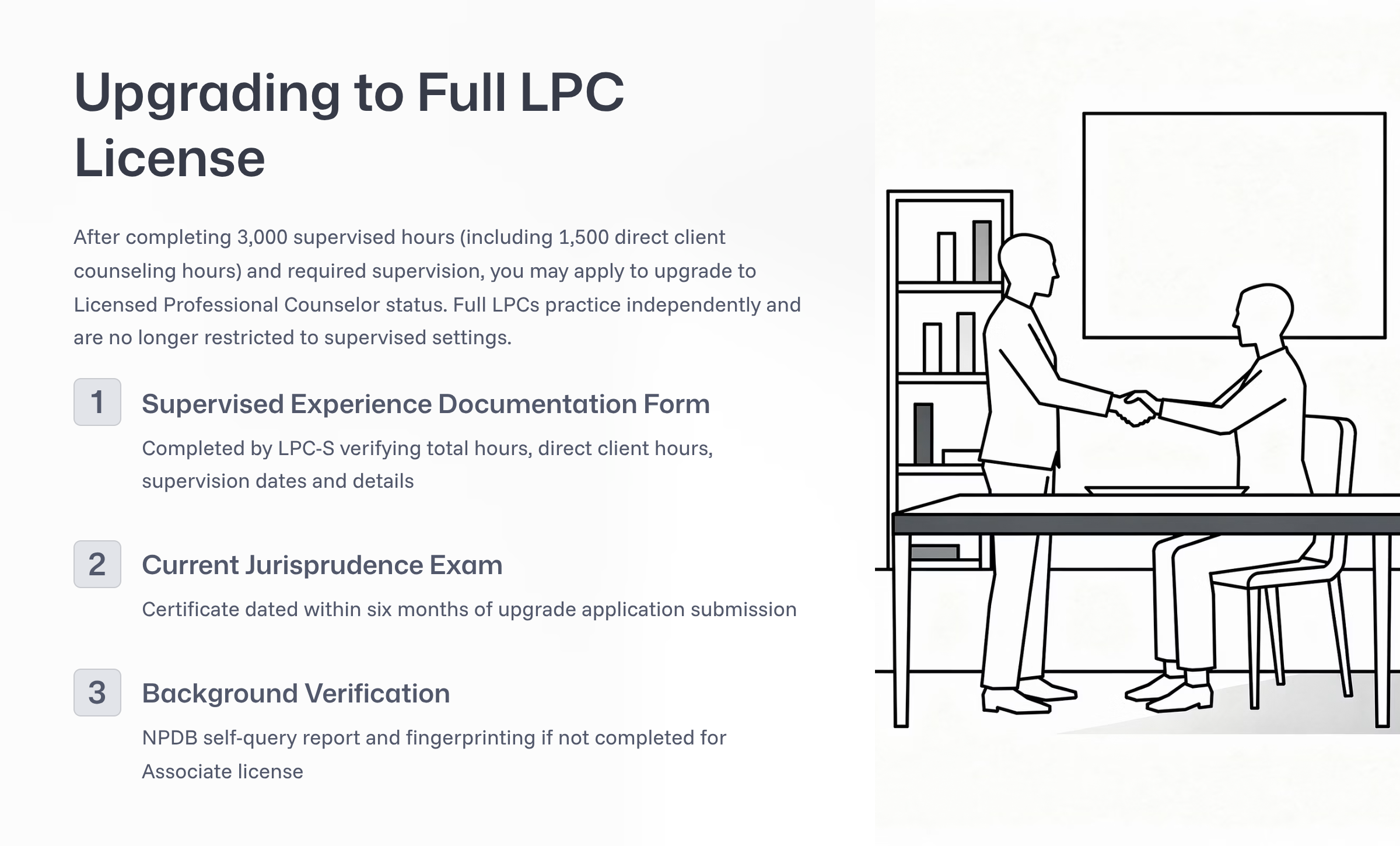
Typical required items when applying to upgrade (summarized):
Supervised Experience Documentation Form completed by your LPC‑S, verifying:
- Total supervised hours (3,000)
- At least 1,500 direct client counseling hours
- Dates of supervision and other details (bhec.texas.gov)
Texas Jurisprudence Examination certificate, again dated within six months of the upgrade application. (bhec.texas.gov)
NPDB self‑query report (certified electronic or sealed original). (bhec.texas.gov)
Fingerprinting, if it was not already completed for the initial LPC Associate licensure. (bhec.texas.gov)
Once the Board approves your upgrade, you are issued a standard LPC license and may practice independently (subject to all ethical and legal requirements).
7. After you are licensed: Renewal and continuing education (briefly)
Although your question is about initial licensure, knowing the ongoing expectations can help you plan:
- LPCs must complete at least 24 hours of continuing education (CE) each renewal period.
- At least 6 hours must be in ethics and at least 3 hours must be in cultural diversity and competency; these can count toward the 24‑hour total.
- You must pass the jurisprudence examination each renewal period; you may claim 1 hour of ethics CE for doing so. (bhec.texas.gov)
8. Hour requirements summarized
Putting the hour‑based requirements side by side:
-
Graduate practicum/internship (during degree)
- 300 clock‑hours minimum practicum, primarily counseling in nature.
- At least 100 hours of direct client counseling within those 300 hours.
- Must appear for academic credit on your transcript. (txrules.elaws.us)
-
Post‑graduate supervised experience (as LPC Associate)
- 3,000 clock‑hours of supervised counseling experience under a Council‑approved supervisor.
- At least 1,500 clock‑hours of direct client counseling contact (“only actual time spent counseling may be counted”). (txrules.elaws.us)
- The remaining up to 1,500 hours are other supervised counseling‑related activities in an approved setting.
- Must be completed in no less than 18 months. (txrules.elaws.us)
- While accruing hours, you must receive at least 4 hours per month of supervision, with no more than 50% of supervision hours in group format. (txrules.elaws.us)
-
Academic coursework
- 60 graduate semester hours in counseling or a counseling‑related field for anyone beginning their qualifying program on or after August 1, 2017 (48 hours only if program was begun before that date). (regulations.justia.com)
- Includes Board‑specified content areas and a 300‑hour practicum. (txrules.elaws.us)
These are the central quantitative and definitional requirements the Texas State Board of Examiners of Professional Counselors uses when determining eligibility for LPC licensure. Always check the BHEC website and the current Texas Administrative Code sections (22 TAC Chapter 681 and Texas Occupations Code Chapter 503) before you make final academic or training decisions, as rules can change.
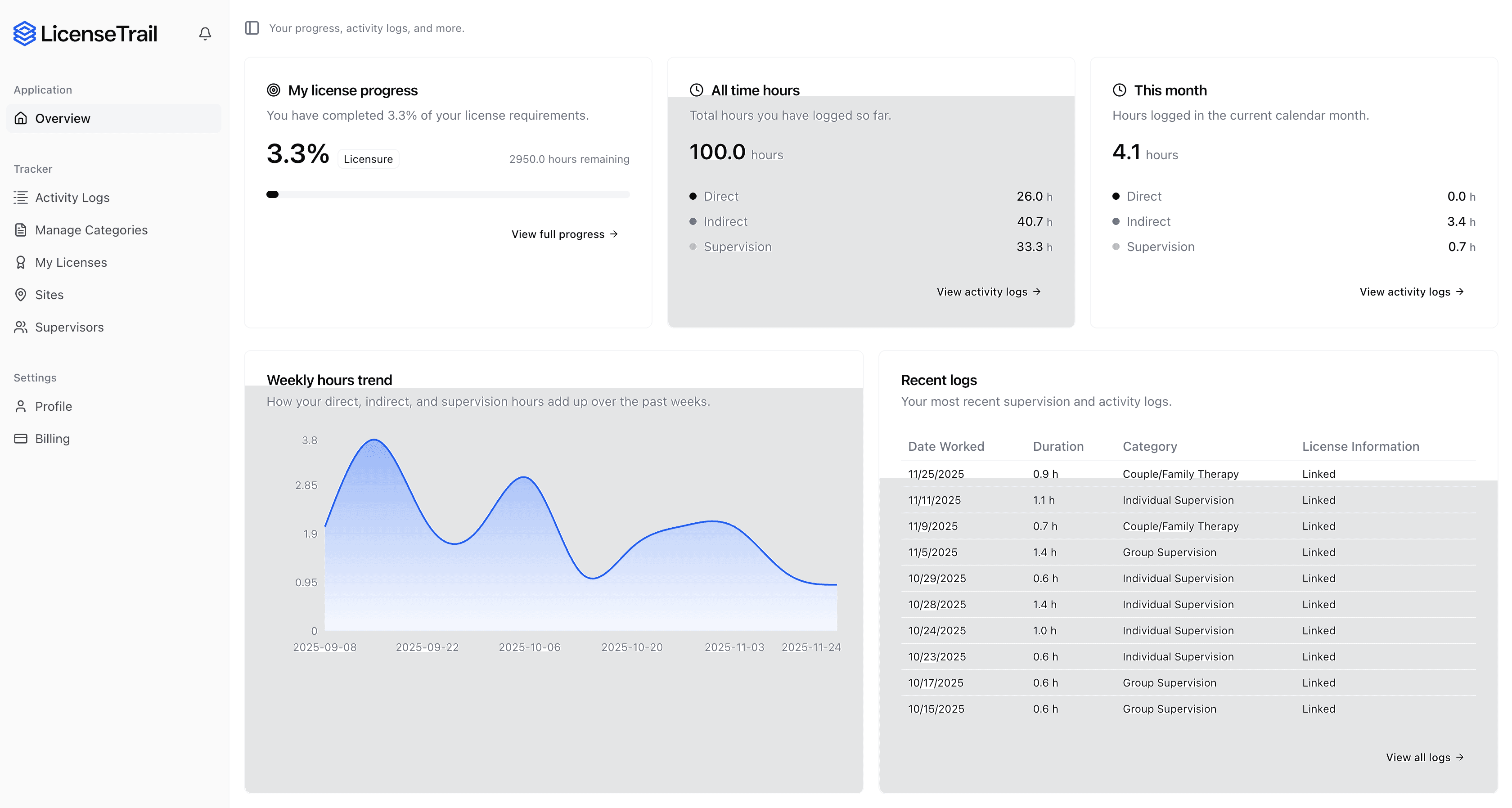
Track your LPC hours with confidence
License Trail checks your direct, indirect, and supervision hours against Texas LPC requirements continuously and flags mismatches before you submit.
 Start Tracking for Free
No credit card required · Free plan available
Is your spreadsheet hiding Texas LPC risks?
Stop guessing if your categories match Texas State Board of Examiners of Professional Counselors requirements. License Trail checks your direct, indirect, and supervision hours continuously and flags mismatches before you submit.
Import or log
Bring your spreadsheet or start fresh
Upload your existing tracking spreadsheet and we'll map every hour into the right Texas State Board of Examiners of Professional Counselors categories automatically.
Verify against Texas
Catch mismatches before the board does
License Trail checks your direct, indirect, and supervision hours against Texas LPC requirements continuously.
Export board-ready
One-click clean reports
Generate professional, board-ready reports for supervision meetings and Texas State Board of Examiners of Professional Counselors submissions in seconds.
No credit card required · Free plan available