
Texas LPC (Art Therapy Specialty) Requirements: Hours, Exams & Step-by-Step Guide
Stop guessing if your categories match Texas requirements. License Trail checks your direct, indirect, and supervision hours against LPC (Art Therapy Specialty) requirements continuously and flags mismatches before you submit.
No credit card required · Free plan available
Quick Requirements Overview
- Degree (LPC): Master’s/doctoral in counseling or related field; 48 sem hrs if program began before 8/1/2017, 60 sem hrs if on/after 8/1/2017
- LPC Associate: Must be licensed as an LPC Associate and have an LPC‑S supervisory agreement before hours count (unlicensed hours don’t count)
- Exams (LPC): Pass required national counseling exam + TX jurisprudence exam
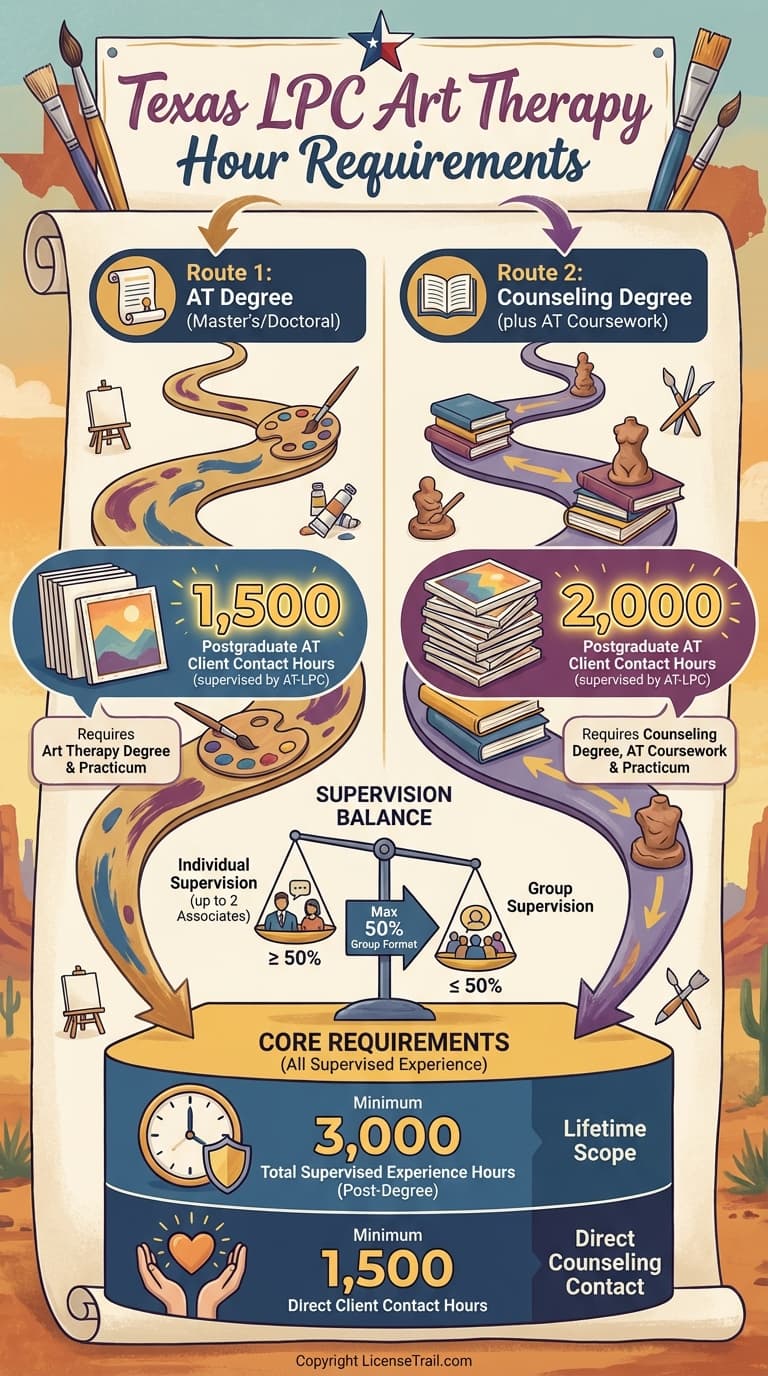
- Supervised experience (LPC): 3,000 clock hours total, incl. 1,500 direct client counseling; ≥18 months; ≥4 hrs/month supervision (≤50% group)
- Art therapy education/practicum (choose path):
- Path A: Master’s/doctoral in art therapy + 700-hr supervised practicum
- Path B: Master’s in counseling/related + 21 sem hrs sequential art therapy coursework + 700-hr supervised practicum
- Art therapy postgrad client contact (within LPC supervised experience): Under supervision of an LPC with Art Therapy specialty: 1,500 hrs (Path A) or 2,000 hrs (Path B)
- Art therapy exam: Pass ATCB Certification Examination in Art Therapy
- Title use: Must hold the Art Therapy Specialty Designation to use “art therapist” or “AT” in TX
License Details
Procedures
In Texas, becoming a Licensed Professional Counselor (LPC) with an Art Therapy Specialty Designation means satisfying two layers of requirements:
- All the requirements for standard LPC licensure.
- Additional education, practicum, experience, and exam criteria specific to art therapy.
Below is a step‑by‑step outline, with the board’s own terminology (“direct client counseling contact,” “client contact hours,” “supervised practicum,” etc.) highlighted.
1. First qualify for a standard LPC in Texas
1.1 Graduate degree requirements
Texas LPC licensure is based on having a graduate degree in counseling or a counseling‑related field that meets specific semester‑hour thresholds:
-
If you began the qualifying program before August 1, 2017:
At least 48 semester hours in counseling or a counseling‑related field. -
If you began the qualifying program on or after August 1, 2017:
At least 60 semester hours in counseling or a counseling‑related field. (regulations.justia.com)
The degree must also meet the detailed “Academic Course Content” requirements in §681.83 (e.g., counseling theories, assessment, ethics), but those are general LPC rules rather than art‑therapy‑specific.
1.2 Become an LPC Associate
Before you can start accruing post‑graduate supervised hours for LPC licensure, you must hold an LPC Associate license. The Council may issue an LPC Associate license to an applicant who has:(law.cornell.edu)
- Filed the LPC application and paid the required fees.
- Met all academic requirements for licensure.
- Successfully completed required examinations (national counseling exam and jurisprudence exam, per §681.101 and §681.72).
- Entered into a supervisory agreement with a Licensed Professional Counselor Supervisor (LPC‑S).
- Not yet completed the supervised experience described in §681.92.
Any hours obtained while unlicensed do not count toward Texas LPC supervised experience. (law.cornell.edu)
1.3 LPC supervised experience requirements (the “3,000 hours”)
For the standard LPC (independent license), Texas requires 3,000 clock‑hours of supervised experience that meets §681.92 (“Experience Requirements”). (law.cornell.edu)
Key points:
-
Total supervised experience:
“All applicants for LPC licensure must complete supervised experience acceptable to the Council of 3,000 clock‑hours under a Council‑approved supervisor.” -
Direct client counseling requirement:
The supervised experience must include at least 1,500 clock‑hours of direct client counseling contact, and “only actual time spent counseling may be counted.” (law.cornell.edu)In other words:
- 3,000 total supervised hours.
- Of those, at least 1,500 hours must be direct client counseling (face‑to‑face or equivalent telehealth counseling sessions).
-
Minimum time frame:
“An LPC Associate may not complete the required 3,000 clock‑hours of supervised experience in less than 18 months.” (law.cornell.edu) -
Nature of the experience:
The hours must “consist primarily of the provision of direct counseling services within a professional relationship to clients,” using counseling principles and techniques to address mental, emotional, physical, social, moral, educational, spiritual, or career‑related development. (law.cornell.edu) -
Supervision frequency:
The LPC Associate must receive a minimum of four (4) hours per month of supervision, individual or group, while engaged in counseling, with no more than 50% of total supervision hours in group format. (law.cornell.edu)
These 3,000 hours and their embedded 1,500 direct‑counseling hours form the foundation on which the art therapy specialty is built.
2. Art therapy–specific graduate education and practicum
To obtain the Art Therapy Specialty Designation, you must meet special education and practicum standards in addition to the general LPC requirements. These are codified in Texas Occupations Code §503.303 (Specialization in Art Therapy) and 22 TAC §681.73 (Application for Art Therapy Specialty Designation). (statutes.capitol.texas.gov)
There are two main degree pathways:
2.1 Path A – Art therapy graduate degree
You must hold:
- A master’s or doctoral degree in art therapy that includes at least 700 hours of supervised practicum from an accredited institution or school. (statutes.capitol.texas.gov)
Board terminology: “700 hours of supervised practicum” in art therapy.
2.2 Path B – Counseling degree + art therapy coursework
Alternatively, you may hold:
- A master’s degree in a counseling‑related field, and
- At least 21 semester hours of sequential coursework in the history, theory, and practice of art therapy, and
- 700 hours of supervised practicum from an accredited institution or school. (statutes.capitol.texas.gov)
For both Path A and Path B, the art‑therapy‑related practicum is graduate‑level supervised practicum, distinct from the later post‑graduate supervised experience.
Run a counseling program? Pracadium tracks practicum & internship hours, supervision, and CACREP evidence — and shows students how their hours map to Texas licensure. From the team behind License Trail.
3. Post‑graduate art therapy–specific supervised experience
After the degree and practicum, Texas requires additional post‑graduate client contact hours in art therapy, under specialized supervision.
3.1 Statutory framework
The Occupations Code states that, beyond the education/practicum, the applicant must complete additional postgraduate client contact hours under the supervision of a licensed professional counselor with a specialization in art therapy:(statutes.capitol.texas.gov)
-
If you hold an art therapy degree (Path A):
At least 1,000 client contact hours. -
If you hold a counseling‑related degree with art therapy coursework (Path B):
At least 2,000 client contact hours.
3.2 Board rule (current practice requirement)
The Board’s rule, 22 TAC §681.73(c), tightens and clarifies these requirements as part of your LPC supervised experience: (regulations.justia.com)
- The rule explicitly says these are requirements “as part of the supervised experience requirements for art therapy specialty designation under the Act, §503.303,” and that you must also fulfill §§681.91–681.93 (LPC Associate and supervisor requirements).
It then specifies:
-
If you hold a master’s or doctoral degree in art therapy with 700 hours practicum (Path A):
You must have 1,500 client contact hours under supervision of a licensed professional counselor with an art therapy specialty designation. -
If you hold a master’s degree in counseling or a counseling‑related field with 21 hours of art therapy coursework and 700‑hour practicum (Path B):
You must have 2,000 client contact hours under supervision of a licensed professional counselor with an art therapy specialty designation.
Board language here is “client contact hours under supervision of a licensed professional counselor with an art therapy specialty designation.”
How these hours relate to the 3,000 LPC hours
Because §681.73(c) says this occurs “as part of the supervised experience requirements” and requires compliance with §681.91–681.93, these art‑therapy client contact hours are:
- Post‑graduate, supervised hours (not your degree practicum).
- Counted within, and not less than, the standard 3,000 LPC supervised clock‑hours.
In practice that means:
- You must still complete the full 3,000 supervised hours required for LPC licensure (with at least 1,500 of those as direct client counseling).
- Within those supervised hours, you must accumulate:
- 1,500 art‑therapy “client contact hours” if you have an art therapy degree (Path A), or
- 2,000 art‑therapy “client contact hours” if you have a counseling‑related degree plus art therapy coursework (Path B),
- And those art‑therapy hours must be:
- Direct counseling sessions involving art therapy, and
- Supervised by an LPC who holds the art therapy specialty designation.
Because “direct client counseling contact” (for LPC) must be “actual time spent counseling,” and “client contact hours” in §681.73 are a subset of that same kind of activity, your art‑therapy client contact hours normally also count toward the 1,500 direct‑counseling hours required for LPC. (law.cornell.edu)
4. Art therapy examination requirement
Both the statute and the Board rule require proof that you have passed the national art therapy certification exam:
- You must demonstrate successful completion of the national “Certification Examination in Art Therapy” administered by the Art Therapy Credentials Board (ATCB) and submit documentation of that completion. (statutes.capitol.texas.gov)
This exam requirement is in addition to the national counseling exam(s) and jurisprudence exam used for LPC licensure.
5. Application to the Board for Art Therapy Specialty Designation
Once you:
- Have met the academic requirements for LPC and art therapy (Sections 681.82, 681.83, and 681.73(a)(2));
- Have become an LPC and completed the 3,000 hours of supervised LPC experience (with required direct counseling hours, timeframe, and supervision as per §681.92);
- Have completed the art‑therapy‑specific client contact hours under a qualified art therapy–specialized LPC as described in §681.73(c); and
- Have passed the ATCB Certification Examination in Art Therapy,
you may apply to the Texas State Board of Examiners of Professional Counselors (through the Behavioral Health Executive Council) for the Art Therapy Specialty Designation, following §681.73 (“Application for Art Therapy Specialty Designation”). (regulations.justia.com)
You will need, at minimum:
- The standard LPC license and all usual application materials (per §§681.71–681.72).
- Official transcripts showing:
- Degree type (art therapy or counseling‑related).
- Required 21 hours in history, theory, and practice of art therapy if using Path B.
- 700 hours of supervised art therapy practicum.
- Supervised experience documentation:
- 3,000 total LPC supervised hours with at least 1,500 direct client counseling hours (§681.92).
- 1,500 or 2,000 art‑therapy “client contact hours” under supervision of an LPC with art therapy specialty designation (§681.73(c)).
- Documentation of passing the Certification Examination in Art Therapy (ATCB).
6. Use of the title “art therapist” and initials “AT”
Once the specialty designation is granted, you may use the protected art therapy title:
- Board rules provide that a licensee must hold the art therapy specialty designation to use the title “art therapist” or the initials “AT.”
- A licensee who does not hold the designation may use art therapy as a counseling method, but “may not use the title or initials.” (regulations.justia.com)
This is important for how you advertise and describe your services.
7. Hour‑by‑hour summary
Putting it all together, the key types and amounts of hours, using the Board’s terminology, are:
-
Graduate‑level practicum (before degree conferment)
- 700 hours of supervised practicum in art therapy from an accredited institution/school (required for both paths). (statutes.capitol.texas.gov)
-
Post‑graduate supervised experience for LPC licensure
- 3,000 clock‑hours of supervised experience under a Council‑approved supervisor (LPC‑S).
- Within those 3,000 hours, at least 1,500 clock‑hours of direct client counseling contact (actual time spent counseling). (law.cornell.edu)
- Completed in no less than 18 months, with at least 4 hours/month of supervision, not more than 50% of supervision in group format.
-
Art therapy specialty designation – art‑therapy client contact hours (post‑graduate)
- If you have an art therapy degree (Path A):
- 1,500 client contact hours under supervision of a licensed professional counselor with an art therapy specialty designation.
- If you have a counseling‑related degree + art therapy coursework (Path B):
- 2,000 client contact hours under supervision of a licensed professional counselor with an art therapy specialty designation. (regulations.justia.com)
- If you have an art therapy degree (Path A):
In practice, these art‑therapy client contact hours are a subset of your 3,000 supervised LPC hours and generally also count toward the 1,500 direct counseling hours, provided they are actual counseling sessions using art therapy within a counseling relationship.
Because regulations can change and there is an interaction between statute (Texas Occupations Code) and administrative rules (22 TAC, BHEC/TSBEPC), it is wise to verify details directly from:
- The current text of Texas Occupations Code Chapter 503, especially §503.303 (Specialization in Art Therapy). (statutes.capitol.texas.gov)
- The Board’s rules in 22 TAC Chapter 681, especially §§681.73, 681.82, 681.91–681.93, and §681.92. (regulations.justia.com)
Track your LPC (Art Therapy Specialty) hours with confidence
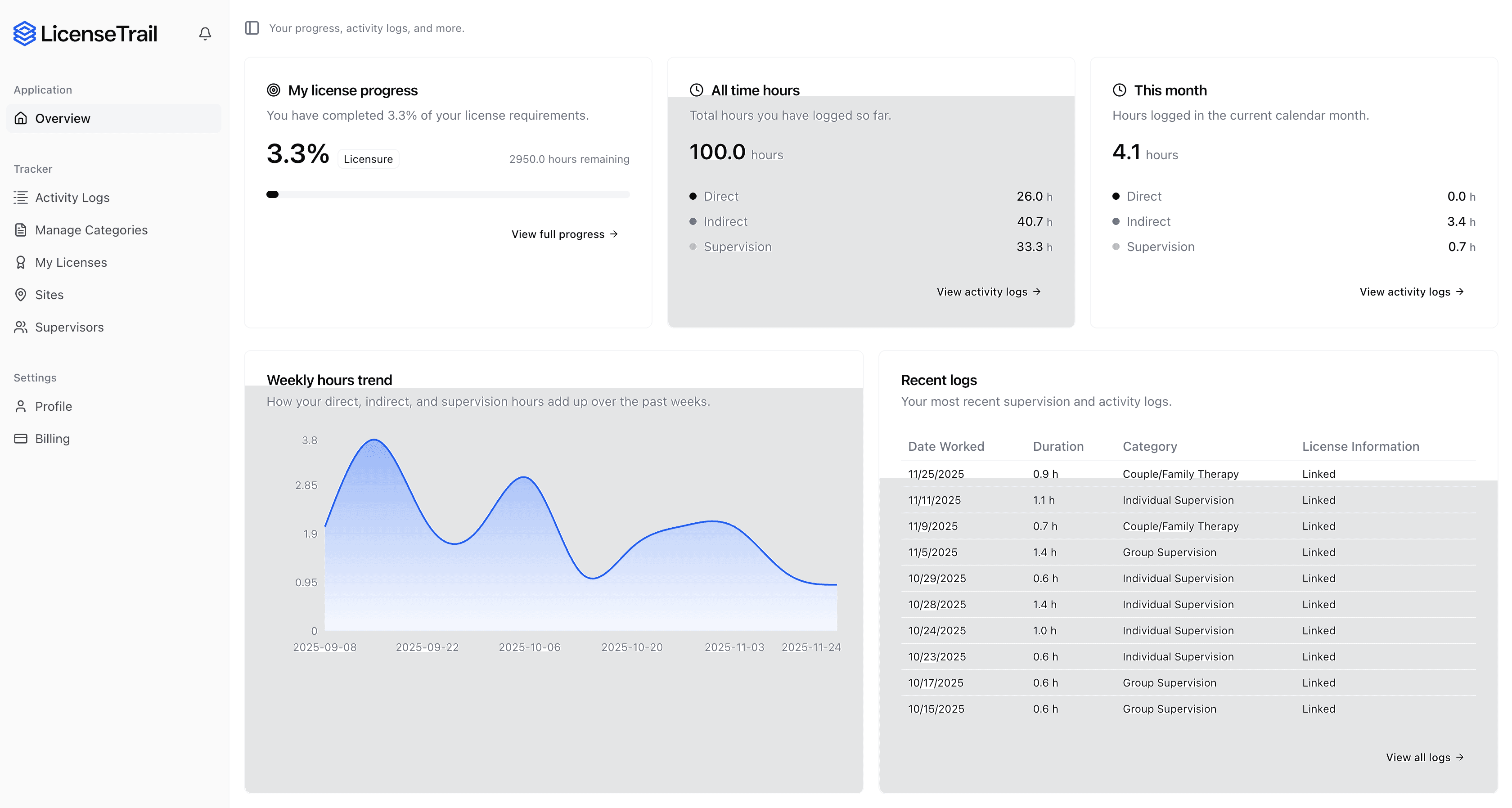
License Trail checks your direct, indirect, and supervision hours against Texas LPC (Art Therapy Specialty) requirements continuously and flags mismatches before you submit.
 Start Tracking for Free
No credit card required · Free plan available
Related Licenses
Is your spreadsheet hiding Texas LPC (Art Therapy Specialty) risks?
Stop guessing if your categories match Texas State Board of Examiners of Professional Counselors requirements. License Trail checks your direct, indirect, and supervision hours continuously and flags mismatches before you submit.
Import or log
Bring your spreadsheet or start fresh
Upload your existing tracking spreadsheet and we'll map every hour into the right Texas State Board of Examiners of Professional Counselors categories automatically.
Verify against Texas
Catch mismatches before the board does
License Trail checks your direct, indirect, and supervision hours against Texas LPC (Art Therapy Specialty) requirements continuously.
Export board-ready
One-click clean reports
Generate professional, board-ready reports for supervision meetings and Texas State Board of Examiners of Professional Counselors submissions in seconds.
No credit card required · Free plan available