
Texas LP Requirements: Hours, Exams & Step-by-Step Guide
Stop guessing if your categories match Texas requirements. License Trail checks your direct, indirect, and supervision hours against LP requirements continuously and flags mismatches before you submit.
No credit card required · Free plan available
Quick Requirements Overview
- Doctoral degree in psychology (regionally accredited; transcript must show psychology major; foreign degrees need NACES evaluation)
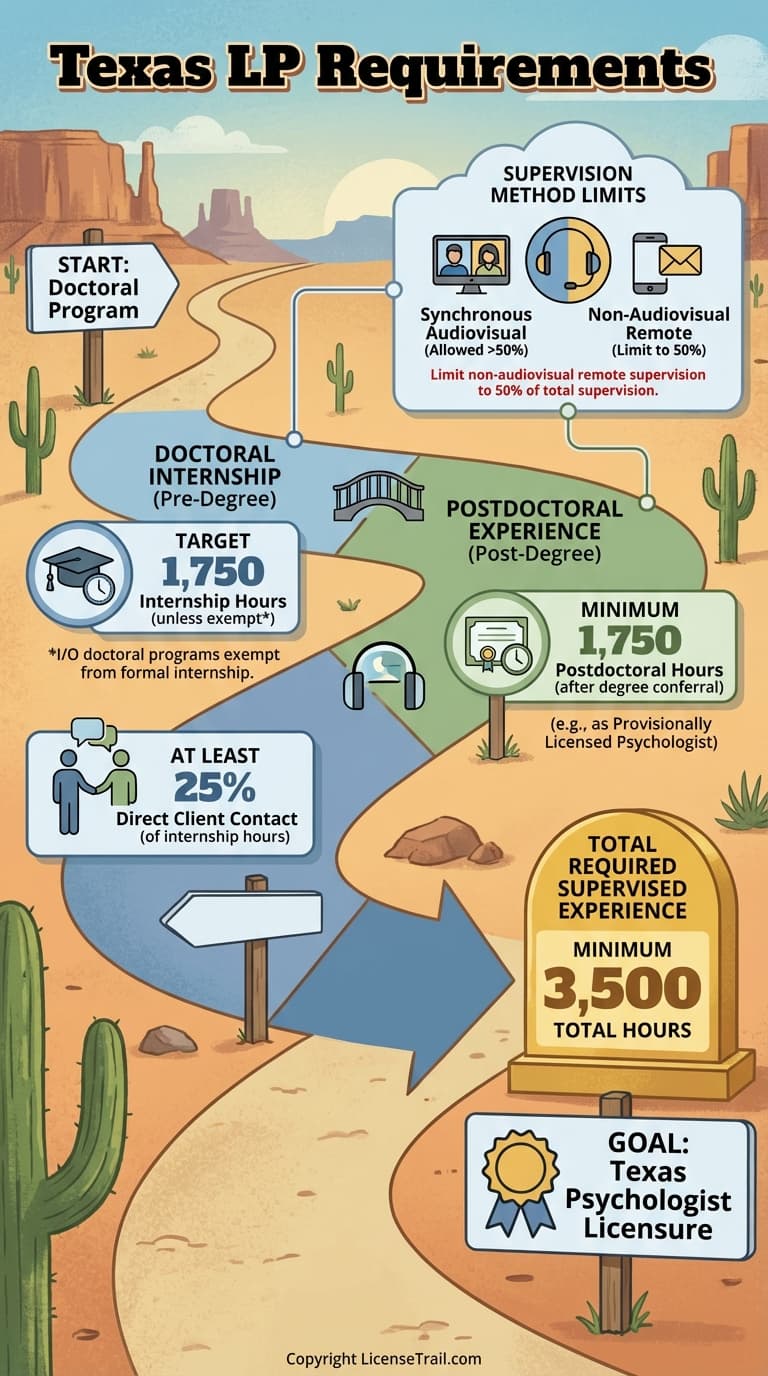
- 3,500 total supervised hours required: 1,750-hour formal doctoral internship + 1,750-hour postdoctoral supervised experience
- Internship must be APA/CPA/APPIC or meet Board criteria; includes ≥25% direct client contact, ≥2 hrs/week individual face-to-face supervision, plus ≥4 hrs/week learning activities
- Postdoc hours must occur after degree (typically as Provisionally Licensed Psychologist); certain supervised hours as LPA/LSSP, exempt settings, other jurisdictions may substitute if supervised by an LP
- Some practicum/excess internship hours may count toward postdoc if program-accredited/equivalent and meets structure/ratio rules (≥50% service-related; ≥25% direct contact; supervision ≥25% of service-related)
- Exams: EPPP + Texas Jurisprudence Exam required
- Provisional LP: non-renewable 2-year license to complete postdoc hours and/or EPPP under supervision (full LP may be issued directly if already complete)
- Alternatives/waivers: 5+ years licensed practice out-of-state may waive supervised-experience docs; CPQ holders only need TX Jurisprudence; ABPP may be exempt from EPPP & JP; OK reciprocity available
License Details
Procedures
Licensure as a Licensed Psychologist (LP) in Texas is governed by the Texas State Board of Examiners of Psychologists under the Texas Behavioral Health Executive Council (BHEC). The core requirements are set out in:
- 22 TAC §463.10 – Licensed Psychologists
- 22 TAC §463.11 – Supervised Experience Required for Licensure as a Psychologist (sos.texas.gov)
Below is a step‑by‑step guide, with the key hour requirements and how the Board’s rules define the types of experience.
1. Basic eligibility and education
Doctoral degree requirement
To apply as a Licensed Psychologist in Texas, you must:
- Hold a doctoral degree in psychology from a regionally accredited college or university.
- The transcript must designate a major in psychology (for degrees on/after January 1, 1979) or be the substantial equivalent under §463.15 for earlier degrees. (sos.texas.gov)
Foreign degrees must be evaluated by a NACES‑member evaluation service before application, per BHEC’s application FAQ. (bhec.texas.gov)
2. Required supervised experience: total hours and breakdown
The Board defines the supervised experience requirement in §463.11 as follows:
Total supervised experience
You must document a minimum of 3,500 hours of supervised experience, which are split into two major components: (txrules.elaws.us)
-
Formal doctoral internship
- At least 1,750 hours of supervised experience
- Must be obtained through a formal internship that occurred within your doctoral degree program (with a limited exception for some pre‑2017 degrees that completed internship after degree conferral). (txrules.elaws.us)
-
Post‑doctoral supervised experience
- At least 1,750 hours of supervised experience
- Must be obtained after the doctoral degree is conferred.
- The rule describes this as experience “received as a provisionally licensed psychologist (or under provisional trainee status under prior versions of this rule).” (txrules.elaws.us)
So, in Board language:
- Minimum 3,500 hours of supervised experience,
- Comprised of 1,750 hours in a formal doctoral internship and 1,750 hours of post‑doctoral supervised experience.
Substituting equivalent post‑doctoral hours
Instead of doing all 1,750 post‑doc hours under a Provisional LP license, the Board allows certain other supervised work to count, if it was under a licensed psychologist, such as: (txrules.elaws.us)
- Work delivering psychological services in an exempt setting (e.g., some institutional employers),
- Work while licensed/authorized in another jurisdiction,
- Work as a Licensed Psychological Associate (LPA) or Licensed Specialist in School Psychology (LSSP) in Texas.
These substitute hours must still be supervised by a licensed psychologist and must follow applicable Council rules.
3. What “counts” within those hours: direct contact, service‑related activities, and supervision
The 3,500 total hours are not just any work; §463.11 and related internship/practicum provisions specify the nature of acceptable experience.
A. Practicum hours that may count toward the 1,750 post‑doc hours
If your doctoral program is accredited by APA, CPA, PCSAS, or is substantially equivalent, some program‑based hours beyond the basic 1,750‑hour internship can be credited toward the post‑doctoral 1,750 hours:
- Internship hours in excess of 1,750, and
- Certain practicum hours, if certified by your doctoral program’s training director as meeting Board criteria. (txrules.elaws.us)
For practicum hours to count toward the post‑doc requirement, the Board requires that:
- The practicum is an organized, sequential set of supervised experiences overseen by the graduate program.
- It is governed by a written training plan between the student, site, and program (goals, objectives, evaluation methods, supervision arrangements).
- The supervising psychologist must be on staff at the practicum site.
- At least 50% of practicum hours must be “service‑related activities,” which the rule defines as activities such as treatment/intervention, assessment, interviews, report‑writing, case presentations, and consultations.
- At least 25% of practicum hours must be face‑to‑face patient or client contact.
- Individual face‑to‑face supervision must be at least 25% of the time spent in service‑related activities.
- No more than 25% of supervision may be by a licensed allied mental health professional or a psychology intern/post‑doc fellow.
- Practicum must average at least 15 hours per week. (txrules.elaws.us)
In other words, for practicum to be credited as supervised experience, the Board expects substantial direct client work, intensive supervision, and a formal training structure.
B. Formal doctoral internship requirements
Your 1,750‑hour formal internship must either:
- Be accredited by APA or CPA, or be a member of APPIC, or
- Meet detailed Board criteria in §463.11(d), which include: (law.cornell.edu)
Key points of those criteria include:
-
Timing and structure
- Internship occurs at or near the end of formal training (post‑clerkship/practicum/externship).
- Typically full‑time for one year or half‑time for two consecutive years (see school‑district internship provisions).
-
Supervisory staff
- Internship agency must have two or more full‑time licensed psychologists as primary supervisors.
- Supervision must be provided by agency staff or affiliates who carry clinical responsibility for the cases supervised.
-
Direct client contact
- At least 25% of the intern’s time must be in direct patient/client contact.
(This is the closest the rules come to a “direct vs non‑direct hours” breakdown for LPs.)
- At least 25% of the intern’s time must be in direct patient/client contact.
-
Supervision and didactic time
- At least 2 hours per week of scheduled, face‑to‑face individual supervision.
- At least 4 additional hours per week of learning activities such as case conferences, seminars, group supervision, co‑therapy with a staff person, etc.
-
Cohort and staffing
- Agency must typically have a minimum of two full‑time equivalent interns at the internship level (with a rural HPSA exception).
- Program must publish goals, content, and expectations for quantity/quality of intern work.
These requirements articulate the Board’s expectations about the quality and intensity of the 1,750 internship hours, including how much must be direct client service and how much must be structured supervision and didactic training.
4. Special variants of the supervised‑experience requirement
A. Industrial/Organizational (I/O) psychologists
For applicants from Industrial/Organizational psychology doctoral programs, §463.11 provides: (law.cornell.edu)
- They are exempt from the formal internship requirement,
- But must still complete at least 3,500 hours of supervised experience,
- With at least 1,750 hours occurring after the doctoral degree under the same general conditions as other applicants.
The Board explicitly notes that psychologists may not practice in areas for which they lack sufficient training and experience, and considers a formal internship an “integral” part of preparation in many practice areas.
B. Respecialization pathway
Applicants who complete a formal post‑doctoral respecialization program in psychology must show: (law.cornell.edu)
- A previously conferred doctoral degree in psychology from a regionally accredited institution.
- A respecialization program that includes at least 1,750 hours in a formal internship.
- After respecialization, at least 1,750 hours of supervised experience obtained as a provisionally licensed psychologist (or prior equivalent).
Meeting these elements is deemed to satisfy the supervised‑experience requirement in §463.11.
5. Examination requirements
For LP licensure, the Board requires two exams: (bhec.texas.gov)
-
Examination for Professional Practice in Psychology (EPPP)
- National exam developed by ASPPB, covering broad psychological knowledge.
-
Texas Jurisprudence Examination
- An online exam on Texas laws, rules, and ethics relevant to psychological practice.
Minimum passing scores and administration details are set in §463.31 and on BHEC’s exam pages.
6. Application process and license status (Provisional LP to full LP)
Step 1 – Apply for Licensed Psychologist
You submit an application for LP licensure, documenting:
- Your doctoral degree in psychology,
- Completion (or planned completion) of internship and supervised experience as required by §§463.10–.11, and
- Plan to take/pass the EPPP and the Texas Jurisprudence Exam. (bhec.texas.gov)
Step 2 – Provisional Licensed Psychologist status
Once the application is approved, first‑time applicants who still need to complete post‑doctoral hours and/or the EPPP are issued a Licensed Psychologist with Provisional Status:
- This is a non‑renewable, 2‑year license.
- It allows you to practice under supervision while you:
- Complete the 1,750 post‑doctoral supervised hours, and
- Pass the EPPP (and have already passed the Jurisprudence Exam). (bhec.texas.gov)
If you have already completed both the post‑doc supervision and the EPPP at the time of application, staff may skip the provisional step and issue a full LP license directly. (bhec.texas.gov)
Step 3 – Request issuance of the full LP license
After:
- Completing the required 3,500 hours of supervised experience in the correct configuration, and
- Passing the EPPP and Jurisprudence Exam,
you file a Request for License Issuance and submit:
- Supervisory documentation (e.g., Supervised Post‑Doc Experience Documentation Form), and
- Any other items listed in the LP issuance checklist. (bhec.texas.gov)
If approved, the Council converts your status to a full Licensed Psychologist.
7. Alternative and streamlined pathways
While the core framework above applies to a standard Texas‑trained applicant, the Board recognizes several special routes: (bhec.texas.gov)
-
Experienced out‑of‑state psychologists
- Documentation of supervised experience can be waived if you are:
- Actively licensed at the doctoral level in another jurisdiction,
- In good standing, and
- Have practiced for at least five years.
- You still must pass the Texas Jurisprudence Exam and meet all other statutory requirements.
- Documentation of supervised experience can be waived if you are:
-
CPQ holders (Certificate of Professional Qualification in Psychology)
- Considered to have met all licensure requirements except the Texas Jurisprudence Exam.
-
ABPP specialists (American Board of Professional Psychology)
- Considered to have met all requirements except the EPPP and the Jurisprudence Exam.
-
Oklahoma reciprocity
- A formal reciprocity agreement offers a streamlined application for currently licensed Oklahoma psychologists.
8. How the Board’s hour requirements compare to “direct vs supervised” shorthand
For LPCs and LMFTs in Texas, BHEC rules explicitly state ratios like “3,000 hours total, 1,500 direct counseling.” (bhec.texas.gov)
For Licensed Psychologists, the Board instead emphasizes:
- Total supervised hours and where they occur (internship vs post‑doc), and
- The nature of activities within those hours, via requirements such as:
- At least 25% of internship time in direct patient/client contact, and
- For practicum hours that may count post‑doctorally, at least 25% of hours as direct patient/client contact and at least 50% in “service‑related activities.” (txrules.elaws.us)
So, the Texas LP requirements are best summarized as:
- 3,500 hours of supervised experience total,
- 1,750 hours in a qualifying formal doctoral internship, and
- 1,750 hours of post‑doctoral supervised experience,
with detailed rules dictating how much of that must be direct client work, how much must be service‑related activities, and how intensive the supervision must be, rather than a simple 1,500‑direct/1,500‑indirect formula.
Track your LP hours with confidence
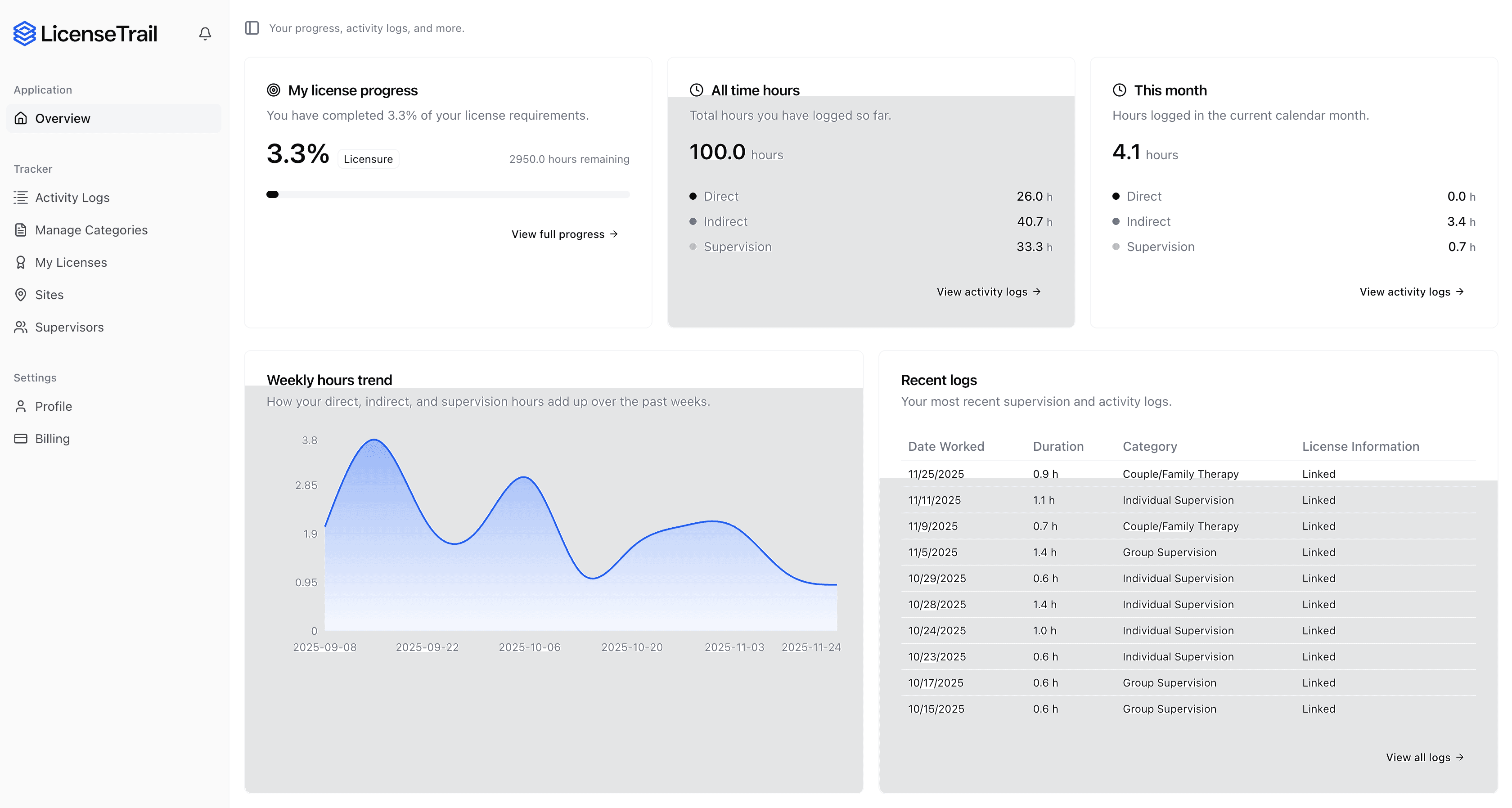
License Trail checks your direct, indirect, and supervision hours against Texas LP requirements continuously and flags mismatches before you submit.
 Start Tracking for Free
No credit card required · Free plan available
Related Licenses
Is your spreadsheet hiding Texas LP risks?
Stop guessing if your categories match Texas State Board of Examiners of Psychologists requirements. License Trail checks your direct, indirect, and supervision hours continuously and flags mismatches before you submit.
Import or log
Bring your spreadsheet or start fresh
Upload your existing tracking spreadsheet and we'll map every hour into the right Texas State Board of Examiners of Psychologists categories automatically.
Verify against Texas
Catch mismatches before the board does
License Trail checks your direct, indirect, and supervision hours against Texas LP requirements continuously.
Export board-ready
One-click clean reports
Generate professional, board-ready reports for supervision meetings and Texas State Board of Examiners of Psychologists submissions in seconds.
No credit card required · Free plan available