
Texas LSSP Requirements: Hours, Exams & Step-by-Step Guide
Stop guessing if your categories match Texas requirements. License Trail checks your direct, indirect, and supervision hours against LSSP requirements continuously and flags mismatches before you submit.
No credit card required · Free plan available
Quick Requirements Overview
- Credential/Authority (TX): Licensed Specialist in School Psychology (LSSP) via BHEC/TSBEP
- Education: Appropriate graduate degree; typically ≥60 graduate semester credit hours (max 12 internship credits counted)
- Coursework/Practicum: Required school psychology content areas + school-based practicum (no set clock-hour minimum in rule)
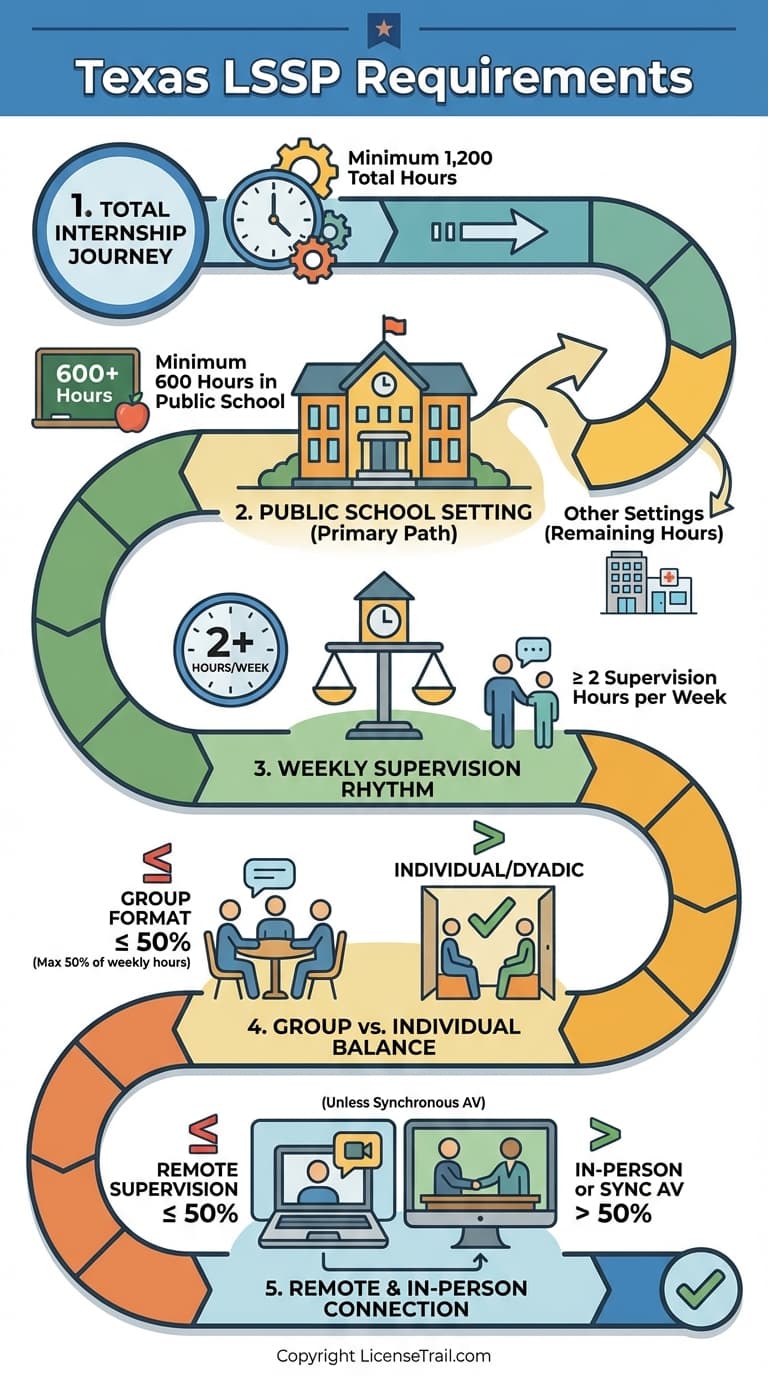
- Internship Hours: Formal internship ≥1,200 hours supervised experience
- Setting/Structure: ≥600 hours in a Texas public school; internship spans 1–2 academic years; ≤2 placements
- Supervision: ≥2 hours/week supervision (≤50% group); public-school hours supervised by LSSP (≥3 years unsupervised experience); non-school hours by Licensed Psychologist
- Exams: Praxis School Psychology + Texas Jurisprudence Exam (NCSP generally waives all but jurisprudence)
- Documentation/Other: Written internship agreement + supervision logs/forms; background check/character & fitness apply
License Details
Procedures
In Texas, the credential required to practice school psychology in the public schools is the Licensed Specialist in School Psychology (LSSP), issued by the Texas Behavioral Health Executive Council (BHEC) through the Texas State Board of Examiners of Psychologists (TSBEP). The key legal authorities are:
- Texas Occupations Code §501.260 (Licensed Specialist in School Psychology) (law.justia.com)
- 22 Texas Administrative Code (TAC) §463.9 (Licensed Specialist in School Psychology) (law.cornell.edu)
- 22 TAC §465.2 (Supervision) (law.cornell.edu)
- BHEC’s “How to Become a Licensed Specialist in School Psychology” guidance. (bhec.texas.gov)
The sections below summarize the requirements with an emphasis on hours and how the Board/BHEC describe them.
1. Statutory baseline: supervised‑experience requirement
Texas law requires that the standards for LSSP licensure include “completion of at least 1,200 hours of supervised experience” for each applicant. (law.justia.com)
The TSBEP implements this through a required formal internship (see Section 3 below). There is not an additional 3,000‑hour or 3,500‑hour post‑degree supervision requirement for LSSPs the way there is for Licensed Psychologists or LPAs with independent practice.
2. Graduate degree and coursework requirements
2.1. Type of degree
Under 22 TAC §463.9:
- An applicant must “hold an appropriate graduate degree” and show proof of required coursework and an acceptable internship. (law.cornell.edu)
- If you do not already hold NCSP certification and did not complete a NASP‑approved or APA‑accredited school psychology program, you must have a graduate degree in psychology from a regionally accredited institution; the program title must actually be “psychology.” (law.cornell.edu)
- You must have completed at least 60 graduate semester credit hours, with no more than 12 hours of internship counted toward that 60‑hour minimum. (law.cornell.edu)
2.2. Required content areas
For applicants going the “graduate degree in psychology” route (i.e., not using NCSP or NASP/APA accreditation to waive training review), the Board requires graduate coursework in the following areas: (law.cornell.edu)
-
Psychological Foundations, including:
- biological bases of behavior
- human learning
- social bases of behavior
- multicultural bases of behavior
- child or adolescent development
- psychopathology or exceptionalities
-
Research and Statistics
-
Educational Foundations, in topics such as instructional design, operation of schools, classroom management, or educational administration.
-
School‑based Assessment, including:
- psychoeducational assessment
- socio‑emotional/behavioral (including cultural) assessment
-
School‑based Interventions, including:
- counseling
- behavior management
- consultation
-
Professional, Legal and Ethical Issues
-
A school‑based practicum (the rule requires a practicum but does not specify a clock‑hour minimum; training programs typically set their own practicum‑hour requirements). (law.cornell.edu)
3. Internship / supervised‑experience hours (the 1,200 hours)
3.1. Total hours and label used
Texas law’s “1,200 hours of supervised experience” requirement for LSSPs is implemented as a formal internship in school psychology. (law.justia.com)
The Board’s rule states that applicants under §463.9(d) must complete “an internship with a minimum of 1200 hours.” (law.cornell.edu)
BHEC’s public guidance mirrors this, describing the requirement as a “formal internship of at least 1200 hours” for LSSP licensure. (bhec.texas.gov)
3.2. Distribution of hours by setting
Within that 1,200‑hour internship:
- At least 600 hours must be completed in a public school setting (Texas public school district, co‑op, or consortium). (law.cornell.edu)
- The remaining hours (up to 600) may be in:
- additional public‑school work, and/or
- other approved settings (e.g., clinics or agencies) that meet the Board’s criteria.
The rule also limits placements:
- Internship hours must be done in no more than two placements; a district, consortium, or educational co‑op each count as one placement. (law.cornell.edu)
- The internship must span not less than one and not more than two academic years. (law.cornell.edu)
3.3. Nature of the work within those hours
The 1,200 hours are not broken down into “direct vs. indirect” hours in the way some counseling or social‑work licenses are. Instead, Texas specifies required functions:
- The internship must include direct application by the intern of:
- assessment
- intervention
- behavior management
- consultation
with children across a range of ages, populations, and needs. (law.cornell.edu)
In other words, your 1,200 hours must be structured so that you are actually delivering and applying core school‑psychology services (not just observing or doing administrative tasks), but the rules do not say, for example, “X hours of direct client contact and Y hours of indirect services.”
4. Supervision requirements during the internship
4.1. Who can supervise
Under 22 TAC §463.9(f) and §465.2(d): (law.cornell.edu)
- Any internship hours in a public school must be supervised by a Licensed Specialist in School Psychology (LSSP).
- Any internship hours outside a public school must be supervised by a Licensed Psychologist.
- Supervision in public schools can only be provided by an LSSP who has at least 3 years of experience providing school psychological services without supervision (and can document their authority and service history in that setting).
Supervision cannot be counted if:
- The supervisor is related to you within the second degree of affinity or consanguinity (e.g., spouse, parent, child, sibling, grandparent, grandchild, parent‑in‑law). (law.cornell.edu)
- The supervisor practices under a restricted license, unless the Council explicitly authorizes that supervision for licensure purposes. (law.cornell.edu)
4.2. Amount and structure of supervision
The Board sets minimum supervision time:
- Interns must receive at least two hours of supervision per week, and no more than half of this supervision can be group supervision. (law.cornell.edu)
- If you are working less than full time, the weekly supervision time can be reduced proportionally.
22 TAC §465.2 also adds general requirements for supervision of interns and trainees: (law.cornell.edu)
- You must be under the supervision of a qualified licensee at all times when providing psychological services under the internship or practicum provisions of the law.
- Supervisors must document your performance in writing and provide that documentation to you.
- Supervisors must keep written logs of supervision dates, duration, and focus.
4.3. Written agreement for the internship
Supervisors are required to ensure that each intern has a written agreement for the internship that clearly states: (law.cornell.edu)
- expectations, duties, and responsibilities of each party
- total hours to be performed by the intern
- benefits and support to be provided
- how the intern will be supervised and evaluated
This document is part of how the Board verifies that your 1,200 hours meet licensure standards.
5. NCSP and NASP/APA‑accredited program pathways
Texas provides streamlined recognition for certain national credentials and program approvals:
- If you hold active Nationally Certified School Psychologist (NCSP) certification, you are considered to have met all requirements for LSSP licensure under 22 TAC §463.9, except the Jurisprudence Examination. (law.cornell.edu)
- If you completed a school‑psychology training program that is NASP‑approved or APA‑accredited in School Psychology, you are considered to have met all training and internship requirements under §463.9. (law.cornell.edu)
In practice, those programs are required by NASP/APA standards to include a 1,200‑hour internship (typically with at least 600 hours in a school), so the Board does not re‑calculate your individual clock hours if your program and documentation meet those standards.
6. Other licensing requirements beyond hours
While your question focuses on hours, it can be useful to see where they fit in the full set of conditions for an LSSP license.
6.1. Exams
The standards in §501.260 and the Board rules require: (law.justia.com)
- A nationally recognized qualifying examination in school psychology – in practice, this is the Praxis School Psychology Examination.
- The Texas Jurisprudence Examination, covering Texas laws and rules governing psychology.
NCSP holders have already passed the Praxis; Texas still requires the Jurisprudence Exam.
6.2. General licensure qualifications
In addition to degree, coursework, internship, and exams, an LSSP applicant must meet the general character and fitness requirements that apply to psychology licenses under Occupations Code §501.2525(a)(3)–(9). These include: (law.cornell.edu)
- age of majority
- good moral character
- physical and mental competence to practice
- no disqualifying criminal history, fraud in applications, or problematic substance use, among others.
A criminal background check is required as part of the application process. (trinity.edu)
6.3. Documentation of supervised experience
BHEC provides a “Supervised Experience Documentation Form (Specialist in School Psychology)”, which your supervisor and/or training program must complete to verify your 1,200 internship hours and supervision. (bhec.texas.gov)
7. How this compares to the “1,500 direct / 1,500 supervised” type of models
Some Texas mental‑health credentials (e.g., LPC, LMFT, LCSW) use models like 3,000 hours total supervised experience, with a specified proportion of “direct” client contact (often 1,500 direct + 1,500 other supervised hours). (bhec.texas.gov)
For the LSSP:
- The law and rules require “at least 1,200 hours of supervised experience” completed as a formal internship in school psychology. (law.justia.com)
- Of those 1,200 hours, at least 600 must be in a public‑school setting. (law.cornell.edu)
- The hours must include direct intern application of assessment, intervention, behavior management, and consultation across a range of students, but the Board does not further divide those 1,200 hours into “direct” vs. “indirect” categories in rule. (law.cornell.edu)
So if you are looking for a breakdown like “1,500 hours of direct experience and 1,500 hours of supervised experience,” that is not how Texas structures the LSSP requirements. The operative numbers for LSSP licensure are:
- 1,200 total supervised internship hours,
- 600 or more of those hours in a public school,
- 2 hours per week of supervision, with limits on group supervision,
- completion in 1–2 academic years and in no more than two placements,
all under qualified LSSP or Licensed Psychologist supervision.
8. Practical checklist (hours‑focused)
Putting the Board’s language into a concise checklist for someone planning their path:
-
Enroll in an approved graduate program
- Either NASP‑approved / APA‑accredited in school psychology, or a graduate psychology program that can meet the 60‑hour and content‑area requirements of 22 TAC §463.9. (law.cornell.edu)
-
Complete required coursework, including:
- Psychological foundations, educational foundations, research/statistics, assessment, interventions, ethics/professional issues, and a school‑based practicum. (law.cornell.edu)
-
Arrange and complete a formal internship that:
- Totals at least 1,200 clock hours of supervised experience in school psychology,
- Provides at least 600 hours in a public school,
- Spans one or two academic years, in no more than two placements,
- Involves direct application of assessment, intervention, behavior management, and consultation with a range of students,
- Provides at least 2 hours of supervision per week (no more than half in group format),
- Is supervised in public schools by an LSSP with 3+ years of unsupervised school practice, and in non‑school settings by a Licensed Psychologist. (law.cornell.edu)
-
Have your supervisor/program complete the Board’s internship/supervised‑experience documentation form for LSSP applicants. (bhec.texas.gov)
-
Pass required exams
- Praxis School Psychology exam.
- Texas Psychology Jurisprudence exam. (bhec.texas.gov)
-
Submit the LSSP application via BHEC, including:
- Official transcript(s) documenting degree and coursework,
- Supervised‑experience (internship) documentation,
- Any required practicum/internship agreements or logs if requested,
- Background‑check and other standard application items. (bhec.texas.gov)
Regulations and Board interpretations can change (TSBEP’s LSSP rule was amended as recently as March 2025), so before relying on this for timing or planning, it is wise to confirm your plan against the current text of 22 TAC §463.9, 22 TAC §465.2, and BHEC’s LSSP application materials on the official site. (law.cornell.edu)
Track your LSSP hours with confidence
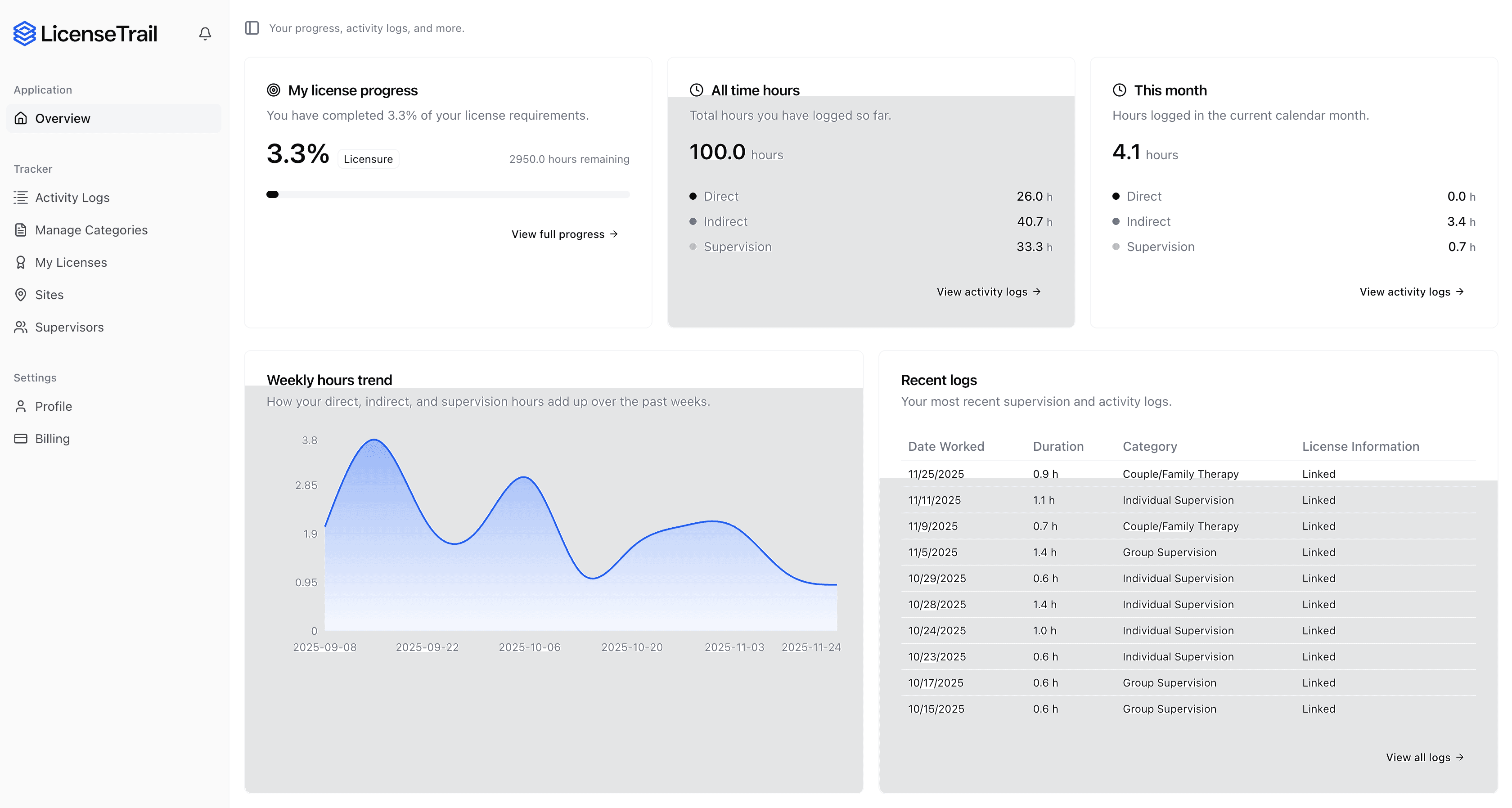
License Trail checks your direct, indirect, and supervision hours against Texas LSSP requirements continuously and flags mismatches before you submit.
 Start Tracking for Free
No credit card required · Free plan available
Related Licenses
Is your spreadsheet hiding Texas LSSP risks?
Stop guessing if your categories match Texas State Board of Examiners of Psychologists requirements. License Trail checks your direct, indirect, and supervision hours continuously and flags mismatches before you submit.
Import or log
Bring your spreadsheet or start fresh
Upload your existing tracking spreadsheet and we'll map every hour into the right Texas State Board of Examiners of Psychologists categories automatically.
Verify against Texas
Catch mismatches before the board does
License Trail checks your direct, indirect, and supervision hours against Texas LSSP requirements continuously.
Export board-ready
One-click clean reports
Generate professional, board-ready reports for supervision meetings and Texas State Board of Examiners of Psychologists submissions in seconds.
No credit card required · Free plan available