
Utah ACMHC Requirements: Hours, Exams & Step-by-Step Guide
Stop guessing if your categories match Utah requirements. License Trail checks your direct, indirect, and supervision hours against ACMHC requirements continuously and flags mismatches before you submit.
No credit card required · Free plan available
Quick Requirements Overview
- Master’s/Doctorate meeting CMHC education standard: CACREP Clinical Mental Health Counseling/Clinical Rehabilitation Counseling/Counselor Ed & Supervision or equivalent field from CHEA-recognized institution
- Minimum 60 semester / 90 quarter graduate counseling credits
- If non-CACREP/equivalent, coursework must include 3 semester / 4 quarter credits each across required content areas (incl. diversity, groups, helping relationships, addictions, assessment/testing, DSM/mental status, research, ethics/orientation, etc.)
- Graduate practicum/internship (in-degree): 700 documented supervised clinical training hours, incl. 240 direct client therapy hours
- Apply to DOPL: application + fee + certified transcripts
- Criminal background check required
- NCE may be requested by DOPL for non-CACREP applicants (discretionary)
- Not required for ACMHC issuance: post-degree 3,000 hours, suicide-prevention training, or exams (those apply later for CMHC)
License Details
Procedures
In Utah, the Associate Clinical Mental Health Counselor (ACMHC) license is the post‑graduate, pre‑independent credential you hold while you accumulate supervised hours toward full Clinical Mental Health Counselor (CMHC) licensure. The ACMHC itself has relatively modest “hours” requirements (they are embedded in your degree), while the large blocks of supervised hours come afterward, during your time as an ACMHC.
Below is a step‑by‑step breakdown focused on what the Utah Division of Occupational and Professional Licensing (DOPL) and the Clinical Mental Health Counselor Licensing Act Rule actually require, with the board’s own terminology highlighted and the hours spelled out.
1. Degree and Program Requirements
To qualify for an ACMHC license, Utah statute requires that you meet the same education standard as a full CMHC, just without the post‑degree experience and exams.
Under Utah Code § 58‑60‑405(1)(c), an applicant must:(law.justia.com)
-
Hold a master’s or doctorate degree in one of the following:
- Clinical Mental Health Counseling
- Clinical Rehabilitation Counseling
- Counselor Education and Supervision from a CACREP‑accredited program; or
- Clinical Mental Health Counseling or an equivalent field from a program at an institution accredited by a body recognized by the Council for Higher Education Accreditation (CHEA).
-
Have at least 60 semester credit hours or 90 quarter credit hours of counseling‑related graduate coursework.(law.justia.com)
If your program is not CACREP, the rules define an “equivalent field” and spell out the required coursework.
Required Coursework Areas for an “Equivalent Field”
The Clinical Mental Health Counselor Licensing Act Rule (R156‑60c‑102(11)) specifies that an “equivalent field” program must include three semester or four quarter credit hours in each of these graduate‑level content areas:(law.cornell.edu)
- Social and cultural diversity
- Group counseling and group work
- Human growth and development
- Career development
- Counseling and helping relationships
- Substance‑related and addictive disorders
- Assessment and testing
- Mental status examination and appraisal of DSM maladaptive and psychopathological behavior
- Research and program evaluation
- Professional counseling orientation and ethical practice
DOPL’s ACMHC application page also calls out mental status examination and professional and counseling ethics, and then the practicum/internship requirement described next.(dopl.utah.gov)
2. Graduate Practicum / Internship Hours Required for ACMHC
For the ACMHC itself, the only explicit “hours” requirement is your graduate clinical training (practicum/internship) that is part of the degree.
Two different but consistent sources govern this:
-
Utah Administrative Code R156‑60c‑102(11)(c) states that an equivalent program must include:
- “700 documented hours of supervised clinical training from at least one practicum or internship, of which 240 hours consists of providing therapy directly to clients.”(law.cornell.edu)
-
DOPL’s official ACMHC application page requires, for non‑CACREP programs,
- “a practicum or internship that includes at least 700 documented hours of supervised clinical mental health counselor training of which at least 240 hours consist of providing clinical therapy directly to clients under the direction of an educational institution.”(dopl.utah.gov)
In practical terms, to be eligible for ACMHC in Utah you must have, within your graduate program:
-
Total supervised clinical training (practicum/internship):
- 700 documented hours (minimum) supervised by a qualified mental health training supervisor at an approved site (mental health agency, hospital, educational institution, nonprofit, or government agency).(law.cornell.edu)
-
Direct service hours within that training:
- At least 240 hours providing therapy directly to clients (direct client contact/therapy) as part of those 700 hours.(law.cornell.edu)
Utah’s rules refer to this collectively as “supervised clinical training from at least one practicum or internship,” with a specified minimum number of direct client therapy hours within it.
No additional pre‑licensure “field hours” beyond this graduate practicum/internship are required to receive the ACMHC license.
3. Application and Background Check
Under Utah Code § 58‑60‑405(1)(a)–(c) and (h), an ACMHC applicant must:(law.justia.com)
- Submit an application on forms provided by DOPL.
- Pay the required fee set by the department.
- Provide certified transcripts showing:
- The qualifying master’s or doctoral degree, and
- The required 60 semester / 90 quarter credits of graduate coursework.
- Consent to a criminal background check in accordance with § 58‑60‑103.1 and any rules DOPL has adopted.(law.justia.com)
DOPL may also request National Counselor Examination (NCE) scores for non‑CACREP graduates; their ACMHC page notes that “the Division may request a passing score of the NCE examination for non‑CACREP accredited programs” and that scores must be sent directly from NBCC.(dopl.utah.gov) This is discretionary and is not listed as a universal ACMHC requirement in the statute.
4. What Is Not Required for the ACMHC (But Is Required Later)
The Utah statute is explicit about the difference between an associate and a full clinical mental health counselor.
Associate vs. Full Licensure in the Statute
- Subsection (1) of Utah Code § 58‑60‑405 lists the full requirements for licensure as a clinical mental health counselor, including large supervised‑experience blocks, suicide‑prevention training, and examinations.(law.justia.com)
- Subsection (2) then states:
- “An applicant for licensure as an associate clinical mental health counselor shall comply with the provisions of Subsections (1)(a) through (c) and (h).”(law.justia.com)
This means:
-
For ACMHC you must meet:
- (1)(a) Application
- (1)(b) Fee
- (1)(c) Degree + 60 credits
- (1)(h) Background check
-
You do not have to meet, at the time of ACMHC licensure:
- (1)(d)–(e): The 3,000‑hour clinical supervision / 1,200 direct client care hours requirements (these are for full CMHC and for Medicare eligibility).(law.justia.com)
- (1)(f): Suicide‑prevention training hours (these come later, prior to full CMHC).(law.justia.com)
- (1)(g): Passing the qualifying exam(s) or the exam‑alternative pathway (also for full CMHC).(law.justia.com)
So the large supervised‑experience hour requirements do not apply to you until you are an ACMHC and are working toward full CMHC licensure.
5. Post‑Graduate Supervised Hours You Will Complete While Licensed as an ACMHC
Although not required to obtain the ACMHC, it is helpful to understand the hour structure you must complete while holding the ACMHC to later become fully licensed.
The Clinical Mental Health Counselor Licensing Act Rule R156‑60c‑302a interprets § 58‑60‑405 and sets the experience requirement for full CMHC:
Total Supervised Clinical Experience
Under R156‑60c‑302a(1):(law.cornell.edu)
- You must complete a minimum of 3,000 hours of clinical mental health experience after finishing your degree.
- Within these 3,000 hours, at least:
- 1,000 hours must be providing clinical mental health therapy directly to clients (direct service hours).
- 75 hours must be clinical mental health therapy performed under “direct supervision” (face‑to‑face or approved synchronous video supervision that meets the rule’s definition).(law.cornell.edu)
- Within these 3,000 hours, at least:
The rule labels these broadly as “clinical mental health experience,” which can include: individual, family, and group therapy; crisis intervention; intermediate and long‑term treatment.(law.cornell.edu)
Conditions on How These Hours Are Earned
R156‑60c‑302a(3) adds important structural requirements:(law.cornell.edu)
- These hours must be:
- Completed after all education required by § 58‑60‑405 is finished.
- Not inclusive of any practicum or internship hours (those 700/240 graduate hours cannot double‑count).
- Completed while you are licensed as an ACMHC, except in narrow circumstances for out‑of‑state or exempt practice.
- Accrued while you are a W‑2 employee providing clinical mental health services in one of these settings:
- Mental health agency
- In‑patient or out‑patient hospital
- Educational institution
- Non‑profit organization
- Government agency
- Completed in not less than 18 months.
Additionally, all supervised experience must comply with the supervision‑contract requirements in R156‑60c‑305b and be under a supervisor who meets R156‑60c‑305a (licensed mental health therapist with specified experience and independence from your employment control).(law.cornell.edu)
The updated statute (58‑60‑405(1)(d)–(e)) also introduces language for “3,000 hours of clinical supervision” and “not less than 1,200 direct client care hours,” which DOPL will harmonize with the existing 3,000/1,000/75 framework through rule and guidance, particularly for Medicare eligibility.(law.justia.com)
Again, these post‑graduate hours are not part of the ACMHC license requirements, but they define what you will do while you hold that license on your way to full CMHC.
6. Summary of Hour Requirements Tied to the ACMHC Path
To distill the numbers as they relate to becoming and then practicing as an ACMHC in Utah:
To Qualify for the ACMHC License
Embedded in your graduate program:
- 700 documented hours of supervised clinical training (practicum or internship)
- At least 240 hours of therapy provided directly to clients.(law.cornell.edu)
There is no additional pre‑license supervised‑experience block (like 1,500 + 1,500 hours) required just to obtain the ACMHC. Those larger supervised totals apply later, for full CMHC.
To Progress from ACMHC to Full CMHC (Post‑Degree, While ACMHC)
After you hold the ACMHC:
- 3,000 hours of clinical mental health experience, including at least:(law.cornell.edu)
- 1,000 hours of clinical mental health therapy directly to clients (direct service).
- 75 hours under “direct supervision” (face‑to‑face or approved synchronous supervision).
- All hours:
- Completed after finishing your degree and practicum/internship.
- Earned while licensed as an ACMHC and working as a W‑2 employee in approved clinical settings.
- Accrued over no less than 18 months.
The statute then layers on at least 1,200 direct client care hours, suicide‑prevention training, and examination or exam‑alternative requirements for full licensure, but those are beyond the scope of the ACMHC itself.(law.justia.com)
In short: to become an ACMHC in Utah you need a qualifying 60‑credit clinical mental health counseling degree that includes 700 supervised clinical training hours (240 direct therapy hours) plus the standard application and background‑check steps. The 3,000‑hour supervised experience block (with its 1,000 direct‑therapy and 75 directly supervised hours) belongs to the post‑graduate phase while you are already licensed as an ACMHC, and is what eventually qualifies you for full CMHC licensure.
Track your ACMHC hours with confidence
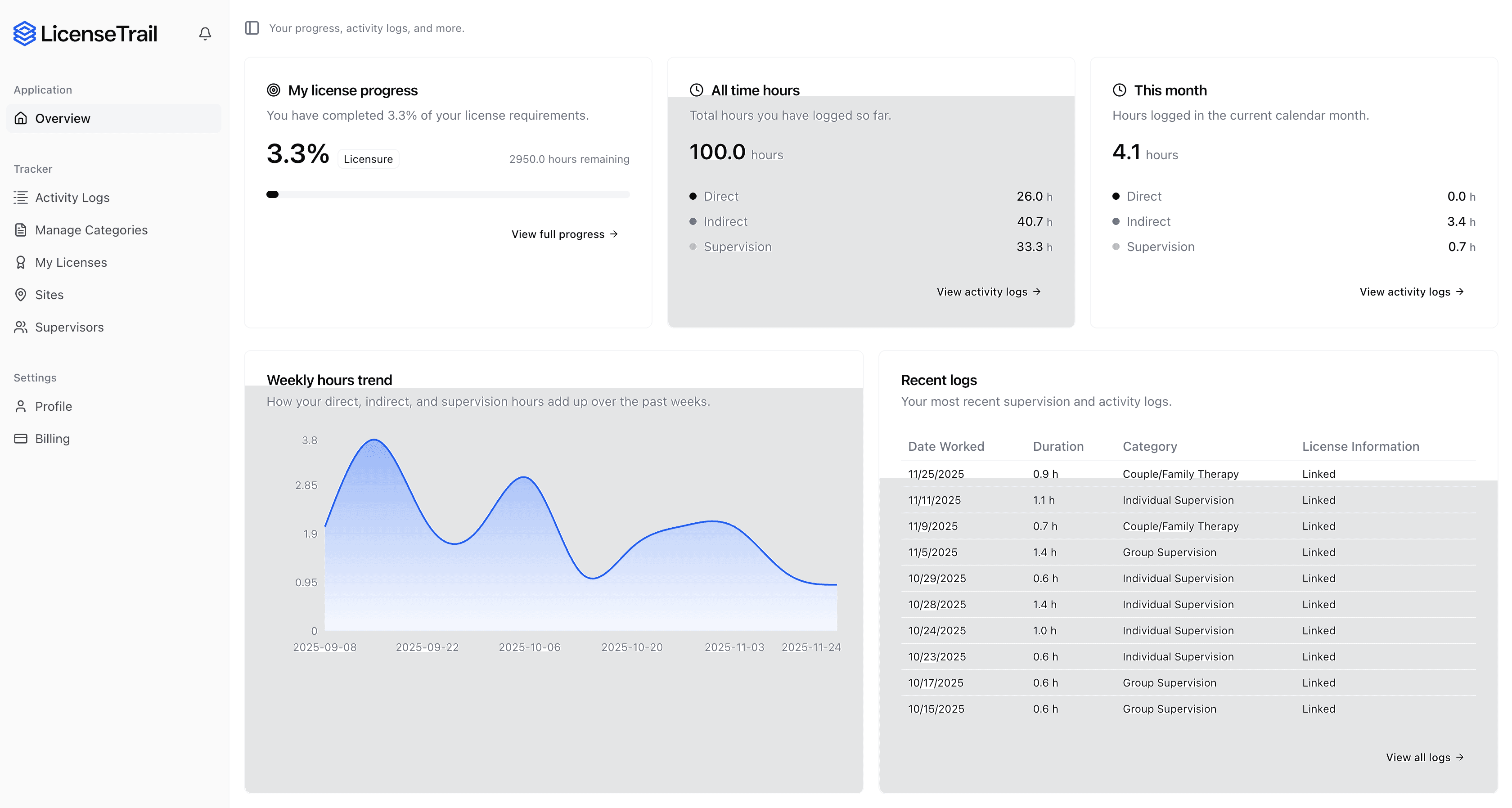
License Trail checks your direct, indirect, and supervision hours against Utah ACMHC requirements continuously and flags mismatches before you submit.
 Start Tracking for Free
No credit card required · Free plan available
Related Licenses
Is your spreadsheet hiding Utah ACMHC risks?
Stop guessing if your categories match Utah Clinical Mental Health Counselor Licensing Board requirements. License Trail checks your direct, indirect, and supervision hours continuously and flags mismatches before you submit.
Import or log
Bring your spreadsheet or start fresh
Upload your existing tracking spreadsheet and we'll map every hour into the right Utah Clinical Mental Health Counselor Licensing Board categories automatically.
Verify against Utah
Catch mismatches before the board does
License Trail checks your direct, indirect, and supervision hours against Utah ACMHC requirements continuously.
Export board-ready
One-click clean reports
Generate professional, board-ready reports for supervision meetings and Utah Clinical Mental Health Counselor Licensing Board submissions in seconds.
No credit card required · Free plan available