
Utah ACMHC Extern Requirements: Hours, Exams & Step-by-Step Guide
Stop guessing if your categories match Utah requirements. License Trail checks your direct, indirect, and supervision hours against ACMHC Extern requirements continuously and flags mismatches before you submit.
No credit card required · Free plan available
Quick Requirements Overview
- Temporary DOPL-issued license to practice only under supervision while finishing limited missing coursework toward ACMHC/CMHC
- Education: Master’s/Doctoral in Clinical Mental Health Counseling or equivalent (CHEA-recognized institution); school counseling/psychology/educational psychology do not qualify
- Must have completed graduate clinical training: 700 supervised practicum/internship hours incl. 240 direct client therapy hours
- Must have completed: clinical practicum + ethics course + DSM course (current DSM)
- Coursework deficiency limit for extern: up to 12 semester / 18 quarter credits by rule (DOPL page notes ≤12 quarter credits)
- Practice setting: must be a W‑2 employee at an approved organization (e.g., agency/hospital/education/nonprofit/government); no independent practice
- Supervision: qualified supervisor (e.g., CMHC/LCSW/psychiatrist/psychologist/MFT/APRN PMH) licensed ≥2 years; written supervision contract + supervisor verification required before hours count
- Extern license expires upon full license issuance or 3 years (possible extension for good cause); no exam required for ACMHC‑Extern
License Details
Procedures
Utah’s Associate Clinical Mental Health Counselor Extern (ACMHC‑Extern) license is a temporary credential that lets you begin (or continue) practicing under supervision while you finish a small amount of missing coursework in a qualifying counseling master’s or doctoral program. It is issued by the Utah Division of Professional Licensing (DOPL) under the Clinical Mental Health Counselor Licensing Act and rules of the Clinical Mental Health Counselor Licensing Board.
Below is a step‑by‑step guide, focusing on the specific hours and the exact types of experience the Board requires or expects at the extern level and beyond.
1. Understand What the ACMHC‑Extern License Is For
Utah law creates an “externship license” as a temporary license under the Clinical Mental Health Counselor Licensing Act for applicants who otherwise qualify for licensure as mental health therapists but are still deficient in some coursework. (codes.findlaw.com)
DOPL’s CMHC program describes the ACMHC‑Extern specifically as available to individuals:
- Who are within a limited number of credits of completing a qualifying master’s program in Clinical Mental Health Counseling (or an equivalent field), and
- Who have already completed key clinical and foundational courses (practicum, ethics, and DSM coursework). (dopl.utah.gov)
The extern license is not a separate long‑term path; it is a temporary bridge while you complete those remaining credits and transition into full Associate (ACMHC) status and then full CMHC licensure.
2. Educational Foundation and Practicum/Internship Hour Requirements
Although the ACMHC‑Extern page itself is brief, it explicitly requires that you have completed your clinical practicum. Utah’s CMHC rules and the ACMHC application page define what that practicum/internship must include in terms of hours.
2.1. Degree program and accreditation
To qualify for ACMHC or ACMHC‑Extern, your degree program must be:
- A master’s or doctoral degree in Clinical Mental Health Counseling or an “equivalent field” from a program associated with an institution accredited by an accrediting body recognized by the Council for Higher Education Accreditation (CHEA). (dopl.utah.gov)
DOPL emphasizes that the following fields do not qualify for extern licensure:
- School Counseling
- Psychology
- Educational Psychology/Counseling (dopl.utah.gov)
2.2. Required practicum/internship hours (pre‑licensure)
Utah’s CMHC rule and the ACMHC application specify that your program must include substantial supervised clinical training:
- Minimum of 700 documented hours of supervised clinical mental health counselor training, coming from at least one practicum or internship; and
- Of those 700 hours, at least 240 hours must consist of providing therapy directly to clients. (dopl.utah.gov)
In other words, at the graduate‑training level you must have:
- 700 total supervised practicum/internship hours, including
- 240 direct client therapy hours (individual, family, or group therapy as defined in rule).
The ACMHC‑Extern page then adds that, at a minimum, extern applicants must already have completed:
- Their clinical practicum
- An Ethics course
- A course that thoroughly covers the current DSM (dopl.utah.gov)
Functionally, this means you cannot obtain an ACMHC‑Extern license in Utah unless you already have at least those 700 supervised clinical training hours (240 direct) built into your graduate program.
3. “Deficiency in Coursework” Limits for Extern Licensure
The extern license is specifically for people who are near the end of their degree and are missing only a limited amount of coursework.
Two official sources describe that limit:
-
Utah Administrative Code R156‑60c‑302c (post‑degree programs) states that a person whose degree is deficient in no more than 12 semester credits or 18 quarter credits may complete those missing courses post‑degree and may qualify for temporary licensure as an associate clinical mental health counselor extern under Utah Code § 58‑60‑117. (law.cornell.edu)
-
The DOPL ACMHC‑Extern application page currently says the externship license is available for individuals “who are deficient in no more than 12 quarter credit hours of a Master’s program” in Clinical Mental Health Counseling or a related field. (dopl.utah.gov)
In practice:
- The rule allows deficiency of up to 12 semester or 18 quarter credits.
- The program webpage is stricter (no more than 12 quarter credits).
If you are between 12 and 18 quarter credits short, you would want to clarify directly with DOPL whether you can still qualify as an extern, because the rule and web text are not perfectly aligned.
4. Statutory Requirements for an Extern License (Utah Code § 58‑60‑117)
Utah’s Mental Health Professional Practice Act lays out the general conditions for any externship license, including ACMHC‑Extern. To receive a temporary extern license under the Clinical Mental Health Counselor Licensing Act, a person must: (codes.findlaw.com)
- Submit an application for licensure under the Clinical Mental Health Counselor Licensing Act (i.e., you are actively applying for ACMHC/CMHC licensure).
- Pay the required fee set by the department.
- Hold a master’s or doctoral degree in a discipline that is a prerequisite for practice as a mental health therapist (such as Clinical Mental Health Counseling or an equivalent field as defined in rule).
- Have a “deficiency, as defined by division rule, in coursework” – which ties back to the “deficiency” definition in R156‑60c‑102(8) and the credit limits in R156‑60c‑302c. (law.cornell.edu)
- Provide mental health therapy as an employee of a public or private organization that provides mental health therapy, while under the supervision of a person licensed under this chapter.
- Have no disciplinary action pending or in effect against you in connection with the practice of mental health therapy in any jurisdiction.
A temporary extern license expires on the earlier of:
- Issuance of the full license you applied for, or
- Three years from the date the extern license was issued (unless the deadline is extended by the division for good cause). (codes.findlaw.com)
5. Employment and Supervision Conditions While You Are an Extern
Even at the extern level, Utah’s rules require that your clinical work and supervision meet the same structural standards that apply to ACMHCs accruing hours toward full CMHC licensure.
5.1. Employment setting (W‑2 requirement)
Under Utah’s supervised‑experience rule for CMHCs, your qualifying hours must be obtained while you are a W‑2 employee (not a 1099 contractor) of one of the following: (regulations.justia.com)
- A mental health agency
- An in‑patient or out‑patient hospital
- An educational institution
- A non‑profit organization
- A government agency
That W‑2 employment requirement also appears in the general supervision rule (R156‑60c‑305b) for anyone gathering supervised experience. (law.cornell.edu)
5.2. Supervisor qualifications
To supervise an ACMHC (and, by extension, an extern functioning in that role), a supervisor must: (law.cornell.edu)
- Hold an active license in good standing as one of the following:
- CMHC
- Clinical Social Worker (LCSW)
- Psychiatrist
- Psychologist
- Marriage and Family Therapist
- APRN specializing in psychiatric mental health nursing
- Have been licensed in that classification for at least two years
- Be currently engaged in the lawful practice of providing clinical mental health therapy
- Supervise no more than six individuals who are gathering experience hours for licensure (unless an exception is granted)
- Be employed by, or have a contract with, the facility that employs you.
5.3. Supervision contract and verification
Before you begin accruing supervised experience hours, you must: (law.cornell.edu)
- Enter into a written supervision contract with your supervisor (signed by both of you), and
- Ensure your supervisor has submitted a Supervisor Verification form to DOPL, and that the division has acknowledged receipt.
The contract must spell out, at minimum:
- A plan ensuring your access to the supervisor
- The frequency, duration, objectives, format (individual, triadic, small group), and location (in‑person or remote) of supervision
- How supervision will be documented
- How supervision will address conflicts between clinical recommendations and agency policies.
You must then maintain licensure, remain a W‑2 employee at an approved site, comply with the supervision contract, and obey all confidentiality and ethics rules. (law.cornell.edu)
6. Post‑Degree Supervised Experience Hours You Are Working Toward
Although the ACMHC‑Extern license itself does not require you to have accumulated any post‑degree clinical hours, it is the status under which you will begin (or continue) gaining the supervised experience needed for full CMHC licensure.
Utah defines the CMHC experience requirements in R156‑60c‑302a:
6.1. Total hours and breakdown
For full Clinical Mental Health Counselor licensure, Utah requires a minimum of 3,000 hours of clinical mental health experience, which must include: (regulations.justia.com)
-
1,000 hours providing clinical mental health therapy directly to clients.
- “Clinical mental health therapy” is defined as the direct practice of mental health counseling focused on assessment, diagnosis, and treatment of mental disorders and emotional or behavioral disturbances, using individual, group, and family therapy. (law.cornell.edu)
-
75 hours of clinical mental health therapy performed under direct supervision.
- “Direct supervision” is defined as supervision where the supervisor meets with the supervisee either:
- In the same room in person, or
- Remotely via synchronous audio‑visual electronic means as specified in the supervision contract. (law.cornell.edu)
- “Direct supervision” is defined as supervision where the supervisor meets with the supervisee either:
The remainder of the 3,000 hours (up to 1,925 hours) can be other qualifying clinical mental health experience, such as: (regulations.justia.com)
- Individual, family, or group therapy
- Crisis intervention
- Intermediate or long‑term treatment
- Assessment, intake, treatment planning, clinical documentation, and other activities described in the definition of “clinical mental health experience.”
6.2. Timing and setting of the 3,000 hours
The rules further require that: (regulations.justia.com)
- These 3,000 hours must be completed after you finish the qualifying education (they cannot include practicum or internship hours).
- They must be acquired while you are licensed as an ACMHC, except in narrowly defined situations (such as certain out‑of‑state experience or exempt settings), which must still meet Utah’s standards.
- They must be completed in not less than 18 months.
- They must be accumulated while you are a W‑2 employee at an approved facility, under a supervisor who meets R156‑60c‑305a, and in compliance with the supervision requirements of R156‑60c‑305b.
As an ACMHC‑Extern, you are essentially beginning this same supervised experience trajectory, but under a temporary license while you close the last gaps in coursework.
7. Examinations and How They Relate to the Extern License
Utah’s CMHC program currently states: (dopl.utah.gov)
-
There is no examination requirement for:
- Associate Clinical Mental Health Counselor (ACMHC), and
- Associate Clinical Mental Health Counselor Extern (ACMHC‑Extern).
-
For full CMHC licensure, you must pass the NCMHCE (and in some cases, the NCE, especially for non‑CACREP educational pathways).
The division may also request an NCE score when reviewing non‑CACREP programs even at the ACMHC level, but that is determined case‑by‑case. (dopl.utah.gov)
8. Professional Title and Scope While an Extern
A few final, practical points from Utah’s rules:
- You may only use titles such as “ACMHC‑Extern” or “ACMHC‑Extern” if you are licensed in that classification; using those abbreviations without holding the license is considered unprofessional conduct under R156‑60c‑502. (regulations.justia.com)
- As an extern, you provide mental health therapy only as an employee of a qualifying organization and under supervision; you may not practice independently. (codes.findlaw.com)
Summary of Key Hour Requirements Tied to ACMHC‑Extern Status
-
Pre‑licensure graduate practicum/internship (must be completed before ACMHC‑Extern)
- 700 documented hours of supervised clinical training
- 240 direct client therapy hours within that 700 (dopl.utah.gov)
-
Externship coursework deficiency limit
- No more than 12 semester or 18 quarter credits deficient under rule; DOPL page currently states no more than 12 quarter credits. (law.cornell.edu)
-
Post‑degree supervised clinical hours for full CMHC licensure (completed while ACMHC / ACMHC‑Extern path is underway)
- 3,000 hours total clinical mental health experience
- Including 1,000 hours of clinical mental health therapy directly to clients
- Including 75 hours of therapy performed under direct supervision (regulations.justia.com)
- Completed in not less than 18 months
- Under a qualified supervisor, with a supervision contract, while employed as a W‑2 employee at an approved facility. (regulations.justia.com)
- 3,000 hours total clinical mental health experience
Those are the core hour‑ and experience‑based requirements, as articulated in current Utah statute, administrative rule, and DOPL guidance, that are relevant to obtaining and using an Associate Clinical Mental Health Counselor Extern license in Utah.
Track your ACMHC Extern hours with confidence
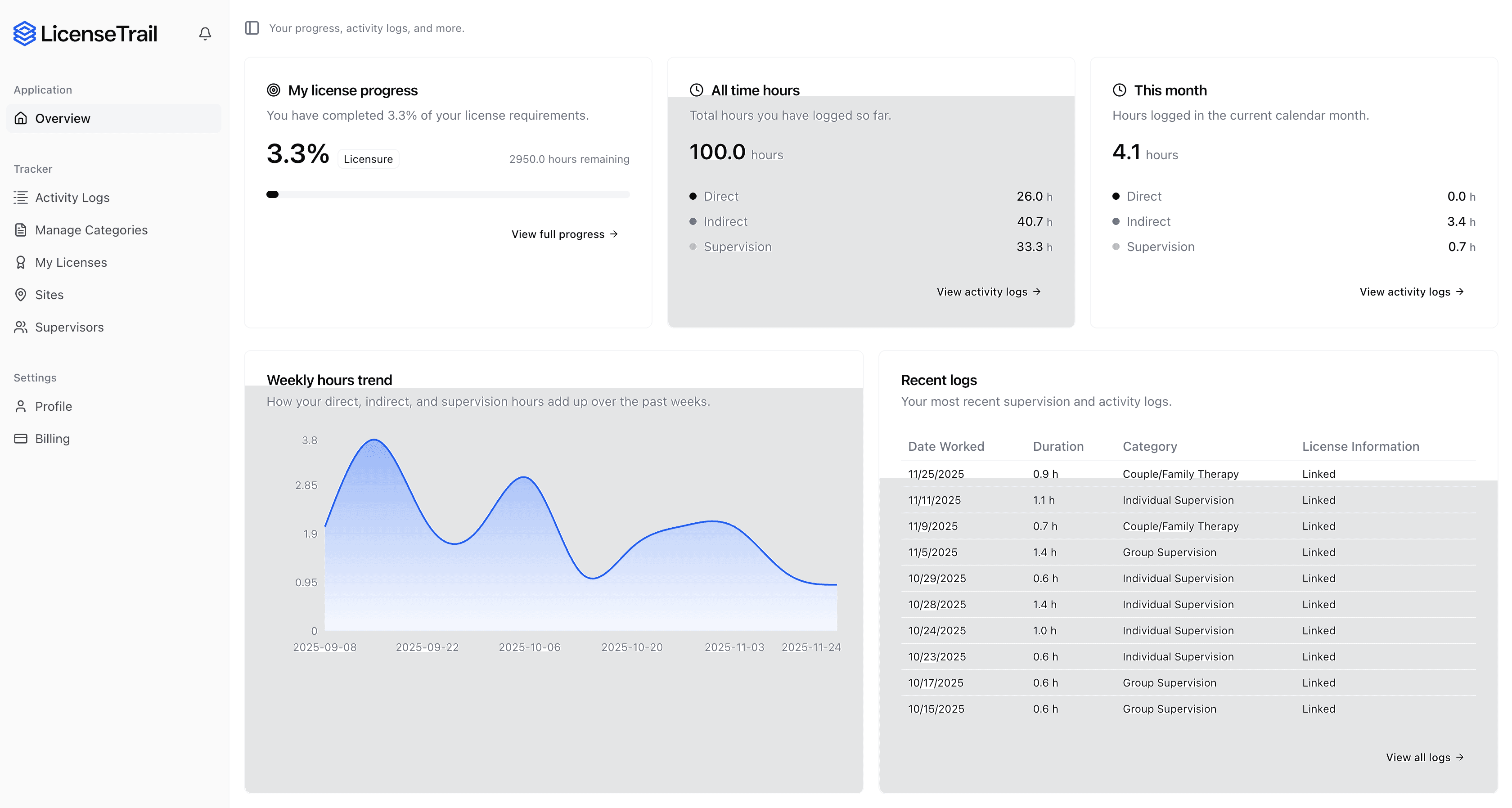
License Trail checks your direct, indirect, and supervision hours against Utah ACMHC Extern requirements continuously and flags mismatches before you submit.
 Start Tracking for Free
No credit card required · Free plan available
Related Licenses
Is your spreadsheet hiding Utah ACMHC Extern risks?
Stop guessing if your categories match Utah Clinical Mental Health Counselor Licensing Board requirements. License Trail checks your direct, indirect, and supervision hours continuously and flags mismatches before you submit.
Import or log
Bring your spreadsheet or start fresh
Upload your existing tracking spreadsheet and we'll map every hour into the right Utah Clinical Mental Health Counselor Licensing Board categories automatically.
Verify against Utah
Catch mismatches before the board does
License Trail checks your direct, indirect, and supervision hours against Utah ACMHC Extern requirements continuously.
Export board-ready
One-click clean reports
Generate professional, board-ready reports for supervision meetings and Utah Clinical Mental Health Counselor Licensing Board submissions in seconds.
No credit card required · Free plan available