
Utah LCSW Requirements: Hours, Exams & Step-by-Step Guide
Stop guessing if your categories match Utah requirements. License Trail checks your direct, indirect, and supervision hours against LCSW requirements continuously and flags mismatches before you submit.
No credit card required · Free plan available
Quick Requirements Overview
- Qualifying degree + CSW required: Earn MSW/approved doctoral degree; accrue LCSW hours while licensed as a Utah CSW (CSW‑Intern hours don’t count; limited exceptions).
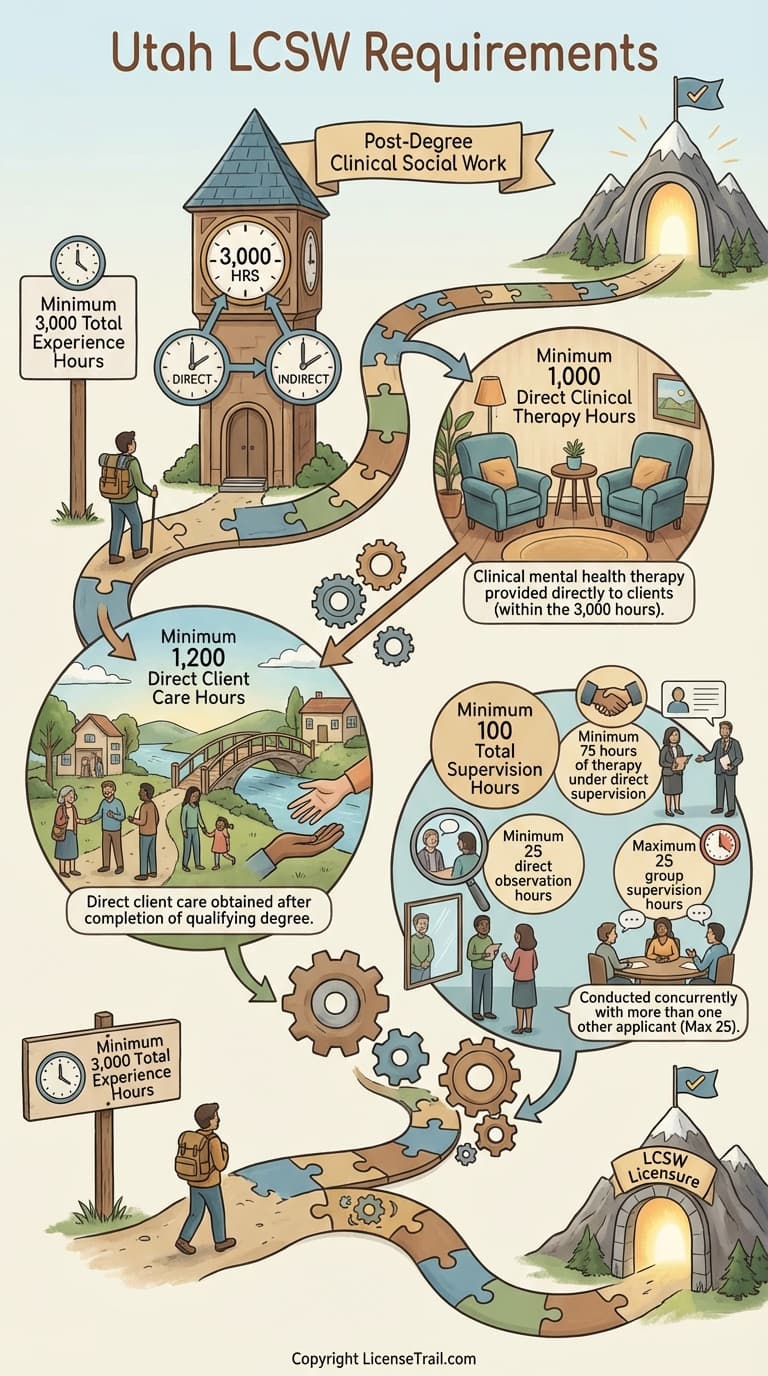
- Total supervised experience: 3,000 hours post‑degree clinical social work experience, completed over ≥ 18 months.
- Employment/setting limits: Hours must be as a W‑2 employee providing clinical mental health services in approved settings (e.g., MH agency, hospital, school, nonprofit, government).
- Direct service minimums (within 3,000): ≥ 1,200 hours direct client care, including ≥ 1,000 hours of clinical mental health therapy provided directly to clients.
- Supervision minimums: Within the direct client care, ≥ 100 hours direct clinical supervision, including ≥ 25 hours direct observation; group supervision capped at 25 hours.
- “Direct supervision” therapy: ≥ 75 hours of therapy must be performed under real‑time (“direct”) supervision (in‑person or synchronous A/V per contract).
- Required practice domains: Experience must include individual/family/group therapy, crisis intervention, intermediate treatment, and long‑term treatment.
- Supervisor eligibility (UT rule): Supervisor generally may be LCSW/CMHC/MFT/psychiatrist/psychologist/psych‑MH APRN, licensed ≥ 2 years and practicing; written supervision contract required (some out‑of‑state pathways require LCSW‑only supervision).
License Details
Procedures
Utah requirements for licensure as a Licensed Clinical Social Worker (LCSW) are defined in statute (Utah Code Title 58, Chapter 60) and in the Social Worker Licensing Act Rule (Utah Admin. Code R156‑60a), and are administered by the Utah Division of Occupational and Professional Licensing (DOPL) / Social Worker Licensing Board.
Below is a structured summary focused on the hours, types of hours, and supervision language the state uses, based on current law and rule as of late 2025.
1. Basic pathway overview
To become an LCSW in Utah, you must:
- Hold a qualifying graduate degree (typically an MSW from a CSWE‑accredited program, or a board‑approved doctoral degree with a clinical social work concentration). (law.justia.com)
- Obtain a Certified Social Worker (CSW) license; you must be licensed as a CSW to accrue qualifying LCSW experience in Utah (with narrow exceptions for out‑of‑state or exempt settings). (law.cornell.edu)
- Complete the required supervised clinical social work / clinical supervision hours (details below).
- Complete required suicide prevention training after your degree. (law.justia.com)
- Pass the ASWB Clinical Examination (often already done for CSW) and meet background‑check and application requirements. (dopl.utah.gov)
2. Total supervised experience required
3,000 hours of clinical social work / clinical supervision
Utah now sets the core requirement at 3,000 hours, not 4,000.
Two key pieces of law interact here:
- Statute (Utah Code § 58‑60‑205) requires that a clinical social worker applicant complete “not less than 3,000 hours of clinical supervision” (or not less than two years of clinical supervision), if needed to meet certain federal Medicare eligibility standards. (law.justia.com)
- Rule (Utah Admin. Code R156‑60a‑302c) states that “the minimum 3,000 hours of clinical social work experience required” must include specific types of work (see below). (law.cornell.edu)
DOPL’s LCSW Utah‑applicant page reflects this figure in plain language: you must have “Completed 3,000 hours of experience while licensed as a Utah CSW” (Utah CSW‑Intern hours do not count). (dopl.utah.gov)
For Utah and non‑endorsement out‑of‑state applicants, DOPL also emphasizes that these 3,000 hours must be completed:
- While licensed as a CSW (or equivalent); and
- (For out‑of‑state non‑endorsement applicants) “under an LCSW ONLY”, with hours under other supervisors not counting for Utah licensure. (dopl.utah.gov)
3. Required breakdown of those 3,000 hours
3.1 Clinical social work vs. direct therapy
Under R156‑60a‑302c, Utah requires that the 3,000 hours of clinical social work experience must include at least:
- 1,000 hours providing clinical mental health therapy directly to clients. (law.cornell.edu)
“Clinical mental health therapy” is defined in rule as social work that focuses on assessment, diagnosis, treatment, and prevention of mental, emotional, and behavioral disorders using individual, group, and family therapy modalities. (law.cornell.edu)
In addition, the statute separately requires:
- At least 1,200 direct client care hours after your graduate education. (law.justia.com)
“Direct client care” is defined in statute as mental health therapy performed by the applicant, including therapy itself, use of outcomes data to inform care, and direct observation. (law.justia.com)
Practically, this means:
- You must accumulate 3,000 total supervised hours of “clinical social work experience/clinical supervision.”
- Within those 3,000 hours, at least:
- 1,200 hours must be direct client care, and
- 1,000 of those hours must specifically be clinical mental health therapy delivered directly to clients.
3.2 Direct supervision, direct clinical supervision, and observation
Several narrower hour‑types sit inside those totals:
-
Clinical mental health therapy under direct supervision (rule):
- Of your therapy hours, at least 75 hours must be therapy performed under “direct supervision” as defined in R156‑60a‑102(9). (law.cornell.edu)
- “Direct supervision” means you and the supervisor meet in real time, either:
- physically in the same room, or
- via synchronous video/other methods that allow live audio‑visual interaction, according to your supervision contract. (law.cornell.edu)
-
Direct clinical supervision hours (statute):
Under Utah Code § 58‑60‑205, of your 1,200 direct client‑care hours, at least: (law.justia.com)- 100 hours must be “direct clinical supervision” with your clinical supervisor,
- 25 of those 100 hours must be “direct observation” hours, and
- No more than 25 of the supervision hours may be group supervision with more than one other applicant at the same time.
“Direct clinical supervision” is defined as meeting in real time in accordance with your supervision contract; group supervision is expressly included. “Direct observation” means your supervisor (or a supervisor‑approved licensee) observes your live or recorded direct client care, followed by a discussion to build your clinical skills. (law.justia.com)
So the supervision‑related hours can be pictured this way:
- Inside your 3,000 hours, you must have:
- ≥ 1,200 hours of direct client care
- which include ≥ 100 hours of direct clinical supervision
- of which ≥ 25 are direct observation
- and ≤ 25 can be group supervision
- which include ≥ 100 hours of direct clinical supervision
- and within the 3,000‑hour total, at least 1,000 hours specifically of clinical mental health therapy to clients, including ≥ 75 hours of therapy under “direct supervision” as defined in rule.
- ≥ 1,200 hours of direct client care
The rule and statute are layered; there is some overlap between these categories, but the safest practical planning approach is to ensure you separately meet each numeric minimum listed above.
4. Content of the clinical social work experience
Utah’s rule is explicit about what your clinical social work experience must cover. R156‑60a‑302c states that clinical social work experience “shall include” all of the following areas: (law.cornell.edu)
- Individual, family, and group therapy
- Crisis intervention
- Intermediate treatment (defined as short‑term intensive therapy in institutional settings providing temporary residential/nursing care)
- Long‑term treatment (therapy in nursing homes, residential care, group homes, or similar long‑term facilities)
These content requirements apply within the 3,000 hours; you and your supervisor are expected to structure your role so you gain experience across these domains.
5. Where and how the hours must be earned
5.1 Employment and setting
Under R156‑60a‑302c(3), supervised training for LCSW licensure must: (law.cornell.edu)
- Be obtained after completion of your qualifying degree;
- May not include any clinical practicum or internship hours from your education;
- Be completed, unless a specific exception applies, while you are licensed as a CSW;
- Be completed while you are a W‑2 employee providing clinical mental health services at one of the following:
- mental health agency
- in‑patient or out‑patient hospital
- educational institution
- non‑profit organization
- government agency
- Be accumulated in not less than 18 months.
For Utah‑licensed CSWs, DOPL emphasizes that hours as a Utah CSW‑Intern do not count toward the 3,000. (dopl.utah.gov)
For out‑of‑state applicants not applying by endorsement, DOPL requires that the 3,000 hours were completed under an LCSW only, while licensed as a CSW (or equivalent). (dopl.utah.gov)
5.2 Timeframe and Medicare‑related supervision requirement
Historically, Utah required 4,000 hours over at least two years; that has been revised. Current law:
- Rule requires a minimum 3,000 hours over at least 18 months for licensure. (law.cornell.edu)
- Statute adds that if federal Medicare rules require it for you to qualify as an eligible professional, you must document either at least 3,000 hours of clinical supervision or at least two years of clinical supervision. (law.justia.com)
Most LCSW applicants will meet this by aiming for the 3,000 hours of supervised experience described above.
6. Who can supervise your hours
Supervisor eligibility for CSWs accumulating LCSW hours is set in R156‑60a‑305a. To supervise a CSW’s clinical experience, the supervisor must: (law.cornell.edu)
- Hold an active license in good standing as one of the following:
- LCSW
- Clinical Mental Health Counselor (CMHC)
- Marriage and Family Therapist (MFT)
- Psychiatrist
- Psychologist
- APRN specializing in psychiatric mental health nursing
- Have been licensed in that role for at least two years before providing supervision; and
- Be engaged in the lawful practice of providing clinical mental health therapy.
Separately, DOPL’s out‑of‑state guidance currently tightens this for some pathways by insisting that all 3,000 hours be “under an LCSW ONLY” for non‑endorsement out‑of‑state applicants. (dopl.utah.gov)
You must also have a written supervision contract and comply with supervision‑contract requirements and supervisor duties set out elsewhere in rule; failure to comply can constitute unprofessional conduct. (law.cornell.edu)
7. Suicide‑prevention and other training tied to hours
Utah statute requires that, in addition to accruing hours, an LCSW applicant must: (law.justia.com)
- Document completion of at least two hours of training in suicide prevention, taken after meeting the education requirement, through a course approved by the Division.
- For license renewal (once you are licensed), complete 40 hours of continuing education every two years, including:
- at least 6 hours in ethics, law, or technology, and
- at least 2 hours in suicide prevention.
8. Summary of the hour requirements in plain numbers
For a Utah LCSW applicant, the core hour‑related requirements, as currently defined by Utah statute, rule, and DOPL, are:
- 3,000 hours of post‑degree clinical social work / clinical supervision experience:
- Earned after your qualifying degree;
- While licensed as a CSW (or equivalent, with narrow exceptions);
- As a W‑2 employee in specified mental‑health settings;
- Over at least 18 months. (law.cornell.edu)
- Within those 3,000 hours:
- ≥ 1,200 hours of direct client care; (law.justia.com)
- ≥ 1,000 hours providing clinical mental health therapy directly to clients; (law.cornell.edu)
- ≥ 100 hours of direct clinical supervision,
- with ≥ 25 hours of direct observation,
- and no more than 25 of the supervision hours counted as group supervision. (law.justia.com)
- ≥ 75 hours of therapy performed under “direct supervision” (live, real‑time supervision meetings). (law.cornell.edu)
- Experience content must include individual, family, and group therapy; crisis intervention; intermediate and long‑term treatment. (law.cornell.edu)
These are the controlling figures and definitions from the Utah Social Worker Licensing Board’s statutes and rules. Because the law has been amended several times in recent years, applicants should always match their supervision plan and documentation to the current versions of Utah Code § 58‑60‑205 and Utah Admin. Code R156‑60a, and to the latest DOPL application instructions.
Track your LCSW hours with confidence
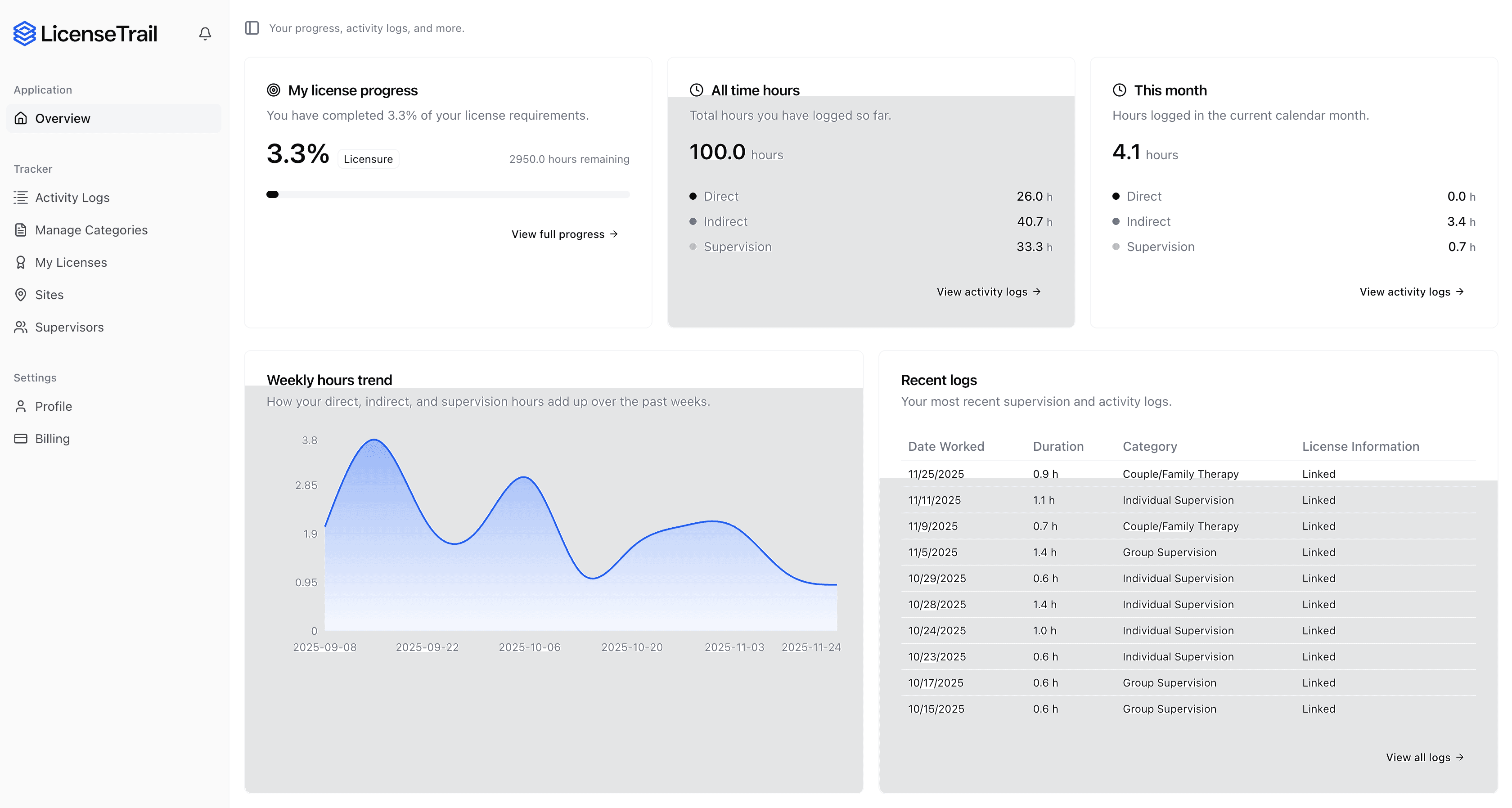
License Trail checks your direct, indirect, and supervision hours against Utah LCSW requirements continuously and flags mismatches before you submit.
 Start Tracking for Free
No credit card required · Free plan available
Related Licenses
Is your spreadsheet hiding Utah LCSW risks?
Stop guessing if your categories match Utah Social Worker Licensing Board requirements. License Trail checks your direct, indirect, and supervision hours continuously and flags mismatches before you submit.
Import or log
Bring your spreadsheet or start fresh
Upload your existing tracking spreadsheet and we'll map every hour into the right Utah Social Worker Licensing Board categories automatically.
Verify against Utah
Catch mismatches before the board does
License Trail checks your direct, indirect, and supervision hours against Utah LCSW requirements continuously.
Export board-ready
One-click clean reports
Generate professional, board-ready reports for supervision meetings and Utah Social Worker Licensing Board submissions in seconds.
No credit card required · Free plan available