
Utah SSW Requirements: Hours, Exams & Step-by-Step Guide
Stop guessing if your categories match Utah requirements. License Trail checks your direct, indirect, and supervision hours against SSW requirements continuously and flags mismatches before you submit.
No credit card required · Free plan available
Quick Requirements Overview
- Regulator/authority: Utah DOPL (Utah Code 58‑60; Rule R156‑60a)
- Scope: entry‑level social work services only under general supervision of a “mental health therapist” (no diagnosis/treatment of mental illness)
- Education (meet one pathway): CSWE/CASWE BSW; approved related master’s; 1st year of CSWE MSW; or any bachelor’s + required coursework + hours
- Coursework (only for “any bachelor’s” pathway): 3 semester hours each in social welfare policy, human growth & development, social work practice methods
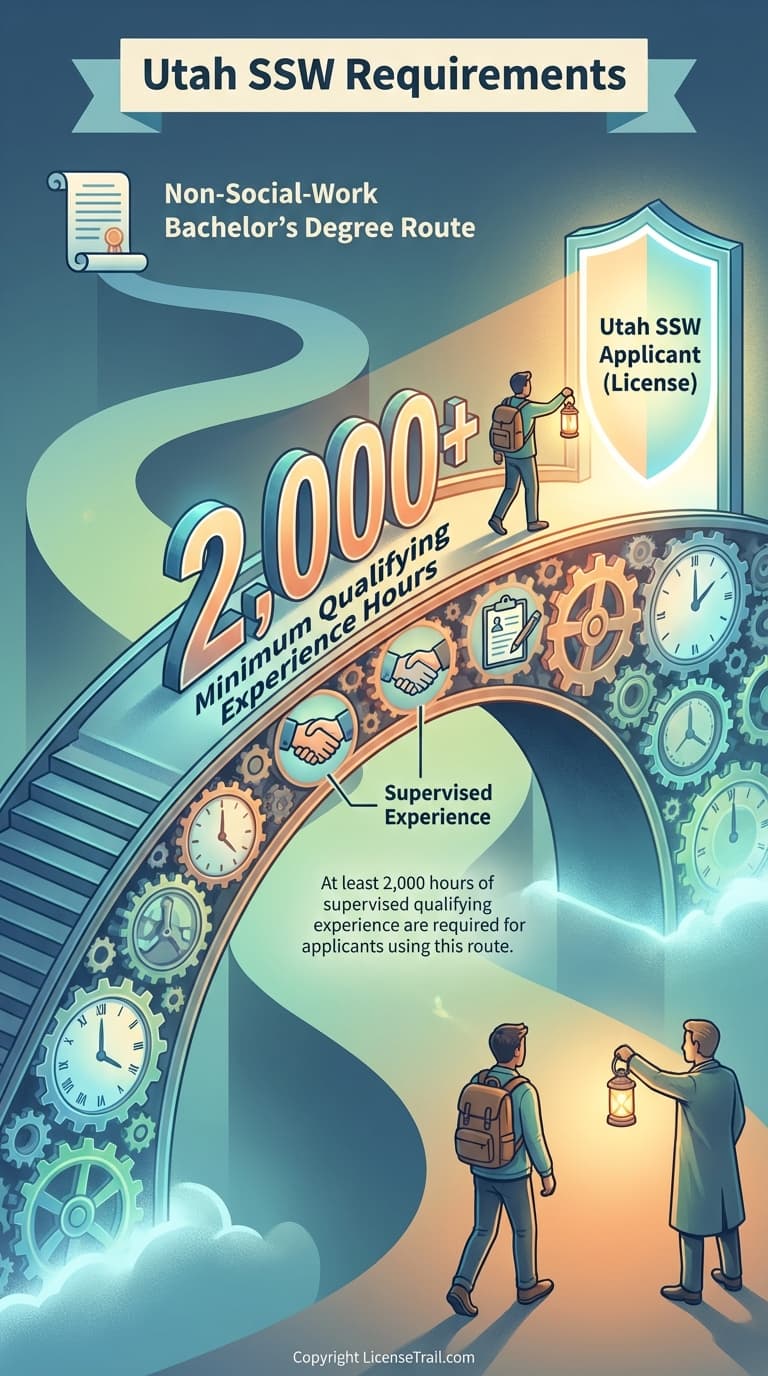
- Experience (only for “any bachelor’s” pathway): 2,000 hours supervised qualifying experience after degree requirements, minimum 1 year
- Hour conditions: must be W‑2 employee at an agency providing social work services, working under a written job description approved by supervisor
- Supervision/documentation: supervisor must be a qualifying mental health therapist and must complete/sign DOPL experience verification
- Exam: No ASWB exam required for Utah SSW
License Details
Procedures
Utah’s Social Service Worker (SSW) license is the entry‑level social work credential regulated by the Utah Division of Occupational and Professional Licensing (DOPL) under the Mental Health Professional Practice Act (Utah Code 58‑60) and the Social Worker Licensing Act Rule (R156‑60a). This overview focuses on the exact education and hour requirements as defined in statute and rule, and how to move through the licensing process.
1. What the SSW license allows you to do
Utah law defines “practice as a social service worker” as providing general, entry‑level social work services “under general supervision of a mental health therapist”, using social work theory and methods to enhance the social or psychosocial functioning of individuals, couples, families, groups, or communities. Tasks expressly include things like non‑clinical psychosocial assessments, home studies, ongoing case management, referrals, advocacy, and supportive counseling, but not diagnosing or treating mental illness. (codes.findlaw.com)
Supervision is by a “mental health therapist” as defined in Utah Code 58‑60‑102 (e.g., LCSW, CSW, LMFT/AMFT, CMHC/ACMHC, psychiatrist, certain APRNs, etc.). (law.justia.com)
2. Education pathways to the SSW license
All SSW applicants must submit an application, pay the required fee, and provide official transcripts from an accredited institution, but there are four alternative education pathways in law. (le.utah.gov)
Under Utah Code 58‑60‑205(3)(c), an applicant for licensure as a social service worker must hold one of the following:
-
Bachelor’s in Social Work (BSW)
- A bachelor’s degree in a social work program accredited by the Council on Social Work Education (CSWE) or the Canadian Association of Schools of Social Work. (le.utah.gov)
- No additional post‑degree hour requirement is attached to this path beyond what your accredited program already required.
-
Master’s in an approved related field
- A master’s degree in a field “approved by the division in collaboration with the board” (DOPL’s site specifies psychology, marriage and family therapy, or mental health counseling). (rules.utah.gov)
- Again, no separate 2,000‑hour requirement applies to this path in the statute or rule.
-
Bachelor’s in any field + specific coursework + 2,000 supervised hours
This is the path where hour requirements are critical and spelled out:-
A bachelor’s degree in any field, and successful completion of at least three semester hours (or equivalent) in each of:
- Social welfare policy
- Human growth and development (across the lifespan)
- Social work practice methods (as defined by rule) (le.utah.gov)
-
Plus: “at least 2,000 hours of qualifying experience under the supervision of a mental health therapist,” approved by DOPL in collaboration with the board, performed after you’ve met the bachelor’s degree requirements. (le.utah.gov)
DOPL’s public SSW page restates this as requiring a bachelor’s in another field, the three courses, “2,000 hours of qualifying experience,” and a supervisor‑completed experience form. (dopl.utah.gov)
-
-
First year of an accredited MSW program
- Successful completion of the first academic year of a CSWE‑accredited Master of Social Work curriculum and practicum also qualifies. (le.utah.gov)
Only the third pathway (bachelor’s in any field + coursework) has a specific, board‑defined hour requirement. The other three are degree‑only routes.
3. The 2,000‑hour experience requirement (non‑social‑work bachelor route)
3.1. Exact language and structure of the hours
For applicants using the “bachelor’s in any field” route, the statute requires the applicant to:
“provide documentation that the applicant has completed at least 2,000 hours of qualifying experience under the supervision of a mental health therapist, which experience is approved by the division in collaboration with the board.” (le.utah.gov)
The Social Worker Licensing Act Rule further clarifies what those 2,000 hours must look like. Under Utah Admin. Code R156‑60a‑302b (current through mid‑2025):
- The “2,000 hours of supervised qualifying experience” must be performed:
- “as a W‑2 employee of an agency providing social work services and activities;”
- “according to a written social work job description approved by the licensed mental health therapist supervisor;” and
- “in not less than one year.” (law.cornell.edu)
A few key take‑aways from that language:
- Employment status: You must be a W‑2 employee, not an independent contractor or volunteer, for hours to count.
- Setting: The employer must be an agency providing social work services and activities (e.g., social services agencies, community mental health providers, hospitals, child welfare agencies, etc.).
- Role definition: Your work must follow a written social work job description that your supervising mental health therapist reviews and approves.
- Timeframe: You must complete the 2,000 hours over at least one year; you cannot compress them into a shorter period.
3.2. “Direct” vs. “supervised” hours
Utah’s rules for the SSW do not split the 2,000 hours into sub‑categories like “direct client contact,” “indirect,” or distinct “supervision hours,” the way they do for higher‑level licenses.
For comparison, the LCSW rule requires 3,000 hours, including 1,000 hours of clinical mental health therapy and 75 hours under direct supervision. (law.cornell.edu) No such breakdown appears in the SSW rule.
For the SSW, what the board requires is simply:
- 2,000 total hours of “supervised qualifying experience” meeting the conditions in R156‑60a‑302b;
- Ongoing supervision by a mental health therapist as defined in statute;
- Documentation of those hours on a DOPL experience verification form signed by your supervisor. (le.utah.gov)
In practice, most or all of those hours will involve direct work with clients or client systems in the kinds of entry‑level tasks described in the SSW scope of practice (case management, assessments, home studies, coordination, advocacy, etc.), but the law does not prescribe a set minimum of “direct” versus other tasks.
4. Supervision details for the 2,000 hours
The statute requires that qualifying experience be “under the supervision of a mental health therapist”. (le.utah.gov)
A “mental health therapist” in Utah includes (among others):
- Clinical social workers (LCSW)
- Certified social workers (CSW)
- Clinical mental health counselors and associate CMHCs
- Marriage and family therapists and associate MFTs
- Psychiatrists, certain APRNs in psychiatric mental health, some psychologists and psychology residents, and certain PAs with mental health specialization. (law.justia.com)
Although the rule for SSW hours doesn’t lay out a specific number of supervision meetings or supervision hours (unlike the LCSW rules), your supervisor must:
- Be a qualifying mental health therapist;
- Approve your written job description as social‑work‑related; and
- Complete and sign DOPL’s experience/supervision verification form to confirm your 2,000 hours. (law.cornell.edu)
Because the rule ties qualifying hours to being a W‑2 employee “of an agency providing social work services and activities,” private side‑arrangements that don’t meet that structure normally won’t count.
5. Exam requirements (or lack thereof) for SSW
According to DOPL’s Social Work Exam Information page:
- Utah currently requires the ASWB exam only for the LCSW license.
- It explicitly states: “There are no exam requirements for Social Service Worker or Certified Social Worker.” (dopl.utah.gov)
So, as of late 2025:
- No ASWB exam is required to obtain an SSW license in Utah.
(Always verify this on the current DOPL site or by calling the board, as exam policies have changed in recent years.)
6. Step‑by‑step guide to getting Utah SSW licensure
Step 1: Choose your education pathway
Decide which of the four legal pathways you fit or will pursue:
- BSW from a CSWE‑accredited program; or (le.utah.gov)
- Master’s in psychology, marriage and family therapy, or mental health counseling (or another field DOPL approves); or
- Bachelor’s in any field + three specific courses (social welfare policy, human growth and development, social work practice methods) + 2,000 supervised hours; or
- Completion of the first year (coursework + practicum) of a CSWE‑accredited MSW program. (le.utah.gov)
If you have a non‑social‑work bachelor’s, you may take the three required courses at institutions like the University of Utah or Salt Lake Community College, which have offerings specifically aligned with DOPL’s SSW requirements. (dopl.utah.gov)
Step 2: If you’re on the non‑social‑work bachelor route, secure qualifying employment
For the pathway that requires 2,000 hours:
- Obtain a W‑2 job at an agency providing social work services and activities. (law.cornell.edu)
- Make sure your role and duties are accurately described in a written social work job description.
- Confirm that a qualifying mental health therapist will be your supervisor and is willing to:
- Approve your job description as meeting social‑work‑related duties; and
- Sign DOPL’s experience verification form when you’ve completed the hours. (law.cornell.edu)
Step 3: Accrue and document the 2,000 supervised hours (if required)
- Work at least one year in the qualifying position while keeping accurate records of:
- Dates of employment;
- Approximate total hours worked;
- Supervisor’s name, license type, and license number. (law.cornell.edu)
- Maintain regular supervision and professional standards consistent with the SSW scope of practice.
At the end of the period, your supervisor completes the official DOPL experience verification/approval form confirming your 2,000 hours of supervised qualifying experience.
Step 4: Prepare your application package
When you’ve met the education and (if applicable) experience requirements:
- Transcripts:
- Request official transcripts sent to you (sealed) or directly to DOPL showing your qualifying degree and any required coursework. (le.utah.gov)
- Experience Form (if applicable):
- Obtain the completed and signed Supervisor Experience Form verifying your 2,000 hours if you used the non‑social‑work bachelor route. (dopl.utah.gov)
- Application form and fee:
- Complete the SSW application online or via the paper form from DOPL’s “Apply for a Social Service Worker License” page. (dopl.utah.gov)
- Pay the license fee specified on the application (amounts can change, so rely on current DOPL information).
A background check may be required depending on DOPL’s current practice and any compact participation; the general criminal background framework is in Utah Code 58‑60‑103.1. (le.utah.gov)
Step 5: Wait for board review and license issuance
DOPL and the Behavioral Health Board review:
- Your application form;
- Education credentials;
- If applicable, the 2,000‑hour experience verification; and
- Any required background information.
Once approved, DOPL issues your Utah SSW license, allowing you to practice within the statutory scope under supervision of a mental health therapist.
7. After you’re licensed: renewal and continuing education (briefly)
- License term: Social work licenses, including SSW, expire September 30 of even‑numbered years. (dopl.utah.gov)
- Renewal fee: The SSW renewal fee is listed by DOPL (currently $88 on the renewal page; always check for updates). (dopl.utah.gov)
- Continuing education:
- SSWs must complete 20 hours of continuing education every two years,
- Of which at least 6 hours must be in ethics, law, or technology and 2 hours in suicide prevention. (dopl.utah.gov)
In summary
For the Utah Social Service Worker (SSW) license, the only explicitly quantified experience requirement in statute and rule is:
- 2,000 hours of supervised qualifying experience
- Under the supervision of a mental health therapist
- As a W‑2 employee of an agency providing social work services and activities
- According to a supervisor‑approved social work job description
- Completed over at least one year
—and this applies only if you are using the non‑social‑work bachelor’s degree + coursework pathway. All other approved education routes (BSW, certain master’s degrees, or first‑year MSW completion) do not carry a separate hour requirement beyond their built‑in practica.
Track your SSW hours with confidence
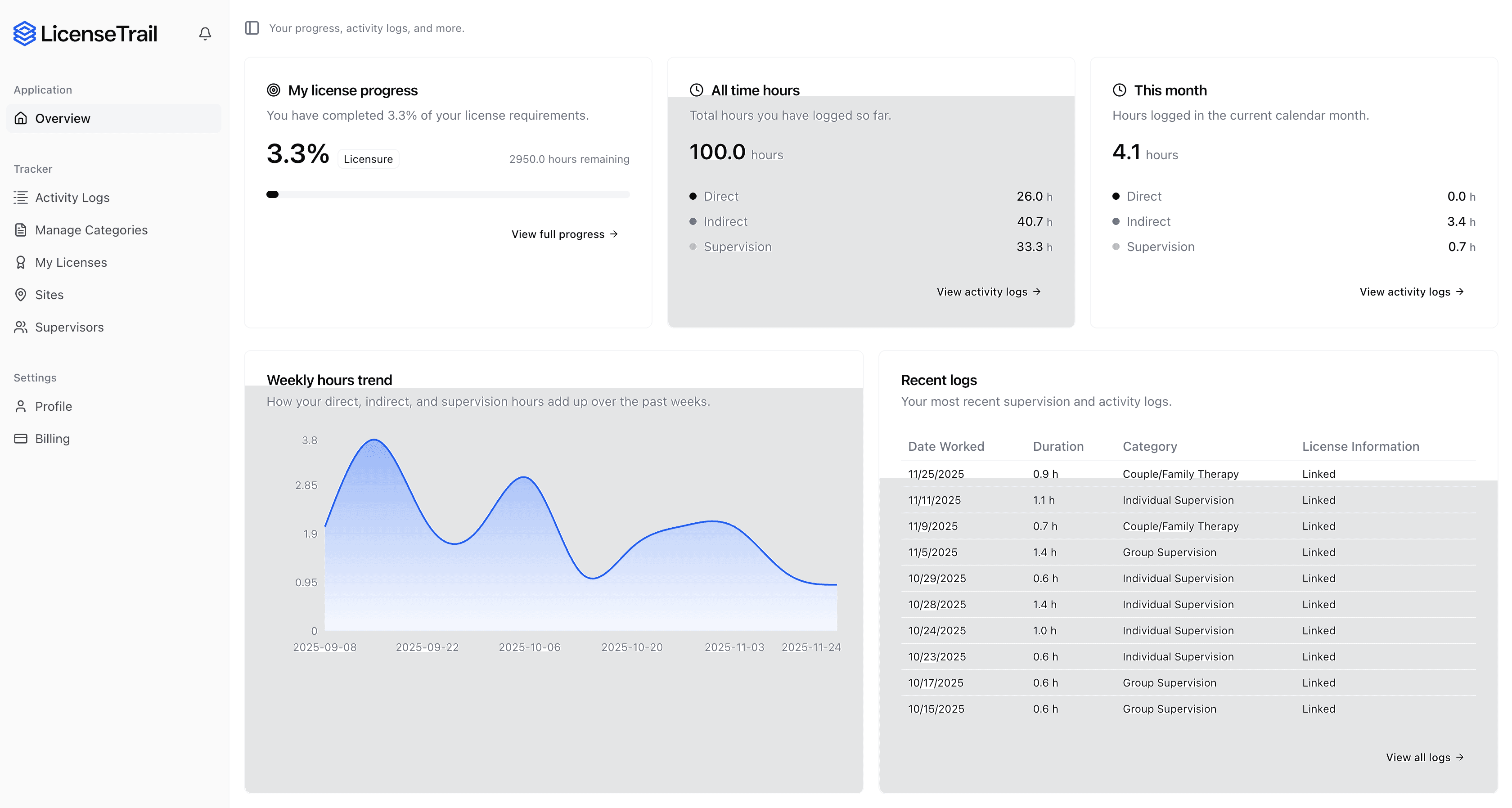
License Trail checks your direct, indirect, and supervision hours against Utah SSW requirements continuously and flags mismatches before you submit.
 Start Tracking for Free
No credit card required · Free plan available
Related Licenses
Is your spreadsheet hiding Utah SSW risks?
Stop guessing if your categories match Utah Social Worker Licensing Board requirements. License Trail checks your direct, indirect, and supervision hours continuously and flags mismatches before you submit.
Import or log
Bring your spreadsheet or start fresh
Upload your existing tracking spreadsheet and we'll map every hour into the right Utah Social Worker Licensing Board categories automatically.
Verify against Utah
Catch mismatches before the board does
License Trail checks your direct, indirect, and supervision hours against Utah SSW requirements continuously.
Export board-ready
One-click clean reports
Generate professional, board-ready reports for supervision meetings and Utah Social Worker Licensing Board submissions in seconds.
No credit card required · Free plan available