
Utah MFT Intern Requirements: Hours, Exams & Step-by-Step Guide
Stop guessing if your categories match Utah requirements. License Trail checks your direct, indirect, and supervision hours against MFT Intern requirements continuously and flags mismatches before you submit.
No credit card required · Free plan available
Quick Requirements Overview
- Regulator: Utah DOPL + Marriage and Family Therapist Licensing Board; “MFT Intern” is licensed as Associate Marriage & Family Therapist (AMFT) (or AMFT Extern).
- AMFT eligibility: clinical master’s/doctorate in MFT (or equivalent); COAMFTE or other CHEA-recognized accreditation with required MFT content areas.
- AMFT practicum minimum: 400 hours total = 100 direct supervision + 300 direct client contact, incl. 150 couple/family hours (two+ clients physically present).
- AMFT Extern (minor coursework deficiency only): up to 6 semester/8 quarter credits short; practicum 600 hours = 100 supervision + 500 direct contact, incl. 250 couple/family hours.
- AMFT application items: application + fee + official/certified transcripts + background check; no post-degree hours required to be issued AMFT.
- Full MFT path after AMFT: 3,000 supervised experience hours incl. 1,000 therapy hours (≥500 with two+ clients) + 75 hours under direct personal supervision.
- Statutory minimums within post-degree hours: 1,200 direct client care incl. 100 direct clinical supervision, 25 direct observation, and ≤25 group supervision hours.
- Supervised practice constraints: must be AMFT and typically W‑2 at approved sites; written supervision contract + supervisor verification before hours; supervisor max 6 supervisees; hours completed over ≥18 months.
License Details
Procedures
Utah regulates marriage and family therapists through the Division of Occupational and Professional Licensing (DOPL) and the Marriage and Family Therapist Licensing Board. The “intern” level in Utah is now formally licensed as an Associate Marriage and Family Therapist (AMFT), with a closely related Associate Marriage and Family Therapist Extern license. In practice, many agencies still call these roles “MFT interns,” but the Board’s official titles are AMFT and AMFT Extern. (law.justia.com)
Below is a step‑by‑step outline of what Utah requires, with emphasis on the exact hour types and the way the Board defines them.
1. License levels that function as “MFT intern” in Utah
Under current Utah law:
- Full, independent license: Marriage and Family Therapist (MFT/LMFT).
- Pre‑licensure/intern level: Associate Marriage and Family Therapist (AMFT).
- Pre‑licensure with minor educational deficiencies: Associate Marriage and Family Therapist Extern.
Utah Code §58‑60‑305(2) states that “all applicants for licensure as an associate marriage and family therapist” must meet only certain application and education requirements ((1)(a)–(c) and (h)), not the post‑degree experience hours; those hours are for the full MFT license. (law.justia.com)
So, when you ask about becoming a “MFT intern,” the closest current Board credential is AMFT (or AMFT Extern).
2. Educational and practicum hour requirements before you can be an AMFT
To qualify for an AMFT or AMFT Extern license, you must complete:
2.1 Degree
Utah Administrative Code R156‑60b‑302a requires a clinical master’s or doctorate in marriage and family therapy (or equivalent) from:
- A COAMFTE‑accredited MFT program, or
- A program accredited by a CHEA‑recognized accrediting body, with specified MFT coursework. (law.cornell.edu)
2.2 Required coursework (summary)
For non‑COAMFTE programs, the Board rule requires at least these content areas (semester/quarter‑hour minimums): (law.cornell.edu)
- Theoretical foundations of MFT
- Assessment and treatment in MFT (including DSM)
- Human development and family studies (including diversity, gender, sexuality)
- Professional ethics
- Research methodology and data analysis
- MFT elective(s)
2.3 Practicum / clinical training hours (this is the first place “hours” show up)
For a standard AMFT license, R156‑60b‑302a(2)(g) and the DOPL AMFT page require a minimum 400‑hour practicum, broken down as: (law.cornell.edu)
- Total practicum hours:
- At least 400 hours of clinical practicum under supervision, which must include:
- Supervision hours (during practicum):
- At least 100 hours of “direct supervision” (time spent with a supervisor reviewing and supervising your clinical work).
- Direct client contact/therapy hours (during practicum):
- At least 300 hours of face‑to‑face supervised clinical practice (direct contact),
- Of those, at least 150 hours must be with couples or families who are physically present in the therapy room.
In Board language, this is summarized as “a clinical practicum… which includes at least 400 hours as follows: (i) 100 hours of direct supervision; and (ii) 300 hours of mental health therapy under direct supervised clinical practice, with at least 150 hours in couple or family therapy with two or more clients participating.” (law.cornell.edu)
For an AMFT Extern license (if you are short a small number of academic credits), DOPL requires a larger practicum: (dopl.utah.gov)
- Total practicum hours:
- At least 600 hours of clinical practicum.
- Supervision hours (during practicum):
- At least 100 hours of face‑to‑face supervision.
- Direct client contact/therapy hours (during practicum):
- At least 500 direct contact hours of face‑to‑face supervised clinical practice.
- At least 250 of those hours must be with couples or families who are physically present in the therapy room.
You must also be deficient in no more than six semester or eight quarter credits of specific coursework to qualify as an Extern. (dopl.utah.gov)
3. Requirements to obtain the AMFT (intern‑level) license itself
Once the degree and practicum above are completed:
3.1 What the statute requires for associate MFT applicants
Utah Code §58‑60‑305(2) provides that associate MFT applicants must comply with: (law.justia.com)
- (1)(a) – Submit an application on a Division form.
- (1)(b) – Pay the required fee.
- (1)(c) – Produce certified transcripts showing completion of a qualifying MFT master’s/doctoral degree (as described above).
- (1)(h) – Consent to a criminal background check as required by Division rule.
Note: The big experience‑hour requirements (3,000 hours, 1,000 hours of therapy, etc.) are not required to get the AMFT. Those are for the later step to full MFT licensure.
3.2 What DOPL’s AMFT application page emphasizes
The Utah DOPL “Associate Marriage and Family Therapist” application instructions reinforce that you must: (dopl.utah.gov)
- Provide official or certified transcripts from a qualifying MFT program.
- Document completion of the required 400‑hour practicum (with 100 supervision hours and 300 direct contact hours, including 150 couple/family hours).
- Show that your coursework matches the Board’s required content areas (often via course descriptions/syllabi).
There is no separate requirement for post‑degree clinical hours to be issued the AMFT license. Once you hold the AMFT, you begin accruing your supervised post‑graduate experience toward full licensure.
4. What you must do as an AMFT (intern period) to reach full MFT licensure
After you are licensed as an AMFT (or AMFT Extern), Utah requires a substantial amount of post‑graduate supervised experience before you can become a fully licensed Marriage and Family Therapist.
There are two key layers to this:
- DOPL application instructions (how they measure your hours for licensure).
- Utah Administrative Code R156‑60b‑302b and Utah Code §58‑60‑305, which define the hour categories.
4.1 Total supervised experience hours after graduation
DOPL’s standard MFT application instructions state that an applicant must submit Verification of Post‑Graduate Supervised Experience, with hours from all supervisors totaling 3,000 hours. (dopl.utah.gov)
Rule R156‑60b‑302b ties those 3,000 hours directly to §58‑60‑305 and further defines them. (regulations.justia.com)
Post‑graduate supervised marriage and family therapy experience must total:
- 3,000 hours of supervised marriage and family therapy experience (minimum to obtain the MFT license).
4.2 Breakdown of those 3,000 hours (Board rule language)
R156‑60b‑302b(1) specifies that the 3,000 hours must include at least: (regulations.justia.com)
-
1,000 hours providing marriage and family therapy
- These are direct client service hours where you are providing “marriage and family therapy” as the practice is defined in statute (assessment, diagnosis, and treatment of individuals, couples, and families, etc.).
- At least 500 of those 1,000 hours must involve “two or more clients participating” – in other words, couple, family, or other relational sessions.
-
75 hours of therapy delivered under “direct personal supervision”
- The rule requires “75 hours of marriage and family therapy performed continually and uniformly under direct personal supervision” (as defined in R156‑60b‑102(7)). (regulations.justia.com)
- “Direct personal supervision” means the supervisor is directly observing your work or immediately available, not merely reviewing notes later.
-
The remaining hours (up to 2,000 of the 3,000 total)
- The balance of your hours can be a mix of:
- Additional individual, couple, family, or group therapy
- Crisis intervention
- Mediating relationships
- Work aimed at “breaking dysfunction cycles”
- R156‑60b‑302b(2) explicitly states that supervised experience “shall include individual, couple, family, and group therapy; crisis intervention; mediating relationships; and breaking dysfunction cycles.” (regulations.justia.com)
- The balance of your hours can be a mix of:
Put differently in the style of your example:
- Total supervised experience: 3,000 hours
- Within that total:
- At least 1,000 hours = direct provision of marriage and family therapy,
- Of which at least 500 hours = relational sessions with two or more clients in the room.
- At least 75 hours = therapy performed under direct personal supervision (supervisor closely observing).
- Up to 2,000 hours may consist of additional therapy plus related clinical experience (crisis work, mediating relationships, etc.), as long as it fits within the Board’s definitions.
- At least 1,000 hours = direct provision of marriage and family therapy,
4.3 Additional statutory requirements about direct client care and supervision
The 2024 revision of Utah Code §58‑60‑305, effective May 1, 2024, adds further minimums focused on direct client care and supervision hours (especially to align with federal Medicare standards). It requires that a licensure applicant: (law.justia.com)
- Document at least 1,200 direct client care hours, obtained after the qualifying degree.
- Within those 1,200 direct client care hours:
- At least 100 must be “direct clinical supervision hours” under a clinical supervisor.
- At least 25 must be “direct observation hours” (supervisor directly observing your client care).
- No more than 25 may be group supervision hours conducted concurrently with more than one supervisee.
These 1,200 direct client care hours and supervision/observation hours are part of your 3,000 total supervised experience hours, not in addition to them. The statute sets minimums for the nature of those hours; the administrative rule (3,000 total, 1,000 therapy, 500 relational, 75 under direct personal supervision) tells you how DOPL expects the hours to be structured and documented.
4.4 Where and how supervision must occur (Board rule)
R156‑60b‑305b and R156‑60b‑302b(3) specify the circumstances under which supervised hours can be accrued: (law.cornell.edu)
- You must be:
- Licensed as an Associate Marriage and Family Therapist (or a qualifying doctoral student), and
- A W‑2 employee (not a 1099 contractor) providing clinical mental health services at one of these sites:
- Mental health agency
- In‑patient or out‑patient hospital
- Educational institution
- Non‑profit organization
- Government agency
- You and your supervisor must:
- Enter a written supervision contract before hours start.
- Have the supervisor submit a Supervisor Verification form to DOPL and receive acknowledgment.
- Ensure the supervisor meets the Board’s Supervisor Eligibility Requirements (R156‑60b‑305a).
- Ensure the supervisor does not supervise more than six individuals accruing LMFT hours at once. (law.cornell.edu)
Supervised experience must also be completed in not less than 18 months, so you cannot compress 3,000 hours into a shorter period for licensure purposes. (regulations.justia.com)
5. Final step: full Marriage and Family Therapist license
Once you have:
- Completed the qualifying degree and practicum (400 or 600 hours, depending on AMFT vs Extern),
- Held an AMFT (or Extern) license and accrued 3,000 hours of supervised experience as described above, and
- Met the statutory direct‑care and supervision minimums (1,200 direct client care hours, including specified supervision/observation), (law.justia.com)
- Completed at least two hours of Board‑approved suicide‑prevention training after your degree, (law.justia.com)
- Passed the National MFT Exam (AMFTRB), (commerce.dev.utah.gov)
you may apply for the full Marriage and Family Therapist license using DOPL’s standard MFT application.
In summary (focused on “intern” / AMFT stage and hours)
To be licensed as an “MFT intern” in Utah (AMFT), the hour‑related requirements are:
-
During your graduate program (for AMFT):
- 400 total practicum hours, including:
- 100 hours of direct supervision
- 300 hours of direct client contact, of which 150 hours with couples/families physically present
- 400 total practicum hours, including:
-
During your graduate program (for AMFT Extern):
- 600 total practicum hours, including:
- 100 hours of supervision
- 500 hours of direct client contact, of which 250 hours with couples/families physically present
- 600 total practicum hours, including:
There are no additional post‑graduate hours required to obtain the AMFT license itself. Once you are an AMFT, you then begin accruing:
- 3,000 hours of post‑graduate supervised MFT experience, including:
- 1,000 hours providing marriage and family therapy (direct client work)
- 500 of those 1,000 hours must involve two or more clients in session
- 75 hours of therapy under direct personal supervision, and
- At least 1,200 direct client care hours overall, including at least 100 direct clinical supervision hours, at least 25 direct observation hours, and no more than 25 group supervision hours.
- 1,000 hours providing marriage and family therapy (direct client work)
These are the hour categories and wording as defined in current Utah statute, administrative rule, and DOPL’s official licensing instructions. (law.justia.com)
Track your MFT Intern hours with confidence
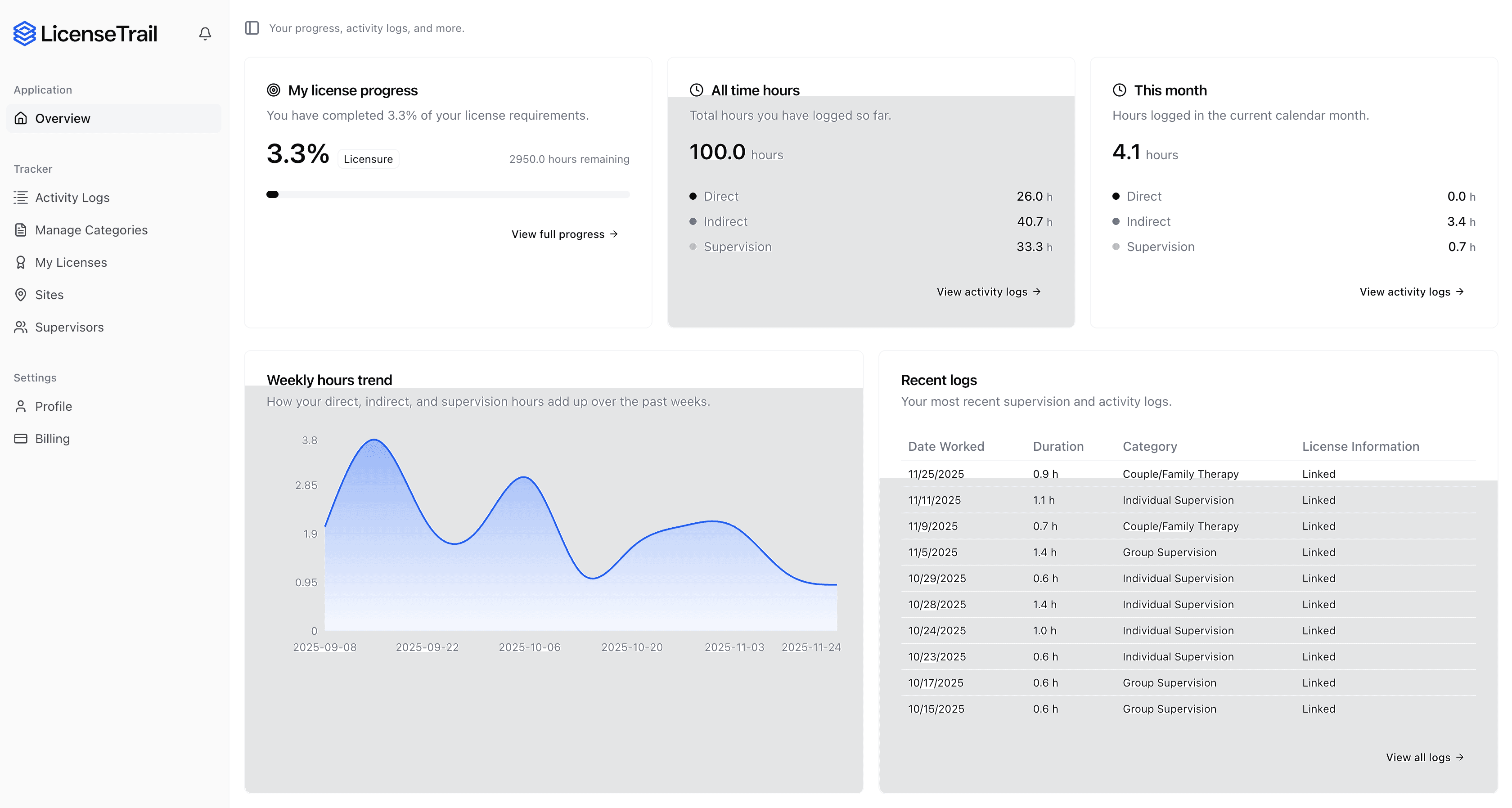
License Trail checks your direct, indirect, and supervision hours against Utah MFT Intern requirements continuously and flags mismatches before you submit.
 Start Tracking for Free
No credit card required · Free plan available
Related Licenses
Is your spreadsheet hiding Utah MFT Intern risks?
Stop guessing if your categories match Utah Marriage and Family Therapist Licensing Board requirements. License Trail checks your direct, indirect, and supervision hours continuously and flags mismatches before you submit.
Import or log
Bring your spreadsheet or start fresh
Upload your existing tracking spreadsheet and we'll map every hour into the right Utah Marriage and Family Therapist Licensing Board categories automatically.
Verify against Utah
Catch mismatches before the board does
License Trail checks your direct, indirect, and supervision hours against Utah MFT Intern requirements continuously.
Export board-ready
One-click clean reports
Generate professional, board-ready reports for supervision meetings and Utah Marriage and Family Therapist Licensing Board submissions in seconds.
No credit card required · Free plan available