
Vermont LCMHC Requirements: Hours, Exams & Step-by-Step Guide
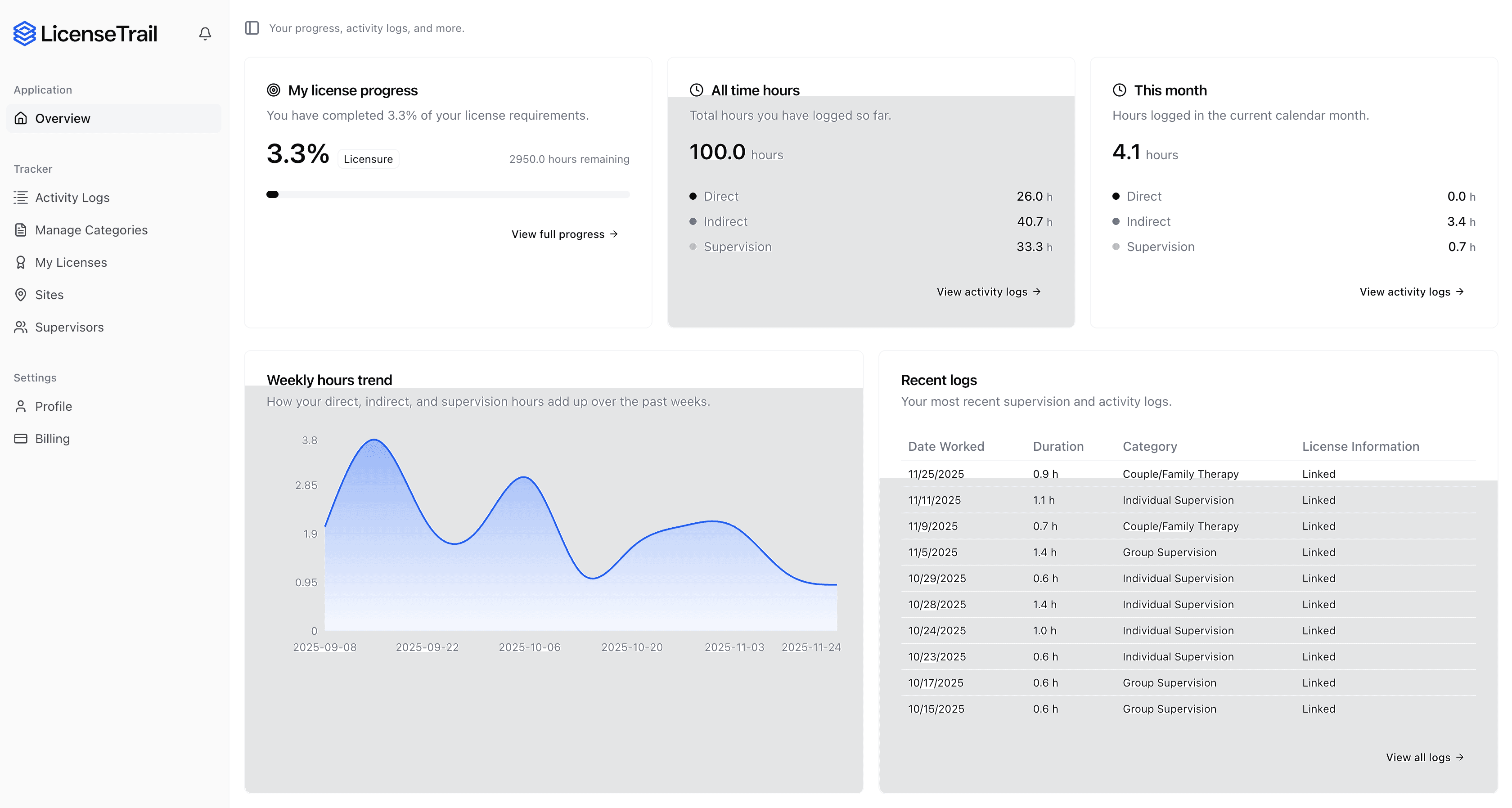
Stop guessing if your categories match Vermont requirements. License Trail checks your direct, indirect, and supervision hours against LCMHC requirements continuously and flags mismatches before you submit.
No credit card required · Free plan available
Quick Requirements Overview
- Governing authority: VT Board of Allied Mental Health Practitioners (Title 26, Ch. 65; CVR 04-030-350 Part 3)
- Education: Master’s or higher in counseling/related field; CACREP CMHC or Board-acceptable equivalent; ≥60 graduate credits (must include diagnosis/assessment/treatment coursework)
- Internship (degree-based): 700 hours supervised internship total; ≥600 hours must be within the degree (cannot be made up post-degree if <600); ≤100 hours may be practicum/field experience
- Exams: Pass NCE + NCMHCE (or Board-approved successors); scores must be within 5 years of licensure decision
- Jurisprudence: Must pass Statutes & Rules exam once adopted/implemented by the Board
- Post-degree supervised practice: 3,000 hours over ≥2 years; hours must be within 5 years of licensure decision
- Hour distribution: Of 3,000 hours, 2,000 direct service + 1,000 indirect/related services
- Supervision/eligibility gate: ≥100 face-to-face supervision hours (≥50 individual; group ≤6); max 30 practice hours per 1 supervision hour; must be on VT Roster of nonlicensed/noncertified psychotherapists before accruing VT hours
License Details

Procedures
Vermont licenses clinical mental health counselors through the Board of Allied Mental Health Practitioners, under Title 26, Chapter 65 of the Vermont Statutes and the Board’s Administrative Rules (Code of Vermont Rules 04-030-350). Together, these set out detailed requirements for becoming a Licensed Clinical Mental Health Counselor (LCMHC), including very specific hour requirements for education, internship, and post‑degree supervised practice. (legislature.vermont.gov)
Below is a structured guide that tracks the Board’s own terminology and numbers.
1. Governing laws and rules
Two main sources control LCMHC licensure in Vermont:
- Statute: 26 V.S.A. Chapter 65 – Clinical Mental Health Counselors (definitions, Board authority, basic eligibility). (legislature.vermont.gov)
- Administrative Rules: “Administrative Rules for Clinical Mental Health Counselors, Marriage and Family Therapists, and Psychotherapists,” Part 3 (Clinical Mental Health Counselors). These rules “have the force of law” and spell out education, internship, supervised practice, exams, and supervision in detail. (law.cornell.edu)
The Board itself states that applicants must meet (a) educational, (b) examination, and (c) supervised practice requirements to be licensed by examination. (law.cornell.edu)
2. Educational requirements (graduate degree + 60 credits)
2.1 Degree level and field
To be eligible for licensure, you must have:
- A master’s degree or higher in counseling or a related field from an accredited institution, as required by statute and defined by the Board’s rules. (legislature.vermont.gov)
- An “acceptable degree” as defined in Part 3 of the rules. The Board accepts either:
- A degree in clinical mental health counseling from a CACREP‑accredited program, or
- A non‑CACREP counseling/related field degree that meets the Board’s specific content criteria. (law.cornell.edu)
2.2 Total graduate credits
The rules require you to:
- “Complete no less than 60 credits of graduate level course work” in mental health counseling, including designated coursework in core content areas. (law.cornell.edu)
A key example the Board highlights is a 3‑credit course in “Diagnosis, Assessment and Treatment” (psychopathology and DSM-based diagnosis and treatment planning). If the degree does not contain these credits, it is not considered an acceptable counseling or related degree for licensure. (law.cornell.edu)
3. Internship and practicum hours (pre‑licensure, during the degree)
Vermont distinguishes between:
- Student internship/practicum hours (completed within your graduate program), and
- Post‑degree supervised practice hours (completed after the degree, as an applicant).
3.1 Required internship hours
For licensure as a clinical mental health counselor, Board rules require:
- Total internship:
- Each applicant must complete 700 hours of supervised internship. (law.cornell.edu)
- Within the degree:
- At least 600 of those hours must occur within the “acceptable” degree program itself. A program with fewer than 600 supervised internship hours “cannot be used as the basis for licensure”; that deficiency cannot be fixed post‑degree. (law.cornell.edu)
- Practicum/field experience portion:
- The 700‑hour internship may include no more than 100 hours of practicum/field experience; at least 600 must be true internship. (law.cornell.edu)
If your degree included an internship of 600–699 hours, you must “make up the difference” either by adding those extra hours to your post‑degree supervised practice or by completing additional internship hours through a graduate‑level internship seminar. (law.cornell.edu)
3.2 Nature of the internship
The rules define a supervised internship as:
- Occurring in a “clinical mental health counseling” practice setting (a setting that fits the statutory definition of clinical mental health counseling) (law.cornell.edu)
- Providing the opportunity to perform “the activities that a regularly employed clinical mental health counselor would be expected to perform.” (law.cornell.edu)
4. Licensing examinations
Vermont requires both national competency exams plus, when implemented, a jurisprudence exam.
4.1 National counseling examinations
Board rules state that applicants must:
- Successfully complete both of the following:
- National Counselor Examination (NCE)
- National Clinical Mental Health Counseling Examination (NCMHCE)
or any Board‑approved successor exams in clinical mental health counseling theory and practice. (regulations.justia.com)
4.2 Recency of exam scores
Effective January 1, 2016, only exam results obtained within five (5) years of the final licensure decision may be accepted. (regulations.justia.com)
4.3 Statutes and Rules (jurisprudence) exam
In addition to the national exams:
- The Board requires applicants to pass a “Statutes and Rules Examination” (jurisprudence exam) once it is adopted, before a license will be issued. (law.cornell.edu)
5. Post‑degree supervised practice (3,000 hours total)
This is the core experiential requirement after your degree.
5.1 Definition and total hours
The rules define “supervised practice” as:
- Post‑master’s practice of clinical mental health counseling that is supervised by a clinical supervisor. (law.cornell.edu)
Quantitatively, you must:
- Complete 3,000 hours of supervised practice
- Over a period of no less than 2 years after the master’s degree. (law.cornell.edu)
5.2 Recency of supervised practice
To ensure current competence, the Board requires that:
- Only supervised practice acquired within 5 years of the final decision on licensure will be accepted. (law.cornell.edu)
5.3 Requirement to be on the roster before practicing
There is a critical gatekeeping rule:
- No supervised practice may occur within the State of Vermont until the prospective licensee has been entered on the roster of nonlicensed and noncertified psychotherapists. (law.cornell.edu)
Practically, this means that before you begin counting any post‑degree supervised hours in Vermont, you must:
- Apply for and obtain entry on the Roster of Psychotherapists Who Are Nonlicensed and Noncertified, and
- Then practice under supervision as a rostered psychotherapist while accumulating your 3,000 hours.
6. Breakdown of the 3,000 supervised practice hours
The Board is very specific about how the 3,000 hours must be distributed and what counts as which type of hour.
6.1 Direct service vs. other hours
The rules define:
- “Direct service” as time spent with a client directly, or consulting with another professional about that client (for example, the client’s physician or psychiatrist). It can include phone or emergency time; overall, it is time where you are actively engaged with the client or with the client’s other service providers. (law.cornell.edu)
- “Indirect services” as activities like case notes, staff meetings, supervision, workshops and conferences, general consultation, teaching, case management, and other mental‑health‑counselor‑related work other than direct client contact. (law.cornell.edu)
Under Section 3.17 – Distribution of Practice Hours:
- Of the 3,000 practice hours:
- 2,000 hours must be direct service
- The remaining 1,000 hours may be in continued clinical practice or related/indirect services that support clinical services. (law.cornell.edu)
- All supervised practice must take place in a “clinical mental health” practice setting or settings, consistent with the statutory definition. (law.cornell.edu)
In practical terms:
- 2,000 hours = therapy, assessment, crisis work, and client‑related consultation (“direct service”).
- 1,000 hours = documentation, case conferences, case management, trainings, supervision time, and similar activities (“indirect services” / related services).
Because “indirect services” explicitly include supervision, your face‑to‑face supervision hours are typically counted within this 1,000-hour portion, as part of the overall 3,000. (law.cornell.edu)
7. Supervision requirements within the 3,000 hours
The Board’s rules are equally precise about the supervision component of those 3,000 hours.
7.1 Minimum face‑to‑face supervision hours and frequency
Under Section 3.18 – Supervised Practice, Face‑to‑Face Supervision, supervised practice must be accompanied by:
- At least 100 hours of face‑to‑face supervision over the course of the 3,000 practice hours. (law.cornell.edu)
- A maximum ratio rule:
- You may not accumulate more than 30 hours of practice without at least one hour of face‑to‑face supervision. In other words, supervision must occur at least at a 1:30 (supervision:practice) ratio and at regular intervals. (law.cornell.edu)
At least 50 of the 100 supervision hours must be individual supervision (one supervisor with one supervisee), with the remainder allowed in group format (up to 6 trainees with a supervisor). (regulations.justia.com)
Face‑to‑face supervision must:
- Take place in a formal setting such as an office, clinic, or institution.
- Focus on “raw data” from your clinical work—direct observation, co‑therapy, detailed notes, audio or video recordings—rather than being personal therapy; it is explicitly for professional or vocational development. (regulations.justia.com)
7.2 Supervisor qualifications
Your clinical supervisor must:
- Hold an unencumbered license for at least three years before supervision begins. (law.cornell.edu)
- Be licensed (in the jurisdiction where the supervision occurs) as one of the following:
- Physician or osteopathic physician board‑certified in psychiatry
- Psychiatric nurse practitioner
- Psychologist
- Clinical mental health counselor
- Clinical social worker
- Marriage and family therapist (law.cornell.edu)
If the supervisor is licensed in another jurisdiction, that licensing authority must send direct verification of the supervisor’s license to the Vermont Board before supervision reports will be reviewed. (law.cornell.edu)
7.3 Documentation of supervised practice
The Board requires formal supervision reports, on Office‑supplied forms, to document:
- Total hours of direct and indirect services
- Number of individual and group supervision hours
- Practice settings and client populations served
- Supervisor’s license details and assessment of the applicant’s competence (law.cornell.edu)
These reports must support that:
- You completed 3,000 hours of supervised practice, including:
- 2,000 direct‑service hours, and
- 1,000 hours of continued clinical practice or related/indirect services; and
- You received 100 hours of face‑to‑face supervision, at least 50 of which were individual.
8. Pathways to licensure: examination vs. endorsement
The Board recognizes two main paths to licensure as a Clinical Mental Health Counselor:
-
Licensure by examination
- Meet Vermont’s education, internship, exam (NCE + NCMHCE + jurisprudence), and supervised practice requirements described above. (law.cornell.edu)
-
Licensure by endorsement
- If you’re already licensed in another U.S. or Canadian jurisdiction, the Board may grant a Vermont license if:
- The other jurisdiction’s standards are substantially equivalent (or substantially equivalent except for requiring only one national exam, in which case you may take the second exam), or
- You have at least five years of “active practice” (defined as more than 20 hours/week for 48 weeks per year), no disciplinary history, and current licensure elsewhere. (law.cornell.edu)
- If you’re already licensed in another U.S. or Canadian jurisdiction, the Board may grant a Vermont license if:
9. Putting the hour requirements together
For someone pursuing LCMHC licensure in Vermont by examination, the Board’s hour‑based requirements can be summarized as:
-
Graduate program (pre‑degree)
- 60+ graduate credits in counseling/related field. (law.cornell.edu)
- 700 hours of supervised internship, of which:
- 600+ hours must be within the degree program;
- Up to 100 hours may be practicum/field experience. (law.cornell.edu)
-
Post‑degree supervised practice (after master’s)
- 3,000 hours of supervised practice over at least 2 years, completed within the 5 years before licensure decision. (law.cornell.edu)
- Within those 3,000 hours:
- 2,000 hours must be “direct service” (direct client contact and client‑focused consultation). (law.cornell.edu)
- 1,000 hours may be continued clinical practice or related/indirect services, including documentation, case management, supervision, consultations, and training that support clinical work. (law.cornell.edu)
- Supervision embedded within those hours must include:
- 100 hours of face‑to‑face supervision, at least 50 individual, with the rest permitted in small‑group format (≤ 6 trainees).
- A frequency such that no more than 30 hours of practice are accrued without at least 1 hour of face‑to‑face supervision. (law.cornell.edu)
- All Vermont supervised practice must be done after you are placed on the Roster of Psychotherapists Who Are Nonlicensed and Noncertified. (law.cornell.edu)
These are the core quantitative requirements the Vermont Board of Allied Mental Health Practitioners uses when evaluating applications for LCMHC licensure. Because rules can change, it is always wise to confirm details against the current Administrative Rules (04‑030‑350, Part 3) and the Vermont Statutes Online just before you apply.
Track your LCMHC hours with confidence
License Trail checks your direct, indirect, and supervision hours against Vermont LCMHC requirements continuously and flags mismatches before you submit.
 Start Tracking for Free
No credit card required · Free plan available
Related Licenses
Is your spreadsheet hiding Vermont LCMHC risks?
Stop guessing if your categories match Vermont Board of Allied Mental Health Practitioners requirements. License Trail checks your direct, indirect, and supervision hours continuously and flags mismatches before you submit.
Import or log
Bring your spreadsheet or start fresh
Upload your existing tracking spreadsheet and we'll map every hour into the right Vermont Board of Allied Mental Health Practitioners categories automatically.
Verify against Vermont
Catch mismatches before the board does
License Trail checks your direct, indirect, and supervision hours against Vermont LCMHC requirements continuously.
Export board-ready
One-click clean reports
Generate professional, board-ready reports for supervision meetings and Vermont Board of Allied Mental Health Practitioners submissions in seconds.
No credit card required · Free plan available