
Vermont LMFT Requirements: Hours, Exams & Step-by-Step Guide
Stop guessing if your categories match Vermont requirements. License Trail checks your direct, indirect, and supervision hours against LMFT requirements continuously and flags mismatches before you submit.
No credit card required · Free plan available
Quick Requirements Overview
- Authority: VT Office of Professional Regulation (OPR), Board of Allied Mental Health Practitioners; governed by 26 V.S.A. ch. 76 and Code Vt. R. 04 030 350
- Education: Qualifying graduate degree (COAMFTE-accredited or Board-approved MFT-focused) with ≥48 grad credits (degree must include ≥36); required coursework includes DSM/diagnosis (3 cr, must be in-degree) plus specified MFT core/content areas
- In-degree internship: ≥500 hours supervised internship in an MFT-focused setting (cannot be remediated post-degree if short)
- Direct-service threshold: Must document 500 hours direct service; any internship direct-service shortfall is added to post-degree hour requirement
- Roster prerequisite: Must be on VT Roster of Psychotherapists who are Nonlicensed and Noncertified before counting VT post-degree supervised practice hours
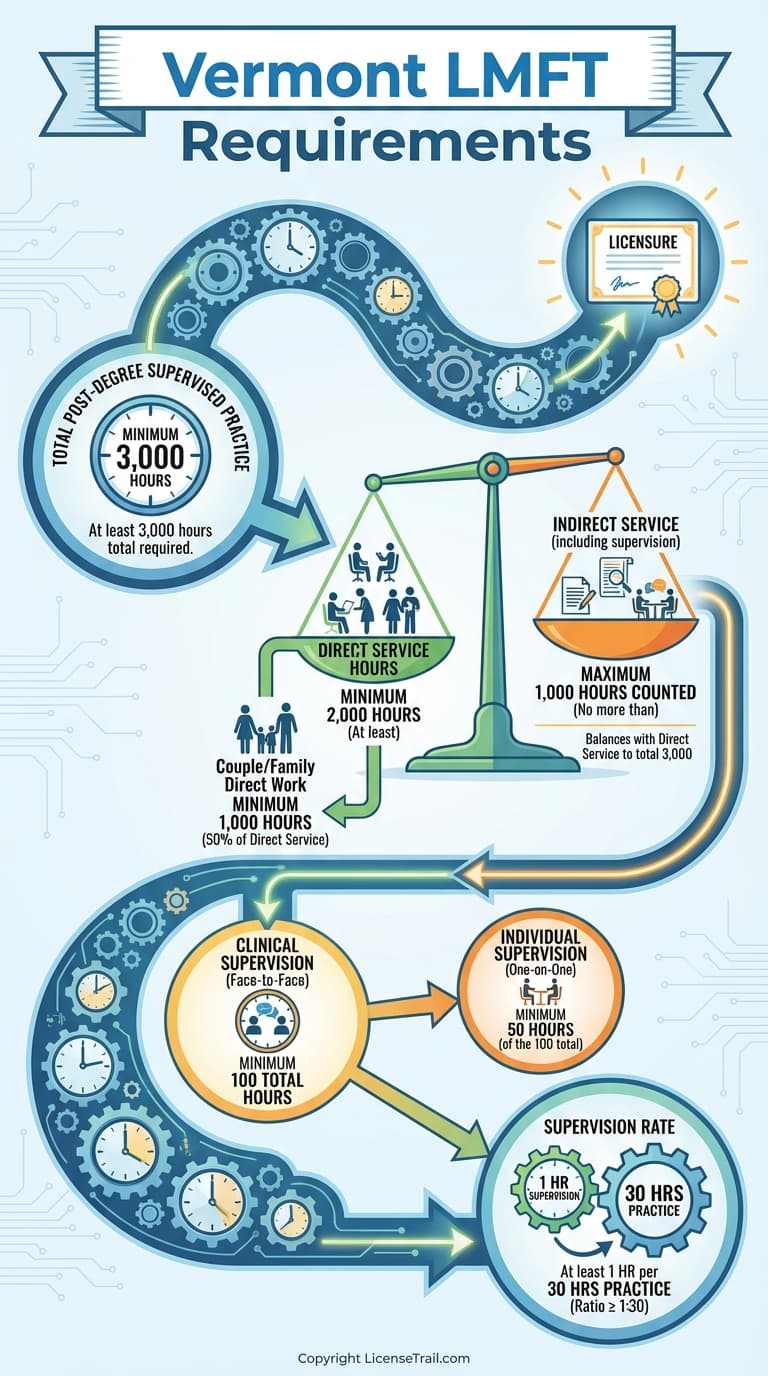
- Post-degree supervised practice: 3,000 hours over ≥2 calendar years (generally must be within 5 years of licensure decision): 2,000 direct service (≥1,000 with couples/families) + 1,000 indirect/clinical support
- Supervision: ≥100 hours face-to-face supervision during post-degree practice; ≥50 individual; no more than 30 practice hours per 1 hour supervision; supervisors need ≥3 years unencumbered licensure (LMFT/LICSW/LCMHC/psychologist/psychiatrist) and no conflicts
- Exams: Pass AMFTRB national MFT exam (education approval first; scores typically ≤5 years old); pass VT statutes/rules (jurisprudence) exam if/when adopted
License Details
Procedures
Becoming licensed as a Marriage and Family Therapist (LMFT) in Vermont is governed by the Board of Allied Mental Health Practitioners within the Office of Professional Regulation (OPR). The requirements are set in statute (26 V.S.A. chapter 76) and in the Board’s Administrative Rules (Code of Rules 04 030 350), which together define the exact types and amounts of hours you must complete. (legislature.vermont.gov)
Below is a step‑by‑step outline of those requirements, with the state’s own terminology highlighted (e.g., “direct service,” “post degree supervised practice,” “face‑to‑face supervision,” “Roster of Psychotherapists who are Nonlicensed and Noncertified”).
1. Regulatory framework
-
Licensing authority:
- Board of Allied Mental Health Practitioners, created at 26 V.S.A. § 3262a. (legislature.vermont.gov)
- Rules are issued by the Office of Professional Regulation and have “the force of law.” (regulations.justia.com)
-
Governing law for LMFTs:
- 26 V.S.A. §§ 4031–4042 (Marriage and Family Therapists). (legislature.vermont.gov)
- Administrative Rules, Part 4: “Marriage and Family Therapists” (Code Vt. R. 04 030 350). (regulations.justia.com)
2. Educational foundation
2.1 Graduate degree requirement (statutory baseline)
To be eligible for LMFT licensure, an applicant must: (legislature.vermont.gov)
- Complete a graduate degree that:
- Is either:
- A graduate degree program in marriage and family therapy accredited both by a regional educational accreditor and by the Commission on Accreditation for Marriage and Family Therapy Education (COAMFTE), or
- A graduate degree “focusing on marriage and family therapy,” at a regionally or nationally accredited institution approved by the Board.
- Is either:
- Meet specific graduate credit and course requirements “as set forth by the Board by rule.”
The statute gives the framework; the Board’s rules spell out the details.
2.2 Board rules on credits and coursework
Under the current Administrative Rules for LMFTs: (regulations.justia.com)
-
Minimum total graduate credits for licensure:
- At least 48 graduate credits in marriage and family therapy and related areas.
- The degree itself must contain at least 36 graduate credits; some applicants will need more than 48 credits total to cover all required content areas.
-
Non‑COAMFTE programs:
- Must have 36 graduate credits, with at least 18 credits clearly identified as from a marriage, couple, or family therapy / systems / relational perspective.
-
Required curriculum areas (abbreviated summary):
- Diagnosis and treatment/DSM (3 credits, must be within the degree and cannot be “fixed” later). (regulations.justia.com)
- Core marriage and family therapy theory, skills, and treatment modalities.
- Human growth and development, diversity/social and cultural foundations, research, and professional ethics (each with specified graduate credits).
- Additional coursework (at least 6 credits) in two or more specified areas such as human sexuality, psychopharmacology, domestic violence, sexual abuse, gender and sexuality, groups, crisis intervention, addictions/chemical dependency, or appraisal/assessment.
The key takeaway: Vermont looks not only at the degree title but at the exact content and number of graduate credits in defined domains.
3. Required supervised internship (within the degree)
Vermont distinguishes between:
- Supervised internship hours within the degree, and
- Post degree supervised practice hours toward licensure.
Under Part 4 of the rules for LMFTs: (regulations.justia.com)
-
Supervised internship requirement
- Your degree program must include a supervised internship in a marriage and family therapy–focused setting, where you perform the kinds of activities a regularly employed marriage and family therapist would perform.
- The internship must total at least 500 hours within the degree for that degree to be accepted toward licensure.
-
Direct service requirement tied to internship
- For licensure, each applicant must document 500 hours of direct service (defined by the Board as providing therapy services to individuals, couples, families, or groups from a systems/relational perspective).
- If you did fewer than 500 direct‑service hours during your internship, you must add the difference to your required post‑degree supervised practice hours.
- Example: If you had 350 direct‑service hours in your internship, you are 150 hours short of the 500 direct‑service threshold; those 150 hours are added on top of the standard post‑degree requirement described below.
-
Non‑remediable deficiency
- A degree based on fewer than 500 total supervised internship hours is not acceptable for licensure and, under the rules, this deficiency “cannot be remedied post‑degree.”
So, before you even begin counting post‑degree hours, you need a qualifying degree with a 500‑hour supervised internship and a path to meeting the 500‑hour direct‑service requirement.
4. Post‑degree supervised practice (core hour requirements)
After the degree and internship, Vermont requires a substantial “Post Degree Supervised Practice Requirement” before issuing the LMFT license.
4.1 Overall supervised practice requirement
Under Section 4.16 of the rules: (regulations.justia.com)
- Total supervised practice:
- 3,000 hours of post degree supervised practice.
- Nature of the practice:
- These 3,000 hours must be individual, couple, family, or group therapy from a systems perspective.
- Timeframe:
- Must be completed over a minimum of two calendar years (which also appears in the statute’s “two‑calendar‑year work experience” requirement). (legislature.vermont.gov)
- For recency, the rules specify that only supervised practice hours acquired within five years of the final licensing decision will normally be accepted.
4.2 Distribution of practice hours (direct vs. indirect)
The Board defines the exact breakdown of the 3,000 hours in Section 4.18: (regulations.justia.com)
-
2,000 hours must be “direct service”, meaning:
- Face‑to‑face therapy services to clients (individuals, couples, families, or groups) from a systemic/marital and family perspective.
- At least 50% of those 2,000 hours (i.e., at least 1,000 hours) must be with couples and/or families.
-
1,000 hours must be “continued clinical practice or indirect services related to or supporting clinical services”, which can include:
- Case consultation, treatment planning, documentation, coordination with other providers, and other professional activities that support the direct clinical work (the rules leave the precise categorization to Board evaluation via supervision reports).
In other words, Vermont does not use a “1,500 direct + 1,500 supervised” model. Instead, it requires:
- 3,000 total post degree supervised practice hours, of which:
- 2,000 are direct‑service hours (≥1,000 with couples/families), and
- 1,000 are indirect/supporting clinical hours.
If your graduate internship did not provide the full 500 direct‑service hours, the shortfall is added on top of these 3,000 hours, increasing the total hours you must accumulate. (regulations.justia.com)
4.3 Entry on the roster before supervised practice
The rules also specify that no supervised practice may occur in Vermont until the candidate has been entered on the: (regulations.justia.com)
“Roster of Psychotherapists who are Nonlicensed and Noncertified.”
Practically, this means:
- Before you start counting any Vermont post‑degree supervised hours:
- You must apply to OPR and be entered on that roster (this is a separate credential from the LMFT license itself).
5. Supervision requirements and supervision hours
Vermont distinguishes clinical practice hours from supervision hours. Supervision hours do not replace practice hours; they are an additional layer of oversight.
5.1 Minimum “face‑to‑face supervision” hours
Section 4.19 of the LMFT rules sets out the supervision requirement: (regulations.justia.com)
- At least 100 hours of face‑to‑face supervision are required during the 3,000 hours of post‑degree supervised practice.
- Frequency requirement / cap:
- You may not accrue more than 30 hours of practice without at least one hour of face‑to‑face supervision.
- Nature and format of supervision:
- Supervision must occur in a formal professional setting (office, clinic, institution).
- It may be:
- Individual supervision (supervisor and applicant only), or
- Group supervision (supervisor plus up to six trainees).
- Individual vs. group supervision mix:
- Of the 100 total supervision hours, at least 50 must be individual.
- Supervision is defined as focused on the supervisee’s actual clinical work (e.g., direct observation, co‑therapy, audio/video review, clinical notes), and explicitly distinguished from personal psychotherapy.
These are in addition to the 3,000 practice hours; they do not reduce the clinical hour requirement.
5.2 Supervisor qualifications
Sections 4.20–4.23 specify who may supervise and under what conditions: (regulations.justia.com)
-
Licensure and experience of supervisors:
- A supervisor must have at least three years of unencumbered licensure before supervision begins.
- The supervisor must hold an unencumbered license in one of the following professions in the jurisdiction where supervision occurs:
- Marriage and family therapist
- Clinical social worker
- Clinical mental health counselor
- Psychologist
- Licensed physician certified in psychiatry by the American Board of Medical Specialties
-
Conflict‑of‑interest exclusions:
- A “clinical supervisor” does not include:
- A spouse, life partner, former spouse, or family member.
- An employer, financial partner, or shareholder in the same counseling enterprise, or anyone who personally profits from the applicant’s practice.
- Routine administrative oversight, classes/workshops, and one‑off consultations do not count as clinical supervision.
- A “clinical supervisor” does not include:
-
Documentation (supervision reports):
- Supervisors must submit supervision reports detailing:
- Dates covered,
- Number of direct and indirect service hours,
- One‑to‑one and group supervision hours,
- Types of duties and client populations, and
- An evaluation of the applicant’s competence and readiness for independent practice. (regulations.justia.com)
- Supervisors must submit supervision reports detailing:
OPR’s application site echoes these requirements and emphasizes that supervisors must be licensed in good standing for at least three years; the site provides specific “Marriage & Family Therapist Report of Supervision” and “Verification of Supervisor License” forms. (sos.vermont.gov)
6. Examinations
6.1 National MFT examination
Vermont requires passing a written examination in marriage and family therapy approved by the Board. (regulations.justia.com)
The OPR’s Allied Mental Health page indicates that Vermont uses the national MFT exam administered by the Association of Marital & Family Therapy Regulatory Boards (AMFTRB) and directs applicants to AMFTRB for exam information. (sos.vermont.gov)
Key points:
- You must first have your education approved by the Board before you can register for the exam.
- For applicants not previously licensed, exam results generally must be no more than five years old at the time of the licensing decision. (regulations.justia.com)
6.2 Vermont statutes and rules (jurisprudence) examination
The rules provide that all applicants must pass a “statutes and rules” / jurisprudence examination specific to Vermont once such an exam is adopted. (regulations.justia.com)
This is intended to ensure familiarity with:
- Vermont statutes regarding LMFTs and allied professions,
- The Board’s own rules,
- Professional and ethical obligations in this jurisdiction.
7. Licensure by endorsement (without full Vermont supervised practice)
Vermont allows licensure by endorsement in certain cases, under both statute and rule. (legislature.vermont.gov)
- A currently licensed MFT from another U.S. state or Canadian jurisdiction:
- May be licensed without repeating all examinations if that jurisdiction’s standards are, in the Board’s judgment, “substantially equivalent” to Vermont’s, or
- In some cases, may qualify based on length of active practice (e.g., at least five years of active practice under a comparable license).
Endorsement cases are evaluated individually, so applicants must provide detailed documentation of prior education, supervision, licensure, and disciplinary history.
8. Ongoing obligations after licensure (briefly)
While your question focuses on initial licensure and hour requirements, it is worth noting that once licensed:
- Licenses renew every two years, with: (legislature.vermont.gov)
- A statutory requirement for at least 20 hours of Board‑approved continuing education in each two‑year period for LMFTs, including specific training in areas such as systemic oppression / anti‑oppressive practice and related topics (as recently amended by the legislature).
- The Board’s rules further flesh out acceptable types of continuing education and ethics requirements.
These requirements may be updated periodically, but they sit on top of the initial 3,000‑hour supervised practice and exam requirements described above.
9. Summary of Vermont LMFT hour requirements (Board terminology)
Putting the key hour requirements together:
-
Within the graduate degree
- ≥ 500 hours of supervised internship in a marriage and family therapy–focused setting (cannot be “fixed” later if fewer than 500). (regulations.justia.com)
- You must ultimately document 500 hours of “direct service”; if your internship provided fewer than 500 direct‑service hours, the shortfall is added to your post‑degree supervised practice requirement.
-
Post degree supervised practice (before licensure)
- 3,000 hours of “post degree supervised practice” over at least two calendar years and within five years of the licensing decision. (regulations.justia.com)
- Distribution of these 3,000 hours:
- 2,000 hours of “direct service,” with:
- At least 1,000 hours of those direct hours with couples and/or families.
- 1,000 hours of “continued clinical practice or indirect services related to or supporting clinical services.”
- 2,000 hours of “direct service,” with:
-
Supervision during post‑degree practice
- At least 100 hours of “face‑to‑face supervision,” with:
- A cap of no more than 30 practice hours between supervision sessions, and
- At least 50 of those supervision hours in an individual (one‑to‑one) format. (regulations.justia.com)
- Supervisor must:
- Have ≥ 3 years of unencumbered licensure,
- Be licensed as an LMFT, clinical social worker, clinical mental health counselor, psychologist, or psychiatrist, and
- Avoid specified conflicts of interest.
- At least 100 hours of “face‑to‑face supervision,” with:
-
Roster requirement
- Before any Vermont post‑degree supervised hours can be counted, the applicant must be entered on the “Roster of Psychotherapists who are Nonlicensed and Noncertified.” (regulations.justia.com)
Taken together, this is the Board’s structure for ensuring that a Vermont LMFT has a qualifying degree, a substantial and clearly defined mix of direct and indirect clinical experience, intensive supervision, and familiarity with both national MFT standards and Vermont‑specific law and ethics.
Track your LMFT hours with confidence
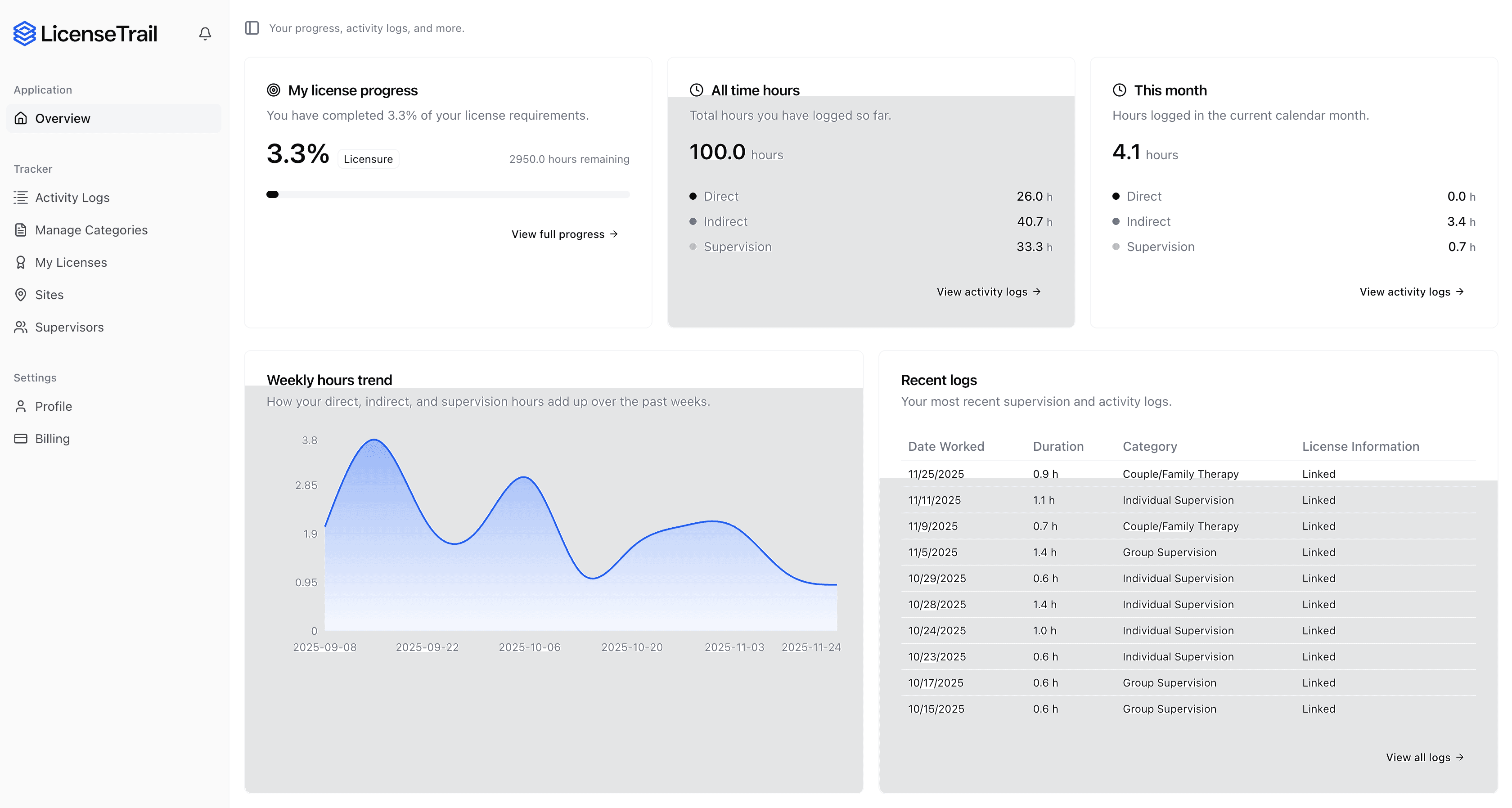
License Trail checks your direct, indirect, and supervision hours against Vermont LMFT requirements continuously and flags mismatches before you submit.
 Start Tracking for Free
No credit card required · Free plan available
Related Licenses
Is your spreadsheet hiding Vermont LMFT risks?
Stop guessing if your categories match Vermont Board of Allied Mental Health Practitioners requirements. License Trail checks your direct, indirect, and supervision hours continuously and flags mismatches before you submit.
Import or log
Bring your spreadsheet or start fresh
Upload your existing tracking spreadsheet and we'll map every hour into the right Vermont Board of Allied Mental Health Practitioners categories automatically.
Verify against Vermont
Catch mismatches before the board does
License Trail checks your direct, indirect, and supervision hours against Vermont LMFT requirements continuously.
Export board-ready
One-click clean reports
Generate professional, board-ready reports for supervision meetings and Vermont Board of Allied Mental Health Practitioners submissions in seconds.
No credit card required · Free plan available