
Vermont LMSW Requirements: Hours, Exams & Step-by-Step Guide
Stop guessing if your categories match Vermont requirements. License Trail checks your direct, indirect, and supervision hours against LMSW requirements continuously and flags mismatches before you submit.
No credit card required · Free plan available
Quick Requirements Overview
- Regulator: VT Secretary of State — Office of Professional Regulation (OPR) under Title 26, Ch. 61
- Education: MSW (or doctoral social work degree) from an accredited program (typically CSWE)
- Exams: Pass ASWB Master’s exam + VT Social Work Jurisprudence exam
- Timing: Required exams must be passed within 5 years prior to applying
- Experience hours: No post-degree supervised/practice-hour requirement for VT LMSW (0 hours)
- Practicum: Field/practicum hours are those required by the accredited degree program, not separately required by OPR for LMSW
- Application: Submit OPR application, fee, and official transcript sent to OPR
License Details
Procedures
Licensure as a Licensed Master Social Worker (LMSW) in Vermont is defined primarily in state statute and implemented by the Vermont Secretary of State’s Office of Professional Regulation (OPR). Vermont’s law is unusual in that it does not impose any post‑degree practice‑hour requirement for the LMSW license itself; hours come into play later if you pursue clinical licensure (LICSW).
Below is a structured walkthrough of what the law and OPR actually require, with specific attention to hours and the state’s own terminology.
1. Who Regulates Social Work in Vermont
- Social work is regulated under Title 26, Chapter 61 – Social Workers of the Vermont Statutes.(legislature.vermont.gov)
- The Office of Professional Regulation (OPR), within the Secretary of State’s office, issues Vermont social work licenses (LMSW and LICSW).(publichealthonline.org)
Although people often say “Vermont Board of Social Work Examiners,” licensing is handled by OPR under this chapter, with advisor appointees instead of a traditional stand‑alone board.
2. What “Master’s Social Work” Means in Vermont Law
The statute defines “master’s social work” as professional social work at an advanced level using social work theory, knowledge, methods, ethics, and the professional use of self, to restore or enhance social, psychosocial, or biopsychosocial functioning for individuals, families, groups, organizations, and communities.(legislature.vermont.gov)
Key elements of master’s social work practice in Vermont’s definition include:(legislature.vermont.gov)
- Applying specialized knowledge and advanced practice skills
- Activities such as assessment, treatment planning, implementation, evaluation, case management, information and referral
- Supportive counseling, supervision, consultation, education, research, advocacy, community organization
- Developing, implementing, and administering policies, programs, and activities
- Under supervision, master’s social work may include practices reserved for clinical social workers, such as psychotherapy and clinical assessment.
This statutory definition underlies what the LMSW credential authorizes you to do in Vermont.
3. Legal Eligibility Requirements for the Vermont LMSW
The core eligibility rule is contained in 26 V.S.A. § 3205 (Licensed master’s social worker eligibility). It requires two things: a qualifying degree and passing designated examinations within a time window.(legislature.vermont.gov)
3.1 Education Requirement
You must have:
- A master’s degree in social work (MSW) or
- A doctoral degree in social work
from an accredited social work education program.(legislature.vermont.gov)
In practice, OPR expects the program to be accredited (or in candidacy) with the Council on Social Work Education (CSWE) or equivalent recognized accreditor.(socialworklicensure.org)
There is no separate Vermont‑mandated minimum number of practicum hours beyond what your accredited MSW program itself requires.
3.2 Examination Requirements
For the LMSW, Vermont requires that you:(legislature.vermont.gov)
- Pass the ASWB Master’s‑level exam (Association of Social Work Boards).
- Pass the Vermont Social Work Jurisprudence Exam, which covers Vermont statutes and rules governing social work practice.
By statute, you must have “passed the examinations designated by the Director” within five years prior to applying for licensure (paraphrased from § 3205).(legislature.vermont.gov)
3.3 Time Window
- The exam requirement must be completed within 5 years before your LMSW application is submitted.(legislature.vermont.gov)
3.4 Application / Administrative Requirements
From OPR’s standard process as summarized in multiple sources:(publichealthonline.org)
- Create an online account with OPR.
- Submit an LMSW application and pay the licensure fee (commonly reported as $100, but always verify current fees with OPR).
- Have your official graduate transcript sent directly to OPR.
- After OPR clears you to test, register for and pass the ASWB Master’s exam.
- Complete the jurisprudence exam and any other OPR forms.
Once all conditions are satisfied (degree, exams, fees, and a complete application), OPR issues your Licensed Master Social Worker license.
4. Hours Requirements for the LMSW in Vermont
This is the crux of your question: does Vermont specify required hours for LMSW licensure, and if so, how are they categorized (e.g., “direct experience” vs “supervised experience”)?
4.1 Post‑Degree Practice Hours for LMSW
Vermont law does not require any post‑MSW practice hours to obtain the LMSW license.
- 26 V.S.A. § 3205 lists only two eligibility criteria: the degree and passing designated examinations within the five‑year timeframe; it does not mention any practice‑hour or supervised‑hour requirement for LMSW.(legislature.vermont.gov)
- Multiple independent licensure guides confirm that “the LMSW license does not require work experience hours” or “no supervised experience required” for the LMSW itself.(socialworklicensure.org)
So there is no Vermont‑board requirement such as “1,500 hours direct + 1,500 hours supervised” for the LMSW. The state simply doesn’t structure LMSW that way.
4.2 Practicum / Field Hours During the MSW
Your accredited MSW program will include field education or practicum hours (often in the 900‑hour range across generalist and specialized placements), but:
- These hours are imposed by the CSWE‑accredited program, not by Vermont statute or OPR as a separate licensing condition.(socialworklicensure.org)
- Vermont accepts your MSW from a properly accredited program as evidence that you’ve met professional preparation standards.
From the Board/OPR perspective for LMSW admission, the state does not re‑count or re‑label these hours into categories like “direct” vs. “supervised.”
5. How Hours Come Into Play for Clinical Licensure (LICSW)
The confusion about hours often comes from Vermont’s Licensed Independent Clinical Social Worker (LICSW) requirements, not the LMSW itself.
5.1 Statutory Requirement for LICSW
Under 26 V.S.A. § 3205a, an LICSW applicant must:(legislature.vermont.gov)
- Hold a master’s or doctoral degree in social work
- Have passed examinations designated by the Director
- Have “completed 3,000 hours of supervised practice of independent clinical social work as defined by rule” under supervision of appropriately licensed professionals (LICSW, psychologist, psychiatrist, certain clinical mental health counselors, etc., per rule).
The statute itself calls this “supervised practice of independent clinical social work” and sets the 3,000‑hour total but leaves detailed breakdowns to rules.
5.2 Board/OPR Rule–Level Breakdown of LICSW Hours
Secondary sources summarizing OPR’s rules describe the LICSW requirement more specifically as:(publichealthonline.org)
- Total supervised post‑MSW practice:
- 3,000 hours of post‑degree clinical social work over at least two years.
- Direct client / psychotherapy hours within that total:
- At least 2,000 hours providing face‑to‑face psychotherapy or direct clinical services to clients.
- Supervision hours:
- Commonly summarized as at least 100 hours of direct supervision, usually by a Vermont‑licensed independent clinical social worker (LICSW) or other qualified supervisor recognized by rule.
- Timing and setting:
- These hours are accrued after earning the MSW, typically while you hold an LMSW and are also listed on Vermont’s Roster of Non‑Licensed, Non‑Certified Psychotherapists so that you can legally provide psychotherapy while supervised.(publichealthonline.org)
This 3,000‑hour / 2,000‑direct‑hour / 100‑supervision‑hour structure is only for LICSW. It does not apply to your initial LMSW licensure.
6. Social Work Licensure Compact Language (Hours in a Different Context)
Vermont has adopted statutory language related to the Social Work Licensure Compact, which includes a generic “practice requirement” for a master’s‑category multistate license that can be satisfied by, for example, 3,000 hours of postgraduate supervised clinical practice or two years of full‑time supervised practice (or an equivalent combination).(legislature.vermont.gov)
This compact language:
- Exists alongside Vermont’s state licensure structure
- Is not an additional hours requirement for a Vermont LMSW license
- Speaks to portability/compact eligibility rather than your initial single‑state LMSW.
7. Step‑by‑Step Summary: Becoming an LMSW in Vermont
Putting the legal and practical pieces together, the process is:
-
Complete an Accredited MSW (or DSW):
- From a CSWE‑accredited (or equivalent) social work program.
- Includes all practicum/field hours required by your program, but those are not re‑specified by OPR as licensing hours.
-
Create an OPR Account & Apply for LMSW:
- Submit the LMSW application through OPR’s online portal.
- Pay the application/licensure fee.(publichealthonline.org)
-
Have Your School Send Transcripts:
- Official graduate transcripts must go directly to OPR to document your qualifying degree.(publichealthonline.org)
-
Take and Pass the ASWB Master’s Exam:
- OPR typically must first approve you and notify ASWB that you are eligible to test.(socialworklicensure.org)
-
Complete the Vermont Jurisprudence Exam:
- Online exam on Vermont social work laws and rules, required for licensure.(socialworklicensure.org)
-
Receive Your LMSW License:
- Once degree, exams, and paperwork are verified and fees paid, OPR issues your LMSW credential.
No additional state‑mandated practice hours—whether labeled “direct practice,” “indirect practice,” or “supervised experience”—are required for this LMSW step.
8. After Licensure: Renewal and Continuing Education (Briefly)
While you didn’t ask specifically about continuing education, it’s relevant to understand that hours re‑enter the picture for renewals, though as CE hours rather than practice hours:
- LMSW and LICSW licenses renew every two years.(publichealthonline.org)
- Vermont requires a set number of continuing education hours per renewal cycle, including at least 1.5 hours in professional ethics; more recent guidance adds at least 1 hour related to cultural competency/anti‑oppressive practice starting with the 2026 cycle.(msweducation.org)
Specific CE hour totals for each license level have been reported differently across secondary sources, and may have been updated. For precise current CE requirements (e.g., whether LMSWs must complete 10 vs. 20 hours), it is important to confirm directly with OPR’s current rules, since those are subject to change.
Bottom line on hours for a Vermont LMSW
- State‑mandated post‑degree practice hours for LMSW: 0
- Required hours for LICSW (after LMSW), by statute and rule:
- 3,000 hours of post‑MSW supervised clinical practice,
- including 2,000 hours of face‑to‑face psychotherapy/direct clinical work,
- plus at least 100 hours of direct supervision, over a minimum of two years.(legislature.vermont.gov)
Vermont’s Board/OPR therefore does not break LMSW requirements into categories like “X direct hours + Y supervised hours.” Those hour‑based categories belong exclusively to the clinical licensure (LICSW) and, separately, to compact or portability rules.
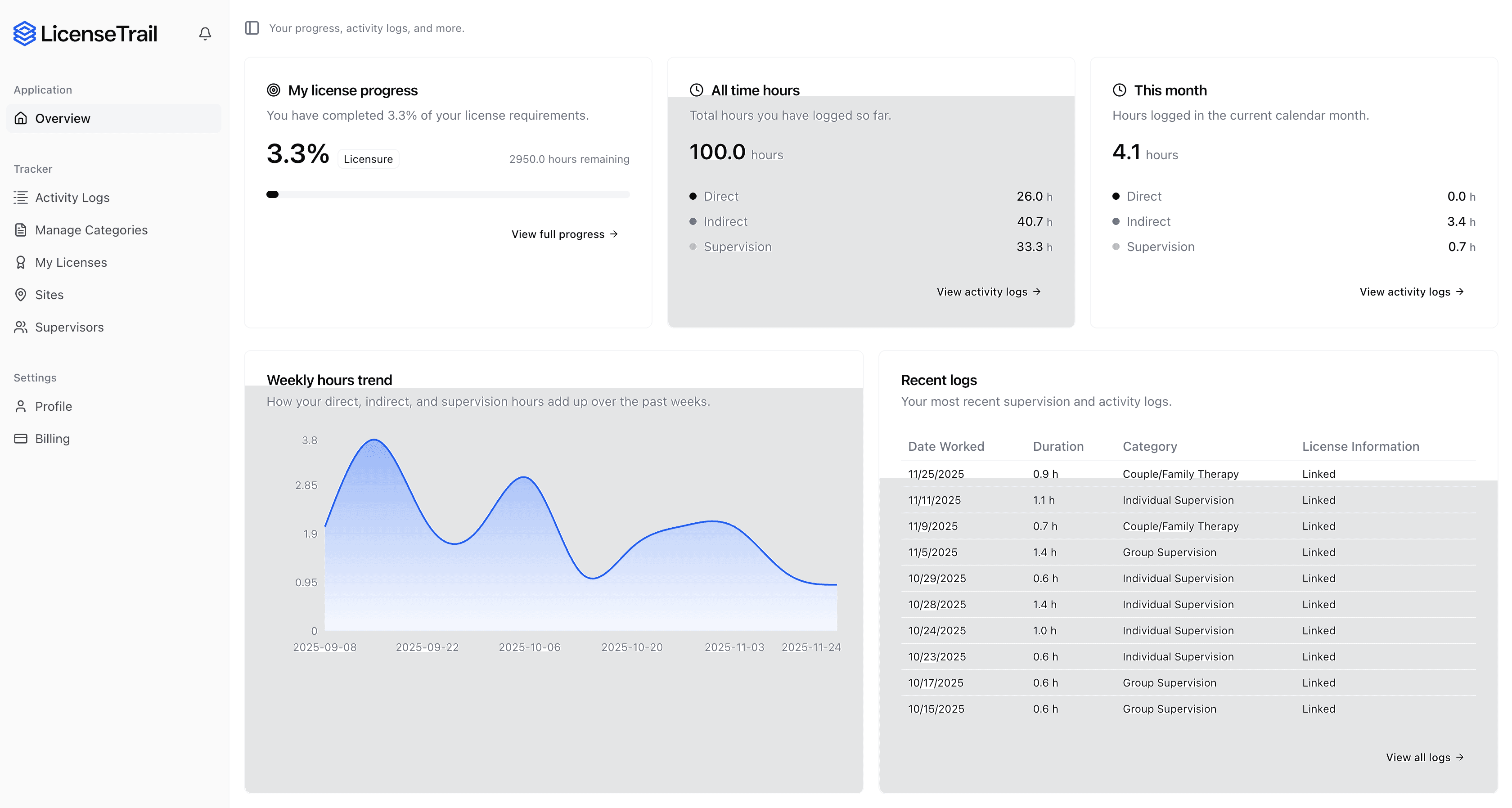
Track your LMSW hours with confidence
License Trail checks your direct, indirect, and supervision hours against Vermont LMSW requirements continuously and flags mismatches before you submit.
 Start Tracking for Free
No credit card required · Free plan available
Related Licenses
Is your spreadsheet hiding Vermont LMSW risks?
Stop guessing if your categories match Vermont Board of Social Work Examiners requirements. License Trail checks your direct, indirect, and supervision hours continuously and flags mismatches before you submit.
Import or log
Bring your spreadsheet or start fresh
Upload your existing tracking spreadsheet and we'll map every hour into the right Vermont Board of Social Work Examiners categories automatically.
Verify against Vermont
Catch mismatches before the board does
License Trail checks your direct, indirect, and supervision hours against Vermont LMSW requirements continuously.
Export board-ready
One-click clean reports
Generate professional, board-ready reports for supervision meetings and Vermont Board of Social Work Examiners submissions in seconds.
No credit card required · Free plan available