
Virginia LBSW Requirements: Hours, Exams & Step-by-Step Guide
Stop guessing if your categories match Virginia requirements. License Trail checks your direct, indirect, and supervision hours against LBSW requirements continuously and flags mismatches before you submit.
No credit card required · Free plan available
Quick Requirements Overview
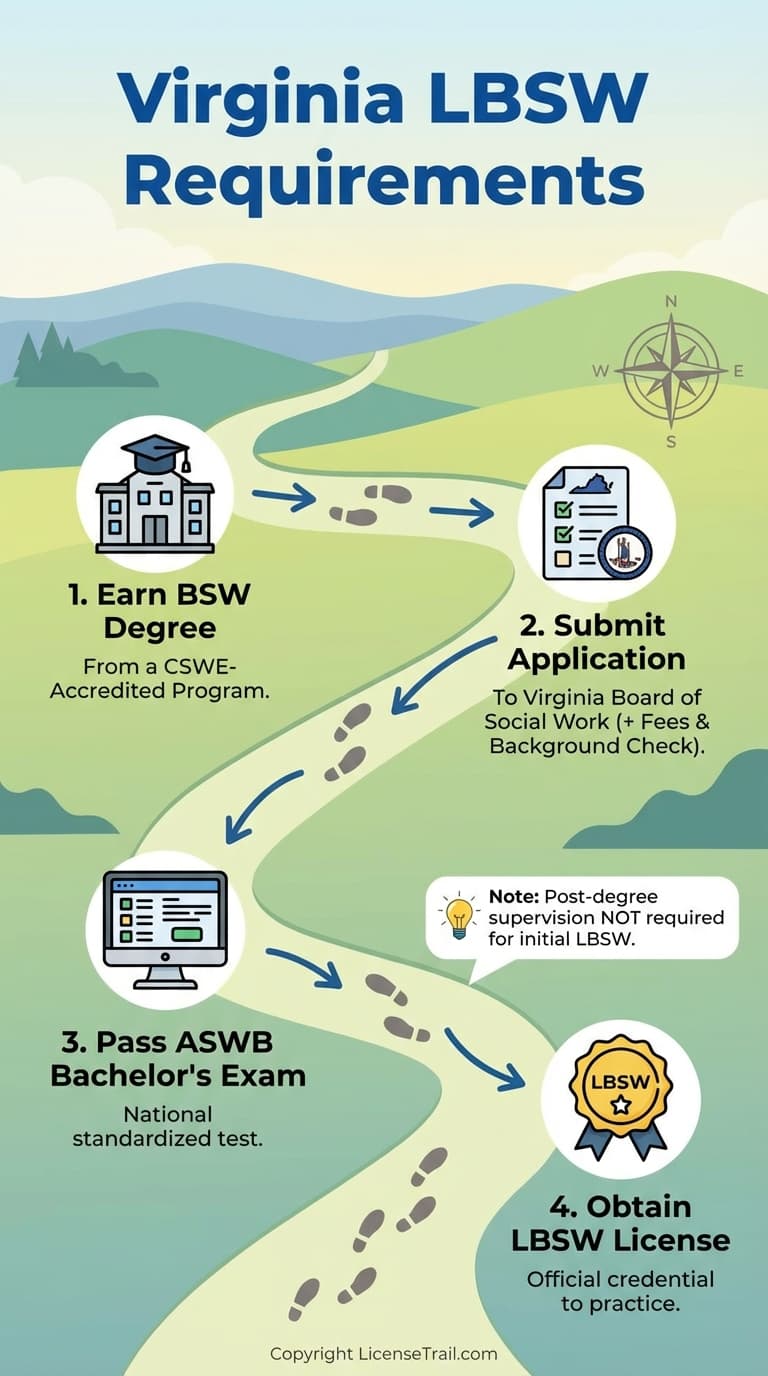
- Education: BSW from a CSWE-accredited program (or CSWE foreign equivalency)
- Experience hours: No post-baccalaureate supervised experience hours required (0 hours)
- Exam: Pass the ASWB Bachelors exam (board-approved national exam)
- Application: Submit board application + $100 fee + official transcripts
- Background/Disclosures: Provide NPDB report and documentation of any other licenses and any legal/disciplinary issues
- Practice/Supervision: May provide only basic generalist services and must practice under supervision of a master’s-level social worker (no set supervision-hour ratio)
- Exam timing/retakes: Must pass within 2 years of board approval; 90-day wait between attempts; reapply if window expires
- Renewal/CE: 15 CE hours each renewal cycle (even-numbered years), including 3 hours in ethics/standards/law (Category I/II limits apply)
License Details
Procedures
In Virginia, the Licensed Baccalaureate Social Worker (LBSW) credential is the entry‑level social work license for graduates of accredited BSW programs. It authorizes “basic generalist services” such as case management and supportive services, but always under the supervision of a master’s‑level social worker. (dhp.virginia.gov)
A key point about Virginia: as of recent regulatory changes, there is no longer any post‑baccalaureate experience‑hour requirement (such as 3,000 supervised hours) to obtain an LBSW. Licensure is now based on education + examination and standard background documentation. (law.lis.virginia.gov)
1. Practice scope and supervision
The Board describes an LBSW as a social worker who: (dhp.virginia.gov)
- Engages in the practice of social work under the supervision of a master social worker, and
- Provides basic generalist services, including casework management, supportive services, consultation, and education.
Virginia’s general FAQ also makes clear that, unless you fall under a statutory exemption, you must hold an LBSW, LMSW, or LCSW license to provide social work services. (dhp.virginia.gov)
The regulations, however, do not set a required number of supervised practice hours for LBSWs (either before or after licensure). The only hours you must track on an ongoing basis are continuing‑education hours for renewal (discussed in Section 4).
2. Pathways to the LBSW license
Virginia offers two main routes:
- Licensure by Examination – for first‑time licensees who have a qualifying BSW. (law.lis.virginia.gov)
- Licensure by Endorsement – for those already licensed at a comparable baccalaureate level in another jurisdiction. (dhp.virginia.gov)
Most new graduates will use the examination pathway, so the step‑by‑step requirements below focus on that first.
3. Licensure by Examination: step‑by‑step
3.1 Education requirement (no practicum hour count specified by the Board)
To be eligible to sit for the LBSW exam, you must meet the education standard in 18VAC140‑20‑60:
- “The applicant for licensure as an LBSW shall hold a bachelor’s degree from an accredited school of social work.” (law.cornell.edu)
- If your degree is from outside the U.S., you must show equivalency through the Foreign Equivalency Determination Service of CSWE. (law.cornell.edu)
The regulation does not specify a numeric practicum‑hour requirement at the licensure level; instead, it relies on the CSWE accreditation standards your BSW program had to meet.
3.2 Application to sit for the exam
Under 18VAC140‑20‑51(A), to be approved to sit for the board‑approved exam as an LBSW you must: (law.lis.virginia.gov)
- Meet the education requirement in 18VAC140‑20‑60 (described above).
- Submit a completed application to the Board, including:
- The application fee specified in 18VAC140‑20‑30 (currently $100 for LBSW, per Board website). (dhp.virginia.gov)
- Official transcripts sent directly from your social work program.
The Board strongly recommends reviewing the Regulations Governing the Practice of Social Work and the LBSW Licensure Process Handbook before applying. (dhp.virginia.gov)
3.3 Examination requirement and timing
Virginia requires you to pass a national, board‑approved examination at the bachelor’s level: (law.lis.virginia.gov)
- The required test is the ASWB Bachelors Examination.
- You may apply to take this exam after you graduate with your BSW and your application to the Board has been approved. (dhp.virginia.gov)
Timing and retakes: (dhp.virginia.gov)
- Once approved, you must pass the exam within 2 years of the date the Board first approves you to register.
- If you fail, you can retake the exam, but there is a 90‑day waiting period between attempts.
- If you still have not passed by the end of the 2‑year window, you must reapply to the Board under whatever requirements are then in effect.
- If you go through a second 2‑year approval period and still do not pass, the Board requires that you register for supervision and complete one additional year as a supervisee before it will approve you again. (This is a special circumstance for repeated exam failures, not a normal pre‑licensure requirement for all applicants.) (dhp.virginia.gov)
3.4 Requirements to be licensed (after you pass the exam)
For licensure by examination, 18VAC140‑20‑51(B) requires that you: (law.lis.virginia.gov)
- Continue to meet the education requirement in 18VAC140‑20‑60.
- Submit, in addition to the initial application materials:
- Verification of a passing score on the board‑approved national exam (ASWB Bachelors).
- Documentation of any other health or mental health licensure or certification, if applicable.
- A current report from the National Practitioner Data Bank (NPDB).
The Board’s online LBSW‑by‑Examination page also notes that you must upload any required supporting documents (for example, NPDB report, out‑of‑state license verification, name‑change documents, and any criminal or disciplinary explanations) and pay the nonrefundable $100 application fee. (dhp.virginia.gov)
4. Hours associated with LBSW licensure
4.1 Pre‑licensure supervised experience hours
Current requirement:
- 0 hours of post‑bachelor’s supervised work experience are required for LBSW licensure in Virginia.
Evidence for this:
- The current LBSW/LMSW licensure regulation, 18VAC140‑20‑51, lists only education, application documentation, and a passing national exam plus NPDB and related disclosures; it includes no supervised‑experience or clock‑hour requirement for LBSW applicants. (law.lis.virginia.gov)
- Earlier versions of the regulations required BSW applicants to complete a minimum of 3,000 hours of supervised post‑bachelor’s experience (with specified supervision ratios), but those provisions were removed in a 2019–2020 fast‑track regulatory change. A professional summary of the Board’s amendments explicitly notes the elimination of the 3,000‑hour requirement for LBSWs as a “significant reduction in regulatory burden.” (register.dls.virginia.gov)
So, unlike clinical licensure (LCSW), where you must document thousands of hours of supervised clinical practice, LBSW applicants in Virginia do not submit any experience‑hour logs as part of the licensure application.
4.2 Supervision in practice (qualitative, not hourly, requirement)
Although there is no numeric hour requirement at the LBSW level, the Board’s description makes clear that LBSWs practice “under the supervision of a master social worker.” (dhp.virginia.gov)
In practice, that means:
- Your employing agency must ensure that your work is overseen by an LMSW or LCSW (or other appropriately qualified supervisor depending on agency policy).
- The Board’s regulations define “supervision” generally as a professional relationship in which the supervisor directs, monitors, and evaluates practice to promote competent, ethical services, but they do not set a specific supervision‑to‑practice hour ratio for LBSWs the way they do for clinical supervisees under 18VAC140‑20‑50. (law.cornell.edu)
4.3 Continuing‑education hours after licensure
The only recurring “hour” requirement tied directly to the LBSW credential is for continuing education. Under 18VAC140‑20‑105, the Board requires: (law.lis.virginia.gov)
- 15 contact hours of continuing education for each renewal cycle (LBSWs and LMSWs).
- These hours must be completed prior to renewal in even‑numbered years.
- At least 3 of the 15 hours must be in ethics, standards of practice, or Virginia laws governing social work practice.
- At least 10 of the 15 hours must come from “formally organized learning activities” (Category I), such as courses, workshops, or seminars from approved providers; up to 5 hours can come from “individual professional activities” (Category II), such as presenting, publishing, or certain committee work. (law.lis.virginia.gov)
- Up to 2 CE hours may be earned by providing uncompensated social work services to low‑income clients through a local health department or free clinic; 3 hours of volunteer service = 1 CE hour. (law.lis.virginia.gov)
Failure to meet CE requirements can result in your license not being renewed.
5. Licensure by Endorsement (for out‑of‑state social workers)
If you already hold a social work license in another state that is comparable to an LBSW, you may qualify by endorsement rather than examination alone. Under the Board’s endorsement page and 18VAC140‑20‑45: (dhp.virginia.gov)
To apply by endorsement, you must:
- Hold an active, unrestricted, comparable social work license in another jurisdiction (at the baccalaureate level).
- Provide verification of that license from the issuing state.
- Provide evidence of a passing score on the ASWB Bachelors exam. If your original state did not require a national exam at the time you were licensed, the Board may accept proof that a national exam was not required then.
- Submit the Board’s online application, fee (currently $100 for LBSW), NPDB report, and any required supporting documents (e.g., name change, conviction explanations). (dhp.virginia.gov)
There is no separate Virginia hours requirement for endorsement, beyond whatever supervised experience your original licensing state may have required historically.
6. Key points at a glance
- Degree: BSW from a CSWE‑accredited program (or foreign equivalent as determined by CSWE). (law.cornell.edu)
- Pre‑licensure practice hours:
- None required in Virginia for LBSW licensure by examination (the old 3,000‑hour supervised experience requirement has been removed). (law.lis.virginia.gov)
- Exam: ASWB Bachelors exam; must pass within 2 years of initial Board approval to register; 90‑day wait between attempts. (dhp.virginia.gov)
- Paperwork: Online application + fee, official transcripts, NPDB report, documentation of any other licenses or legal/disciplinary issues. (law.lis.virginia.gov)
- Supervision: LBSWs must practice under the supervision of a master’s‑level social worker, but Virginia does not set a required number of supervision hours for LBSWs. (dhp.virginia.gov)
- Continuing education: 15 hours every renewal cycle, with 3 hours in ethics/standards/law and specific limits on Category I and II activities; up to 2 hours may be earned via uncompensated service to low‑income clients. (law.lis.virginia.gov)
In sum, to become an LBSW in Virginia you need a qualifying BSW, a clean and well‑documented application, and a passing score on the ASWB Bachelors exam—but no logged pre‑licensure work‑experience hours. The only hour‑based obligations tied specifically to the credential are continuing‑education hours after licensure and appropriate, ongoing supervision of your practice.
Track your LBSW hours with confidence
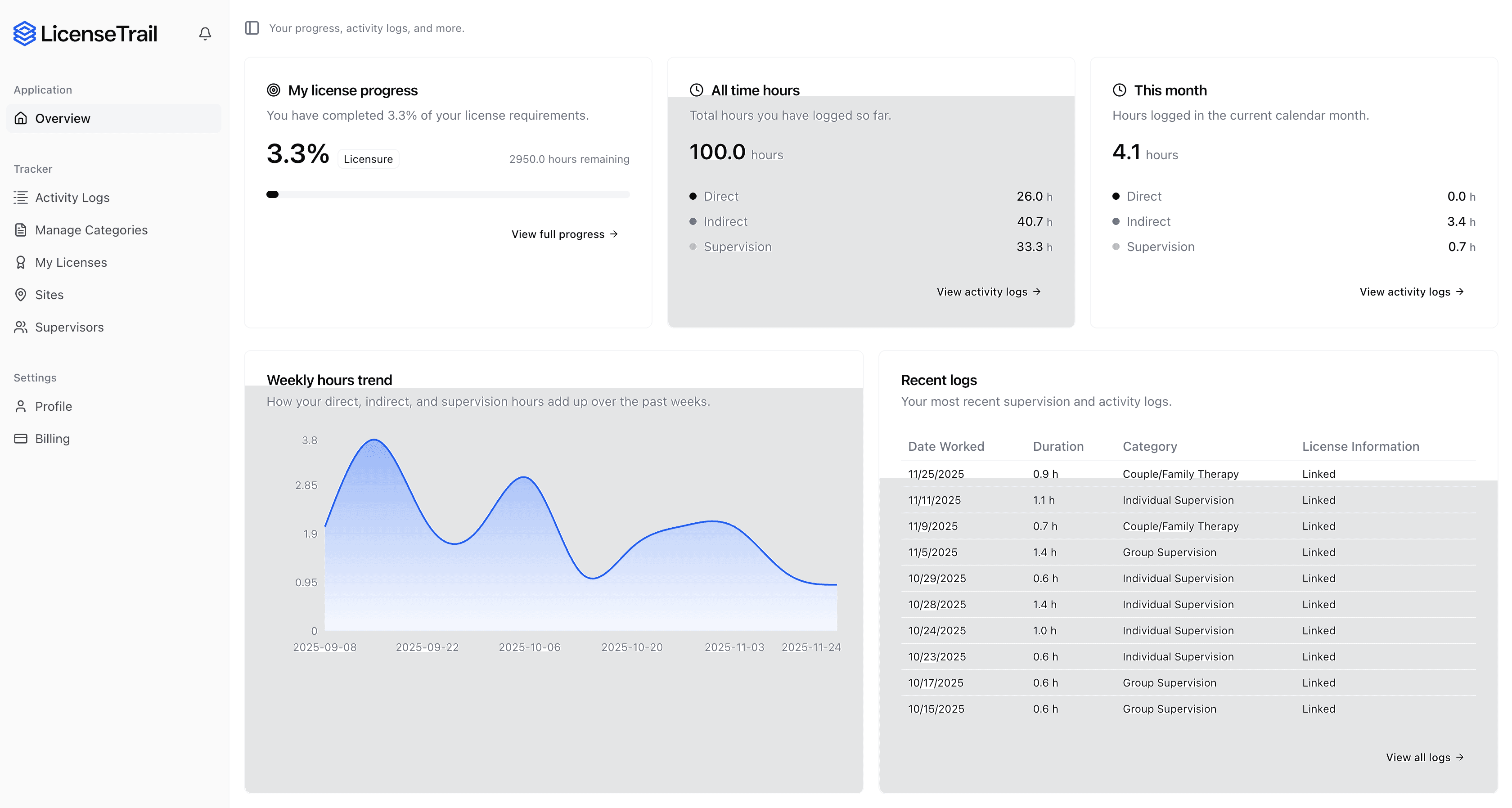
License Trail checks your direct, indirect, and supervision hours against Virginia LBSW requirements continuously and flags mismatches before you submit.
 Start Tracking for Free
No credit card required · Free plan available
Related Licenses
Is your spreadsheet hiding Virginia LBSW risks?
Stop guessing if your categories match Virginia Board of Social Work requirements. License Trail checks your direct, indirect, and supervision hours continuously and flags mismatches before you submit.
Import or log
Bring your spreadsheet or start fresh
Upload your existing tracking spreadsheet and we'll map every hour into the right Virginia Board of Social Work categories automatically.
Verify against Virginia
Catch mismatches before the board does
License Trail checks your direct, indirect, and supervision hours against Virginia LBSW requirements continuously.
Export board-ready
One-click clean reports
Generate professional, board-ready reports for supervision meetings and Virginia Board of Social Work submissions in seconds.
No credit card required · Free plan available