
Virginia LCSW Requirements: Hours, Exams & Step-by-Step Guide
Stop guessing if your categories match Virginia requirements. License Trail checks your direct, indirect, and supervision hours against LCSW requirements continuously and flags mismatches before you submit.
No credit card required · Free plan available
Quick Requirements Overview
- Degree: CSWE-accredited MSW with a clinical course of study (or make up CSWE-accredited clinical coursework); foreign program must be CSWE-recognized
- Clinical practicum: 600 supervised clinical practicum hours (deficits can be made up via additional supervised clinical practice in addition to post-MSW hours)
- Pre-approval: Must register as “Supervisee in Social Work” and obtain written Board approval before hours count (LMSW not required)
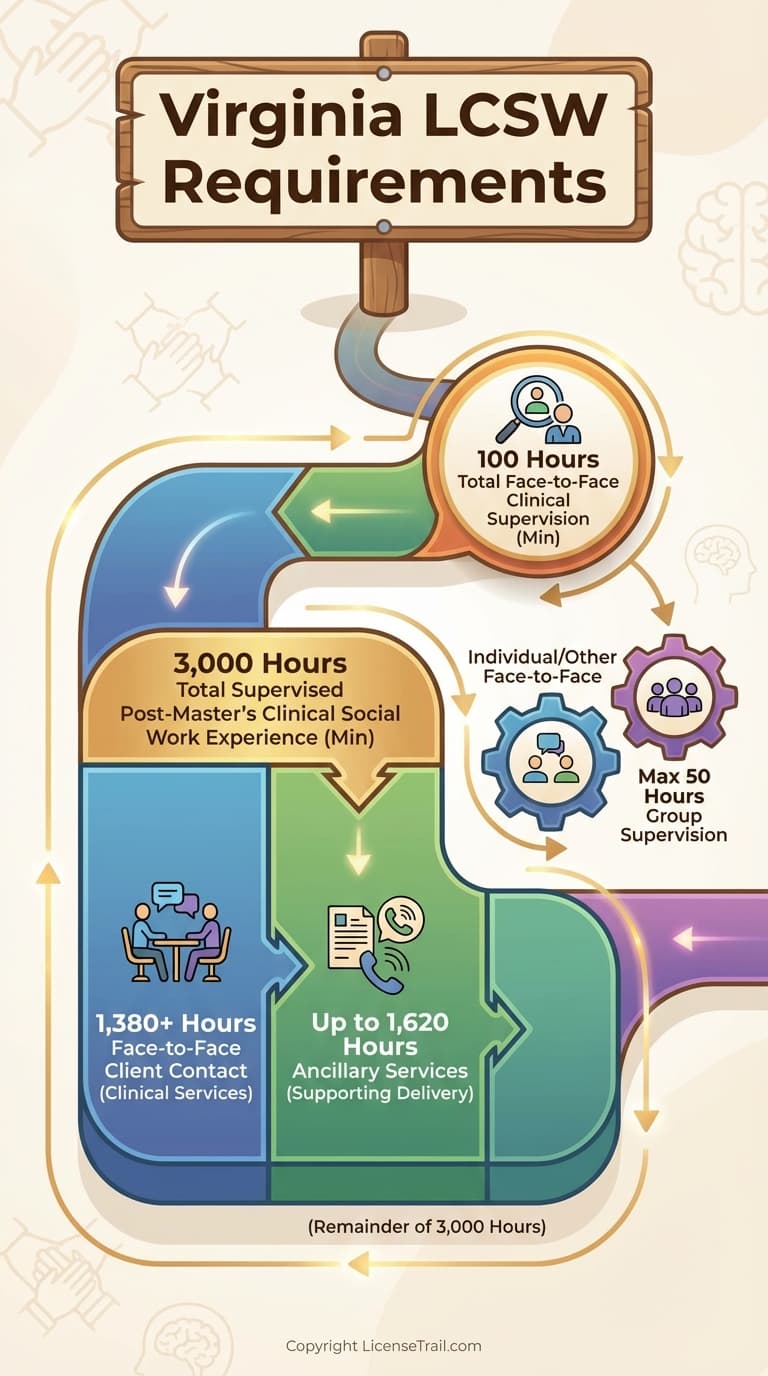
- Post-MSW experience: 3,000 hours supervised clinical/ancillary experience, including 1,380 face-to-face clinical client-contact hours (up to 1,620 ancillary)
- Supervision: 100 hours face-to-face supervision; 1–4 hours per 40 work hours; ≤50 hours may be group; ≤6 supervisees per group unless pre-approved
- Timeframe: Complete 3,000 hours in 2–4 consecutive years (one-time up to 12-month extension for extenuating circumstances)
- Supervisor: Active unrestricted LCSW + 2 years post-licensure clinical experience + supervision training (3-credit course or 14 CE hrs, then 7 CE hrs/5 yrs); no dual relationships
- Exam: Apply for LCSW by examination and pass ASWB Clinical; 2 years to pass after approval (reapply if not; after second 2-year period, must complete 1 additional year as a supervisee before reapproval)
License Details
Procedures
Licensure as a Licensed Clinical Social Worker (LCSW) in Virginia is governed by the Virginia Board of Social Work and the Regulations Governing the Practice of Social Work (18VAC140‑20). To qualify, you must meet specific education, supervision, and examination requirements, including clearly defined types and amounts of hours.
1. Educational foundation (what your degree must include)
Virginia requires a CSWE‑accredited social work degree plus a clinical course of study:
-
Acceptable degrees for LCSW:
- A master’s in social work (MSW) with a clinical course of study from a CSWE‑accredited program, or
- A non‑clinical CSWE‑accredited MSW plus additional CSWE‑accredited clinical coursework that brings you up to a “clinical course of study,” or
- A social work program outside the U.S. recognized by CSWE. (law.lis.virginia.gov)
-
Required clinical practicum:
- At least 600 hours of supervised clinical practicum, integrated with your clinical coursework.
- The practicum must be supervised by:
- an LCSW, or
- a social worker with at least a master’s or doctoral degree in social work and 3+ years of post‑graduate clinical social work experience. (law.lis.virginia.gov)
-
If your MSW program did not include the full 600 clinical practicum hours:
- You may make up the missing practicum hours as additional supervised clinical practice, on top of the post‑master’s supervision required for licensure (they are in addition to the 3,000 post‑master’s hours described below). (law.lis.virginia.gov)
2. Registering as a “Supervisee in Social Work” (before you count hours)
You cannot simply start working and later ask the Board to count those hours. Virginia is strict about this:
-
Board approval before counting hours
- Post‑master’s supervised experience in Virginia “without prior written board approval will not be accepted” toward LCSW licensure. (law.lis.virginia.gov)
- Practically, this means you must:
- Submit an Application for Initial Registration of Supervision (LCSW – Initial Registration of Supervision).
- Include a supervisory contract, official transcript, and pay the registration of supervision fee. (law.lis.virginia.gov)
-
LMSW is not a prerequisite:
- The Board explicitly states that the Licensed Master Social Worker (LMSW) license “is not a prerequisite for clinical licensure.” (dhp.virginia.gov)
- If you want to start counting hours toward LCSW, you apply for Initial Registration of Supervision, not for LMSW.
-
Supervision from another U.S. jurisdiction:
- Supervised post‑master’s experience completed in another U.S. state may be accepted if it met that state’s requirements. (law.lis.virginia.gov)
3. Post‑master’s supervised experience: total hours and required breakdown
3.1 Total supervised experience hours
Virginia requires:
- At least 3,000 hours of supervised post‑master’s degree experience in:
- the delivery of clinical social work services, and
- ancillary services that support such delivery. (law.lis.virginia.gov)
These 3,000 hours must be:
- Post‑master’s (hours during the degree don’t count toward this total).
- Completed under Board‑approved supervision (or qualifying supervision in another U.S. jurisdiction).
3.2 Minimum direct client contact hours
Within those 3,000 hours, Virginia specifically requires:
- At least 1,380 hours of face‑to‑face client contact providing clinical social work services. (law.lis.virginia.gov)
This is the clearest Virginia equivalent of “direct experience” hours. It means:
- You physically (or via approved real‑time technology, if permitted under Board policies) meet with clients.
- You are directly providing clinical services (assessment, diagnosis, treatment, psychotherapy, clinical interventions, etc.).
3.3 Ancillary (indirect) hours
The remainder of your 3,000 hours may be in ancillary services that support clinical social work, such as:
- Case documentation and treatment planning
- Case management
- Consultation with other professionals
- Team meetings and clinical case conferences
- Related administrative tasks that directly support service delivery
Regulations state that after the 1,380 hours of face‑to‑face client contact, “the remaining hours may be spent in ancillary services supporting the delivery of clinical social work services.” (law.lis.virginia.gov)
Numerically:
- Total supervised experience: 3,000 hours
- Minimum face‑to‑face client contact: 1,380 hours
- Maximum ancillary/support hours: 3,000 − 1,380 = 1,620 hours
4. Supervision hours: amount, format, and limits
4.1 Total supervision hours and frequency
During your 3,000 supervised hours, Virginia requires at least 100 hours of supervision with the following structure:
- Supervision must be face‑to‑face with your supervisor (with limited allowances for alternatives in hardship situations).
- For every 40 hours of work experience, you must receive:
- Minimum: 1 hour of face‑to‑face supervision
- Maximum: 4 hours of face‑to‑face supervision
- Across the 3,000 hours, you must accumulate at least 100 hours of individual face‑to‑face supervision (which may include some group time subject to the limits below). (law.lis.virginia.gov)
4.2 Individual vs group supervision
Virginia places caps on group supervision:
- Of the required 100 hours of supervision:
- No more than 50 hours may be obtained through group supervision.
- Group supervision size:
- No more than six supervisees in a group, unless a larger group is approved in advance by the Board. (law.lis.virginia.gov)
In practice, to be safe, most supervisees plan for at least 50+ hours of one‑on‑one supervision, and limit group supervision to ≤50 hours and ≤6 people per group unless they have specific Board approval otherwise.
5. Timeframe to complete supervised experience
Your 3,000 supervised hours must be completed within a specific window:
- Minimum duration: 2 years
- Maximum duration: 4 consecutive years (law.lis.virginia.gov)
If you cannot finish within 4 consecutive years:
- You may request a one‑time extension of up to 12 months, but:
- You must show “extenuating circumstances” that prevented completion within the 4‑year window. (law.lis.virginia.gov)
6. Supervisor requirements (who can supervise you)
Your supervisor must meet Virginia’s LCSW supervision standards:
-
License and experience
- Hold an active, unrestricted LCSW license in the jurisdiction where the services are provided.
- Have at least two years of post‑licensure clinical social work experience. (law.lis.virginia.gov)
-
Training in supervision
- Either:
- A 3‑credit graduate course in supervision, or
- At least 14 hours of approved continuing education (CE) in supervision.
- After this initial training, the supervisor must complete at least 7 hours of CE in supervision every 5 years before taking on new supervisees. (law.lis.virginia.gov)
- Either:
-
No dual relationships
- The supervisor may not supervise a family member.
- The supervisor may not supervise anyone with whom they have a dual relationship (e.g., business partner, close personal relationship). (law.lis.virginia.gov)
Supervisors also have specific responsibilities, including reviewing representative diagnostic assessments and treatment plans, evaluating your competence in key clinical areas, and documenting which clients were under supervision, among other duties. (law.lis.virginia.gov)
7. Your status and responsibilities as a supervisee
While accruing hours, you must follow the Board’s rules for supervisees:
-
Title and identification
- You must use:
- Your name
- The initials of your degree (e.g., MSW)
- The title “Supervisee in Social Work”
- This title must appear in all written communications (e.g., notes, letters, business cards, electronic signatures). (law.lis.virginia.gov)
- You must use:
-
Informing clients
- Clients must be informed in writing that you are a supervisee.
- The notice must also include your supervisor’s:
- Name
- Professional address
- Telephone number. (law.lis.virginia.gov)
-
Billing and independence
- You may not directly bill for services.
- You may not represent yourself as an independent practitioner or as an LCSW. (law.lis.virginia.gov)
-
Continuous supervision requirement
- Even after you have completed all required hours, you must remain under Board‑approved supervision until you are actually licensed as an LCSW in Virginia. (law.lis.virginia.gov)
8. Applying for LCSW by examination
Once you have:
- Met the educational requirements (including the 600‑hour clinical practicum or equivalent); and
- Completed the 3,000 supervised post‑master’s hours (with at least 1,380 face‑to‑face client contact hours and 100 hours of supervision, within the 2–4 year window),
you may apply for LCSW by examination.
8.1 Application by examination
Key points from the Board’s LCSW Exam page: (dhp.virginia.gov)
- You apply online as a Licensed Clinical Social Worker – by Examination applicant.
- You submit:
- Application form and fee (currently $165, nonrefundable).
- Verification of education and practicum.
- Verification of clinical supervision (Board form, notarized).
- Any required supporting documentation (e.g., NPDB Self‑Query, out‑of‑state license verification, etc.).
If approved, the Board authorizes you to take the ASWB Clinical exam.
8.2 Exam time limits and retakes
The Board’s examination information establishes specific timeframes: (dhp.virginia.gov)
- From your initial approval, you have 2 years to pass the ASWB Clinical exam.
- If you do not pass within that first 2‑year period:
- You must reapply for another 2‑year exam approval period.
- If you still do not pass by the end of the second 2‑year period:
- You must register for supervision again and complete one additional year as a supervisee before the Board will approve another 2‑year period to retake the exam.
9. Licensure by endorsement (for already‑licensed clinicians in other states)
If you are already licensed at a clinical level elsewhere, you may qualify for LCSW by endorsement:
- You must hold an active, unrestricted, comparable clinical social work license in another jurisdiction.
- You must provide evidence of a passing ASWB Clinical exam score (or meet Board‑specified alternatives if your jurisdiction did not require ASWB at the time of your original licensure).
- You must meet the requirements outlined in 18VAC140‑20‑45 (the endorsement section of the regulations). (dhp.virginia.gov)
The endorsement route generally recognizes your existing license and supervised experience, but the Board still evaluates whether it is comparable to Virginia’s LCSW requirements.
10. Hour requirements summarized (Virginia LCSW)
For quick reference, the core hour requirements defined by the Virginia Board of Social Work are:
-
Clinical practicum (during/around the degree):
- 600 hours of supervised clinical practicum (or equivalent supervised clinical practice if practicum hours were deficient). (law.lis.virginia.gov)
-
Post‑master’s supervised experience (toward LCSW): (law.lis.virginia.gov)
- 3,000 hours total supervised post‑master’s experience in:
- Clinical social work services, and
- Ancillary services that support clinical work.
- 1,380 hours minimum of face‑to‑face client contact delivering clinical social work services.
- Up to 1,620 hours may be in ancillary/support activities.
- 100 hours minimum of face‑to‑face supervision, with:
- At least 1 and no more than 4 hours of supervision per 40 hours of work.
- No more than 50 of the 100 hours in group supervision.
- No more than 6 supervisees in a group (unless pre‑approved for a larger group).
- Timeframe:
- At least 2 years, no more than 4 consecutive years.
- Possible one‑time extension up to 12 months for extenuating circumstances (by Board approval).
- 3,000 hours total supervised post‑master’s experience in:
These are the central hour‑based requirements that must be met to become licensed as an LCSW in Virginia, in the exact framework and terminology used by the Virginia Board of Social Work and its regulations.
Track your LCSW hours with confidence
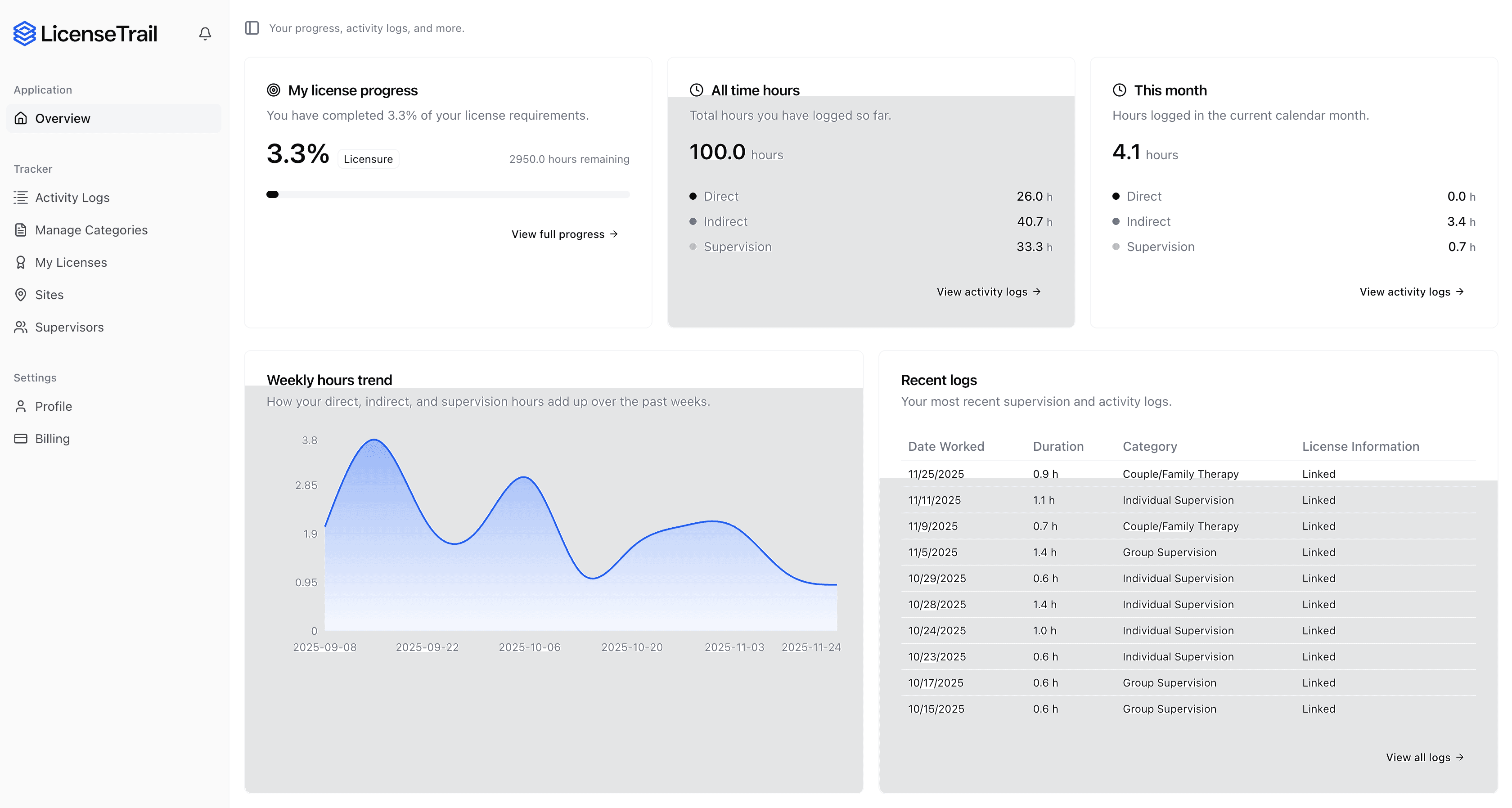
License Trail checks your direct, indirect, and supervision hours against Virginia LCSW requirements continuously and flags mismatches before you submit.
 Start Tracking for Free
No credit card required · Free plan available
Related Licenses
Is your spreadsheet hiding Virginia LCSW risks?
Stop guessing if your categories match Virginia Board of Social Work requirements. License Trail checks your direct, indirect, and supervision hours continuously and flags mismatches before you submit.
Import or log
Bring your spreadsheet or start fresh
Upload your existing tracking spreadsheet and we'll map every hour into the right Virginia Board of Social Work categories automatically.
Verify against Virginia
Catch mismatches before the board does
License Trail checks your direct, indirect, and supervision hours against Virginia LCSW requirements continuously.
Export board-ready
One-click clean reports
Generate professional, board-ready reports for supervision meetings and Virginia Board of Social Work submissions in seconds.
No credit card required · Free plan available