
Virginia LMFT Requirements: Hours, Exams & Step-by-Step Guide
Stop guessing if your categories match Virginia requirements. License Trail checks your direct, indirect, and supervision hours against LMFT requirements continuously and flags mismatches before you submit.
No credit card required · Free plan available
Quick Requirements Overview
- Education: Master’s+ in MFT/counseling (CACREP/COAMFTE or VA-equivalent) with 60 semester/90 quarter hours covering required core areas
- Graduate internship: 600 hrs total incl. 240 direct client contact; 200 of those with couples/families (only hours after 30 grad semester hrs may later count)
- Resident license required first: Obtain Resident in Marriage & Family Therapy registration (supervisory contract + transcript + fee + NPDB report; no unresolved discipline) before counting post-degree hours
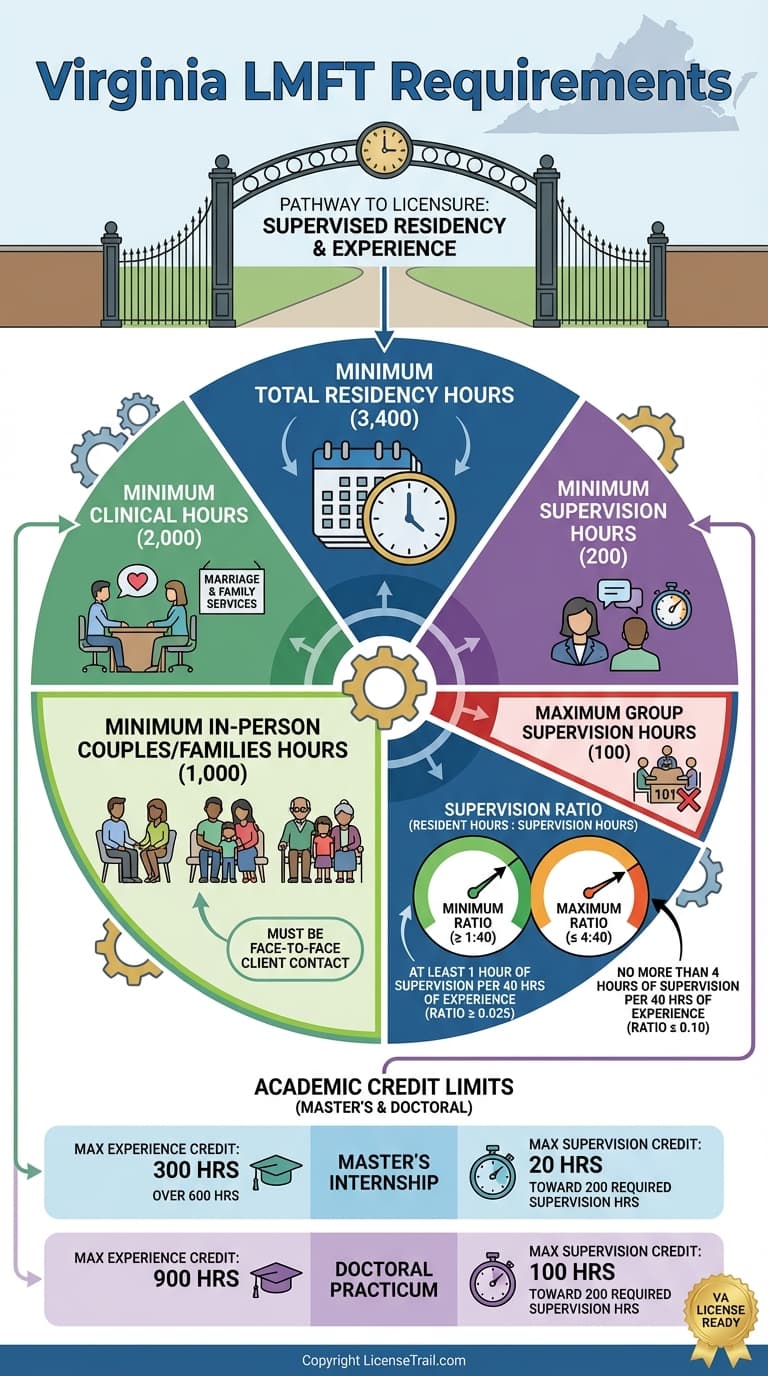
- Post-degree residency hours: 3,400 hrs supervised residency total, incl. 2,000 hrs clinical marriage & family services and 1,000 hrs face-to-face with couples/families (ancillary services allowed beyond minimums)
- Supervision: 200 hrs in-person/real-time visual supervision; 1–4 hrs per 40 work hrs; ≤100 group (max 6 residents); ≥100 supervision hrs by an LMFT (up to 20 internship supervision hrs may count)
- Timeframe: Residency completed in 21 months–4 years (board approval needed if exceeding 4 years)
- Exam: Pass AMFTRB National MFT Exam within 6 years of resident license issuance (VA LPC holders may have exam waived)
- Allowed hour reductions: Up to +300 hrs from master’s internship beyond 600; up to 900 doctoral practicum/internship hrs + up to 100 supervision hrs (board-approved)
License Details
Procedures
Virginia licenses Marriage and Family Therapists (LMFTs) through the Board of Counseling under the “Regulations Governing the Practice of Marriage and Family Therapy” (18VAC115‑50). As of late 2025, becoming an LMFT by examination in Virginia involves four main pieces:
- A qualifying graduate degree and internship
- A temporary “Resident in Marriage and Family Therapy” license
- A post‑degree supervised residency with specific hour types and supervision
- Passing the National MFT exam and applying for full licensure
Below is a step‑by‑step outline with the board’s own hour categories and terminology.
1. Graduate education and internship
Degree and coursework
You must complete a graduate program (master’s or higher) that either:
- Is CACREP- or COAMFTE‑accredited, or
- “Prepares individuals to practice marriage and family therapy” as defined in Virginia law, and meets the board’s coursework rules. (dhp.virginia.gov)
The regulations require:
- At least 60 semester hours or 90 quarter hours of graduate coursework
- Specific credit minimums across 10 “core areas” (marriage and family studies; marriage and family therapy; human growth and development; abnormal behaviors; diagnosis and treatment of addictive behaviors; multicultural counseling; professional identity and ethics; research; assessment and treatment; and supervised internship). (law.lis.virginia.gov)
Internship (pre‑degree clinical hours)
Within those 60 hours you must complete a supervised internship that is:
- At least 600 hours total, and
- Includes 240 hours of direct client contact, of which 200 hours must be with couples and families. (law.lis.virginia.gov)
Key details:
- Only internship hours earned after 30 graduate semester hours may later be counted toward residency. (law.lis.virginia.gov)
Some of your internship hours (beyond the minimum 600) can later reduce your residency hour total (see Section 3).
2. Obtain a Resident in Marriage and Family Therapy license
Before you begin post‑degree supervised hours that you want the board to count, you must hold a temporary resident license.
To qualify as a “Resident in Marriage and Family Therapy”, you must: (law.lis.virginia.gov)
-
Submit a resident application on the board’s form, including:
- Verification of a supervisory contract
- Name, license number, and practice location of your supervisor
- An attestation that you will be providing marriage and family services
-
Provide an official transcript showing a qualifying graduate degree that meets the coursework and internship requirements in 18VAC115‑50‑50 and 18VAC115‑50‑55. (law.lis.virginia.gov)
-
Pay the resident registration fee. (law.lis.virginia.gov)
-
Submit a current report from the National Practitioner Data Bank (NPDB). (law.lis.virginia.gov)
-
Have no unresolved disciplinary action on a health‑related license in Virginia or any other jurisdiction. (law.lis.virginia.gov)
Title and practice limits during residency:
- You may not call yourself an LMFT, directly bill for services, or otherwise represent yourself as a licensed marriage and family therapist.
- You may use your name, degree initials, and the title “Resident in Marriage and Family Therapy.”
- Clients must be informed in writing that you are a resident under supervision, including your supervisor’s name, address, and telephone number. (law.lis.virginia.gov)
3. Complete the supervised residency: hours and categories
Virginia’s LMFT residency is where the detailed hour requirements come in. There are three nested levels of hours:
- Total supervised residency hours
- Hours in clinical marriage and family services
- Hours of face‑to‑face client contact, with a subset specifically with couples/families
In addition, there is a separate requirement for supervision hours.
3.1. Overall residency hours
The regulations require:
- “No fewer than 3,400 hours of supervised residency in the role of a marriage and family therapist”. (law.lis.virginia.gov)
The Board’s LMFT exam page summarizes this as having “delivered 3,400 hours of clinical marriage and family therapy services” during a board‑approved residency. (dhp.virginia.gov)
These 3,400 hours are your post‑degree, supervised work experience under your resident license.
3.2. Clinical marriage and family services hours and “face‑to‑face” hours
Within the 3,400 total hours, the regulations further break down your clinical work: (law.lis.virginia.gov)
- At least 2,000 hours must be in “clinical marriage and family services.”
- Of those 2,000 hours, at least 1,000 hours must be “face‑to‑face client contact with couples or families or both.”
- The remaining hours (beyond those specific minimums) may be spent performing ancillary counseling services (documentation, consultation, treatment planning, etc.).
The Board’s own checklist restates this more simply as: (dhp.virginia.gov)
- 2,000 hours of face‑to‑face client contact in the provision of clinical marriage and family services
- 1,000 hours of face‑to‑face client contact with couples, families, or both
In practical terms, you should plan on:
- 3,400 total supervised residency hours, of which
- 2,000+ hours are direct clinical marriage and family services, and
- 1,000+ of those clinical hours are face‑to‑face with couples and/or families.
3.3. Supervision hours within the residency
Within the 3,400 residency hours, you must also meet a supervision minimum:
- 200 hours of in‑person supervision with your supervisor, reviewing your marriage and family therapy services. (law.lis.virginia.gov)
Important supervision details:
- Frequency ratio:
- Minimum 1 hour and maximum 4 hours of supervision for every 40 hours of supervised work experience. (law.lis.virginia.gov)
- Modality and technology:
- For the 200‑hour requirement, “in‑person” supervision can include secure technology that maintains client confidentiality and provides real‑time visual contact between supervisor and resident. (law.lis.virginia.gov)
- Who can supervise:
- Supervisors must hold an active, unrestricted license as a marriage and family therapist or professional counselor (or certain grandfathered disciplines) and have two years of post‑licensure MFT experience plus specific training in supervision.
- At least half of the 200 supervision hours must be provided by a licensed marriage and family therapist. (law.lis.virginia.gov)
- Group supervision limits:
- No more than 100 of the 200 hours may be group supervision.
- Group supervision must include no more than six residents, and one hour of group counts as one hour of individual supervision for meeting the 200‑hour requirement. (law.lis.virginia.gov)
- Internship supervision carry‑over:
- Up to 20 hours of supervision received during your qualifying graduate internship may be counted toward the 200 supervision hours, if that supervision was provided by a licensed LMFT or LPC. (law.lis.virginia.gov)
3.4. Timeframe to complete residency
Your residency must be completed within a specific window:
- Minimum length: not less than 21 months
- Maximum length: not more than 4 years
If you do not complete the residency within 4 years, you must submit evidence to the board explaining why it should be allowed to continue. You must also keep your resident license current and in active status during this period. (law.lis.virginia.gov)
3.5. Counting internship and doctoral hours toward residency
You can reduce the 3,400‑hour requirement with certain pre‑ or post‑master’s training:
-
Master’s internship in excess of 600 hours
- If your graduate internship was more than 600 hours, and the program met Virginia’s requirements, you may count up to an additional 300 hours toward the residency total. (law.lis.virginia.gov)
-
Doctoral‑level practicum/internship (COAMFTE or CACREP accredited)
- Supervised practicum and internship hours in a COAMFTE‑accredited or CACREP‑accredited doctoral program in MFT or counseling may be accepted for up to 900 hours of the residency requirement and up to 100 of the required supervision hours, if the supervisor holds a current, unrestricted LMFT or LPC license. (law.lis.virginia.gov)
These reductions are subject to board approval and require documentation.
3.6. Core practice areas
Your residency must involve practice in the core areas identified in the coursework regulation (18VAC115‑50‑55), such as marriage and family studies, marriage and family therapy, assessment and treatment, etc. (law.lis.virginia.gov)
4. Examination requirement
All applicants for initial LMFT licensure by examination must: (dhp.virginia.gov)
- Pass the National Marriage and Family Therapy Examination administered by the Association of Marital and Family Therapy Regulatory Boards (AMFTRB).
Timing and limits:
- You must pass the exam within six years from the date your resident license was first issued. (dhp.virginia.gov)
- Residents may sit for the exam during the residency; you must request an authorization code from the Board before registering. (dhp.virginia.gov)
- You can retake the exam, but no more than once per calendar quarter, and you must obtain a new authorization from the Board for each attempt. (dhp.virginia.gov)
If you already hold a current, unrestricted Virginia LPC license, the LMFT exam requirement is waived for LMFT licensure. (dhp.virginia.gov)
5. Applying for full LMFT licensure (by examination)
Once you have:
- Completed the qualifying degree and coursework (18VAC115‑50‑50 and 18VAC115‑50‑55)
- Completed the supervised residency requirements (18VAC115‑50‑60)
- Passed the National MFT exam
…you can apply for Licensed Marriage and Family Therapist (LMFT) – by Examination.
According to the Board’s LMFT‑by‑Examination instructions, you must: (dhp.virginia.gov)
- Submit the online application for LMFT by Examination.
- Upload required documentation, which may include:
- Verification of Supervision form (notarized) documenting your 3,400 residency hours and supervision.
- Verification of Degree and Internship and Verification of Required Coursework forms if applicable.
- Updated NPDB Self‑Query Report.
- Any out‑of‑state supervisor license verifications, if you accrued hours outside Virginia.
- Documentation related to any criminal history or prior discipline, if relevant.
- Pay the LMFT licensure fee (currently listed as $175, nonrefundable). (dhp.virginia.gov)
The Board then reviews your application; the published estimate is about 45–60 days from the time the application is complete. (dhp.virginia.gov)
6. Summary of key hour requirements (Virginia LMFT)
Pre‑degree internship (as part of your graduate program) (law.lis.virginia.gov)
- 600 hours supervised internship, minimum
- 240 hours direct client contact
- 200 of those 240 hours with couples and families
- Only internship hours after 30 graduate semester hours may count toward residency
Post‑degree supervised residency (after you become a Resident in MFT) (law.lis.virginia.gov)
- Total supervised residency hours:
- At least 3,400 hours of supervised residency in the role of a marriage and family therapist
- Within the 3,400 hours:
- At least 2,000 hours in clinical marriage and family services
- At least 1,000 hours of face‑to‑face client contact with couples or families or both (a subset of the 2,000)
- Remaining hours may be ancillary counseling services
- Supervision requirement:
- 200 hours of in‑person supervision, at a rate of 1–4 hours per 40 hours of work
- No more than 100 of those 200 may be group supervision (max 6 residents per group)
- At least 100 of the 200 hours must be provided by an LMFT
- Up to 20 hours of qualifying internship supervision may count toward the 200 hours
- Timeframe:
- Residency must be completed in not less than 21 months and not more than 4 years
Credit for additional training (law.lis.virginia.gov)
- Internship beyond 600 hours in your master’s program: may count up to 300 hours toward the 3,400‑hour residency
- COAMFTE/CACREP‑accredited doctoral practicum/internship: may count up to 900 residency hours and up to 100 supervision hours
These are the current, board‑defined requirements for LMFT licensure by examination in Virginia, based on the regulations in 18VAC115‑50 and the Virginia Board of Counseling’s own LMFT application instructions and examination FAQs as they stand through 2025. (law.lis.virginia.gov)
Track your LMFT hours with confidence
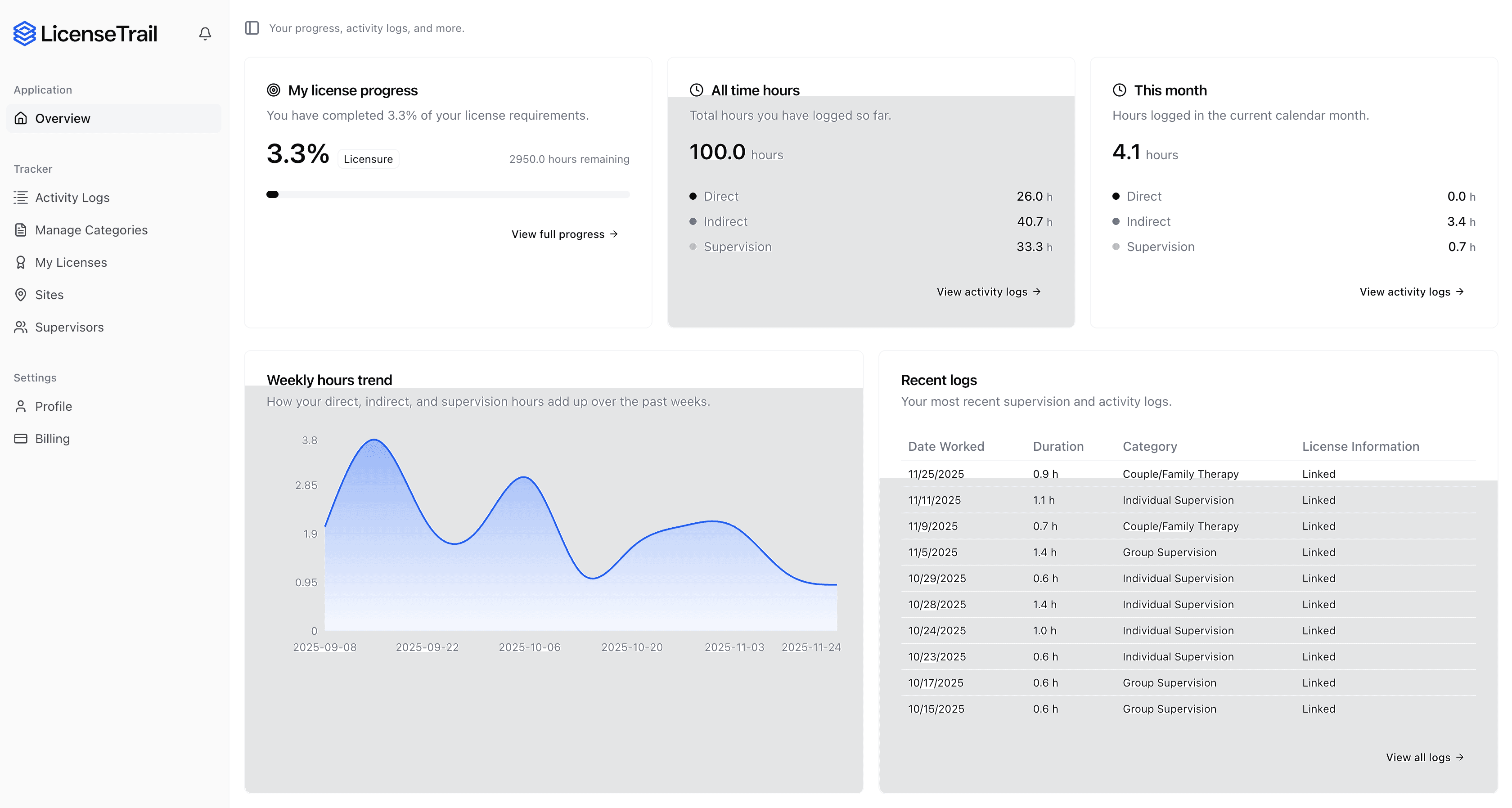
License Trail checks your direct, indirect, and supervision hours against Virginia LMFT requirements continuously and flags mismatches before you submit.
 Start Tracking for Free
No credit card required · Free plan available
Is your spreadsheet hiding Virginia LMFT risks?
Stop guessing if your categories match Virginia Board of Counseling requirements. License Trail checks your direct, indirect, and supervision hours continuously and flags mismatches before you submit.
Import or log
Bring your spreadsheet or start fresh
Upload your existing tracking spreadsheet and we'll map every hour into the right Virginia Board of Counseling categories automatically.
Verify against Virginia
Catch mismatches before the board does
License Trail checks your direct, indirect, and supervision hours against Virginia LMFT requirements continuously.
Export board-ready
One-click clean reports
Generate professional, board-ready reports for supervision meetings and Virginia Board of Counseling submissions in seconds.
No credit card required · Free plan available