
Virginia LPC Requirements: Hours, Exams & Step-by-Step Guide
Stop guessing if your categories match Virginia requirements. License Trail checks your direct, indirect, and supervision hours against LPC requirements continuously and flags mismatches before you submit.
No credit card required · Free plan available
Quick Requirements Overview
- Education: Graduate degree preparing for counseling practice (CACREP or VA‑recognized equivalent program structure)
- Credits/Coursework: 60 semester / 90 quarter hours total, incl. 13 core content areas at 3 semester / 4 quarter hours each (no double‑counting)
- Resident step required: Must obtain Resident in Counseling temporary license before accruing post‑degree hours
- Resident application prereqs: Education/courses met + qualified supervisor & worksite + signed supervisory contract
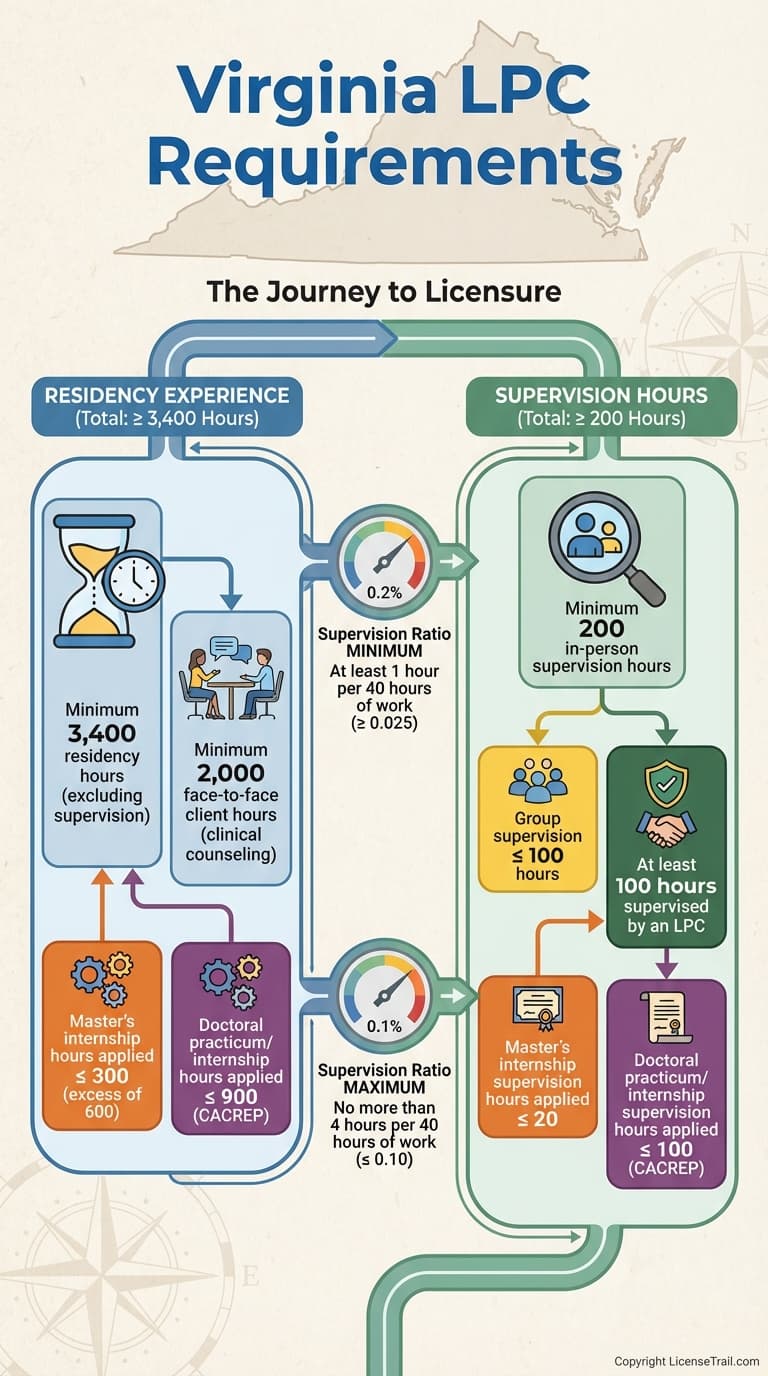
- Residency hours: 3,400 total clinical counseling services hours, incl. 2,000 face‑to‑face client contact hours
- Supervision: 200 hours individual face‑to‑face supervision; 1–4 hours per 40 work hours ratio
- Residency timeframe: Complete in 21 months–4 years
- Exam: Pass NCE or NCMHCE (during residency); must pass within 6 years of resident license issuance (30‑day wait between attempts)
License Details
Procedures
Licensure as a Licensed Professional Counselor (LPC) in Virginia is a multi‑step process governed by the Virginia Board of Counseling. The Board defines in detail the type and amount of education, supervised residency hours, and examinations required before a full LPC license is issued.
Below is a step‑by‑step guide organized around the Board’s own language and structure, with emphasis on the specific hour requirements and how they are defined.
1. Meet Virginia’s Graduate Education Requirements
Before you can become a Resident in Counseling (and later an LPC), you must meet the degree and coursework standards in the Board’s regulations (18VAC115‑20‑49 and 18VAC115‑20‑51). In practice, this means:
1.1. Degree program
You must have completed a graduate degree that:
- “Prepares individuals to practice counseling, as defined in §54.1‑3500 of the Code of Virginia,” and
- Is from either:
- A CACREP‑accredited program, or
- A college or university that has:
- A documented academic study with the expressed intent to prepare counselors
- Identifiable counselor training faculty
- An identifiable body of students preparing to be counselors
- Clear authority and primary responsibility for the core and specialty coursework areas (dhp.virginia.gov)
1.2. Minimum credit hours and core content
You must complete:
- At least 60 semester hours or 90 quarter hours of graduate study, and
- That study must include 3 semester hours (or 4 quarter hours) in each of 13 core content areas; one course may count for only one content area. (dhp.virginia.gov)
(Those 13 areas are spelled out in 18VAC115‑20‑51; examples include counseling theories, group counseling, ethics, assessment, etc., but the exact list lives in the regulation and the Board’s forms.)
2. Obtain a Temporary License as a “Resident in Counseling”
In Virginia, you cannot simply start accruing post‑degree supervised hours toward LPC licensure on your own. You must first be approved as a Resident in Counseling.
2.1. Prerequisites to apply as a Resident in Counseling
To apply for a temporary Resident in Counseling license, you must:
- Have met the degree program requirements of 18VAC115‑20‑49.
- Have met the coursework requirements of 18VAC115‑20‑51.
- Have a qualified supervisor and worksite established, with a signed supervisory contract in place that “identifies the worksite where the resident will provide clinical counseling services.” (dhp.virginia.gov)
The Board explicitly states that you must meet the degree and coursework requirements and have the supervisor/worksite in place in order to apply for temporary licensure as a Resident in Counseling. (dhp.virginia.gov)
3. Complete the Post‑Degree Supervised Residency
Virginia uses very specific language for the required residency. For LPC licensure by examination, the Board requires you to:
“Have completed a Board‑approved post‑degree degree residency consisting of:
• Delivered 3,400 hours of clinical counseling services.
• Completed 2,000 hours of face‑to‑face client contact in the provision of clinical counseling services.
• Completed a minimum of 1 hour per 40 hours of work experience, and a maximum of 4 hours per 40 hours of work experience for a total of 200 hours of individual face‑to‑face supervision with your qualified supervisor.
• Completed your supervision within a minimum of 21 months and a maximum of 4 years.” (dhp.virginia.gov)
Breaking that down into practical terms:
3.1. Total “clinical counseling services” hours
- You must deliver 3,400 hours of clinical counseling services during your post‑degree residency.
- This total 3,400 hours includes both:
- Direct, face‑to‑face client contact, and
- Other clinical counseling activities allowed under the Board’s definitions (e.g., case notes, staffing, treatment planning), as approved by your supervisor and consistent with the Board’s standards.
3.2. Direct “face‑to‑face client contact” hours
Within the 3,400 total hours, you must have:
- 2,000 hours of face‑to‑face client contact “in the provision of clinical counseling services.” (dhp.virginia.gov)
“Face‑to‑face client contact” is direct clinical service time—providing counseling/psychotherapy to clients individually, in groups, couples, or families, consistent with the definition of professional counseling in §54.1‑3500 and the LPC regulations.
3.3. Supervision hour requirements
Supervision is structured with both ratio rules and total hour requirements:
- You must meet with your qualified supervisor for:
- A minimum of 1 hour of supervision for every 40 hours of work experience, and
- A maximum of 4 hours of supervision for every 40 hours of work experience, and
- This must total 200 hours of individual face‑to‑face supervision over the course of the residency. (dhp.virginia.gov)
The Board specifies “individual face‑to‑face supervision” with a qualified supervisor. Group supervision may be allowed as a supplement by regulation, but the explicit licensure‑by‑exam language emphasizes 200 hours of individual, face‑to‑face supervision.
3.4. Time frame to complete the residency
The Board sets a strict time window for these supervised hours:
- The residency must be completed within no less than 21 months and no more than 4 years. (dhp.virginia.gov)
This means:
- You cannot compress your residency into a very short period (e.g., 12 months);
- You must finish all 3,400 hours (including 2,000 face‑to‑face client contact and 200 supervision hours) within four years from the start of the approved residency.
4. Pass the Required National Examination
Virginia requires a national counseling exam for LPC licensure:
- For initial LPC licensure, you must pass either:
- The National Clinical Mental Health Counselor Examination (NCMHCE), or
- The National Counselor Examination (NCE),
both administered by the National Board for Certified Counselors (NBCC). (dhp.virginia.gov)
Key points from the Board’s examination FAQ:
- “All Licensed Residents in Counseling are required to take and pass the NCMHCE or NCE Examination during their residency. You do not need Board approval to register.” (dhp.virginia.gov)
- The exam “must be passed within six (6) years from the date of initial issuance of the resident license.” Extensions after six years “will not be considered.” (dhp.virginia.gov)
- You can take either exam multiple times, with a 30‑day waiting period between attempts. (dhp.virginia.gov)
The Board also notes that, although Virginia will license you if you pass either exam, TRICARE reimbursement requires the NCMHCE; simply passing the NCE is not enough for TRICARE paneling. (dhp.virginia.gov)
5. Apply for LPC Licensure by Examination
Once you have:
- Completed the degree requirements (18VAC115‑20‑49)
- Completed the coursework (18VAC115‑20‑51)
- Completed the post‑degree supervised residency requirements (18VAC115‑20‑52)
- Passed the NCMHCE or NCE
you may submit the **“Application for Licensure as a Professional Counselor by Examination.” (dhp.virginia.gov)
The LPC by Examination page emphasizes:
“This application is for individuals who have completed the degree program requirements of 18VAC115‑20‑49 and the coursework requirements of 18VAC115‑20‑51, have completed the post‑degree supervised residency requirements of 18VAC115‑20‑52, and passed the NCMHCE or NCE examination, and would like approval for licensure as a Licensed Professional Counselor (LPC).” (dhp.virginia.gov)
The application typically includes:
- Verification of Supervision form(s) documenting:
- Total 3,400 hours of clinical counseling services
- 2,000 hours of face‑to‑face client contact
- 200 hours of individual face‑to‑face supervision, meeting the 1–4 hour per 40‑hour ratio
- Time frame (within 21 months–4 years)
- Verification of Degree and Internship form
- Verification of Required Coursework form
- Examination verification (NCE or NCMHCE)
- Any supporting documentation (e.g., criminal history, name changes) as requested. (dhp.virginia.gov)
You pay the initial licensure by examination fee of $175 for LPC, as listed in the Board’s fee schedule. (dhp.virginia.gov)
6. After Licensure: Continuing Competency (Briefly)
Once you are licensed, there are ongoing education requirements (not part of initial licensure but important context):
- Licensed professional counselors must complete a minimum of 20 hours of continuing competency for each annual license renewal, as specified in 18VAC115‑20‑105. (dhp.virginia.gov)
- Up to 2 of those hours may be obtained via documented volunteer counseling services to low‑income individuals through a local health department or qualifying free clinic, at a rate of one CE hour per three volunteer hours. (dhp.virginia.gov)
- A counselor “licensed by examination is exempt from meeting continuing competency requirements for the first renewal following initial licensure.” (dhp.virginia.gov)
7. Summary of Virginia LPC Hour Requirements (Using the Board’s Verbiage)
For clarity, the core residency requirements as defined by the Virginia Board of Counseling for LPC by Examination are:
-
Total clinical hours:
- “Delivered 3,400 hours of clinical counseling services.”
-
Direct client contact hours:
- “Completed 2,000 hours of face‑to‑face client contact in the provision of clinical counseling services.”
-
Supervision hours and ratio:
- “Completed a minimum of 1 hour per 40 hours of work experience, and a maximum of 4 hours per 40 hours of work experience for a total of 200 hours of individual face‑to‑face supervision with your qualified supervisor.”
-
Time frame to complete residency:
- “Completed your supervision within a minimum of 21 months and a maximum of 4 years.” (dhp.virginia.gov)
Along with:
- Graduate degree that prepares you to practice counseling (CACREP or equivalent meeting 18VAC115‑20‑49/51). (dhp.virginia.gov)
- 60 semester/90 quarter graduate hours with required distribution across 13 core content areas. (dhp.virginia.gov)
- Passing score on NCE or NCMHCE within six years of the initial resident license. (dhp.virginia.gov)
Those are the governing quantitative requirements and core definitions used by the Virginia Board of Counseling for LPC licensure.
Track your LPC hours with confidence
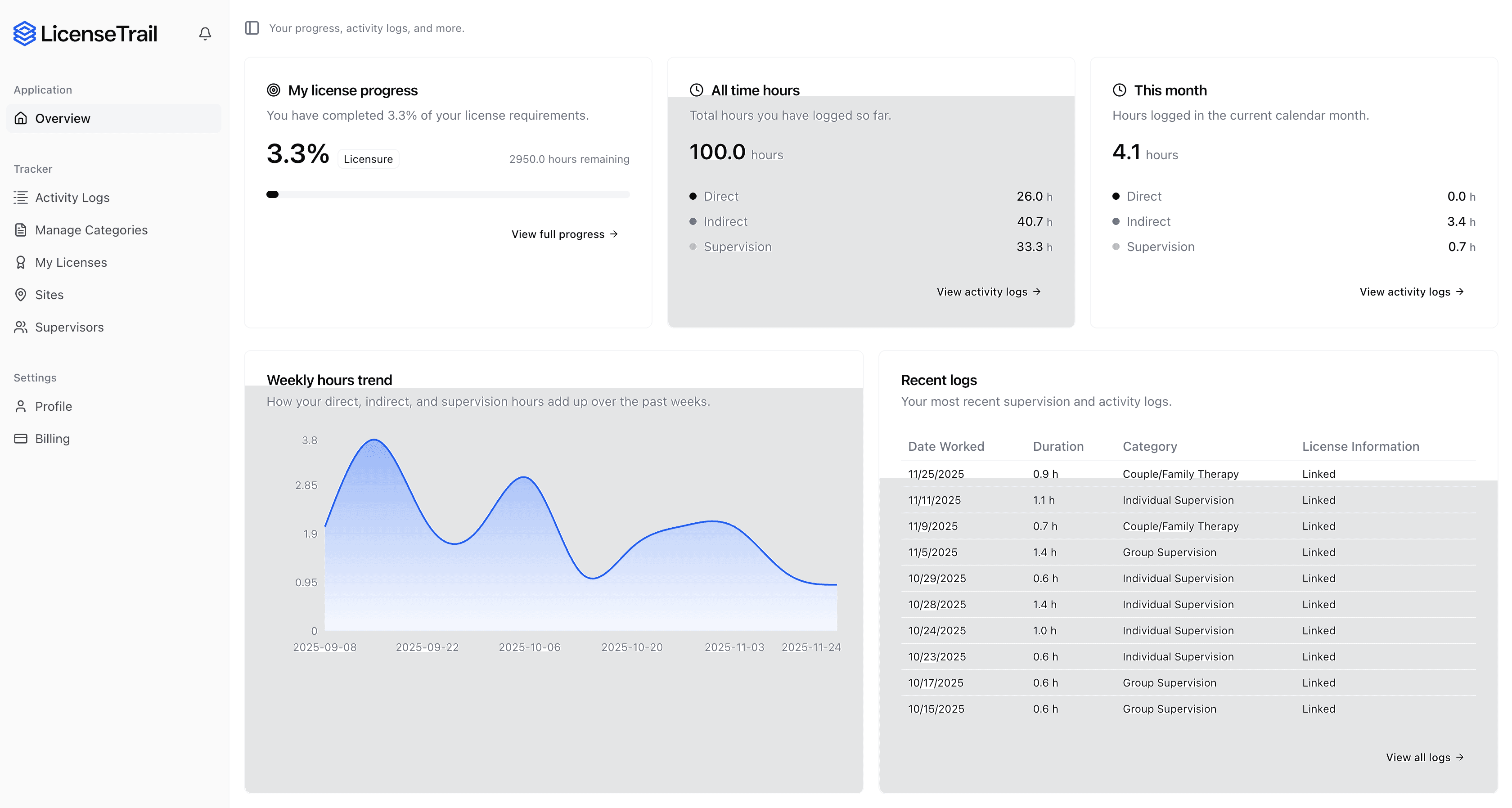
License Trail checks your direct, indirect, and supervision hours against Virginia LPC requirements continuously and flags mismatches before you submit.
 Start Tracking for Free
No credit card required · Free plan available
Is your spreadsheet hiding Virginia LPC risks?
Stop guessing if your categories match Virginia Board of Counseling requirements. License Trail checks your direct, indirect, and supervision hours continuously and flags mismatches before you submit.
Import or log
Bring your spreadsheet or start fresh
Upload your existing tracking spreadsheet and we'll map every hour into the right Virginia Board of Counseling categories automatically.
Verify against Virginia
Catch mismatches before the board does
License Trail checks your direct, indirect, and supervision hours against Virginia LPC requirements continuously.
Export board-ready
One-click clean reports
Generate professional, board-ready reports for supervision meetings and Virginia Board of Counseling submissions in seconds.
No credit card required · Free plan available