
Virginia LSATP Requirements: Hours, Exams & Step-by-Step Guide
Stop guessing if your categories match Virginia requirements. License Trail checks your direct, indirect, and supervision hours against LSATP requirements continuously and flags mismatches before you submit.
No credit card required · Free plan available
Quick Requirements Overview
- Graduate degree in substance abuse treatment or related counseling discipline; program CACREP-accredited or Board-approved
- Coursework: 60 semester / 90 quarter hours incl. counseling core + 12 semester / 18 quarter hours in substance abuse treatment competencies
- Internship (pre-degree): 600 hours total; 240 direct client hours; ≥200 direct hours treating substance-abuse-specific problems
- Resident credential required: hold Resident in Substance Abuse Treatment temporary license before accruing post-degree hours; have approved supervisor/worksite
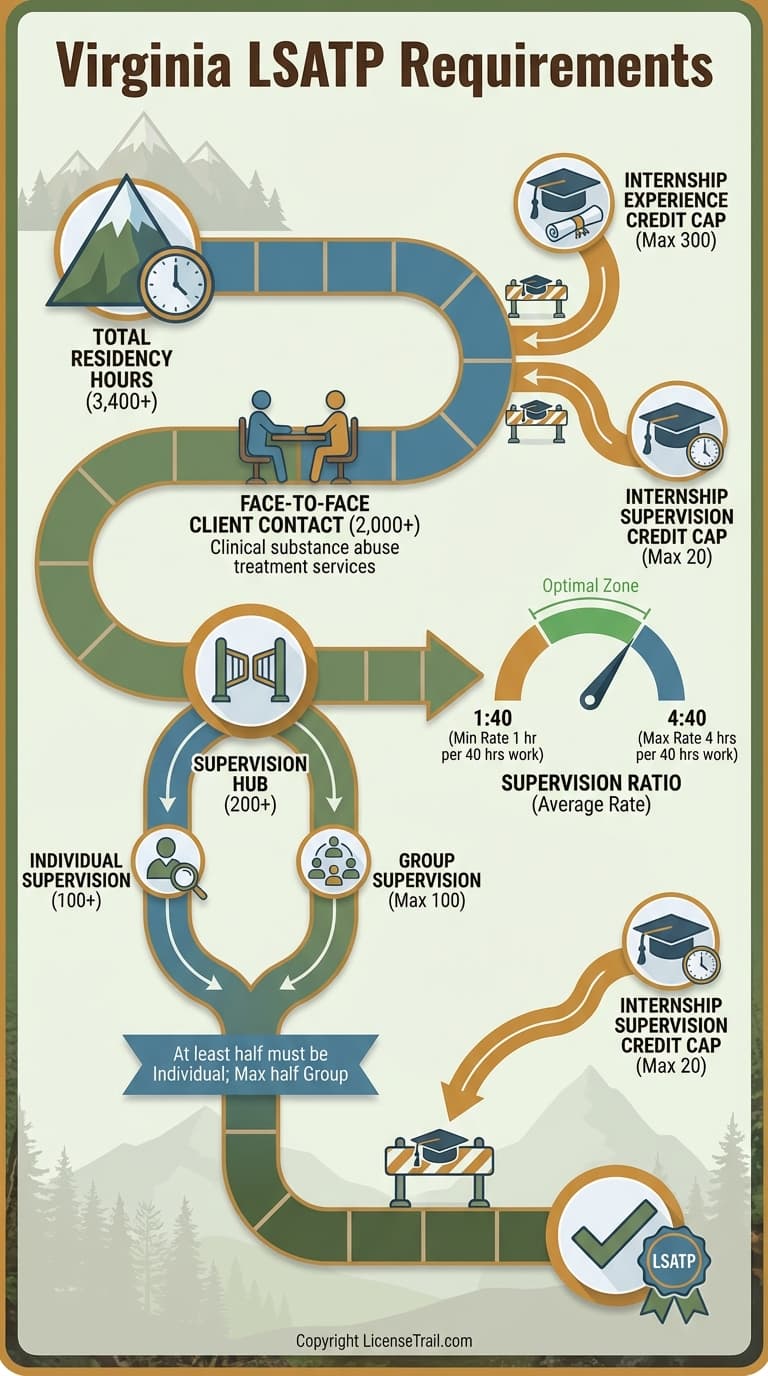
- Post-degree residency: 3,400 hours supervised substance abuse treatment experience (must span key functional areas per regulation)
- Within residency: ≥2,000 hours face-to-face clinical substance abuse treatment + ≥200 hours in-person supervision (1–4 hrs/40 worked; ≤50% group; real-time video allowed)
- Timeframe: residency completed in ≥21 months and ≤4 years (extensions require Board approval)
- Exam: pass the Master Addiction Counselor (MAC) exam; limited credit allowed from internship overages (up to 300 hours residency; up to 20 supervision hours)
License Details
Procedures
Virginia licenses independent substance use disorder clinicians under the title Licensed Substance Abuse Treatment Practitioner (LSATP). The Virginia Board of Counseling spells out the requirements in its regulations (18VAC115‑60) and in the LSATP applicant information and handbook. (dhp.virginia.gov)
The sections below walk through the requirements and, in particular, how the hours are defined and broken down.
1. License pathways and big-picture hour requirements
For someone who does not already hold an equivalent license in another state, the usual route is LSATP by Examination. That route requires: (dhp.virginia.gov)
- A qualifying graduate degree and coursework (see Section 2).
- A 600‑hour supervised internship (with 240 hours of direct client contact, including at least 200 hours treating substance-abuse-specific problems). (law.lis.virginia.gov)
- A post-degree supervised residency totaling:
- 3,400 hours of supervised residency in substance abuse treatment.
- Within those 3,400 hours:
- At least 2,000 hours of face-to-face client contact providing clinical substance abuse treatment services.
- At least 200 hours of in-person supervision with an approved supervisor. (law.lis.virginia.gov)
- Passing the Master Addiction Counselor (MAC) examination. (dhp.virginia.gov)
So, unlike a “1,500 direct / 1,500 supervised” model, Virginia uses a 3,400‑hour supervised residency, inside which you must document 2,000 hours of face-to-face clinical work plus 200 hours of in-person supervision.
2. Education and internship requirements
2.1. Graduate degree
You must complete a graduate degree that: (dhp.virginia.gov)
- “Prepares individuals to practice substance abuse treatment or a related counseling discipline” (as defined in Virginia law), and
- Is from a college/university that is either:
- CACREP‑accredited, or
- Meets the Board’s criteria for a counseling-preparation program (documented counselor-training focus, counselor-training faculty, identifiable body of counseling students, etc.).
2.2. Coursework (60 semester hours / 90 quarter hours)
The degree must include at least 60 semester hours (or 90 quarter hours) of graduate study. Within those hours you must complete: (law.lis.virginia.gov)
- A general core curriculum (minimum 3 semester hours or 4 quarter hours in each of multiple counseling areas such as professional identity/ethics, theories, techniques, group counseling, assessment, psychopathology, multicultural counseling, research, and marriage/family systems).
- 12 graduate semester hours (or 18 quarter hours) in substance abuse treatment competencies, including topics such as:
- Assessment and diagnosis specific to substance abuse.
- Treatment planning, case management, relapse prevention, referral and documentation.
- Understanding addictions (biochemical, sociocultural, psychological factors).
- Addictions and special populations.
- Client and community education.
(One course may satisfy more than one required content area, but the overall hour totals must still be met.) (law.lis.virginia.gov)
2.3. Supervised internship (pre‑licensure, during the degree)
Before starting your LSATP residency, you must complete a supervised internship that meets all of the following: (law.lis.virginia.gov)
- 600 hours total internship.
- At least 240 hours of direct client contact.
- At least 200 of those direct hours must be in treating substance-abuse‑specific treatment problems.
- Only internship hours earned after completion of 30 graduate semester hours may count toward residency hours.
Virginia allows a limited amount of this internship to count toward residency requirements:
- An internship in excess of 600 hours (if it meets LSATP program standards) may count up to an additional 300 hours toward your 3,400‑hour residency. (law.lis.virginia.gov)
- Up to 20 hours of supervision received during that internship may be counted toward the 200 in-person supervision hours if the supervision was provided by a licensed professional counselor. (law.lis.virginia.gov)
3. Temporary license: Resident in Substance Abuse Treatment
Before you can accrue post-degree supervised hours, you must hold a temporary license as a Resident in Substance Abuse Treatment. (dhp.virginia.gov)
To apply as a Resident, you must:
- Have completed:
- The qualifying graduate degree (18VAC115‑60‑60).
- The required coursework and internship (18VAC115‑60‑70).
- Have a qualified supervisor and worksite established.
- Submit the required online application, fee, NPDB report, and supporting documents as described in the Board’s Resident application instructions. (dhp.virginia.gov)
During residency you must use the title “Resident in Substance Abuse Treatment” in all written communications, and you must inform clients in writing that you are practicing under supervision and provide your supervisor’s name, professional address, and telephone number. (law.lis.virginia.gov)
4. Residency (post-degree supervised experience)
4.1. Total residency hours
The core LSATP experience requirement is: (law.lis.virginia.gov)
- No fewer than 3,400 hours in a supervised residency in substance abuse treatment.
These 3,400 hours must involve various populations, clinical problems, and theoretical approaches and must cover work in the following functional areas:
- Clinical evaluation.
- Treatment planning, documentation, and implementation.
- Referral and service coordination.
- Individual and group counseling and case management.
- Client, family, and community education.
- Professional and ethical responsibility. (law.lis.virginia.gov)
4.2. Face‑to‑face client contact hours
Within the 3,400 total residency hours, Virginia explicitly requires: (law.lis.virginia.gov)
- At least 2,000 hours of face-to-face client contact in providing clinical substance abuse treatment services to:
- Individuals,
- Families, or
- Groups of individuals suffering from the effects of substance abuse or dependence.
The remaining 1,400 hours (3,400 total minus 2,000 face-to-face) may be spent in ancillary services related to substance abuse treatment (documentation, case coordination, professional development, etc.), as long as they occur within the supervised residency framework.
4.3. Supervision hours (in‑person supervision)
The residency must also include formal supervision as follows: (law.lis.virginia.gov)
- Minimum of 200 hours of in-person supervision between the supervisor and the resident.
- Supervision must occur at a rate of at least 1 hour and no more than 4 hours per 40 hours of work experience.
- For the purpose of this 200‑hour requirement:
- In-person supervision may include use of technology that maintains client confidentiality and provides real‑time visual contact between supervisor and resident.
- No more than half of the 200 hours may be satisfied with group supervision.
- One hour of group supervision is counted as one hour of individual supervision.
- Supervision that is not concurrent with a residency will not be accepted, and residency hours cannot accrue in the absence of approved supervision.
In other words, within your 3,400 residency hours you must accumulate both:
- 2,000+ hours of direct, face-to-face clinical work and
- 200+ hours of structured, in-person supervision with a qualified supervisor.
4.4. Timeframe to complete the residency
The residency must be completed within specific time limits: (law.lis.virginia.gov)
- Minimum duration: 21 months.
- Maximum duration: 4 years.
If you do not complete the residency within four years, you must submit evidence to the Board explaining why and seek permission for the supervised experience to continue. You must also maintain your resident license in current, active status (meeting renewal requirements) throughout the residency.
4.5. Credit from internship
As noted earlier: (law.lis.virginia.gov)
- An internship over 600 hours may contribute up to 300 hours toward the 3,400 residency hours.
- Up to 20 hours of internship supervision (when provided by a licensed professional counselor) may count toward the 200‑hour supervision requirement.
4.6. Supervisors and settings
Key supervisory rules include: (law.lis.virginia.gov)
- Supervisors must hold an active, unrestricted license as:
- A professional counselor, or
- A substance abuse treatment practitioner in the jurisdiction where supervision is provided.
- Supervisors must document:
- Two years of post‑licensure substance abuse treatment experience, and
- At least 100 hours of didactic instruction in substance abuse treatment, plus specific training in supervision (a graduate course or at least 20 hours of continuing education in supervision).
- Supervision must not be provided by someone whose relationship to the resident would compromise objectivity.
- The supervisor assumes full responsibility for the clinical activities specified in the supervisory contract, must complete quarterly evaluations, and must report total residency hours and evaluate competency in the six core practice areas listed above.
5. Examination requirement
To be licensed by examination as an LSATP, you must pass the Master Addiction Counselor (MAC) examination. The Virginia Board of Counseling recognizes this exam as the qualifying test for LSATP licensure. (dhp.virginia.gov)
Typically you complete your MAC exam after (or near completion of) your residency, and then submit proof of a passing score with your LSATP by Examination application.
6. Applying for the LSATP license
Once you have:
- Completed the graduate degree and coursework requirements.
- Completed the 600‑hour internship (with the required direct client and substance-abuse‑specific hours).
- Held a Resident in Substance Abuse Treatment license and finished your:
- 3,400 supervised residency hours, including
- 2,000 face‑to‑face client contact hours, and
- 200 hours of in-person supervision
- Passed the MAC examination,
you may apply for licensure as an LSATP by Examination through the Board’s online system. (dhp.virginia.gov)
The application process generally involves:
- Completing the online LSATP by Examination application.
- Paying the required initial licensure fee.
- Arranging for official transcripts, verification of residency/supervision, and exam results to be sent as specified in the LSATP Licensure Process Handbook.
- Providing any additional documentation the Board requests (e.g., NPDB report, disciplinary history information).
7. Endorsement pathway (for out‑of‑state licensees)
If you already hold a substantially equivalent substance abuse treatment license in another jurisdiction or meet the Board’s criteria based on other credentials, you may apply for LSATP by Endorsement instead of completing a Virginia residency. (dhp.virginia.gov)
The endorsement route evaluates:
- Equivalency of your license and education,
- Your supervised experience and practice history, and
- Your disciplinary record.
The specific documentation and standards are laid out in 18VAC115‑60‑50 and the LSATP by Endorsement application materials.
8. Quick numerical summary of LSATP experience hours
For convenience, the core hour-related requirements for LSATP (by Examination) are:
During the degree (internship): (law.lis.virginia.gov)
- 600 hours internship (minimum)
- 240 hours direct client contact
- 200 of those hours substance-abuse‑specific
Post-degree residency (under Resident license): (law.lis.virginia.gov)
- 3,400 total residency hours, including:
- 2,000+ hours face‑to‑face client contact providing clinical substance abuse treatment.
- 200+ hours in‑person supervision (1–4 per 40 hours of work; ≤50% via group).
- Completion timeframe: at least 21 months and no more than 4 years.
- Up to 300 residency hours and 20 supervision hours may be drawn from an internship that exceeds minimums (if it meets the regulatory standards).
These numbers and terms come directly from the Virginia Administrative Code and the Virginia Board of Counseling’s LSATP application information pages, and they represent the requirements in effect as of late 2025. (dhp.virginia.gov)
Track your LSATP hours with confidence
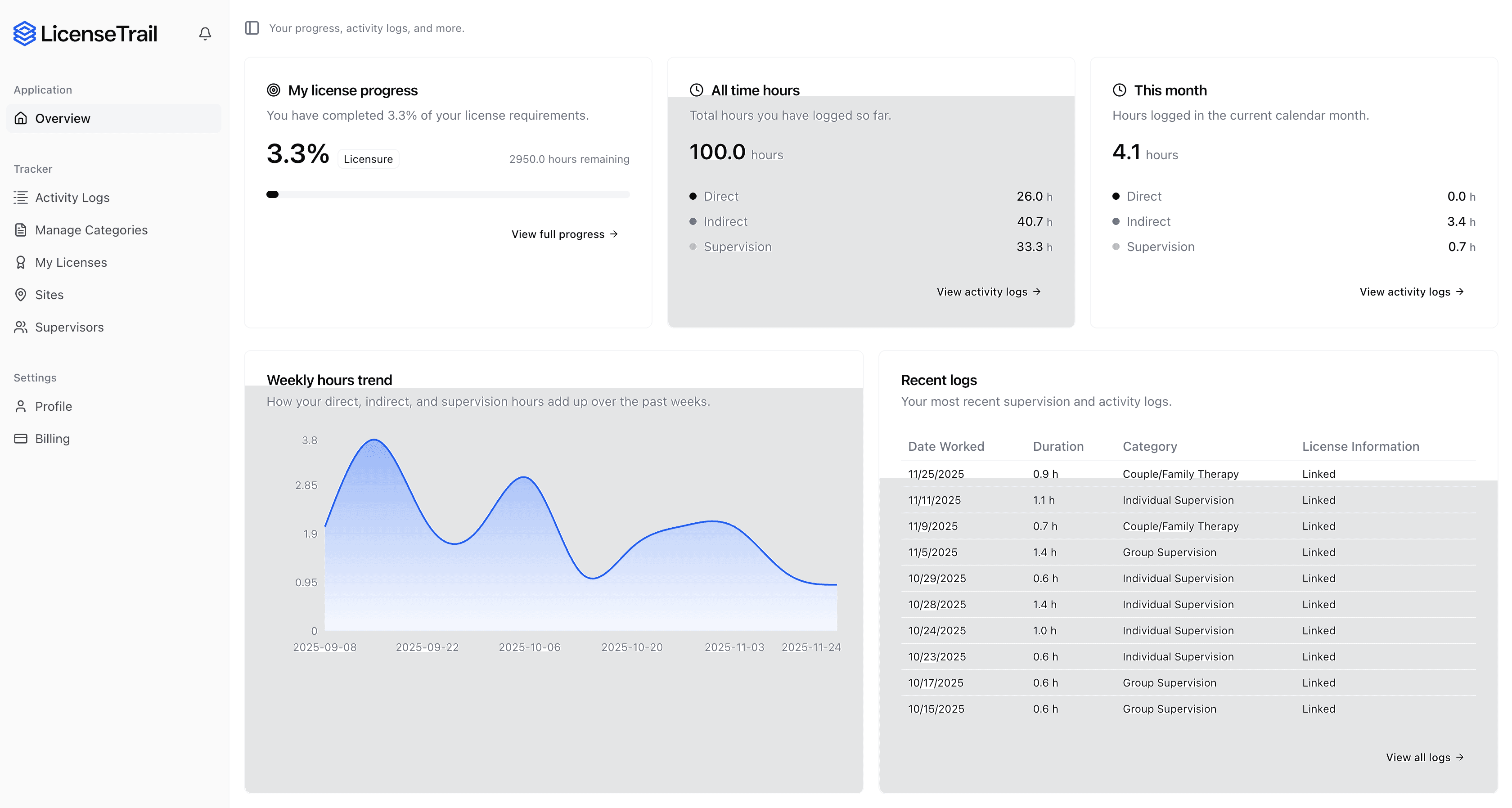
License Trail checks your direct, indirect, and supervision hours against Virginia LSATP requirements continuously and flags mismatches before you submit.
 Start Tracking for Free
No credit card required · Free plan available
Is your spreadsheet hiding Virginia LSATP risks?
Stop guessing if your categories match Virginia Board of Counseling requirements. License Trail checks your direct, indirect, and supervision hours continuously and flags mismatches before you submit.
Import or log
Bring your spreadsheet or start fresh
Upload your existing tracking spreadsheet and we'll map every hour into the right Virginia Board of Counseling categories automatically.
Verify against Virginia
Catch mismatches before the board does
License Trail checks your direct, indirect, and supervision hours against Virginia LSATP requirements continuously.
Export board-ready
One-click clean reports
Generate professional, board-ready reports for supervision meetings and Virginia Board of Counseling submissions in seconds.
No credit card required · Free plan available