
Virginia LP Requirements: Hours, Exams & Step-by-Step Guide
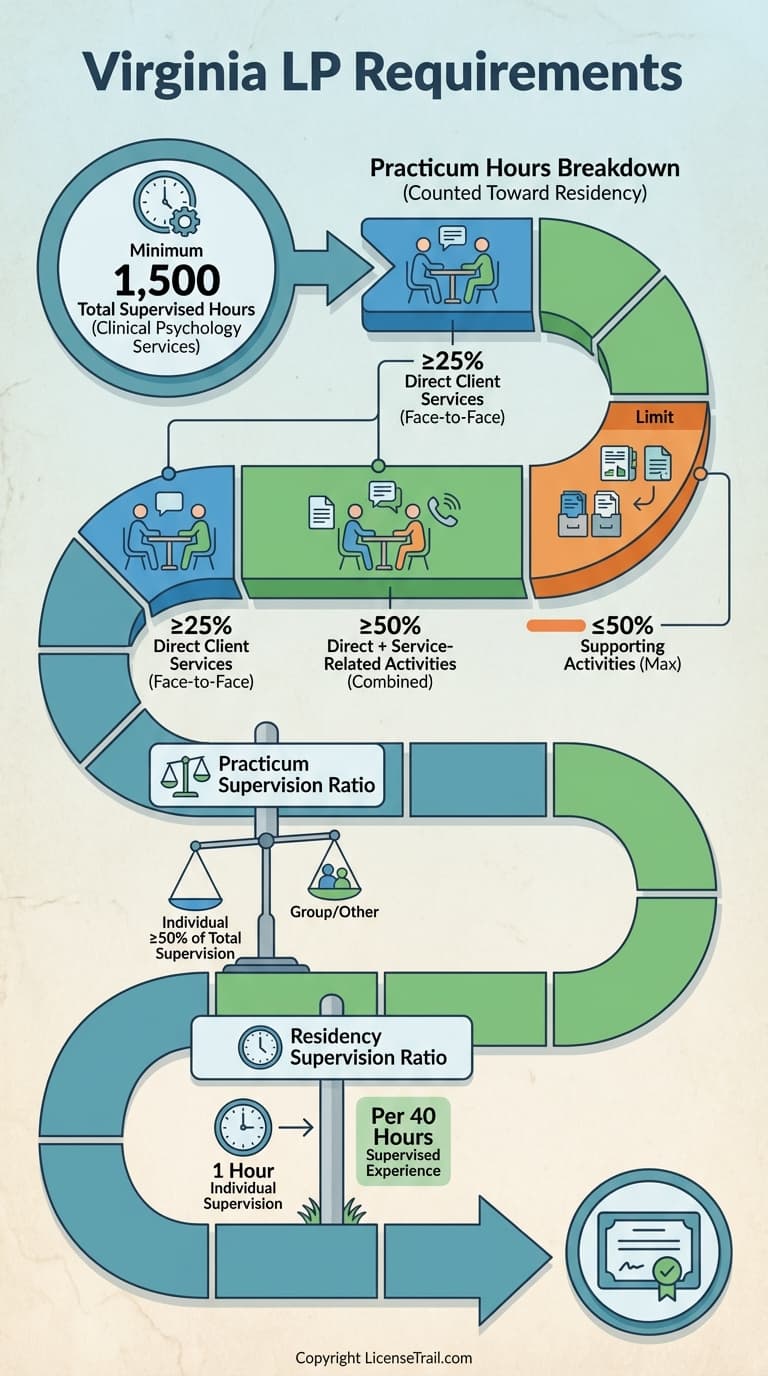
Stop guessing if your categories match Virginia requirements. License Trail checks your direct, indirect, and supervision hours against LP requirements continuously and flags mismatches before you submit.
No credit card required · Free plan available
Quick Requirements Overview
- Provided text describes West Virginia (WV) LP pathway (not VA); VA requirements can’t be confirmed from this source
- Doctoral degree in psychology required for LP track (Ph.D. or Psy.D. treated as equivalent)
- Predoctoral internship: 1,800 hours required; internship must be an organized training program in psychological services
- Within internship: ≥500 hours direct client contact (≥50% of time)
- Internship supervision minimums: 2 hrs/week individual + 2 hrs/week additional learning activities; complete full-time within 24 months (waiver possible)
- Post-degree supervised experience: may be waived if full 1,800-hour internship documented; otherwise 1 year required if <1,800 hours; 2 years if no internship
- While supervised: use title “Supervised-Psychologist”; supervision at least 1 hr per 20 clinical hours (min 1 hr/week); reports countersigned; quarterly reporting/logs
- Exams: Jurisprudence exam, EPPP Part 1, and Board oral exam required before full licensure
License Details
Procedures
Becoming a doctoral‑level licensed psychologist (LP) in West Virginia is structured around a specific combination of education, an 1,800‑hour predoctoral internship, and—if needed—additional supervised experience. The West Virginia Board of Examiners of Psychologists derives these requirements from West Virginia Code §30‑21 and its own Legislative Rules (Title 17, Series 3).
Below is a step‑by‑step guide focused on the actual hour counts and the Board’s own terminology.
1. Degree requirement
West Virginia law requires either a doctoral or a master’s degree in psychology, but the LP pathway you are asking about is the doctoral route.
Under W. Va. Code §30‑21‑7(a): an applicant must hold “a doctor of philosophy degree or its equivalent or a master’s degree in psychology from an accredited institution of higher learning.” (code.wvlegislature.gov)
The Board’s doctoral‑level rule clarifies that a Psy.D. is treated as equivalent to the Ph.D.: “The Psy.D. is determined to be equivalent to the Ph.D.” (regulations.justia.com)
For an LP‑type license (independent practice as a psychologist), you should assume a doctoral degree (Ph.D. or Psy.D.) in psychology from an accredited institution, with coursework that the Board deems “psychological in nature.” (regulations.justia.com)
2. Required predoctoral internship: 1,800 hours
Statutory hour requirement
For doctoral applicants, state law is very explicit:
“When the degree held is a doctor of philosophy degree or its equivalent, at least one thousand and eight hundred hours must be a predoctoral internship in the performance of any of the psychological services described in… §30‑21‑2.” (code.wvlegislature.gov)
So, at minimum you need:
- 1,800 hours of predoctoral internship in psychology.
These 1,800 hours must be accrued in an internship that involves the types of activities in the statutory definition of the “practice of psychology” (assessment, psychotherapy, consultation, etc.), not just generic human‑services work. (code.wvlegislature.gov)
Board rule: what an “acceptable formal one‑year internship” looks like
The Board’s Doctoral Level Training Requirements specify what counts as an acceptable internship. Key points for hours and activities: (regulations.justia.com)
- The internship must be “an organized training program” (not just on‑the‑job training).
- Primary purpose: ensure “breadth and quality of training.”
- Supervision must be under licensed psychologists; at least 75% of supervision is provided by two or more psychologists.
- It must provide training across assessment, consultation and treatment activities conducted directly with clients, agencies, or organizations.
Crucially for hours:
-
Direct client contact:
“At least fifty percent (50%) of the intern’s time shall involve direct contact with clients… (minimum 500 hours).” (regulations.justia.com)- This is the Board’s explicit minimum for direct service hours within the 1,800‑hour internship.
- In other words, of the 1,800 supervised internship hours, at least 500 must be direct client (or agency/organization) contact.
-
Individual supervision during internship:
The internship must include:- 2 hours per week of “regularly scheduled, formal, face‑to‑face, individual supervision” (based on a 40‑hour workweek), and
- 2 additional hours per week in “learning activities such as case conferences, seminars, co‑therapy, group supervision, and additional individual supervision.” (regulations.justia.com)
-
Time frame:
The internship is to be full time (per APA standards) and completed within 24 months, except in “exceptional circumstances” where the Board may waive this. (regulations.justia.com)
So, West Virginia’s structure is not “1,500 direct + 1,500 supervised” or a similar split. Instead it is:
- 1,800 total predoctoral internship hours, of which
- At least 500 are direct client contact, and
- Supervision is embedded at the minimum weekly rates above.
3. How the supervised‑experience requirement works (and when you need post‑degree supervision)
The supervised‑experience requirement for doctoral applicants is framed in years rather than a fixed extra hour count.
Baseline rule: one year of Board‑approved supervised experience
The Board’s supervision rule states:
- “When the applicant holds a Ph.D. or the equivalent, W. Va. Code §30‑21‑7(a)(4) requires at least one year of Board‑approved supervised experience.” (regulations.justia.com)
A “year” is defined not in raw hours but as:
- “Twelve (12) average work months” of full‑time employment; for part‑time work, credit is prorated by dividing hours/week by 40 and applying that fraction to the months worked. (regulations.justia.com)
However, the doctoral rule then allows the 1,800‑hour internship to satisfy that “year” in many cases.
Critical exception: waiving the year of supervised experience with a full 1,800‑hour internship
Under §17‑3‑4.5: (regulations.justia.com)
-
If you hold a doctorate and have completed at least 1,800 hours in a predoctoral internship,
- You may apply to the Board to waive the year of supervision required by §30‑21‑7.
- You must supply documentation of the internship.
- If you are working in WV before full licensure, you still must identify a Board‑approved supervisor and practice under supervision (as a “Supervised‑Psychologist”) until you pass the EPPP and oral exam.
-
If you have a doctorate but have not completed 1,800 hours of predoctoral internship:
- You must complete one year of Board‑approved supervision.
-
If you did not complete an internship at all:
- You are “required to have an additional year of Board‑approved supervision beyond the required one year” (i.e., two years of supervised experience).
In practice, for most current doctoral graduates with an APA‑approved or equivalent 1,800‑hour internship:
- The 1,800‑hour internship is the core supervised‑hours requirement.
- Additional supervised experience is only required if the internship is less than 1,800 hours or if there was no internship.
What counts as acceptable supervised experience (post‑degree)
For any required Board‑approved supervised experience, the Board defines “adequacy of supervised experience” as follows: (regulations.justia.com)
- The supervised‑psychologist must be engaged in the “practice of psychology” as defined in W. Va. Code §30‑21‑2.
- Experience cannot be limited to “essentially repetitious and routine tasks at the pre‑professional level,” such as:
- Only administering and scoring structured tests,
- Computing statistics,
- Merely assisting in courses.
- Acceptable experience includes tasks that apply professional psychological skills and concepts, such as:
- Administering and interpreting tests (including unstructured tests),
- Psychological evaluation, prevention, and treatment of adjustment problems,
- Providing assistance to clients in solving professional or personal problems.
- For university clinical faculty, some supervised teaching, supervising, and research can count, but these may not exceed 50% of the total supervised hours.
- The experience must be under the supervision of a licensed psychologist competent in the relevant area; independent private practice does not count as supervised experience.
The Board does not assign a fixed number of additional post‑doctoral hours (like “1,500 postdoc hours”). Instead, it treats the requirement as one or two “years” of supervised work, defined by full‑time months and the supervision structure described next.
4. Supervision structure and the “Supervised‑Psychologist” role
Title while accruing supervised experience
Anyone providing psychological services who is not yet licensed and is obtaining required supervised experience must work “under the critical observation of a licensee.” (regulations.justia.com)
Applicants for licensure in this category:
- “Shall refer to himself or herself and sign all work as: Supervised‑Psychologist.” (regulations.justia.com)
You may not use the unqualified title “psychologist” for independent practice until fully licensed.
Required supervision ratio and format (during supervised practice)
The Board’s supervision standards for applicants for licensure require: (regulations.justia.com)
- You must be “supervised directly by a licensee.”
- Supervisors must provide at least:
- 1 hour of individual supervision for every 20 hours of your clinical practice, with a minimum of 1 hour per week regardless of hours worked.
- Individual supervision sessions must occur at least every 2 weeks.
- “Individual supervision” is defined as a face‑to‑face, private interaction between supervisor and supervised‑psychologist.
- The supervisor must be available for telephone consultation during business/practice hours.
- All psychological reports and professional opinions you render as a supervised‑psychologist must be countersigned by your supervisor.
- The supervisor must keep a log of supervision sessions and submit quarterly reports to the Board.
For full‑time supervisees, the Board’s supervision contracts further specify: (law.cornell.edu)
- At least 6 hours per month of individual face‑to‑face supervision.
- Up to 2 hours per month of group or multidisciplinary supervision can be counted towards the total supervision requirement (as detailed in the individual supervision contract).
- At least once per quarter, one of the required individual face‑to‑face sessions must occur at the location where you are providing services.
- You must generally be a W‑2 employee of the supervisor or agency (independent contracting is reserved for psychologists already licensed for independent practice).
A licensee may supervise no more than four candidates for licensure at one time. (law.cornell.edu)
Supervisors themselves must meet specific Board‑approved supervisor training requirements (either a 3‑credit graduate course in supervision or 14 hours of Board‑approved supervision training, plus at least two years of licensure and a clean ethical record). (regulations.justia.com)
5. Examinations required for LP licensure
Once degree and supervised experience requirements are met (or in some cases while supervised practice continues), you must complete the examination sequence.
5.1 West Virginia Jurisprudence Examination
Board‑specific requirement (summarized in current licensure guidance): (research.com)
- All applicants must pass a Jurisprudence Examination covering West Virginia laws, rules, and ethics governing psychology.
- It consists of approximately 50 true‑false and multiple‑choice questions.
- A passing score of 75% is typically required.
- Current guidance indicates the jurisprudence exam must be passed before you are approved to sit for the EPPP.
(The Board could update format or score requirements, so candidates should always check the current instructions.)
5.2 National Examination: EPPP (Part 1)
West Virginia uses the Examination for Professional Practice in Psychology (EPPP) Part 1 as its national standardized exam. (research.com)
- The Board has not adopted EPPP Part 2 at this time.
- Passing standards are commonly expressed as 70% or a scaled score of 500 on the computer‑based exam (as summarized in recent guidance), though the exact cutoff is set by the Board in consultation with ASPPB.
5.3 Oral examination by the Board
In addition to the EPPP, West Virginia requires an oral examination conducted by the Board: (research.com)
- The oral exam is designed to evaluate:
- Ethics and legal knowledge,
- Professional competence and judgment,
- Your ability to limit practice to areas in which you have been trained and supervised.
- Successful completion of the oral examination is part of the final licensure decision.
6. How the pieces fit together for a typical doctoral applicant (LP track)
Putting the requirements into a practical sequence, a typical doctoral‑level applicant aiming for LP licensure in West Virginia would:
-
Complete an APA‑approved or Board‑equivalent doctoral program in psychology (Ph.D. or Psy.D.) that meets West Virginia’s curricular expectations. (regulations.justia.com)
-
Complete an acceptable predoctoral internship that meets all of the following:
- At least 1,800 total internship hours.
- At least 500 hours of direct client (or agency/organization) contact.
- Supervision of at least 2 hours/week of individual supervision and 2 hours/week of additional learning activities, typically over a full‑time year completed within 24 months. (regulations.justia.com)
-
Apply to the Board for supervision status and/or waiver of the additional supervision year:
- If you have a full 1,800‑hour internship, you may request that the Board waive the statutory “one year of Board‑approved supervised experience” based on that internship.
- If you did not reach 1,800 internship hours or had no internship, you must complete one or two years (respectively) of Board‑approved supervised experience, under the supervision structure described above. (regulations.justia.com)
-
Work under supervision as a “Supervised‑Psychologist” (if required), complying with:
- The 1:20 supervision ratio (1 hour individual supervision per 20 hours clinical practice, minimum 1 hour/week).
- Face‑to‑face, private supervision at least every two weeks.
- Supervisor countersigning reports.
- Quarterly supervision reports to the Board. (regulations.justia.com)
-
Pass the West Virginia Jurisprudence Examination, then pass the EPPP (Part 1). (research.com)
-
Pass the Board’s oral examination.
-
Receive full licensure as a psychologist from the West Virginia Board of Examiners of Psychologists, authorizing independent practice (what you are referring to as LP).
7. Hour summary in plain terms
To directly answer your hours question with the Board’s own structure:
-
Predoctoral internship (mandatory for doctoral applicants)
- 1,800 hours of supervised predoctoral internship in the practice of psychology. (code.wvlegislature.gov)
- Of those, at least 500 hours must be direct client contact. (regulations.justia.com)
- Internship includes weekly individual and group/learning supervision at specified minimums.
-
Additional supervised experience (post‑degree), if required
- If you have the full 1,800‑hour internship:
- You may have the statutory “one year” of supervised experience waived (though you still practice under supervision until fully licensed).
- If you have <1,800 internship hours:
- 1 year of Board‑approved supervised experience is required.
- If you have no internship:
- 2 years of Board‑approved supervised experience are required. (regulations.justia.com)
- If you have the full 1,800‑hour internship:
These post‑degree supervised periods are measured in years (12 work months, prorated for part‑time) rather than a fixed additional hour count like “1,500 postdoctoral hours.”
In other words, West Virginia’s current model for doctoral‑level psychologist licensure is built around:
- 1,800 predoctoral internship hours with a 500‑hour direct contact minimum, plus
- Zero, one, or two years of Board‑approved supervised experience, depending on the completeness of that internship, all under tightly defined supervision ratios and titles.
Track your LP hours with confidence
License Trail checks your direct, indirect, and supervision hours against Virginia LP requirements continuously and flags mismatches before you submit.
 Start Tracking for Free
No credit card required · Free plan available
Is your spreadsheet hiding Virginia LP risks?
Stop guessing if your categories match West Virginia Board of Examiners of Psychologists requirements. License Trail checks your direct, indirect, and supervision hours continuously and flags mismatches before you submit.
Import or log
Bring your spreadsheet or start fresh
Upload your existing tracking spreadsheet and we'll map every hour into the right West Virginia Board of Examiners of Psychologists categories automatically.
Verify against Virginia
Catch mismatches before the board does
License Trail checks your direct, indirect, and supervision hours against Virginia LP requirements continuously.
Export board-ready
One-click clean reports
Generate professional, board-ready reports for supervision meetings and West Virginia Board of Examiners of Psychologists submissions in seconds.
No credit card required · Free plan available