
Virginia LSP-II Requirements: Hours, Exams & Step-by-Step Guide
Stop guessing if your categories match Virginia requirements. License Trail checks your direct, indirect, and supervision hours against LSP-II requirements continuously and flags mismatches before you submit.
No credit card required · Free plan available
Quick Requirements Overview
- Qualifying School Psychology degree (MA/MS, Ed.S., CAS, or PhD) from a regionally accredited institution; coursework relevant to WV Code §30‑21 practice scope
- Entry to LSP‑II: meet Level I Licensed School Psychologist minimums or hold a doctoral degree in school psychology
- Employment status during supervision: must be a W‑2 employee (1099 work not counted toward supervised experience)
- Obtain/maintain Board-approved supervised status (“Gold Card”) with annual renewal + fee + CE documentation
- Level II supervision requirement (school calendar years, not fixed hours):
- Master’s/Ed.S./CAS: 2 additional school calendar years beyond Level I
- Doctoral w/ internship: 1 school calendar year; without internship: 2 school calendar years
- Documentation while supervised: quarterly reports (4x/yr) logging face-to-face supervision hours + psychology work hours; supervisor maintains supervision log
- CE during supervised status: 10 CE hours per full year, incl. 1.5 ethics, required for Gold Card renewal
- Exams: Praxis School Psychology (NASP cutoff noted as 147, score valid 10 years) + Board oral exam for independent practice issuance
License Details
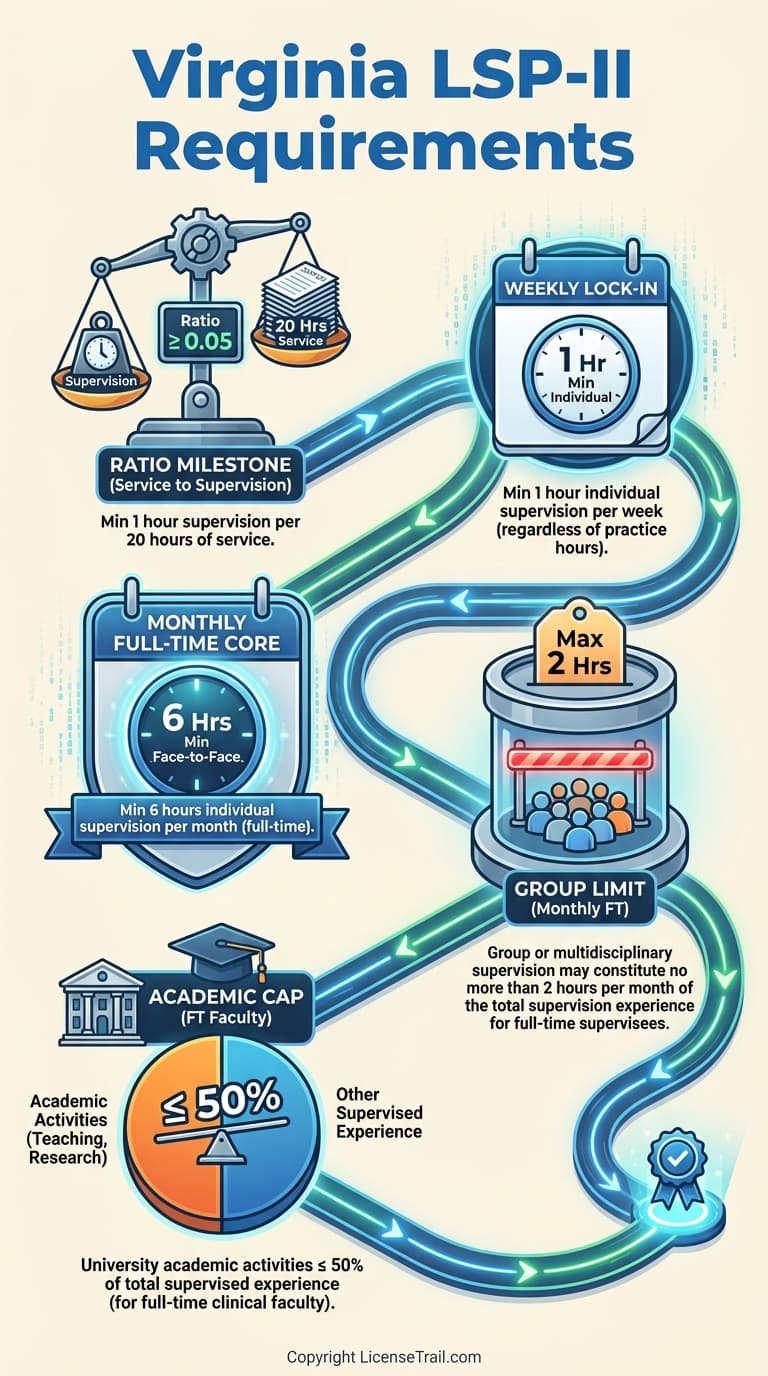
Procedures
In West Virginia, the Licensed School Psychologist Independent Practitioner (LSP‑II, “Licensed School Psychologist Independent Practitioner, Level II”) is the credential that allows a school psychologist to practice independently, including outside of school settings and for a fee. It is issued by the West Virginia Board of Examiners of Psychologists under West Virginia Code §30‑21 and the Board’s own licensure rules. (code.wvlegislature.gov)
What follows is a step‑by‑step guide, focused on the Board’s own terminology and on the types of hours and supervised experience it requires.
1. Understand what the LSP‑II license allows
West Virginia law defines a “Licensed School Psychologist Independent Practitioner (Level II)” as a school psychologist who:
- Provides school psychology services to individuals or the public
- May work on school board or non‑school board property
- Provides services for a fee or other compensation, or as a school board employee or contractee (law.cornell.edu)
In other words, LSP‑II is the credential that lets a school psychologist legally provide services in private practice (and other non‑school-board settings) in addition to work for school boards.
2. Meet the education requirements
The Board’s “School Psychology Level 2 – Master’s or Doctoral Level Requirements” document sets out the basic educational standards. (psychbd.wv.gov)
-
Acceptable degrees
To apply for LSP‑II you must hold one of the following in school psychology from a regionally accredited institution: (psychbd.wv.gov)
- Master’s (M.A., M.S., etc.) in school psychology
- Educational Specialist (Ed.S.) in school psychology
- Certificate of Advanced Study (CAS) in school psychology
- Doctoral degree in school psychology
The Board states that core coursework must be “relevant to the practice of school psychology as defined under WV Code §30‑21‑2.” (psychbd.wv.gov)
-
Accreditation of the graduate institution
The graduate institution must be accredited by one of the six regional accrediting bodies (e.g., Middle States, Southern Association of Colleges and Schools, etc.), which the Board lists explicitly in the Level 2 requirements. (psychbd.wv.gov)
3. Satisfy the Level I (Licensed School Psychologist) requirements – Master’s/Specialist route
Unless you hold a doctoral degree in school psychology, you must first qualify as a Licensed School Psychologist (Level I) and then add the extra supervision for Level II. (code.wvlegislature.gov)
Key Level I points that matter for the Level II path:
-
Employment condition
For Level I, you must be employed by a West Virginia school board as a school psychologist while you work toward the license. (psychbd.wv.gov)
-
Supervised experience – measured in school calendar years, not a fixed hour total
The Board specifies that Level I supervised‑psychologists who hold a master’s, CAS, or Ed.S. must complete: (psychbd.wv.gov)
- Three school calendar years of supervision in school psychology
- If a qualifying internship was required to complete the degree, one school calendar year of supervision is credited, so only two additional school calendar years are required.
- If the school psychologist has already worked for a county school board for at least two years after graduation, the supervision period may be reduced to one‑half of a school calendar year. (psychbd.wv.gov)
The Board does not publish a specific numeric requirement such as 1,500 or 3,000 total hours for Level I. Instead, it uses school calendar years of supervised practice, and it tracks hours through quarterly reporting (see below).
-
Types of hours you must document while supervised
For both Level I and Level II supervised status, the Board requires quarterly reporting that explicitly breaks out two categories of hours: (psychbd.wv.gov)
- “Face to face supervision hours” – time spent directly in supervision with your Board‑approved supervisor
- “Psychology work hours” – hours of school psychology services you provide as the supervisee
These are reported four times per year on Board‑supplied quarterly report forms and supported by a supervision log maintained by the supervisor. (psychbd.wv.gov)
-
Continuing education hours during supervision
While in supervised status (Level I or Level II), you must complete 10 hours of continuing education per full year, including 1.5 hours in ethics, to renew your supervised status (the “Gold Card,” discussed below). (psychbd.wv.gov)
-
Level I examinations
For Level I, the Board requires: (psychbd.wv.gov)
- A passing score on the Praxis School Psychology exam at the level required by NASP (currently a score of 147; older score thresholds apply for exams taken before 2014).
- An oral examination by the Board, which you can take after completing the required number of supervision hours and at least two or three years of full‑time supervision, depending on how your experience credits are applied. (psychbd.wv.gov)
After successful completion of Level I supervision, Praxis, and oral exam, the Board issues a Level I school psychology license.
4. Establish eligibility specifically for Level II (LSP‑II)
To enter the Level II track, the Board’s rules and its Level 2 requirements document specify that you must: (code.wvlegislature.gov)
- Meet all minimum requirements for Licensed School Psychologist (Level I) or
- Hold a doctoral degree in school psychology.
The statute, at §30‑21‑7c, states that an applicant for Licensed School Psychologist Independent Practitioner must: (code.wvlegislature.gov)
- Meet all minimum eligibility requirements for a licensed school psychologist (Level I)
- Complete two additional years of board‑approved supervision by a licensed school psychologist
- Pass an oral examination conducted by the Board
The Level 2 Board document refines how those “additional years of supervision” are handled for master’s vs. doctoral applicants and what competencies must be covered.
5. Register as a supervised Level II candidate and obtain the “Gold Card”
Before beginning Level II supervised practice, you must become a “Level 2 Supervised‑School Psychologist” under a Board‑approved supervisor. (psychbd.wv.gov)
Key points:
-
W‑2 employment requirement
The Board requires that all supervised‑school psychologists (including Level II candidates) be W‑2 employees, and you must submit evidence of this employment with your application. You cannot count independent contractor (1099) work as supervised experience for this license. (psychbd.wv.gov)
-
Gold Card
Once your supervision plan is approved, the Board issues a “Gold Card” that: (psychbd.wv.gov)
- Confirms you are a Board‑approved supervised school psychologist
- Lists the Board‑approved supervisor(s) for your Level II supervision
- Must be renewed annually, with submission of:
- A renewal form
- CE certificates and a CE audit form
- The required fee
6. Complete the required Level II supervised experience
The Level II supervised experience is again specified in school calendar years, with different requirements depending on whether you are a master’s/specialist‑level or doctoral‑level candidate.
6.1 Master’s / Ed.S. / CAS route (coming from Level I)
For applicants trained below the doctoral level who already meet Level I requirements, the Board’s Level 2 document states that “Level 2 Supervised‑School Psychologists shall complete 2 additional school calendar years of supervision” in Level II practice. (psychbd.wv.gov)
During these two school calendar years:
- Supervision must cover “all aspects of the Level 2 professional practice,” as described in the Board’s procedural rules (Title 17, Series 3, Section 17.4). (psychbd.wv.gov)
- The Level 2 supervisee must gain competency in:
- Record keeping
- In‑school crisis intervention
- Duty issues and liability issues
- Client/patient abandonment concerns
- Confidentiality concerns
- Court‑related issues
- Business issues
- Supervision of other licensees
- Professional practice ethics (psychbd.wv.gov)
The Board allows these competencies to be acquired through actual private practice experience, interaction with the supervisor, or formal instruction. (psychbd.wv.gov)
The Board suggests but does not require that Level 2 supervisees gain on‑the‑job experience in a private practice setting during these two school calendar years. If the supervisee does work in private practice while supervised: (psychbd.wv.gov)
- All psychological work must be co‑signed by the supervisor.
- It remains the joint responsibility of the supervisee and supervisor to ensure the candidate is fully prepared for independent Level 2 practice.
6.2 Doctoral route
For applicants holding a doctoral degree in school psychology, the Level 2 supervision requirement is shorter but still defined in school calendar years: (psychbd.wv.gov)
- If a qualifying internship was completed as part of the doctoral program:
- One school calendar year of supervision is required for Level 2.
- If no internship was completed:
- Two school calendar years of supervision are required.
The same categories of competencies (liability, crisis, business, ethics, etc.) and documentation of hours apply.
6.3 Types of hours and how they are tracked (for both routes)
The Board again focuses on years plus documented hours, not a fixed required number such as “1,500 direct hours.” The Level 2 document and the supervision section of the Board’s website make clear that: (psychbd.wv.gov)
- Quarterly reports must be submitted four times per year while supervised.
- These reports must list:
- Face‑to‑face supervision hours (time in supervision meetings)
- Psychology work hours (total hours of service provision / school psychology work)
Supervisors must maintain a supervision log corresponding to those reported hours. (psychbd.wv.gov)
The Board’s published Level 1 and Level 2 requirements and the relevant statute do not specify a fixed total number of hours (e.g., “1,500 direct and 1,500 supervised”) for LSP‑II. Instead, they require:
- A defined number of school calendar years of supervised practice
- Ongoing documentation of supervision hours and work hours each quarter
- CE hours each year during supervision
7. Examination requirements for Level II
Two examinations are relevant to LSP‑II:
-
Praxis School Psychology Exam
For both Level I and Level II, candidates must pass the national Praxis School Psychologist exam at the score required for NASP certification. The Board currently notes: (psychbd.wv.gov)
- Passing score: 147 (for exams under the current format)
- Scores remain valid for 10 years; older scores require retaking the exam.
- Different minimum passing scores apply if the exam was taken:
- Between 2008–2014: 165 or higher
- Before September 2008 (pre‑revision): 660 or higher
-
Board oral examination
After completing the required number of supervision hours and at least one or two years of full‑time Level 2 supervision (depending on degree and internship), the Level 2 supervised‑school psychologist becomes eligible to sit for the Board’s oral examination. (psychbd.wv.gov)
- The oral exam assesses whether you are ready for independent practice as a Licensed School Psychologist Independent Practitioner (Level II).
- On successful passage of the oral exam, the Board issues the Level II psychology license.
8. Issuance of the LSP‑II license and ongoing obligations
Once you have:
- Met the educational requirements
- Completed Level I requirements (if applicable)
- Completed the required Level II supervised school calendar year(s) with documented supervision and work hours
- Maintained required CE hours during supervision
- Passed the Praxis School Psychology exam
- Passed the Board’s oral examination
…the West Virginia Board of Examiners of Psychologists issues a Licensed School Psychologist Independent Practitioner (Level II) license. (code.wvlegislature.gov)
As a Level II licensee, you may:
- Provide school psychology services on school board or non‑school board property
- Provide services to individuals or the public for a fee or other compensation
- Continue to work as a school board employee or contractee if you choose (law.cornell.edu)
The Board’s general licensing provisions then govern renewal and continuing education for the license itself, separate from the 10 CE hours per year that applied while you held supervised (“Gold Card”) status. (code.wvlegislature.gov)
Summary of “hours” for LSP‑II, in the Board’s own framework
-
Supervised practice is specified in school calendar years, not in fixed hour totals.
- Master’s/specialist Level II candidate: 2 additional school calendar years of Level II supervision beyond Level I.
- Doctoral Level II candidate with internship: 1 school calendar year of supervision.
- Doctoral Level II candidate without internship: 2 school calendar years of supervision. (psychbd.wv.gov)
-
During those years you must document, each quarter:
- Face‑to‑face supervision hours
- Psychology work hours (service hours) (psychbd.wv.gov)
-
While supervised, you must complete 10 hours of continuing education per year, including 1.5 hours in ethics, to renew your Gold Card supervised status. (psychbd.wv.gov)
The Board’s published rules do not state a requirement such as “1,500 hours of direct experience plus 1,500 hours of supervised experience” for LSP‑II. Instead, they rely on defined school calendar years of supervised work coupled with documented supervision and work hours and examination and competency requirements.
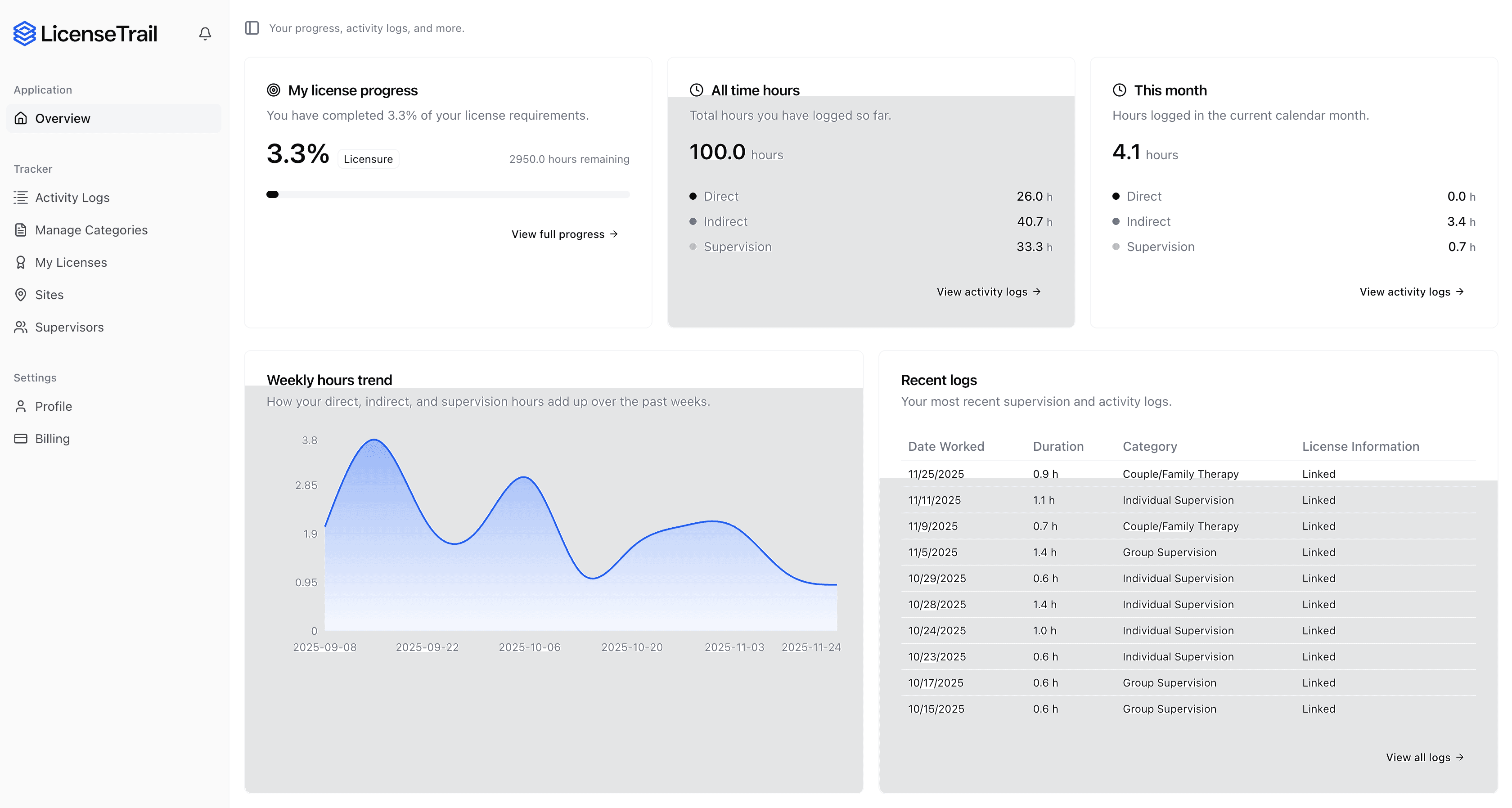
Track your LSP-II hours with confidence
License Trail checks your direct, indirect, and supervision hours against Virginia LSP-II requirements continuously and flags mismatches before you submit.
 Start Tracking for Free
No credit card required · Free plan available
Related Licenses
Is your spreadsheet hiding Virginia LSP-II risks?
Stop guessing if your categories match West Virginia Board of Examiners of Psychologists requirements. License Trail checks your direct, indirect, and supervision hours continuously and flags mismatches before you submit.
Import or log
Bring your spreadsheet or start fresh
Upload your existing tracking spreadsheet and we'll map every hour into the right West Virginia Board of Examiners of Psychologists categories automatically.
Verify against Virginia
Catch mismatches before the board does
License Trail checks your direct, indirect, and supervision hours against Virginia LSP-II requirements continuously.
Export board-ready
One-click clean reports
Generate professional, board-ready reports for supervision meetings and West Virginia Board of Examiners of Psychologists submissions in seconds.
No credit card required · Free plan available