
Wisconsin Private Practice School Psychologist Requirements: Hours, Exams & Step-by-Step Guide
Stop guessing if your categories match Wisconsin requirements. License Trail checks your direct, indirect, and supervision hours against Private Practice School Psychologist requirements continuously and flags mismatches before you submit.
No credit card required · Free plan available
Quick Requirements Overview
- Initial WI DSPS “Private Practice School Psychologist” licensure closed: DSPS will not accept new applications on/after 6/1/2021 (2021 Act 22).
- Only those who held the credential on 5/31/2021 (or applied by then and were issued) may renew and continue private practice under it.
- School-setting practice can be done with DPI school psychologist license only; the DSPS/Examining Board credential is no longer required for school employment.
- Historical (pre-6/1/2021) baseline: must hold a regular DPI school psychologist license.
- Historical education: school-psych prep program leading to PhD/PsyD/EdD/Education Specialist, or ≥60 grad semester credits resulting in a master’s in psychology.
- Historical supervised experience: 1 year of supervised school-psych experience/internship under a DPI-licensed school psychologist (verified in writing); no fixed hour count stated by DSPS.
- Historical exams: Praxis/NTE School Psychologist + WI statutes/rules exam (75% pass for this credential).
- Renewal/CE for existing licensees: renew by Sept 30 odd-numbered years; 40 CE hours/biennium (min 6 ethics/risk management/jurisprudence), unless waived/Non-Practicing.
License Details
Procedures
Licensure as a Private Practice School Psychologist in Wisconsin has changed significantly in recent years. Anyone exploring this pathway now needs to understand both the current legal situation and what the Psychology Examining Board historically required.
1. Critical change: new licenses are no longer issued
Effective June 1, 2021, 2021 Wisconsin Act 22, as incorporated into Wis. Stat. ch. 455, ended initial licensure as a Private Practice School Psychologist through the Wisconsin Psychology Examining Board. (dsps.wi.gov)
Key points from the Department of Safety and Professional Services (DSPS):
- “Applications for initial Wisconsin Psychology Examining Board Private Practice School Psychologist licensure will not be accepted on or after June 1, 2021.” (dsps.wi.gov)
- Only individuals who already held a valid Private Practice School Psychologist license on May 31, 2021 (under 2019 Wis. Stat. § 455.04(4)) may continue to renew that license and “engage in the private practice of school psychology.” (dsps.wi.gov)
- You may still work as a school psychologist in school settings with only a license issued by the Department of Public Instruction (DPI); the Psychology Examining Board license is no longer required for school‑setting practice. (dsps.wi.gov)
In practical terms:
- You cannot newly become a “Private Practice School Psychologist” licensed by the Wisconsin Psychology Examining Board today.
- If you are already licensed in that category, you may maintain it through renewal and continuing education, subject to DSPS rules.
The remainder of this article describes the historical initial licensure requirements (for applications received on or before May 31, 2021), using the Board’s own wording where possible, and notes the type of hours/experience that were required.
2. Historical initial licensure requirements (applications received on or before 5/31/2021)
According to DSPS, the licensure requirements for Private Practice School Psychologist (when this credential was still open) were as follows: (dsps.wi.gov)
2.1 Baseline: DPI school psychologist license
The first requirement was tied to the Department of Public Instruction:
- Applicants had to complete all steps required for a “regular license as a school psychologist” issued by DPI and
- Hold that regular DPI school psychologist license. (dsps.wi.gov)
DSPS does not itself list the specific internship hours DPI requires; those are set by DPI and by each approved educator‑preparation program. DSPS simply requires that you already meet DPI’s standard and hold the DPI credential.
2.2 Graduate education requirement
DSPS then imposed an additional education requirement “for the preparation of school psychologists,” worded as follows: (dsps.wi.gov)
You must have:
- “completed a program for the preparation of school psychologists resulting in a
- doctor of philosophy,
- doctor of psychology,
- doctor of education or education specialist degree,
or
- [a program] consisting of a minimum of 60 graduate semester credits resulting in a master’s degree in psychology.”
Note that this requirement is framed in credits and degree level, not in clock‑hours of practice.
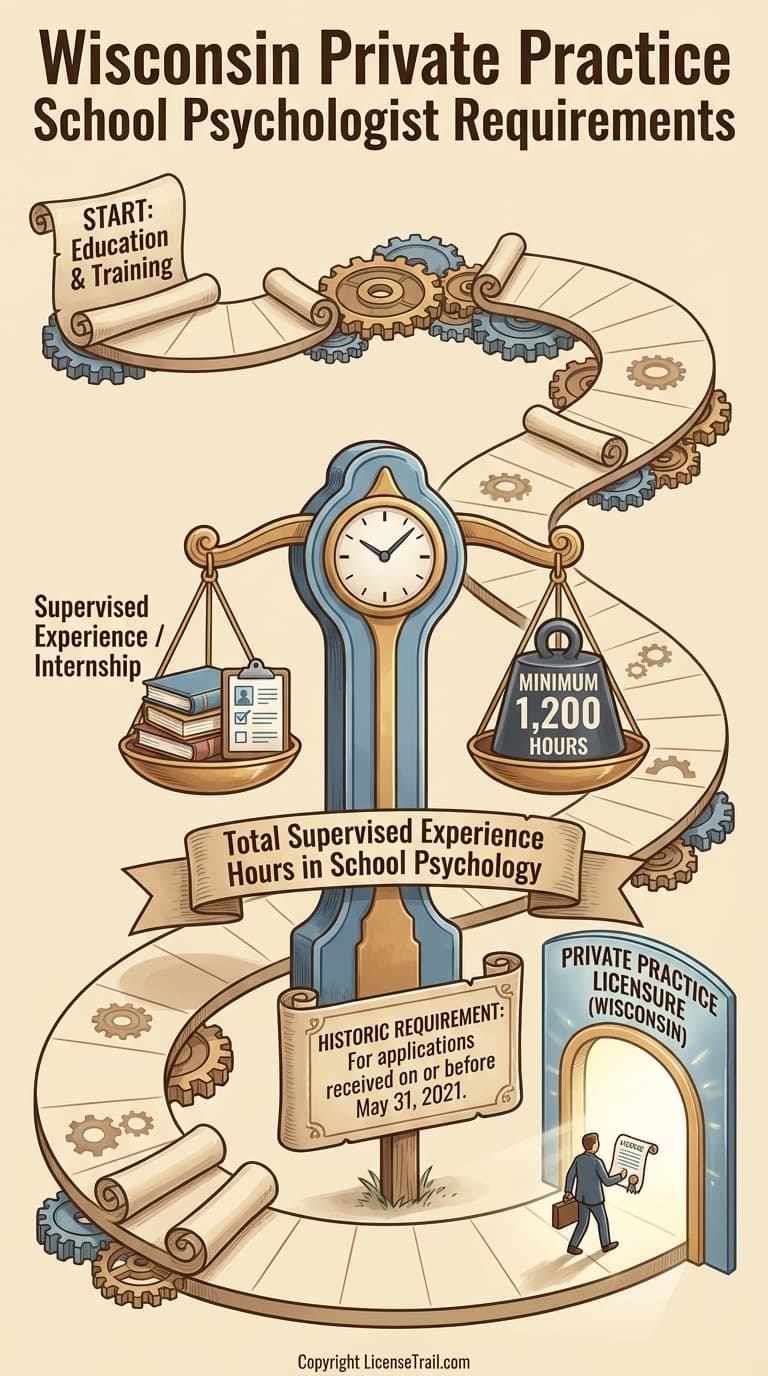
2.3 Supervised experience / internship requirement (no fixed hour count in Board rules)
For supervised experience, DSPS required one year of supervised school‑psychology practice and proof of that experience:
- Applicants had to “submit written verification from the supervising psychologist or a school official or administrator that the applicant has successfully completed one year of experience or internship in school psychology under the supervision of a school psychologist licensed by the Wisconsin Department of Public Instruction.” (dsps.wi.gov)
Important for your question about hours:
- The Psychology Examining Board’s requirement is expressed as “one year of experience or internship,” not as a specific number of clock‑hours (e.g., 1,500 hours).
- There is no published DSPS rule for this credential that breaks that year down into:
- “X hours of direct service” vs.
- “Y hours of supervision.”
The underlying DPI‑approved school psychology programs typically specify internship hour totals (often aligned with national standards), but those hour counts come from DPI/program standards, not from the Psychology Examining Board’s licensure rule. DSPS looks for a year of supervised school‑psychology experience, verified in writing, rather than a particular numeric hour total.
2.4 Examinations
Applicants had to satisfy both a national specialty exam requirement and a state law/ethics exam.
2.4.1 National Teachers Examination / Praxis School Psychologist test
DSPS required:
- Completion of the National Teachers Examination (NTE) Specialty Area Test for School Psychologist, now implemented as a Praxis School Psychologist exam administered by ETS. (dsps.wi.gov)
Candidates had to coordinate with DPI regarding test dates and locations.
2.4.2 Wisconsin state psychology (jurisprudence/ethics) exam
All psychology‑related license applicants take a state written examination on Wisconsin statutes and administrative rules relevant to practice. For this specific credential, DSPS set a lower passing score than for full psychologist licensure:
- “Applicants for a Psychologist license must receive a score of 80% to pass.”
- “Applicants for a Private Practice School Psychologist license must receive a score of 75% to pass.” (dsps.wi.gov)
Content for this exam is taken from:
- Wis. Admin. Code chapters PSY 1, 2, 4, and 5, and
- Wis. Stat. ch. 51. (dsps.wi.gov)
The exam is untimed and delivered online; applicants may log in and out over a three‑month window. (dsps.wi.gov)
Again, this exam requirement concerns content knowledge, not practice hours.
2.5 Application forms and Board review
When the credential was open, an applicant also had to complete DSPS application forms and undergo Board review: (dsps.wi.gov)
Key forms included:
- Form #637 – Application for the Private Practice of School Psychology (now labeled “obsolete”),
- Form #1899 – Experience Verification, documenting the one year of supervised experience/internship,
- Form #638 – Nature of Private Practice of School Psychology, describing planned practice, and
- Additional forms for malpractice suits/claims and criminal convictions, if applicable (Forms #2829 and #2252).
The Psychology Examining Board would:
- Review the completed application file (including verification of degree, DPI license, and supervised experience),
- Determine eligibility to sit for the state ethics/jurisprudence exam and to appear for an oral interview, and
- Schedule the applicant to complete those components, provided the file was complete at least 30 days before the Board meeting at which it was to be reviewed. (dsps.wi.gov)
3. Continuing education and renewal (for existing licensees)
Although initial licensure is now closed, existing Private Practice School Psychologist licenses remain renewable.
3.1 Renewal cycle
Under Wis. Stat. § 440.08(2), the renewal date for Private Practice School Psychologist credentials is September 30 of each odd‑numbered year. (dsps.wi.gov)
Only credentials that were:
- Active on May 31, 2021, or
- Issued from an application received on or before May 31, 2021,
are eligible to continue renewing. (dsps.wi.gov)
3.2 Continuing education hours
The DSPS page specific to Private Practice School Psychologists states that, unless granted a postponement or waiver, all licensed psychologists (including this category), except those in their first full two‑year licensure period, must complete at least 40 hours of board‑approved continuing education per biennium. (dsps.wi.gov)
Key CE features:
- Minimum total: 40 hours every two‑year licensing period. (dsps.wi.gov)
- Acceptable sponsors/activities include:
- APA‑approved activities,
- Category 1 AMA or AOA programs,
- Graduate‑level courses or university‑based CE relevant to psychology,
- Other programs approved by psychology boards in states where the licensee also holds a license. (dsps.wi.gov)
The Psychology Examining Board’s general CE summary (for psychologists) further explains that a minimum of six of those hours must be in ethics, risk management, or jurisprudence. (dsps.wi.gov) Those requirements are contained in Wis. Admin. Code ch. PSY 4, which applies across psychologist credentials.
Again, note how this is framed:
- 40 hours of continuing education in a two‑year period
- 6 of those hours in ethics/risk management/jurisprudence
—rather than any specified number of direct client contact or supervision hours for renewal. The hour specificity here is purely for continuing education, not practice or supervision.
3.3 Non‑practicing status
Licensees who attest to being permanently retired at renewal can:
- Have the CE requirement waived and
- Have the license status updated to “Non‑Practicing,” which means the license is current but not eligible for practice. (dsps.wi.gov)
Non‑practicing status must still be renewed each biennium.
4. Summary of “hours” versus “years” in Wisconsin’s rules
Putting all of this into the specific “hours vs. supervision” frame you asked about:
-
Initial supervised experience requirement (historical):
- The Psychology Examining Board did not define a fixed number of supervised practice hours (e.g., 1,500 direct + 1,500 supervised) for the Private Practice School Psychologist license.
- Instead, it required “one year of experience or internship in school psychology under the supervision of a school psychologist licensed by the Wisconsin Department of Public Instruction,” documented through written verification. (dsps.wi.gov)
- Any specific internship hour counts are governed by DPI and by individual programs, not by the Psychology Examining Board’s licensing rule.
-
Continuing education requirement (for existing licensees):
- 40 hours of board‑approved continuing education every two‑year licensure period, with at least 6 hours in ethics, risk management, or jurisprudence, per PSY 4 and DSPS CE summaries. (dsps.wi.gov)
- These are the only explicit hour counts tied to this credential in the current DSPS guidance, and they concern education hours, not service/supervision hours.
-
Exams and degrees:
- Requirements here are expressed in terms of degree type, graduate credits, exam scores, and DPI licensure, not in numeric experience hours. (dsps.wi.gov)
If you are considering practice options today, the relevant active pathways in Wisconsin are generally:
- DPI school psychologist licensure (for practice in schools), and/or
- Full psychologist licensure under the Psychology Examining Board (for broader psychological practice in non‑school settings),
since the Private Practice School Psychologist credential is closed to new applicants.
Track your Private Practice School Psychologist hours with confidence
License Trail checks your direct, indirect, and supervision hours against Wisconsin Private Practice School Psychologist requirements continuously and flags mismatches before you submit.
 Start Tracking for Free
No credit card required · Free plan available
Related Licenses
Is your spreadsheet hiding Wisconsin Private Practice School Psychologist risks?
Stop guessing if your categories match Wisconsin Psychology Examining Board requirements. License Trail checks your direct, indirect, and supervision hours continuously and flags mismatches before you submit.
Import or log
Bring your spreadsheet or start fresh
Upload your existing tracking spreadsheet and we'll map every hour into the right Wisconsin Psychology Examining Board categories automatically.
Verify against Wisconsin
Catch mismatches before the board does
License Trail checks your direct, indirect, and supervision hours against Wisconsin Private Practice School Psychologist requirements continuously.
Export board-ready
One-click clean reports
Generate professional, board-ready reports for supervision meetings and Wisconsin Psychology Examining Board submissions in seconds.
No credit card required · Free plan available