
Wisconsin Psychologist Requirements: Hours, Exams & Step-by-Step Guide
Stop guessing if your categories match Wisconsin requirements. License Trail checks your direct, indirect, and supervision hours against Psychologist requirements continuously and flags mismatches before you submit.
No credit card required · Free plan available
Quick Requirements Overview
- Must be ≥18, no disqualifying convictions, and hold a doctoral degree in psychology (Board-approved accreditation or equivalent)
- Complete 3,000 hours of supervised graduate-level psychology practice
- Supervised hours structure: 1,500-hour internship (after completion of all doctoral coursework) + 1,500 additional hours
- Additional 1,500 hours may be any mix of: eligible pre-internship hours, excess internship hours, post-internship/pre-degree hours, and/or postdoctoral supervised hours
- Hour content minimums (of the 3,000): ≥25% face-to-face client contact; ≥65% face-to-face + direct service (e.g., reports, test interpretation, consultation)
- Supervision: primary supervisor must be a licensed psychologist (qualified/experienced; not an immediate relative); written evaluations at least semi-annually; supervisor responsible/available for emergencies
- Exams required: EPPP Part 1 + WI Statutes/Rules (jurisprudence) exam (pass score ≥80%)
- Optional Interim Psychologist license (up to 2 years): requires doctoral degree, completed 1,500-hour internship, and passing jurisprudence exam; practice only under supervision
License Details

Procedures
Licensure as a psychologist in Wisconsin is governed by the Psychology Examining Board under Chapter 455 of the Wisconsin Statutes and Chapter Psy 2 of the Wisconsin Administrative Code. What follows focuses on the specific hour requirements and the exact categories of supervised experience the Board recognizes.
1. Core eligibility for a psychologist license
Under Wis. Stat. § 455.04(1), the Board grants a psychologist license to an applicant who: (law.justia.com)
- Is at least 18 years old.
- Does not have a disqualifying conviction record (subject to Wisconsin’s fair employment laws).
- Holds a doctoral degree in psychology from a program accredited by an organization approved by the Board, or has substantially equivalent training as defined in Board rules.
- Completes the required 3,000 hours of supervised graduate‑level experience in the practice of psychology (details below).
- Passes both required examinations (national exam and Wisconsin statutes/rules exam).
The Department of Safety and Professional Services (DSPS) summarizes the educational prerequisite as graduation "from a regionally accredited institution with a doctoral degree in psychology." (dsps.wi.gov)
2. Supervised experience: hours and categories
Total hour requirement
State law and the Board’s rules require at least 3,000 hours of supervised graduate‑level experience in the practice of psychology under conditions satisfactory to the Board. (law.justia.com)
All 3,000 hours must be supervised; the Board does not separate them into “direct experience” vs. “supervised experience.” Instead, the 3,000 hours are structured as:
- 1,500 hours in a qualifying internship, plus
- 1,500 hours of additional supervised experience from specific categories described below.
A. Required internship: 1,500 hours
Both the statute and Psy 2.10 require: (law.justia.com)
- A “successfully completed internship” of at least 1,500 hours, and
- Those internship hours must be accrued after completion of all doctoral‑level coursework (i.e., all required courses for the doctoral degree are finished, unless the Board determines otherwise).
This internship is part of your 3,000 supervised hours.
B. Additional 1,500 hours: acceptable sources
The remaining 1,500 hours can be assembled from several types of supervised graduate‑level experience. The statute and Psy 2.10 specify that the additional 1,500 hours may be any combination of: (law.justia.com)
-
Pre‑internship hours
- Supervised, graduate‑level psychological services after the first year of your doctoral program, or
- Supervised experience during the first year of the doctoral program if you have already completed a master’s degree in psychology or its equivalent.
-
Excess internship hours
- Any supervised internship hours beyond the required 1,500 hours in the qualifying internship can count toward the additional 1,500.
-
Post‑internship, pre‑degree hours
- Supervised psychological practice after completing the internship but before the doctoral degree is formally conferred.
-
Postdoctoral hours
- Supervised practice after the doctoral degree is conferred (postdoc experience).
All of these must be supervised graduate‑level experience in the practice of psychology and must meet the Board’s conditions for supervision.
C. Content of the 3,000 hours: client contact and “direct service”
Psy 2.10 adds two important quantitative requirements about how your hours are spent: (law.cornell.edu)
-
Face‑to‑face client contact – at least 25%
- At least 25% of the total 3,000 hours must be face‑to‑face client contact (i.e., direct encounters with clients or patients for assessment, intervention, etc.).
-
Face‑to‑face + direct service – total of 65%
- At least 65% of the total 3,000 hours must be:
- the face‑to‑face client contact described above plus
- “direct service” activities.
- At least 65% of the total 3,000 hours must be:
The rule defines direct service as activities a psychologist performs that are directly related to providing psychological services to a client, including (for example):
- Writing notes and reports,
- Studying and interpreting test results,
- Case consultation, and
- Reviewing published works (literature) related to the client’s needs. (law.cornell.edu)
In other words, up to 35% of your hours can be activities that are not face‑to‑face or direct service (e.g., general training, some administrative tasks), but the majority must directly serve clients.
D. Supervision requirements and trainee status
Psy 2.10 also sets conditions on supervision: (law.cornell.edu)
-
Primary supervisor must:
- Be a licensed psychologist,
- Have adequate training, knowledge, and skill for any services they supervise,
- Have post‑licensure experience and supervision training/experience, and
- Not be an immediate relative by blood or marriage.
-
Supervisors must:
- Ensure the trainee only practices within the supervisor’s competence,
- Have enough knowledge of the trainee’s clients (including, if needed, their own contact with the client),
- Monitor the trainee’s work regularly,
- Evaluate and document the trainee’s progress at least semi‑annually in writing and make evaluations available to the Board upon request,
- Be available for emergencies, and
- Be legally and ethically responsible for the trainee’s professional activities, with authority to limit or end the trainee’s practice if necessary.
-
Informing clients:
- Clients must be told that the trainee is practicing under supervision and that their case will be discussed in supervision.
- The trainee must inform potential clients in writing of their trainee status and the fact that they are not licensed.
E. Post‑degree supervised experience emphasized by DSPS
On its public guidance page, DSPS currently highlights that applicants must: (dsps.wi.gov)
- Complete supervised experience, including
- One year of supervised experience following conferral of the doctoral degree,
- Under a supervisor who holds a psychologist license.
That statement reflects the Board’s expectation that a significant portion of the 3,000 hours will be postdoctoral supervised practice under a licensed psychologist, even though the statute and rules allow the additional 1,500 hours to be drawn from any mix of pre‑internship, internship excess, pre‑degree, and postdoctoral hours so long as the hour totals and percentage requirements are met.
3. Examinations
Wisconsin requires you to pass two different exams for full licensure. (law.justia.com)
A. National licensing exam – EPPP Part 1
- The Board uses the Examination for Professional Practice in Psychology (EPPP Part 1) as the “examination on the practice of psychology” referenced in Wis. Stat. § 455.045(1)(a).
- DSPS explains that applicants will be authorized for the EPPP after the Board reviews an initial application. (dsps.wi.gov)
Key points from DSPS exam information: (dsps.wi.gov)
- You receive authorization and scheduling instructions after your application is initially reviewed.
- If you previously passed the EPPP in another jurisdiction, you must have ASPPB send an official score transfer directly to DSPS.
- Retakes are coordinated through both DSPS (fee) and ASPPB.
B. Wisconsin jurisprudence / statutes and rules exam
Under Wis. Stat. § 455.045(1)(b), the Board must also administer a written examination on elements of practice essential to public health, safety, or welfare. DSPS implements this as the Wisconsin Statutes and Rules Examination (jurisprudence exam). (wi.elaws.us)
According to DSPS: (dsps.wi.gov)
- The exam is a computer‑based test on Wisconsin Statutes and Administrative Code related to psychology.
- Applicants for a psychologist license must score at least 80% to pass.
- Questions are drawn primarily from:
- Chapters Psy 1, 2, 4, 5 of the Administrative Code, and
- Chapter 51 of the Wisconsin Statutes (mental health laws).
This jurisprudence exam is required both for full licensure and for the interim psychologist license (see below). (regulations.justia.com)
4. Interim Psychologist license (optional step)
Wisconsin offers an Interim Psychologist license as a transitional credential while you complete requirements for full licensure. (law.justia.com)
Under Wis. Stat. § 455.04(2) and Psy 2.012, an interim psychologist license may be granted if you:
- Submit the interim application and required fee.
- Meet full‑license requirements for:
- Age and conviction record (455.04(1)(a)–(b)),
- Doctoral degree in psychology (455.04(1)(c)),
- Completion of the 1,500‑hour qualifying internship (455.04(1)(d)1), and
- Passage of the jurisprudence exam. (law.justia.com)
- Provide required background‑check documents (including fingerprints) so the Board can evaluate any relevant charges or convictions.
Key conditions of the interim license:
- It is valid for up to 2 years, or until you obtain full psychologist licensure, whichever comes first. (regulations.justia.com)
- You must practice only under the supervision of qualified supervisors as defined by the Board.
- Interim license holders are not required to complete continuing education while the interim license is in effect. (regulations.justia.com)
The DSPS psychologist page notes that interim status is intended for doctorate graduates still completing supervised experience or the national exam. (dsps.wi.gov)
5. Step‑by‑step path to licensure in Wisconsin
Putting the statutes, rules, and DSPS guidance together, the typical pathway is:
-
Complete a qualifying doctoral program in psychology
- From a regionally accredited institution and an accreditor approved by the Board (e.g., APA, CPA), or show substantially equivalent academic training under Psy 2.09. (law.justia.com)
-
Finish your doctoral‑level coursework and complete a 1,500‑hour internship
- Internship must be at least 1,500 supervised hours after all doctoral coursework is complete. (law.justia.com)
-
Accrue the remaining 1,500 hours of supervised graduate‑level experience
- Use any combination of:
- Eligible pre‑internship practicum hours,
- Additional internship hours beyond 1,500,
- Post‑internship, pre‑degree supervised work, and
- Postdoctoral supervised practice. (law.justia.com)
- Ensure that at least 25% of your total 3,000 hours are face‑to‑face client contact and that at least 65% are face‑to‑face plus direct service as defined by Psy 2.10 (e.g., note/report writing, test interpretation, case consultation, client‑specific literature review). (law.cornell.edu)
- DSPS emphasizes that this must include one year of supervised experience after the doctorate, supervised by a licensed psychologist. (dsps.wi.gov)
- Use any combination of:
-
Apply through LicensE (Exam method), optionally requesting an interim license
- Use Form 634 and related forms listed on the DSPS psychologist page (e.g., Form 2555 for verification of supervised practice; Form 1634 for interim license request). (dsps.wi.gov)
- If you meet interim criteria and want to start practicing under supervision while finishing requirements, apply for the Interim Psychologist license at the same time. (regulations.justia.com)
-
Take and pass the EPPP (Part 1)
- DSPS authorizes you and you schedule through ASPPB. Official scores must be sent directly to DSPS. (dsps.wi.gov)
-
Take and pass the Wisconsin Statutes and Rules (jurisprudence) exam
- Computer‑based exam on Wisconsin psychology law and rules; must score 80% or higher. (dsps.wi.gov)
-
Board review and issuance of the psychologist license
- The Board verifies your education, 3,000 supervised hours (with required content/percentages), examination results, and background.
- Under Wis. Stat. § 455.04(5), applicants may be required to appear in person if the Board deems it necessary. (law.justia.com)
Summary of hour requirements in plain language
-
Total supervised experience required:
- 3,000 hours of supervised graduate‑level experience in the practice of psychology.
-
Structure of those hours:
- 1,500 hours: Required internship, after doctoral coursework.
- 1,500 hours: Additional supervised experience, which may be:
- Eligible pre‑internship hours (after year one of the doctoral program, or first year after a psychology master’s),
- Internship hours beyond the first 1,500,
- Post‑internship hours before the degree is conferred, and/or
- Postdoctoral supervised hours.
-
Content requirements across the 3,000 hours (Psy 2.10): (law.cornell.edu)
- At least 25% = face‑to‑face client contact.
- At least 65% = face‑to‑face client contact plus direct service (note/report writing, test analysis, case consultation, and client‑specific literature review).
All of these hours must be under qualifying supervision, with explicit disclosure to clients that the trainee is supervised and not yet licensed.
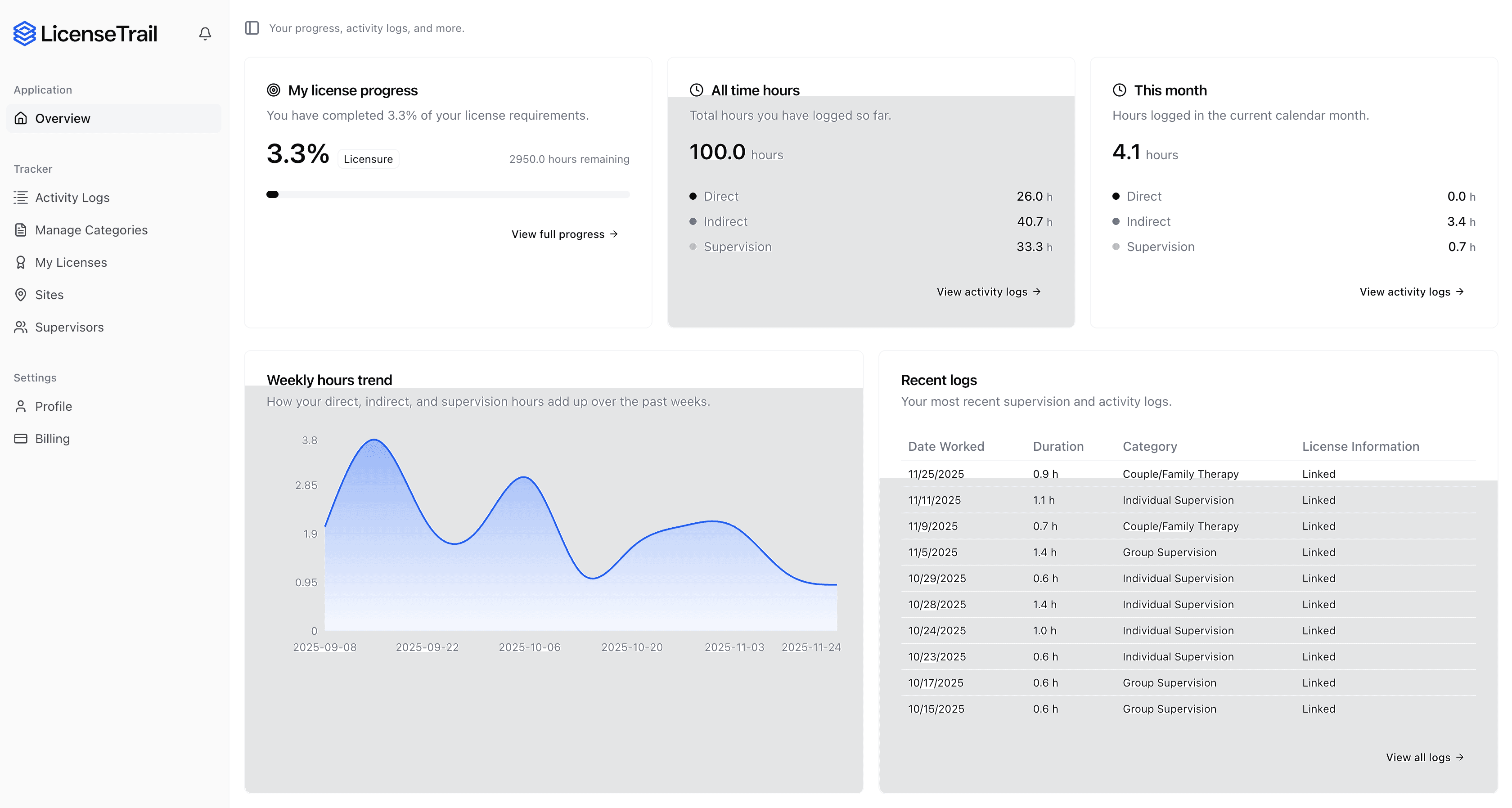
Track your Psychologist hours with confidence
License Trail checks your direct, indirect, and supervision hours against Wisconsin Psychologist requirements continuously and flags mismatches before you submit.
 Start Tracking for Free
No credit card required · Free plan available
Related Licenses
Is your spreadsheet hiding Wisconsin Psychologist risks?
Stop guessing if your categories match Wisconsin Psychology Examining Board requirements. License Trail checks your direct, indirect, and supervision hours continuously and flags mismatches before you submit.
Import or log
Bring your spreadsheet or start fresh
Upload your existing tracking spreadsheet and we'll map every hour into the right Wisconsin Psychology Examining Board categories automatically.
Verify against Wisconsin
Catch mismatches before the board does
License Trail checks your direct, indirect, and supervision hours against Wisconsin Psychologist requirements continuously.
Export board-ready
One-click clean reports
Generate professional, board-ready reports for supervision meetings and Wisconsin Psychology Examining Board submissions in seconds.
No credit card required · Free plan available