
District-of-columbia LICSW Requirements: Hours, Exams & Step-by-Step Guide
Stop guessing if your categories match District-of-columbia requirements. License Trail checks your direct, indirect, and supervision hours against LICSW requirements continuously and flags mismatches before you submit.
No credit card required · Free plan available
Quick Requirements Overview
- Education: CSWE-accredited MSW or doctorate in social work
- Exam: Pass ASWB Advanced Clinical (Independent Clinical) exam (DC uses passing score 75)
- Pre-licensure to earn hours: Must hold a DC social work license (typically LGSW) while accruing hours
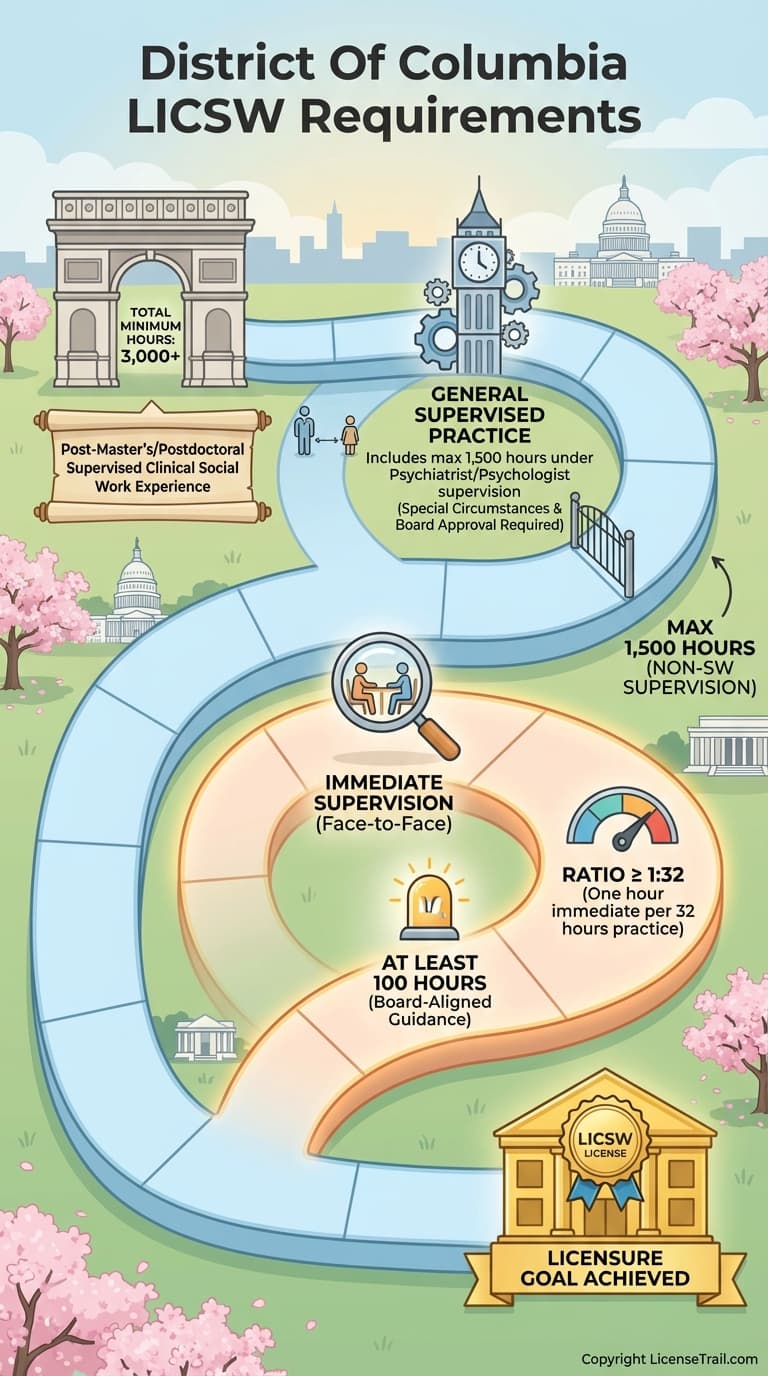
- Supervised experience: 3,000 hours post‑MSW/postdoc in clinical diagnosis & treatment (individuals/families/groups)
- Timeframe: Hours must be earned in 2–4 years and generally within 5 years of application
- Supervisor: DC-licensed LICSW in good standing; Board may allow psychiatrist/psychologist supervision for up to 1,500 hours (special circumstances)
- Supervision intensity: Minimum 1 hour immediate supervision per 32 hours practice (≈ 94+ hours over 3,000) and at least 100 hours face-to-face immediate supervision
- Other application items: DC law/jurisprudence requirement (exam or waiver), criminal background check, apply via DCHealthRenewals
License Details
Procedures
Becoming a Licensed Independent Clinical Social Worker (LICSW) in the District of Columbia
In Washington, DC, the LICSW credential is the highest independent clinical social work license. It is created by statute in the Health Occupations Revision Act (HORA) and implemented through the Board of Social Work’s regulations in Title 17, Chapter 70 of the D.C. Municipal Regulations.(code.dccouncil.gov)
What follows focuses on the exact clinical hour structure and supervision rules the District uses.
1. Core statutory requirements for LICSW
Under D.C. Code § 3‑1208.04, the Board of Social Work will license an individual as an independent clinical social worker if, in addition to the general requirements of HORA, the person:(code.dccouncil.gov)
-
Holds the right degree
- A master’s degree (MSW) or doctorate in social work from a program accredited by the Council on Social Work Education (CSWE).
-
Passes the clinical-level national exam
- Has “satisfactorily completed the examination process at the independent clinical level.”(code.dccouncil.gov)
- Board-related summaries specify this is the Advanced Clinical (Independent Clinical social work) level of the ASWB national examination, with a required passing score of 75.(ecpc-personnel-standards.dev.i3.uconn.edu)
-
Completes the mandated clinical experience
- Has at least 3,000 hours of post‑master’s or postdoctoral experience that consists of participating in the diagnosis and treatment of individuals, families, and groups with psychosocial problems.(code.dccouncil.gov)
- These 3,000 hours must be:
- Completed under the supervision of a licensed independent clinical social worker (LICSW), and
- Accumulated over no less than 2 years and no more than 4 years.(code.dccouncil.gov)
- In “special circumstances” approved by the Board, a psychiatrist or psychologist may substitute as supervisor for up to 1,500 of the 3,000 hours.(code.dccouncil.gov)
These are the controlling statutory requirements. The regulations and Board guidance refine what counts as supervised practice and what supervision must look like.
2. Required license and setting while you accrue hours
2.1. You must practice under a DC social work license
Before you can count hours toward LICSW, you must be licensed under HORA at the appropriate level (usually as a Licensed Graduate Social Worker, LGSW). The supervision rule (17 DCMR § 7012) states that to engage in supervised practice in the District, an applicant or social worker must first obtain licensure at the level for which they are qualified.(dcrules.elaws.us)
In practice, the usual path is:
- Complete CSWE‑accredited MSW.
- Obtain LGSW in DC.
- Work in a clinical setting under LICSW supervision, accruing the required 3,000 hours.
2.2. Who can supervise your LICSW hours?
The supervisor qualifications rule, 17 DCMR § 7013, is explicit:(dcrules.elaws.us)
- Only an independent clinical social worker licensed in DC (LICSW), in good standing, is authorized to:
- Supervise an applicant for independent clinical licensure; and
- Supervise a DC‑licensed social worker who is accumulating the 3,000 hours required under § 3‑1208.04(a).
For non‑clinical independent practice (LISW), either an LISW or LICSW may supervise, but for LICSW‑track hours the supervisor must be a DC‑licensed LICSW unless the Board has specifically approved psychiatrist/psychologist supervision for part of the hours under the statute.(dcrules.elaws.us)
3. The 3,000-hour post-master’s clinical experience
3.1. Total hours and time window
From the statute and Board-related guidance, the experience requirement for LICSW in DC is:(code.dccouncil.gov)
- Total clinical experience:
- 3,000 hours of post‑master’s or postdoctoral experience.
- Content of those hours:
- Work specifically participating in diagnosis and treatment of individuals, families, and groups with psychosocial problems – i.e., true clinical practice, not purely administrative work.
- Timeframe to accrue hours (statutory):
- Over at least 2 years and no more than 4 years.
- Recency of hours (Board guidance):
- The Board expects that the 3,000 hours of supervised practice were completed not more than five years before the application date (a requirement reflected in Board-aligned licensure summaries that quote from DC rules).(ecpc-personnel-standards.dev.i3.uconn.edu)
3.2. Direct vs. indirect clinical hours
Unlike some states, DC does not formally split the 3,000 hours into required “direct client contact” and “indirect” buckets in its statute or social work chapter of the DCMR. There is no official breakdown like “1,500 direct hours + 1,500 indirect hours.”
Instead, DC defines the nature of qualifying work broadly as clinical participation in diagnosis and treatment with individuals, families, and groups with psychosocial problems, under LICSW supervision.(code.dccouncil.gov)
In practice, the vast majority of your 3,000 hours must be face‑to‑face (or live telehealth) clinical service, because that is what “diagnosis and treatment” entails, but DC does not assign a specific numeric minimum for direct contact within the 3,000 hours.
4. Supervision requirements and supervision hours
All 3,000 hours of clinical experience must be accrued as “supervised practice” under the rules in 17 DCMR § 7012.(dcrules.elaws.us)
4.1. Who may practice under supervision
Section 17‑7012.1 lists those who can practice under supervision, including:(dcrules.elaws.us)
- A licensed social work associate (LSWA),
- A licensed graduate social worker (LGSW), and
- A DC‑licensed social worker who is obtaining the required 3,000 hours of post‑master’s or postdoctoral experience under § 3‑1208.03 (LISW) or § 3‑1208.04 (LICSW).
So the 3,000 LICSW hours are, by definition, hours of supervised practice.
4.2. Ratio of “immediate supervision”
The regulation sets a specific supervision ratio for supervised practice:
- At least 1 hour of every 32 hours of supervised practice must be under “immediate supervision.”(dcrules.elaws.us)
With a 3,000‑hour requirement, that ratio implies a minimum of about 93.75 hours (practically, at least 94 hours) of immediate supervision across your total hours.
“Immediate supervision” is defined functionally rather than by a single sentence. The supervision relationship must include:(dcrules.elaws.us)
- Regular, direct contact (in‑person, telephone, video, or internet) between supervisor and supervisee; and
- Ongoing observation, evaluation, oversight, review, and correction of the services you provide, with the supervisor having enough knowledge of your client contacts (including face‑to‑face contact with the client when needed) to monitor treatment and service plans; and
- All major clinical decisions that require social work expertise must be made in collaboration with and with the approval of the supervisor.
4.3. Minimum face-to-face supervision hours
Board‑aligned guidance that quotes DC requirements further specifies that within the 3,000 supervised hours:(ecpc-personnel-standards.dev.i3.uconn.edu)
- At least 100 hours must be completed under immediate, face‑to‑face supervision with a qualified supervisor; and
- The full 3,000 hours of supervised practice must have been completed within the 5‑year period preceding your application.
Taken together with the 1‑in‑32 ratio from 17 DCMR § 7012, this means:
- The District expects roughly 100 hours or more of intensive, face‑to‑face (or equivalent) supervision meetings with your LICSW supervisor spread throughout your 3,000 supervised practice hours.
- The remainder of your supervision is still required (general and immediate supervision), but not all of it must be face‑to‑face.
4.4. Distribution of hours – how to think about it
Putting all of the above in “hour‑type” language, DC’s structure for LICSW hours looks like this:
-
Total supervised clinical experience hours:
- 3,000 hours post‑MSW/post‑doctorate in diagnosis and treatment of individuals, families, and groups with psychosocial problems. All of these hours are supervised.(code.dccouncil.gov)
-
Supervision hours within those 3,000 hours:
- At least 1 supervision hour for every 32 practice hours (by rule).
- At least ~94 hours of immediate supervision are guaranteed by this ratio if you complete exactly 3,000 hours.(dcrules.elaws.us)
- Board‑aligned guidance adds a minimum of 100 hours of face‑to‑face immediate supervision with your qualified supervisor.(ecpc-personnel-standards.dev.i3.uconn.edu)
-
Timeframe:
- Hours must be gathered over 2–4 years (statutory) and be no more than 5 years old at the time you apply (Board practice reflected in licensure summaries).(code.dccouncil.gov)
Notably, the District does not say, for example, “1,500 hours direct client contact + 1,500 hours other experience + 100 hours supervision.” Instead, all 3,000 hours are supervised clinical practice, with embedded supervision expectations (ratio + minimum face‑to‑face hours).
4.5. Other supervision restrictions
Some additional supervision‑related rules from 17 DCMR § 7012:(dcrules.elaws.us)
- While under supervision, you may not establish an independent practice or receive compensation directly from patients; you may be paid only via salary or similar arrangement through the employer.
- If your supervisor is largely off‑site (more than two days per week), you and the supervisor must:
- Have a written supervision contract,
- Maintain documentation of supervision sessions for Board review, and
- Be prepared for Board audits.
5. Examination and law/ethics requirements
5.1. National examination
Consistent with § 3‑1208.04 and Board‑aligned guidance:(code.dccouncil.gov)
- LICSW applicants must pass the ASWB Advanced Clinical (Independent Clinical social work) examination.
- DC‑specific guidance specifies a passing score of 75 for this exam.
5.2. DC law/jurisprudence requirement
The Board’s website lists an “Official Statement Waiver for DC Law Exam,” indicating that there is a DC law/jurisprudence requirement that can be satisfied either by an exam or by signing an official waiver form attesting to your review and understanding of DC social work laws and regulations.(dchealth.dc.gov)
The exact mechanics (exam vs. waiver) can change by policy, so applicants are expected to follow the most current instructions in the Social Work Application Package and related Board documents.(dchealth.dc.gov)
6. Application, background check, and process overview
6.1. Background check and application channel
The Board of Social Work’s site directs applicants to:(dchealth.dc.gov)
- Apply online via DCHealthRenewals (the Department of Health’s licensing portal).
- Complete a Criminal Background Check through Board‑specified channels as part of the application.
- Use the LSWA/LGSW/LISW/LICSW Checklist by Examination (or by endorsement) to verify that you have:
- The CSWE‑accredited MSW/doctorate;
- The required LICSW‑track 3,000 supervised clinical hours under LICSW (or Board‑approved) supervision within the required timeframe;
- The ASWB Advanced Clinical exam passed with a qualifying score;
- Any required DC law exam/waiver and fees.
6.2. Typical sequential steps
Putting the pieces together, the practical sequence looks like this:
- Earn CSWE‑accredited MSW (or social work doctorate).
- Obtain LGSW in DC (graduate‑level exam + application).
- Secure employment in a clinical setting where:
- Services involve diagnosis and treatment of psychosocial problems, and
- You have a DC‑licensed LICSW supervisor (or, if approved, partial psychiatrist/psychologist supervision).
- Accrue 3,000 hours of supervised clinical practice over 2–4 years, ensuring:
- Work is genuinely clinical (diagnosis and treatment of individuals, families, groups),
- At least 1 hour of immediate supervision per 32 hours of practice,
- At least 100 hours of face‑to‑face immediate supervision with your qualified supervisor,
- All 3,000 hours fall within 5 years of your LICSW application date.(code.dccouncil.gov)
- Pass the ASWB Advanced Clinical exam (score ≥75 under DC’s standard).
- Complete DC law/jurisprudence requirement (exam or waiver, as directed).
- Submit online LICSW application with:
- Supervision documentation,
- Exam results,
- Background check,
- Fees and any supporting documents required by the current LICSW checklist.
7. Key hour requirements, distilled
In the specific “hour language” you asked for, the District of Columbia LICSW requirements can be summarized as:
- 3,000 hours of post‑master’s/postdoctoral supervised clinical social work experience in diagnosis and treatment of individuals, families, and groups with psychosocial problems.
- All 3,000 hours must be:
- Supervised by a DC‑licensed LICSW (with up to 1,500 hours allowed under psychiatrist/psychologist supervision only if the Board approves such an arrangement),(code.dccouncil.gov)
- Accrued over 2–4 years,
- Completed within 5 years before you apply for LICSW.
- Supervision structure inside those hours:
- At least 1 hour of immediate supervision for every 32 hours of practice, producing a practical minimum of about 94 hours of immediate supervision for 3,000 total hours,(dcrules.elaws.us)
- At least 100 hours of immediate, face‑to‑face supervision with a qualified supervisor (Board‑reflected requirement).(ecpc-personnel-standards.dev.i3.uconn.edu)
DC does not slice the 3,000 hours into a fixed number of “direct client” vs. “indirect” hours, but it does strictly require that all of them be supervised clinical work centered on diagnosis and treatment, with a defined intensity and structure of supervision.
Track your LICSW hours with confidence
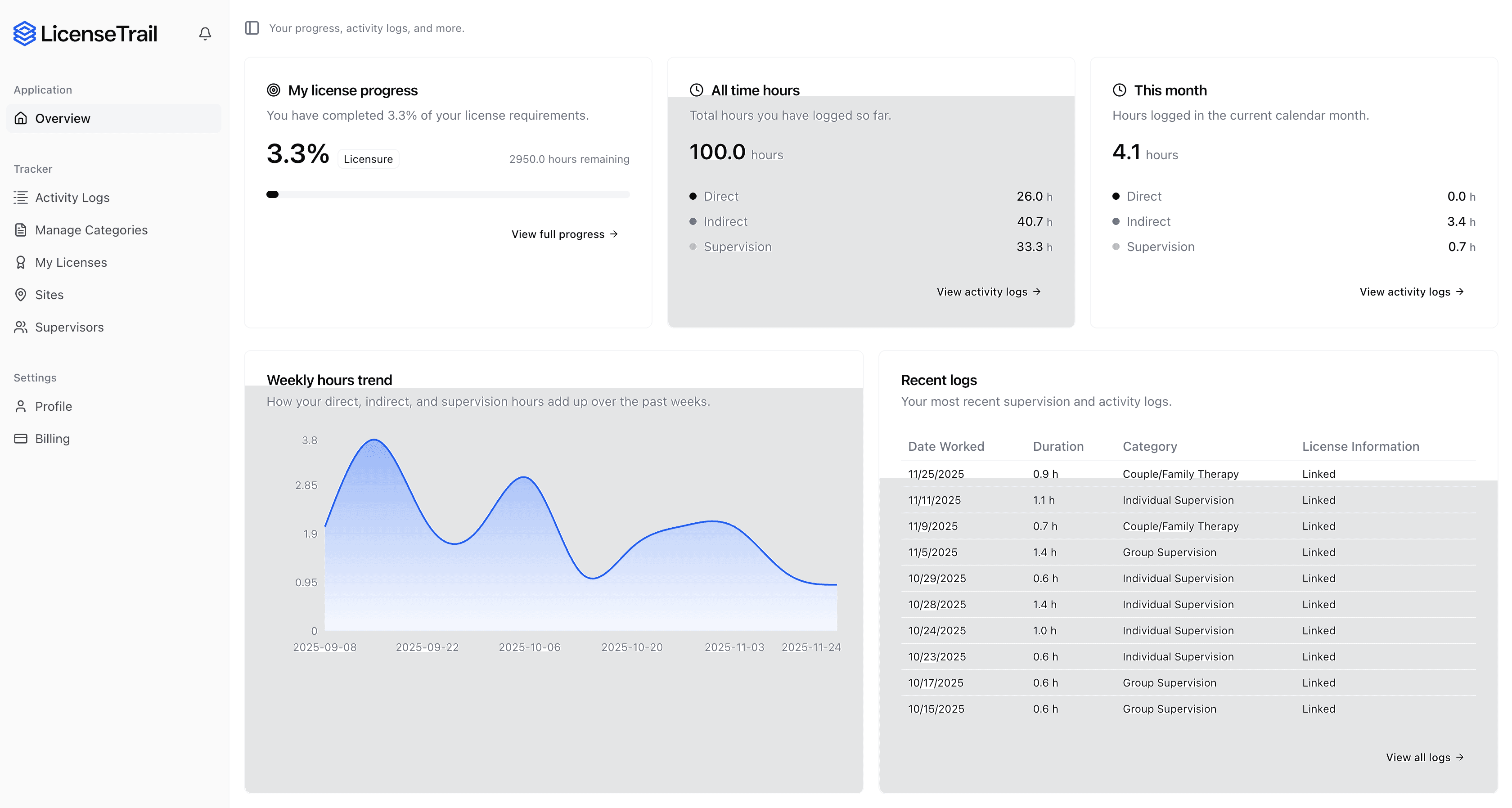
License Trail checks your direct, indirect, and supervision hours against District-of-columbia LICSW requirements continuously and flags mismatches before you submit.
 Start Tracking for Free
No credit card required · Free plan available
Related Licenses
Is your spreadsheet hiding District-of-columbia LICSW risks?
Stop guessing if your categories match District of Columbia Board of Social Work requirements. License Trail checks your direct, indirect, and supervision hours continuously and flags mismatches before you submit.
Import or log
Bring your spreadsheet or start fresh
Upload your existing tracking spreadsheet and we'll map every hour into the right District of Columbia Board of Social Work categories automatically.
Verify against District-of-columbia
Catch mismatches before the board does
License Trail checks your direct, indirect, and supervision hours against District-of-columbia LICSW requirements continuously.
Export board-ready
One-click clean reports
Generate professional, board-ready reports for supervision meetings and District of Columbia Board of Social Work submissions in seconds.
No credit card required · Free plan available