
District-of-columbia LISW Requirements: Hours, Exams & Step-by-Step Guide
Stop guessing if your categories match District-of-columbia requirements. License Trail checks your direct, indirect, and supervision hours against LISW requirements continuously and flags mismatches before you submit.
No credit card required · Free plan available
Quick Requirements Overview
- Scope (LISW, DC): Independent non-clinical social work practice (advanced generalist: policy/admin/case mgmt/supervision); regulated by DC Board of Social Work (DC Health)
- Education: MSW/DSW from a CSWE-accredited program
- Pre-licensure step: Must be licensed at the level qualified (typically LGSW) before accruing DC supervised practice hours
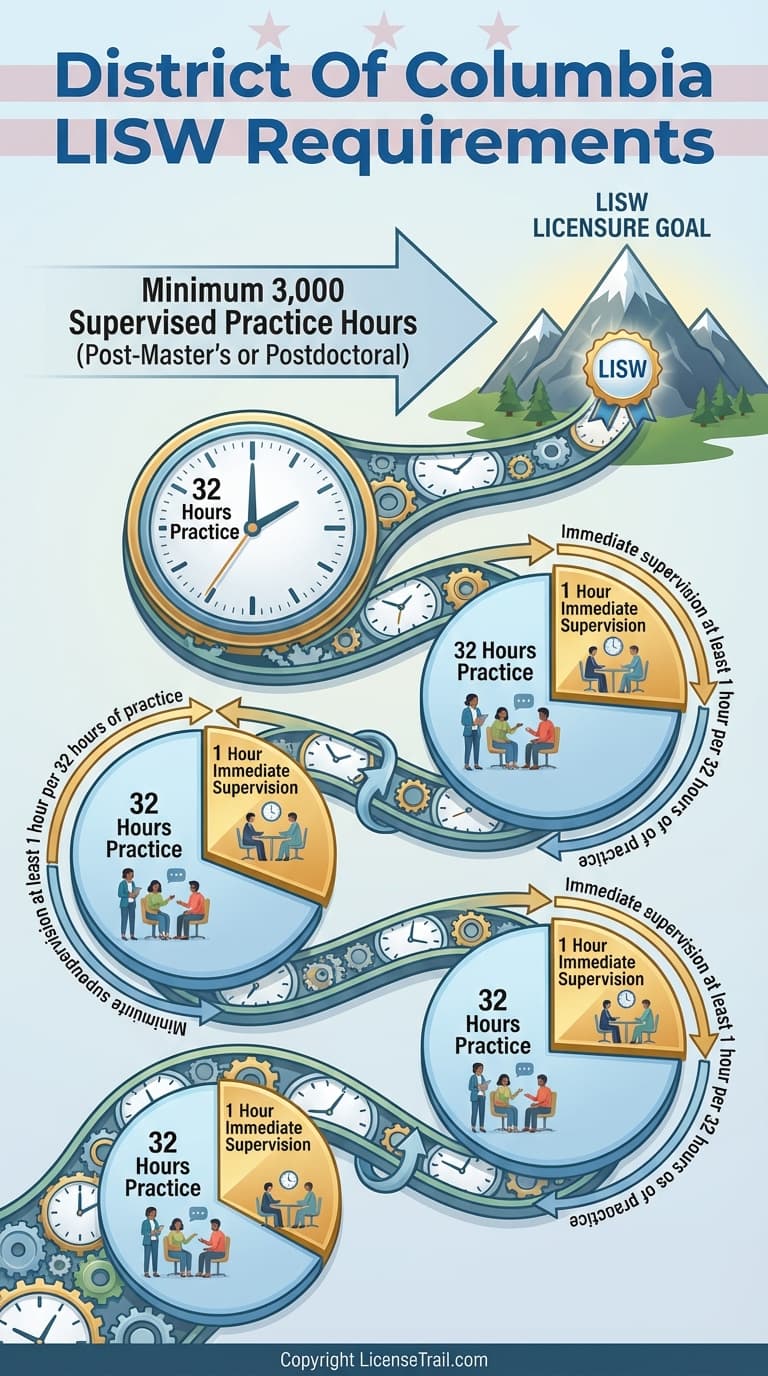
- Experience: 3,000 hours post-master’s/postdoctoral supervised practice under a DC LISW (advanced generalist; no required direct/indirect split stated)
- Time to earn hours: 2–4 years to complete the 3,000 hours
- Supervision ratio/structure: Minimum 1 hour immediate supervision per 32 hours of practice; ongoing communication and case oversight required
- Face-to-face supervision: At least 100 hours must be immediate face-to-face supervision within the 3,000 hours
- Exam: Pass ASWB Advanced Generalist exam (noted passing score 75)
License Details
Procedures
In the District of Columbia, the Licensed Independent Social Worker (LISW) credential authorizes independent, non‑clinical social work practice—policy, administration, case management, supervision, and other advanced generalist work. It is regulated by the DC Board of Social Work within DC Health.
The core of LISW licensure is (1) a CSWE‑accredited social work graduate degree, (2) a period of supervised, post‑graduate practice totaling 3,000 hours, and (3) passing the ASWB Advanced Generalist exam. The law and regulations use specific phrases such as “post‑master’s or postdoctoral experience” and “supervised practice,” and they set detailed supervision ratios rather than a simple “X hours direct / Y hours supervision” split.
1. License level and role
DC recognizes four social work license levels:
- Licensed Social Work Associate (LSWA)
- Licensed Graduate Social Worker (LGSW)
- Licensed Independent Social Worker (LISW)
- Licensed Independent Clinical Social Worker (LICSW) (cga.ct.gov)
The LISW is the non‑clinical independent license. The DC Code provision on “Licensed independent social worker” states that the Board:
“shall license as an independent social worker a person who … has at least 3,000 hours post‑master’s or postdoctoral experience under the supervision of a licensed independent social worker over a period of not less than 2 or more than 4 years.” (law.justia.com)
2. Educational prerequisite
The statute requires:
- A master’s degree or a doctorate in social work
- From a program accredited by the Council on Social Work Education (CSWE) (law.justia.com)
Programs like Tulane and others that are CSWE‑accredited explicitly note that graduates meet the education requirement for LISW in DC; what remains is the 3,000‑hour post‑graduate requirement and the exam. (socialwork.tulane.edu)
3. Step one: become a Licensed Graduate Social Worker (LGSW)
Before you can count DC supervised experience toward LISW, you must first be licensed at the level “for which you are qualified”—in practice, that means as an LGSW once you have your MSW/DSW. DC’s supervision rule states:
“An applicant or social worker must first obtain licensure under the Act at the level of licensure for which he or she is qualified, in order to engage in supervised practice within the District.” (dcrules.elaws.us)
Key points about the LGSW level:
- You hold a CSWE‑accredited MSW/DSW.
- The LGSW may perform “any function described as the practice of social work” but must do so under supervision of an LISW or LICSW; psychotherapy must be supervised by an LICSW. (code.dccouncil.gov)
- For first renewal, an LGSW must either pass a national exam or complete 1,500 hours of practice under supervision; this is a renewal requirement, not the LISW requirement, but it shows that DC expects supervised practice right from the graduate level. (code.dccouncil.gov)
For LISW, the key is that your 3,000 hours must be post‑master’s/postdoctoral and under supervision while you are properly licensed (ordinarily as an LGSW).
4. The 3,000 hours: how DC defines the required experience
4.1 Statutory requirement
The LISW statute requires:
- Total hours: “at least 3,000 hours post‑master’s or postdoctoral experience”
- Type: experience is broadly described as social work practice, not restricted to clinical work (that restriction appears in the LICSW section, not the LISW section).
- Supervision: “under the supervision of a licensed independent social worker”
- Timeframe: “over a period of not less than 2 or more than 4 years.” (law.justia.com)
So, in DC language, all 3,000 hours are “post‑master’s or postdoctoral experience” and “supervised practice.” There is no official split such as “1,500 hours direct / 1,500 hours indirect” written into law for LISW.
External summaries (e.g., university licensure pages and state‑by‑state guides) consistently mirror this: 3,000 hours of supervised, post‑graduate social work experience, completed in 2–4 years. (socialwork.tulane.edu)
4.2 “Supervised practice” and supervision ratios
The DC Municipal Regulations define how all supervised practice must be structured when someone is accruing hours toward LISW/LICSW:
- Eligible supervisees include an LGSW or a social worker “obtaining the required three thousand (3000) hours of post-master’s or postdoctoral experience” for § 3‑1208.03 (LISW) or § 3‑1208.04 (LICSW). (dcrules.elaws.us)
- All supervised practice must meet these conditions:
- “At least one (1) hour of every thirty‑two (32) hours of supervised practice shall be under immediate supervision.”
- The supervision relationship must include daily in‑person, telephone, video‑conference, or internet communication, plus “regular personal observation, evaluation, oversight, review, and correction” of services.
- The supervisor must know the supervisee’s cases, including having direct client contact “when necessary,” and key practice decisions requiring social‑work expertise must be “made in collaboration with and with the approval of the supervisor.” (dcrules.elaws.us)
“Immediate supervision” and “supervised practice” here are DC’s core terms. Practically, the minimum supervision ratio is:
- 1 hour of immediate supervision for every 32 hours of supervised practice.
For a full 3,000 hours, that works out to about 94 hours of immediate supervision at the bare minimum.
4.3 Face‑to‑face supervision requirement
Beyond the 1:32 ratio, DC further requires a specific number of face‑to‑face supervision hours tied to the 3,000 hours of supervised practice. A DC‑focused summary of the Board’s regulations (used for personnel standards and licensure disclosure) states that for both LISW and LICSW:
- “At least one hundred (100) hours of the applicant’s three thousand (3000) hours of supervised practice [must be] completed under the immediate face‑to‑face supervision of a qualified supervisor;”
- “the three thousand (3000) hours of supervised practice” must be completed no more than five years before the application date. (ecpc-personnel-standards.dev.i3.uconn.edu)
This wording tracks DC’s regulatory language and is widely relied on by schools and agencies preparing candidates for DC licensure.
Putting this together, DC’s hour requirements for LISW look like this:
- 3,000 hours total of post‑master’s or postdoctoral supervised practice in social work. (law.justia.com)
- These hours must be accrued over no fewer than 2 and no more than 4 years. (law.justia.com)
- The 3,000 hours must be completed within 5 years before you apply for LISW. (ecpc-personnel-standards.dev.i3.uconn.edu)
- Supervision ratios and structure:
- At least 1 hour of immediate supervision for every 32 hours of supervised practice. (dcrules.elaws.us)
- Within the 3,000 hours, at least 100 hours must be immediate face‑to‑face supervision with a qualified supervisor. (ecpc-personnel-standards.dev.i3.uconn.edu)
Notice that DC sets minimum supervision time and face‑to‑face requirements, but it does not say, for example, “1,500 hours must be direct client contact” for LISW the way some other states do. When external guides mention “3,000 paid social work experience hours within 2–4 years” with one hour of supervision for every 32 hours, they are summarizing exactly this DC framework. (publicservicedegrees.org)
5. What kinds of activities can count toward the 3,000 hours?
DC’s LISW statute and regulations do not publish a point‑by‑point checklist of acceptable tasks, but from the legal definitions and the fact that LISW is an advanced generalist license (non‑clinical), the supervised practice typically includes:
- Macro and administrative social work (program management, policy, evaluation)
- Case management and coordination
- Advocacy and community organizing
- Supervision of other social workers (under your LISW supervisor’s oversight)
- Other functions that fall under DC’s broad statutory definition of the “practice of social work,” excluding psychotherapy (reserved for LICSW). (law.justia.com)
The key is that the work must be professional social work practice and documented as supervised practice under a licensed independent social worker (LISW) or, where permitted, another qualified supervisor recognized by the Board.
6. Supervisor qualifications and supervision logistics
While the full text of the supervisor‑qualification rule (17‑7013) is behind an access gate, the available DC regulations and summaries make several points clear:
- Your primary supervisor for LISW hours must be a Licensed Independent Social Worker (LISW) in DC, unless the Board specifically approves an alternative. (law.justia.com)
- The supervisor is responsible for ensuring you are authorized to practice under supervision and can be disciplined for supervising unauthorized personnel. (dcrules.elaws.us)
- Supervision must involve:
- Ongoing case review
- Regular communication (in person, phone, or secure video/internet)
- Periodic direct observation or review of your work
- Documentation sufficient for the Board to verify your hours and supervision structure. (dcrules.elaws.us)
Many schools and national licensure guides point out that DC expects formal documentation of hours and supervision—log sheets, evaluation forms, and a supervisor verification form for your license application—even though the specific forms are provided through the Board’s application portal rather than in the statute itself. (dchealth.dc.gov)
7. ASWB exam requirement
For LISW, DC uses the ASWB Advanced Generalist exam at the “independent social work” level:
- A DC licensure summary notes that for LISW, “The passing score on the Advanced Generalist (Independent social work) level of the national examination shall be seventy‑five (75).” (ecpc-personnel-standards.dev.i3.uconn.edu)
Practically:
- You complete your supervised hours (or get close to completion, depending on how DC handles exam timing in a given cycle);
- You receive approval from the Board or DC Health to sit for the ASWB Advanced Generalist exam;
- You have your passing score sent to the Board as part of your LISW application. (dchealth.dc.gov)
8. Application and timing considerations
8.1 Timeframe
The experience requirement is constrained in two ways:
- Statutory time window for accrual: at least 2 years and no more than 4 years to earn the 3,000 hours. (law.justia.com)
- Recency requirement: those 3,000 hours must be completed within 5 years of your LISW application. (ecpc-personnel-standards.dev.i3.uconn.edu)
So you must plan so that:
- You are not trying to compress all 3,000 hours into less than 2 years, and
- Older supervised hours do not “fall off” by being more than 5 years old at time of application.
8.2 Board application
The Board’s Social Work Licensing page provides the Social Work Application Package and directs applicants to the online DC Health Renewals/Applications portal, where you submit: (dchealth.dc.gov)
- Proof of identity and education (transcripts from a CSWE‑accredited program)
- Proof of supervised experience (supervisor documentation of your 3,000 hours and the supervisory relationship)
- Verification of any licenses held in other jurisdictions (if applicable)
- ASWB Advanced Generalist exam score
- Fees and any required DC law exam or attestation materials
Rules on “license by endorsement” (17‑7007) also allow experienced LISWs from other states or DC‑equivalent jurisdictions to apply without re‑doing all hours if their prior licensure requirements were substantially equivalent, but this is a separate pathway from initial DC LISW licensure. (dcrules.elaws.us)
9. Hour requirements summarized in plain language
Putting DC’s statute and regulations together, the LISW hour requirements from the DC Board of Social Work can be summarized as:
- 3,000 hours of post‑master’s or postdoctoral social work experience
- DC’s term: “post‑master’s or postdoctoral experience” and “supervised practice” (law.justia.com)
- These hours must be supervised by a Licensed Independent Social Worker (LISW), following DC’s supervision rules. (law.justia.com)
- The hours must be completed in no less than 2 and no more than 4 years. (law.justia.com)
- The supervised practice must satisfy both:
- At least 1 hour of immediate supervision for every 32 hours of supervised practice, and
- At least 100 hours of immediate face‑to‑face supervision within the 3,000 hours. (dcrules.elaws.us)
- The entire 3,000 hours must be completed within 5 years prior to your LISW application. (ecpc-personnel-standards.dev.i3.uconn.edu)
Unlike some states, DC does not break the 3,000 hours into “X hours of direct client contact and Y hours of supervision” for the LISW. Instead, all of the 3,000 hours are treated as supervised practice, with mandatory supervision ratios and face‑to‑face supervision minimums layered on top.
In practical terms, if you map this to the example format you mentioned:
- It is not “1,500 hours of direct experience and 1,500 hours of supervised experience.”
- It is: 3,000 hours of supervised post‑graduate social work practice, of which at least 100 hours are immediate, face‑to‑face supervision, and at least one hour of supervision is required for every 32 hours of practice, completed within statutory time limits and under a DC‑licensed LISW.
Track your LISW hours with confidence
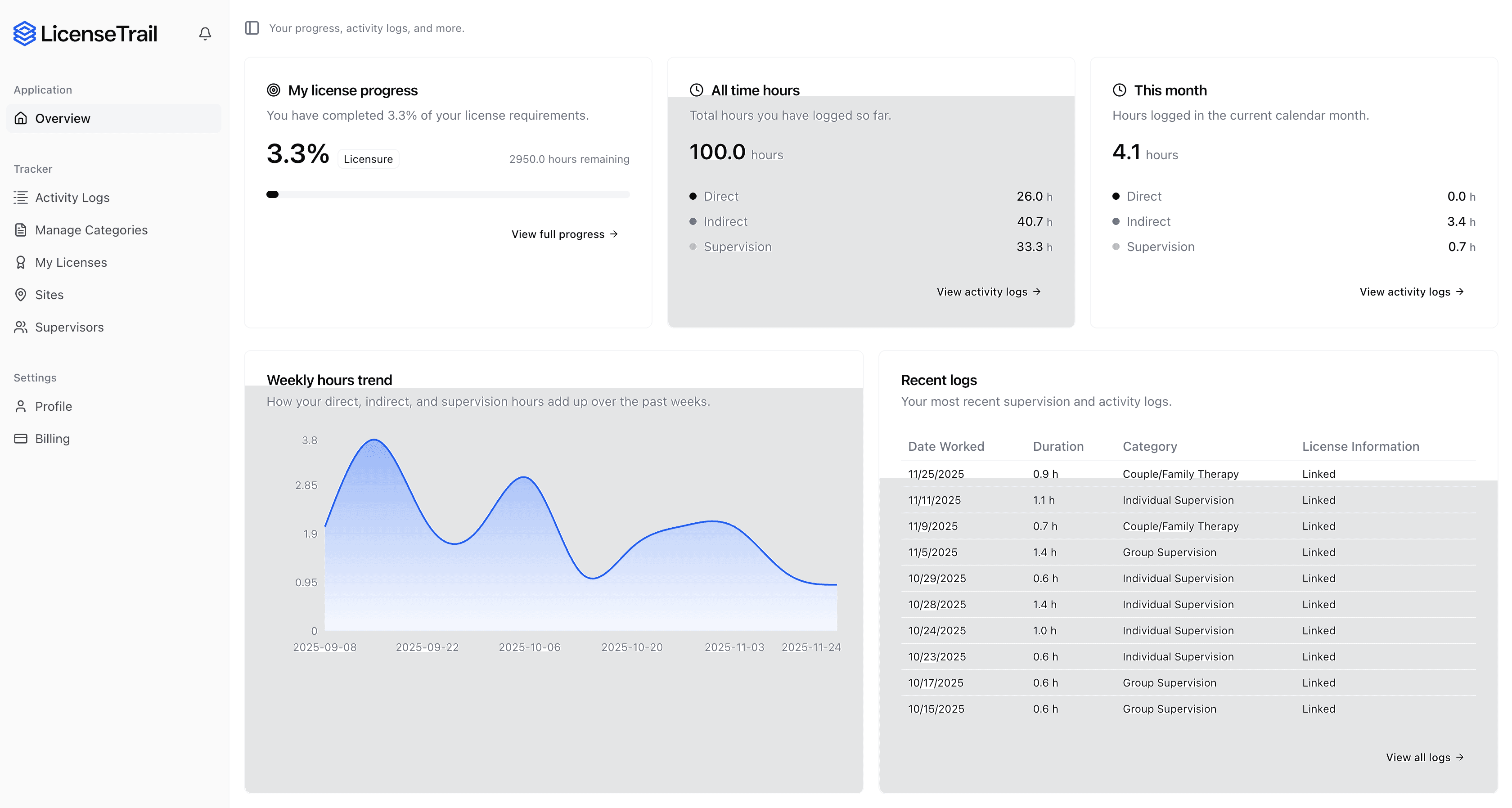
License Trail checks your direct, indirect, and supervision hours against District-of-columbia LISW requirements continuously and flags mismatches before you submit.
 Start Tracking for Free
No credit card required · Free plan available
Related Licenses
Is your spreadsheet hiding District-of-columbia LISW risks?
Stop guessing if your categories match District of Columbia Board of Social Work requirements. License Trail checks your direct, indirect, and supervision hours continuously and flags mismatches before you submit.
Import or log
Bring your spreadsheet or start fresh
Upload your existing tracking spreadsheet and we'll map every hour into the right District of Columbia Board of Social Work categories automatically.
Verify against District-of-columbia
Catch mismatches before the board does
License Trail checks your direct, indirect, and supervision hours against District-of-columbia LISW requirements continuously.
Export board-ready
One-click clean reports
Generate professional, board-ready reports for supervision meetings and District of Columbia Board of Social Work submissions in seconds.
No credit card required · Free plan available