
Georgia LAMFT Requirements: Hours, Exams & Step-by-Step Guide
Stop guessing if your categories match Georgia requirements. License Trail checks your direct, indirect, and supervision hours against LAMFT requirements continuously and flags mismatches before you submit.
No credit card required · Free plan available
Quick Requirements Overview
- Master’s degree in MFT (or Board-defined equivalent) from a CHEA-recognized institution; COAMFTE programs accepted; required coursework areas include MFT studies/therapy, human development (incl. diagnosis/psychopathology), ethics, research
- Complete a 1-year MFT practicum (before or after degree): 500 hrs direct clinical experience + 100 hrs supervision
- Supervision for practicum must be by qualified licensed LMFT/LPC/LCSW/psychiatrist/psychologist with AAMFT Approved Supervisor/GA Board Approved MFT Supervisor (or supervision-of-supervision)
- File a Board-approved Contract for Post‑Graduate Experience & Supervision; update/submit changes within 30 days; hours earned without Board approval may not count toward LMFT
- Pass the national MFT exam (AMFTRB) after Board approval to test; passing required for LAMFT issuance
- Practice only under direction and supervision; may use only the title “Associate Marriage and Family Therapist”; associate practice limited to 5 years while accruing LMFT hours
- LMFT (associate route) post‑master’s: 2–5 years under direction/supervision with 100 hrs supervision and direct clinical hours minimum: statute = 1,500 hrs (Board rule still lists 2,000 hrs)
License Details
Procedures
Licensed Associate Marriage and Family Therapist (LAMFT) in Georgia: Requirements and Hours
Becoming a Licensed Associate Marriage and Family Therapist (called “Associate Marriage and Family Therapist” or AMFT in Georgia law and rules) is the first formal licensure step on the way to becoming a fully Licensed Marriage and Family Therapist (LMFT). The Georgia Composite Board of Professional Counselors, Social Workers, and Marriage & Family Therapists governs this process through both statute (O.C.G.A. § 43‑10A‑13) and Board rules (Ga. Comp. R. & Regs. 135‑5‑.05 and 135‑5‑.06). (law.justia.com)
Below is an organized walkthrough of what Georgia specifically requires to obtain the Associate license, including the exact “type of hours” the Board and statute define, and how those hours function later when you move from LAMFT to LMFT.
1. Legal framework and terminology
Two primary authorities control LAMFT requirements in Georgia:
- Georgia Code § 43‑10A‑13 – Sets the education and experience requirements for licensure in marriage and family therapy, including a distinct subsection for “associate marriage and family therapist.” (law.justia.com)
- Board Rule 135‑5‑.05 – Associate Marriage and Family Therapists – Lays out Board‑level definitions (such as “direct clinical experience” and “supervision”), the required practicum hours, and the application steps for the associate license. (rules.sos.georgia.gov)
Georgia law refers to the credential as “associate marriage and family therapist”, and Board rules restrict the title: a person holding this license may only use the title “associate marriage and family therapist.” (rules.sos.georgia.gov)
2. Educational requirement for LAMFT
To qualify academically for the Associate Marriage and Family Therapist license, the Board requires a master’s degree that is clearly grounded in marriage and family therapy. Board Rule 135‑5‑.05(2)(a) provides: (rules.sos.georgia.gov)
“The applicant must have earned a master’s degree from a program in marriage and family therapy, from a program equivalent to a marriage and family therapy degree program, or from any program accredited by the Commission on Accreditation for Marriage and Family Therapy Education (COAMFTE).”
The program must be housed in an institution accredited by a regional body recognized by the Council on Higher Education Accreditation (CHEA). (rules.sos.georgia.gov)
The Board further defines what counts as a “program in marriage and family therapy” or a “program equivalent,” specifying required graduate coursework in:
- Marriage and Family Studies
- Marriage and Family Therapy
- Human Development (including at least one course in psychopathology or diagnosis of mental problems and conditions)
- Marriage and Family Therapy Ethics
- Research (rules.sos.georgia.gov)
These definitions matter because if your degree is not literally titled “Marriage and Family Therapy,” you must still show that your coursework matches the Board’s “equivalent” structure.
3. Required practicum and hour breakdown (pre‑licensure)
The core hour requirement for becoming a LAMFT in Georgia is embedded in the required one‑year practicum in marriage and family therapy, usually completed during your master’s program.
3.1. Practicum requirement and hours
Board Rule 135‑5‑.05(2)(b) states that an applicant: (rules.sos.georgia.gov)
- “must have completed a one year practicum in the practice of marriage and family therapy before or after the granting of the master’s degree.”
That practicum must include:
-
Minimum 500 hours of direct clinical experience
“Such practicum shall include a minimum of 500 hours of direct clinical experience.” (rules.sos.georgia.gov)
-
Minimum 100 hours of supervision of that practicum
“Such practicum shall include 100 hours of supervision provided by a licensed marriage and family therapist, professional counselor, clinical social worker, psychiatrist or psychologist, who was also an AAMFT Approved Supervisor, a Georgia Board Approved Marriage and Family Therapy Supervisor, or a person who was receiving supervision‑of‑supervision in order to qualify for either designation.” (rules.sos.georgia.gov)
The Georgia Association for Marriage and Family Therapy (GAMFT), summarizing current Board expectations, emphasizes that Georgia still requires 500 client contact hours and 100 supervision hours of practicum to meet standards for associate licensure, even if a COAMFTE‑accredited program has reduced its internal minimums. (gamft.org)
3.2. How the Board defines “direct clinical experience”
Board Rule 135‑5‑.05(1)(h) defines “Direct Clinical Experience” for associate MFT purposes as: (rules.sos.georgia.gov)
“time spent in client contact as therapist or co‑therapist, in supervision, in case staffing, or in case consultation.”
This definition is broader than some jurisdictions’: in Georgia, your direct clinical experience hours can include:
- Face‑to‑face (or comparable) sessions as therapist/co‑therapist with individuals, couples, or families.
- Time spent in supervision related to those cases.
- Time spent in case staffing or case consultation.
Because supervision time can count both as supervision hours and as direct clinical experience (under this rule), careful record‑keeping is essential to avoid confusion when later documenting hours for full licensure.
3.3. How the Board defines “supervision”
Board Rule 135‑5‑.05(1)(n) defines “Supervision” as: (rules.sos.georgia.gov)
“the direct clinical review, for the purpose of training or teaching, by a supervisor of the interactions with clients of a person practicing professional counseling, social work or marriage and family therapy. Supervision may include, without being limited to, the review of case presentations, audio tapes, video tapes, and direct observation in order to promote the development of the practitioner’s clinical skills.”
The rule also requires both supervisors and supervisees to maintain contemporaneous records of each supervision session (date, duration, type, and brief summary), which must be provided to the Board upon request. (rules.sos.georgia.gov)
4. The “Contract for Post‑Graduate Experience and Supervision”
After you have the qualifying degree and practicum, Georgia requires that would‑be LAMFTs file a Contract for Post‑Graduate Experience and Supervision with the Board.
4.1. What the contract is
Board Rule 135‑5‑.05(1)(b) describes this as: (rules.sos.georgia.gov)
“a statement, on forms provided by the Board, made by a person who has completed one of the degree programs required for licensure as an associate marriage and family therapist, specifying that person’s plan for obtaining the remaining experience and supervision required for licensure as a marriage and family therapist. Such a statement, once reviewed and approved by the Board, shall be considered an approved contract.”
4.2. Key requirements about the contract
Board Rule 135‑5‑.05(2)(c) adds: (rules.sos.georgia.gov)
- If you haven’t yet secured employment or begun supervision when you apply, you can indicate that on the contract—but you must submit an updated contract within 30 days of securing post‑graduate employment or beginning supervision.
- Once the contract is approved, any change in employment, supervision, or plan must be submitted to the Board within 30 days for approval.
- The Board can request verification or revisions at its discretion.
- Crucially:
“Any post‑graduate experience or supervision obtained by an associate marriage and family therapist without Board approval may not be applied toward licensure as a marriage and family therapist.” (rules.sos.georgia.gov)
This means you must have a Board‑approved contract in place if you want your later post‑master’s hours (earned as a LAMFT) to count toward full LMFT licensure.
5. Examination requirement for LAMFT
After the Board reviews your application and contract, you must pass the national MFT examination.
Board Rule 135‑5‑.05(2)(d) states: (rules.sos.georgia.gov)
“The applicant shall register and sit for the Examination in Marital and Family Therapy following Board review of his/her application for licensure as an associate marriage and family therapist and approval to take the examination. Passing the examination is a requirement for licensure.”
In practice, this is the AMFTRB National Marriage and Family Therapy Examination, administered through the state’s testing process.
6. Issuance of the LAMFT license and practice limits
Once you have:
- The qualifying master’s degree in (or equivalent to) MFT,
- The one‑year practicum (minimum 500 direct clinical hours + 100 supervision hours),
- A Board‑approved Contract for Post‑Graduate Experience and Supervision, and
- A passing score on the MFT exam,
the Board may issue the Associate Marriage and Family Therapist license.
Two key restrictions then apply:
-
Title restriction – Board Rule 135‑5‑.05(3)(a):
“A person who holds a license as an associate marriage and family therapist may only use the title ‘associate marriage and family therapist.’” (rules.sos.georgia.gov)
-
Practice restriction and five‑year limit – Rule 135‑5‑.05(3)(b) and statute § 43‑10A‑13(a)(1)(c):
- The associate may engage in the practice of marriage and family therapy only while under direction and supervision.
- This may continue “only for a period not to exceed five years while obtaining the post‑master’s experience and supervision required for licensure as a marriage and family therapist.” (rules.sos.georgia.gov)
“Direction” is defined as ongoing oversight by an employer or superior who is responsible for the quality of your services and for ensuring appropriate supervision or intervention in situations requiring greater expertise. Directors and supervisors may not provide direction or supervision to family members, and may not do so in certain ownership/financial‑conflict situations. (rules.sos.georgia.gov)
7. Hours you must complete as a LAMFT to become fully licensed (LMFT)
Although your question centers on the LAMFT, the Associate license exists solely to allow you to accumulate the post‑master’s hours required for full LMFT licensure. This is where the “1,500 hours of direct experience”–type numbers come into play.
There are two overlapping but not identical sets of requirements:
- The statutory standard in O.C.G.A. § 43‑10A‑13 (as amended, effective July 1, 2024), and
- The Board rule in 135‑5‑.06, which has not yet been fully conformed to the latest statutory change.
7.1. Statutory requirement (current law)
Georgia Code § 43‑10A‑13(a)(2)(A) sets the associate‑route standard for LMFT as follows: (law.justia.com)
For licensure as a marriage and family therapist through the associate route, the applicant must have:
- Licensure as an associate marriage and family therapist, and
- Two years of full‑time post‑master’s experience or its equivalent in the practice of marriage and family therapy under direction and supervision as an associate, which must:
- Include “a minimum of 1,500 hours of direct clinical experience,” and
- Include “100 hours of supervision of such experience,”
- All completed within not less than two years and not more than five years.
In statutory language, then, the core post‑master’s requirement via the associate route is:
1,500 hours of direct clinical experience + 100 hours of supervision of that experience over 2–5 years, while licensed as an associate MFT.
7.2. Board rule requirement (not yet updated to the 1,500‑hour statute)
Board Rule 135‑5‑.06(2)(a) still states, for applicants who already hold an Associate MFT license: (rules.sos.georgia.gov)
-
Experience requirement
“The applicant must document two years of full‑time post‑master’s experience or its equivalent, under direction and supervision.
(i) Such experience shall have been in the practice of marriage and family therapy, and shall include a minimum of 2,000 hours of direct clinical experience.
(ii) For applicants who have worked less than full‑time, equivalent experience may be accrued over a total of not less than two years and not more than five years.” -
Supervision requirement
“The applicant must have obtained 100 hours of supervision, concurrent with his/her documented experience.”
– Supervision must be provided by a qualified LMFT, LPC, LCSW, psychiatrist, or psychologist (with at least three years of licensure in good standing, or who is an AAMFT or Georgia Board Approved MFT Supervisor or under supervision‑of‑supervision).
– At least 50 of the 100 hours must be individual supervision; up to 50 may be group supervision.
– “A minimum of 5 hours of such supervision must have been obtained concurrent with each 100 hours of direct clinical experience.” (rules.sos.georgia.gov)
The same definition of “Direct Clinical Experience” applies here as in the associate rule—time spent in client contact as therapist/co‑therapist, in supervision, in case staffing, or case consultation. (rules.sos.georgia.gov)
7.3. Reconciling statute and Board rule
As of late 2025:
- The statute now specifies 1,500 hours of direct clinical experience (plus 100 hours of supervision) for the associate‑route LMFT license. (law.justia.com)
- The Board rule still lists 2,000 hours of direct clinical experience (plus 100 hours of supervision) for associate‑route applicants. (rules.sos.georgia.gov)
Both sources require that:
- The hours be in marriage and family therapy,
- Obtained under direction and supervision,
- Over at least two years, and
- No more than five years.
When you are planning your LAMFT experience, the safest approach is to structure your post‑master’s work so that it would satisfy both the statutory 1,500‑hour minimum and the Board’s 2,000‑hour standard unless and until the Board formally amends its rule and clarifies enforcement. But in terms of precise statutory language, the associate‑route minimum in law is now 1,500 hours of direct clinical experience + 100 hours of supervision of that experience, completed in 2–5 years.
8. Summary of key hour‑based requirements
For quick reference, the Georgia Board’s and statute’s core hour requirements around the LAMFT path are:
Before you can be licensed as a LAMFT (Associate MFT)
- Master’s degree in MFT or a Board‑defined equivalent program (or COAMFTE‑accredited program). (rules.sos.georgia.gov)
- One‑year practicum in marriage and family therapy that includes:
- At least 500 hours of direct clinical experience (as defined by the Board).
- At least 100 hours of supervision of that practicum, provided by properly qualified supervisors (AAMFT Approved Supervisor, Georgia Board Approved MFT Supervisor, or a supervisor under supervision‑of‑supervision, who is also a licensed MFT, LPC, LCSW, psychiatrist, or psychologist). (rules.sos.georgia.gov)
After you are licensed as a LAMFT, to become an LMFT (associate‑route)
-
Statute (O.C.G.A. § 43‑10A‑13(a)(2)(A)):
- 2 years (minimum) full‑time post‑master’s practice as an associate MFT, under direction and supervision, completed within 2–5 years.
- At least 1,500 hours of direct clinical experience.
- At least 100 hours of supervision of that experience. (law.justia.com)
-
Board Rule 135‑5‑.06(2)(a) (not yet updated to the 1,500‑hour change):
- Same 2–5 year timeframe under direction and supervision.
- At least 2,000 hours of direct clinical experience.
- At least 100 hours of supervision, with at least 50 individual, up to 50 group, and at least 5 supervision hours per 100 hours of direct clinical experience. (rules.sos.georgia.gov)
These hour categories—direct clinical experience and supervision of that experience—are the specific “types of hours” that Georgia uses in its licensure framework for Associate Marriage and Family Therapists and, later, full LMFTs.
Track your LAMFT hours with confidence
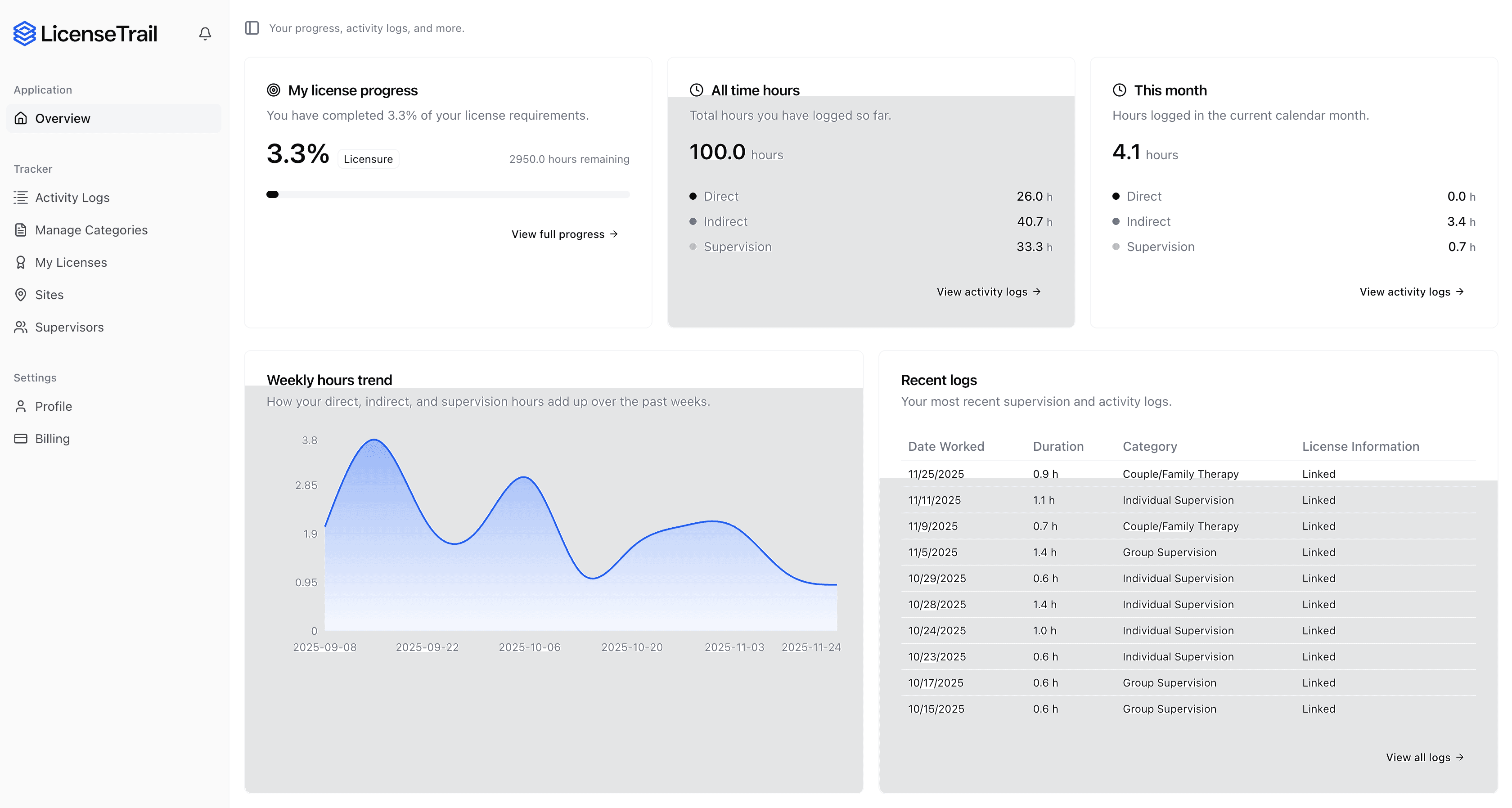
License Trail checks your direct, indirect, and supervision hours against Georgia LAMFT requirements continuously and flags mismatches before you submit.
 Start Tracking for Free
No credit card required · Free plan available
Is your spreadsheet hiding Georgia LAMFT risks?
Stop guessing if your categories match Georgia Board of Professional Counselors, Social Workers, and Marriage & Family Therapists requirements. License Trail checks your direct, indirect, and supervision hours continuously and flags mismatches before you submit.
Import or log
Bring your spreadsheet or start fresh
Upload your existing tracking spreadsheet and we'll map every hour into the right Georgia Board of Professional Counselors, Social Workers, and Marriage & Family Therapists categories automatically.
Verify against Georgia
Catch mismatches before the board does
License Trail checks your direct, indirect, and supervision hours against Georgia LAMFT requirements continuously.
Export board-ready
One-click clean reports
Generate professional, board-ready reports for supervision meetings and Georgia Board of Professional Counselors, Social Workers, and Marriage & Family Therapists submissions in seconds.
No credit card required · Free plan available