
Georgia LAPC Requirements: Hours, Exams & Step-by-Step Guide
Stop guessing if your categories match Georgia requirements. License Trail checks your direct, indirect, and supervision hours against LAPC requirements continuously and flags mismatches before you submit.
No credit card required · Free plan available
Quick Requirements Overview
- Credential/title (GA): LAPC = Associate Professional Counselor (APC); only APCs may use “Associate Professional Counselor” or “Licensed Associate Professional Counselor.”
- Practice restriction: Must practice only under direction and supervision; APC status limited to 5 years while accruing LPC experience.
- Education: Master’s+ in clinical counseling/counseling psychology (or Board-acceptable counseling/applied psychology), regionally accredited, 60 semester / 90 quarter hours.
- Practicum/internship (in degree): Supervised counseling practicum/internship ≥300 hours (degrees after 9/30/2018: ≥600 hours).
- Coursework: Must cover Board-required counseling content areas (post‑9/30/2018 programs: all 9 specified areas).
- Contract required: File Board-approved Directed Experience Under Supervision Contract (approved worksite + qualified supervisor); update within 14 days of changes.
- Exam: Must pass the Board-prescribed competency exam (national counseling exam as specified by the Board at time of application).
- Accruing hours toward LPC (post‑9/30/2018 definitions): 1 “year” = 1,000 Directed Experience hours (≥12 months) + 35 supervision hours; hours must be within last 60 months before LPC application.
License Details
Procedures
In Georgia, the “LAPC” (Licensed Associate Professional Counselor) is the same credential the Georgia Composite Board legally calls an Associate Professional Counselor (APC). The title “licensed associate professional counselor” is explicitly reserved in state law for people holding the APC license. (law.justia.com)
Below is a structured overview of what the Georgia Composite Board requires for APC/LAPC licensure, with emphasis on how the Board defines hours and experience.
1. License name and legal status
Georgia law uses the term “associate professional counselor” and states that only a person licensed at this level may use the titles:
- “associate professional counselor,” or
- “licensed associate professional counselor.” (law.justia.com)
APCs/LAPCs:
- Must practice only under “direction and supervision”; and
- May do so for no more than five years while they obtain the post‑degree experience needed for full LPC licensure. (law.justia.com)
2. Education requirements for APC/LAPC
2.1 Degree level and type
State statute (O.C.G.A. § 43‑10A‑11, as amended July 1, 2024) requires, for APC:
- At least a master’s degree or higher,
- From a regionally accredited program in clinical counseling or counseling psychology,
- Consisting of at least 60 semester hours or 90 quarter hours,
- With an approved supervised internship or practicum primarily counseling in content as part of the degree program. (law.justia.com)
The Board’s rules add that the degree must be:
- In a program “primarily counseling in content” or a “program of applied psychology”, and
- Include a supervised practicum or internship of at least 300 hours as part of the degree. For degrees awarded after September 30, 2018, the Board has raised this requirement to 600 practicum/internship hours. (rules.sos.georgia.gov)
So in practice, a typical APC applicant today must show:
- Master’s or higher in clinical counseling / counseling psychology
- 60 semester (or 90 quarter) graduate credits
- 600 hours of supervised counseling practicum/internship embedded in the program (if degree is post‑9/30/2018)
2.2 Required coursework areas (Board language)
The Board defines a “program primarily counseling in content” by requiring graduate‑level work in:
- One course in counseling/psychotherapy theory
- A counseling or applied psychology practicum/internship, and
- Courses covering specific content areas (Human Growth and Development, Multicultural Counseling, Counseling Techniques, Group Counseling, Career, Assessment, Research, Professional Ethics, Psychopathology). After September 30, 2018, the APC/LPC path must cover all nine content areas. (rules.sos.georgia.gov)
3. The experience “contract” required for APC/LAPC
To become an APC/LAPC, you are not yet required to have post‑master’s practice hours. Instead, Georgia requires you to register a plan for obtaining them.
Board Rule 135‑5‑.01 calls this the “Directed Experience Under Supervision Contract.” You must:
- File a Board‑approved Directed Experience Under Supervision Contract that describes how you will obtain the post‑master’s (post‑degree) experience under direction and supervision needed for LPC licensure.
- Notify the Board within 14 days of any change in the contract by submitting a new one. (rules.sos.georgia.gov)
This contract must list work sites that meet the Board’s definition of “Directed Experience.” The rules define:
- “Directed Experience” as time spent under direction engaging in the practice of professional counseling.
- Valid work sites must have a formal organizational structure, written job description, office hours, performance review and dismissal policies, and a signed agreement documenting your role. (rules.sos.georgia.gov)
The contract ties directly to how many Directed Experience and Supervision hours you will later need for full LPC status (see Section 5).
4. Examination requirement at the APC/LAPC stage
Board rules state:
- To qualify for licensure as an associate professional counselor, an applicant “must pass the required competency examination for licensure prescribed by the Board” in Rule 135‑3‑.03(2)(a)(2). (law.cornell.edu)
The rule itself doesn’t name the test, but current licensure guides for Georgia indicate that:
- The Board uses a national counselor examination, historically the National Counselor Examination (NCE); some sources list that exam explicitly for Georgia. (counselingdegreesonline.org)
Because the Board can change which national exam it adopts, applicants should confirm the exact exam (NCE vs. NCMHCE or other) on the Georgia Secretary of State “How to Guide: Professional Counselor” and APC application instructions at the time they apply. (sos.ga.gov)
5. How Georgia defines hours and experience for APCs working toward LPC
This is the part that often causes confusion. Georgia does not phrase requirements as “X hours of direct experience and Y hours of supervised experience” in the way some other states (for example Nevada) do. Instead, the Composite Board uses its own terms and then converts “years” of experience into hour minimums.
Those terms are:
- Directed Experience – your actual counseling work time under direction in an approved setting;
- Supervision – clinical review of your client work by a qualified supervisor;
- Years of Directed Experience and Years of Supervision – which the Board defines by minimum clock hours.
All of these definitions appear in the Professional Counselor rule (135‑5‑.02) and apply to APCs’ post‑degree experience as they move toward LPC.
5.1 Key Board definitions
From Rule 135‑5‑.02(a): (rules.sos.georgia.gov)
- “Directed Experience” – time spent under direction in the practice of professional counseling at a qualifying work site.
- “Work settings acceptable to the Board” – directed work settings where professional counseling takes place (examples: education, rehabilitation, career development, mental health, community or industrial organizations). Practice without direction is explicitly not acceptable.
- “Supervision” – direct clinical review by a qualified supervisor of your interactions with clients, for training/teaching and skill development. It can include review of cases, audio/video, or direct observation.
- “Supervisor” – a licensed Professional Counselor, Clinical Social Worker, Marriage and Family Therapist, Psychologist, or Psychiatrist who meets specific post‑licensure experience requirements; an LPC supervisor must also hold an approved clinical supervisor credential (NBCC ACS or LPCAGA CPCS) for supervision entered after September 30, 2018. (rules.sos.georgia.gov)
Both supervisor and supervisee must keep contemporaneous documentation of every supervision session (date, duration, type—individual or group—and summary). If there are discrepancies in hours, the Board will request this documentation. (rules.sos.georgia.gov)
5.2 How “years” convert into hours (Directed Experience)
The definitions for Years of Directed Experience appear in Rule 135‑5‑.02(a)(7). The rule distinguishes pre‑ and post‑September 30, 2018 service:
Before September 30, 2018 (old standard): (rules.sos.georgia.gov)
- 1 year of Directed Experience = minimum 600 hours
- 2 years of Directed Experience = minimum 1,200 hours
- 3 years of Directed Experience = minimum 1,800 hours
- 4 years of Directed Experience = minimum 2,400 hours
This older 600‑hour definition is why many older summaries still say Georgia requires 2,400 hours of directed experience and 120 hours of supervision (4 years × 600; 4 years × 30). (counselingdegreesonline.org)
After September 30, 2018 (current standard):
- “One year of Directed Experience” now means a minimum of 1,000 hours of directed experience acquired in not less than 12 months.
- All Directed Experience must be obtained within the 60 months (five years) before the date of application. (rules.sos.georgia.gov)
The number of years you personally must complete depends on your degree path (master’s, specialist, doctoral) and practicum hours, as laid out in Rule 135‑5‑.02(b)–(f). For a typical master’s‑level counselor, the rule still speaks in terms of three or four years of post‑master’s directed experience, though the statute now sets a minimum of two years (see below). (rules.sos.georgia.gov)
5.3 How “years” convert into hours (Supervision)
Rule 135‑5‑.02(a)(8) defines Years of Supervision. Again, there are old and updated standards: (rules.sos.georgia.gov)
Before September 30, 2018:
- 1 year of Supervision = minimum 30 hours of supervision during 1 year of directed experience
- 4 years of Supervision (common LPC path) = 120 hours supervision (4 × 30)
After September 30, 2018 (current standard):
- “One year of Supervision” means a minimum of 35 hours of supervision obtained during a 12‑month period of Directed Experience.
- All supervision must be obtained within the 60 months before application.
5.4 What this means numerically for a current APC/LAPC
Putting the statute and Board rules together:
- The law now requires two years of post‑degree experience under direction and supervision for LPC licensure. (law.justia.com)
- The rules define a post‑2018 “year” of Directed Experience as 1,000 hours, and a year of Supervision as 35 hours. (rules.sos.georgia.gov)
So for an APC who is accruing hours entirely after September 30, 2018, the practical minimums implied by these definitions are:
- Directed Experience (counseling work):
- 2 years × 1,000 hours/year = at least 2,000 hours of directed experience in work settings acceptable to the Board.
- Supervision (clinical oversight):
- 2 years × 35 hours/year = at least 70 hours of documented clinical supervision, with required proportions provided by a qualified LPC supervisor (and/or other qualified mental health professionals, depending on your pathway). (rules.sos.georgia.gov)
However:
- The Board’s detailed LPC rules still refer to three or four years of directed experience for many master’s‑level applicants (with the shorter three‑year path available when the graduate program included at least 300/600 hours of supervised practicum/internship). (rules.sos.ga.gov)
- Because the statute has changed more recently than the rules, there is some tension between the minimum statutory two‑year language and the long‑standing three‑/four‑year rule text. Many recent interpretations assume the Board will align with the statute by accepting 2,000 hours/70 supervision hours as the minimum for work performed under the current definitions, but you should confirm with the Board or a Georgia‑based supervisor how they are presently applying these rules when you sign your contract.
The crucial point for APCs is that your Directed Experience Under Supervision Contract should be structured to meet:
- The legal minimum (two years under direction and supervision), and
- The Board’s definitions of years, hours, and supervision as they are being applied at the time you accrue the hours.
6. Restrictions and practice conditions while holding the APC/LAPC
Once licensed as an APC/LAPC, the Board and statute impose these explicit limits: (rules.sos.georgia.gov)
-
Title usage
- You may use only the titles “Associate Professional Counselor” or “Licensed Associate Professional Counselor.”
- You may not use “Licensed Professional Counselor (LPC)” until fully licensed at that level.
-
Supervision and direction required
- You must practice only under both “direction” and “supervision” as defined by the Board.
- Direction is administrative oversight at the worksite; supervision is clinical oversight of your counseling work.
-
Five‑year time limit in APC status
- You may practice as an APC for no more than five years while accumulating the required post‑degree experience and supervision for LPC.
-
Work settings must be acceptable
- Your APC‑level work that counts toward LPC must occur in “work settings acceptable to the Board”—essentially, bona fide counseling settings with formal organizational structure and documentation.
7. Step‑by‑step summary toward APC/LAPC in Georgia
Putting the requirements into a practical sequence:
-
Complete an approved graduate counseling degree
- Master’s or higher in clinical counseling / counseling psychology (or a Board‑acceptable “program primarily counseling in content” or applied psychology).
- At least 60 semester / 90 quarter hours, with 300–600+ hours of supervised practicum/internship depending on graduation date. (rules.sos.georgia.gov)
-
Ensure coursework matches the Board’s content requirements
- Meet all required counseling content areas (9 areas if degree is post‑September 30, 2018). (rules.sos.georgia.gov)
-
Pass the Board‑prescribed national competency exam
- Typically a national counselor exam such as the NCE (check current APC application instructions for the exact test and cut score). (law.cornell.edu)
-
Secure a qualifying supervisor and worksite(s)
- Supervisor must meet the Board’s definition; an LPC supervisor must hold an NBCC Approved Clinical Supervisor or LPCAGA Certified Professional Counselor Supervisor credential for supervision begun after 9/30/2018. (rules.sos.georgia.gov)
- Worksite must meet the Board’s criteria for “Directed Experience” and “Work settings acceptable to the Board.”
-
File the “Directed Experience Under Supervision Contract”
- Detail your work settings, supervisor(s), and plan for accumulating the required Directed Experience and Supervision hours.
- Update within 14 days if anything changes. (rules.sos.georgia.gov)
-
Submit the APC/LAPC application to the Composite Board
- Include application fee, exam results, official transcripts, proof of degree, contract affidavit(s), and any citizenship/identity affidavits required under Georgia’s general licensing provisions. (counselingschools.com)
Once the Board approves your application, you hold the APC/LAPC license and can begin/continue accruing post‑degree experience under your contract, with the goal of meeting the Board‑defined Directed Experience and Supervision hour standards necessary to transition to full LPC licensure.
Track your LAPC hours with confidence
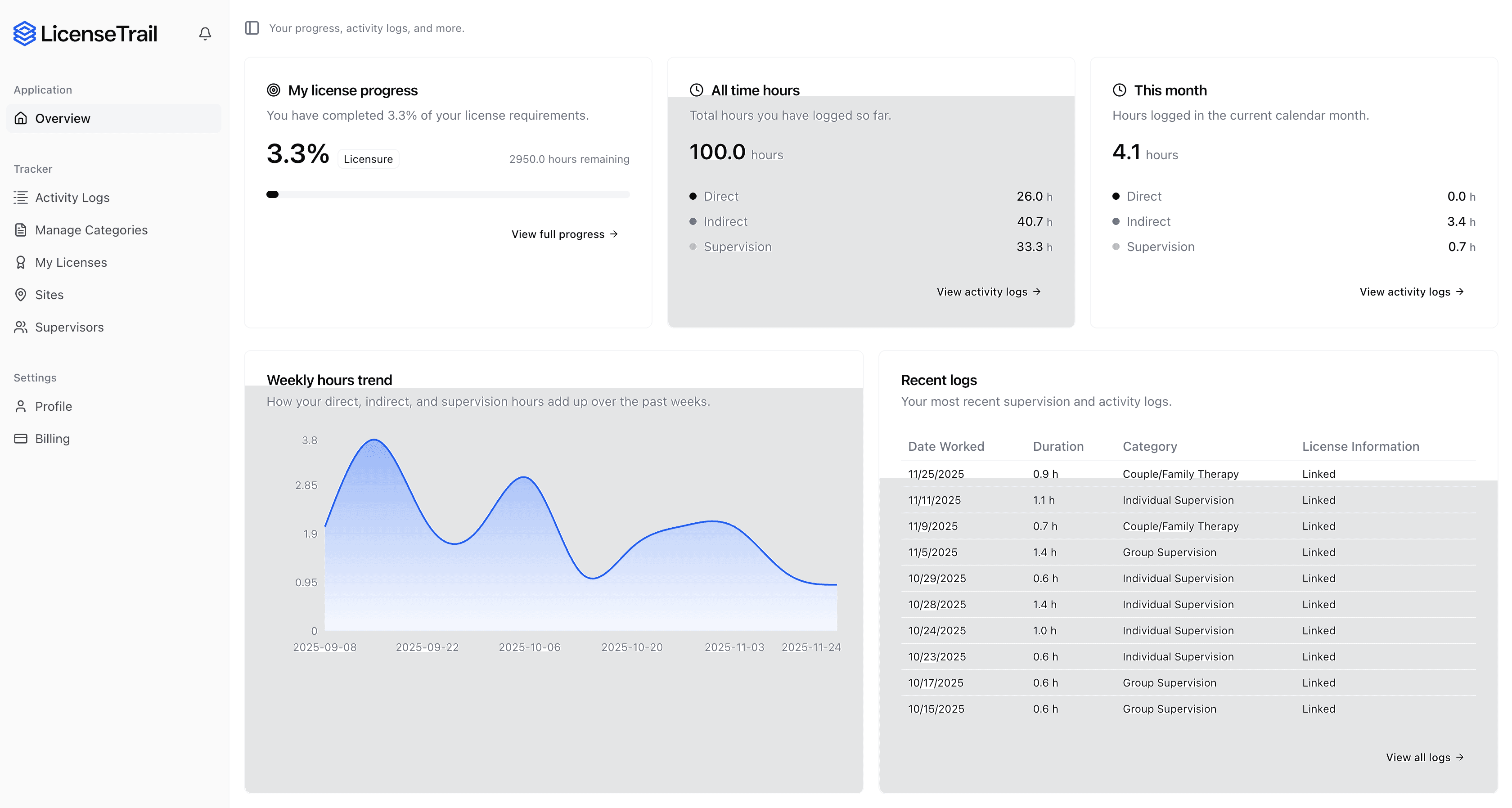
License Trail checks your direct, indirect, and supervision hours against Georgia LAPC requirements continuously and flags mismatches before you submit.
 Start Tracking for Free
No credit card required · Free plan available
Is your spreadsheet hiding Georgia LAPC risks?
Stop guessing if your categories match Georgia Board of Professional Counselors, Social Workers, and Marriage & Family Therapists requirements. License Trail checks your direct, indirect, and supervision hours continuously and flags mismatches before you submit.
Import or log
Bring your spreadsheet or start fresh
Upload your existing tracking spreadsheet and we'll map every hour into the right Georgia Board of Professional Counselors, Social Workers, and Marriage & Family Therapists categories automatically.
Verify against Georgia
Catch mismatches before the board does
License Trail checks your direct, indirect, and supervision hours against Georgia LAPC requirements continuously.
Export board-ready
One-click clean reports
Generate professional, board-ready reports for supervision meetings and Georgia Board of Professional Counselors, Social Workers, and Marriage & Family Therapists submissions in seconds.
No credit card required · Free plan available