
Idaho LPC Requirements: Hours, Exams & Step-by-Step Guide
Stop guessing if your categories match Idaho requirements. License Trail checks your direct, indirect, and supervision hours against LPC requirements continuously and flags mismatches before you submit.
No credit card required · Free plan available
Quick Requirements Overview
- Graduate degree primarily counseling in nature; CACREP-accredited or Board-approved equivalent; ≥60 semester credits (90 quarter)
- Degree must include 1 year advanced practicum with ≥280 direct client contact hours (may count toward supervised experience if standards met)
- Pass NBCC National Counselor Examination (NCE); scores sent to Board
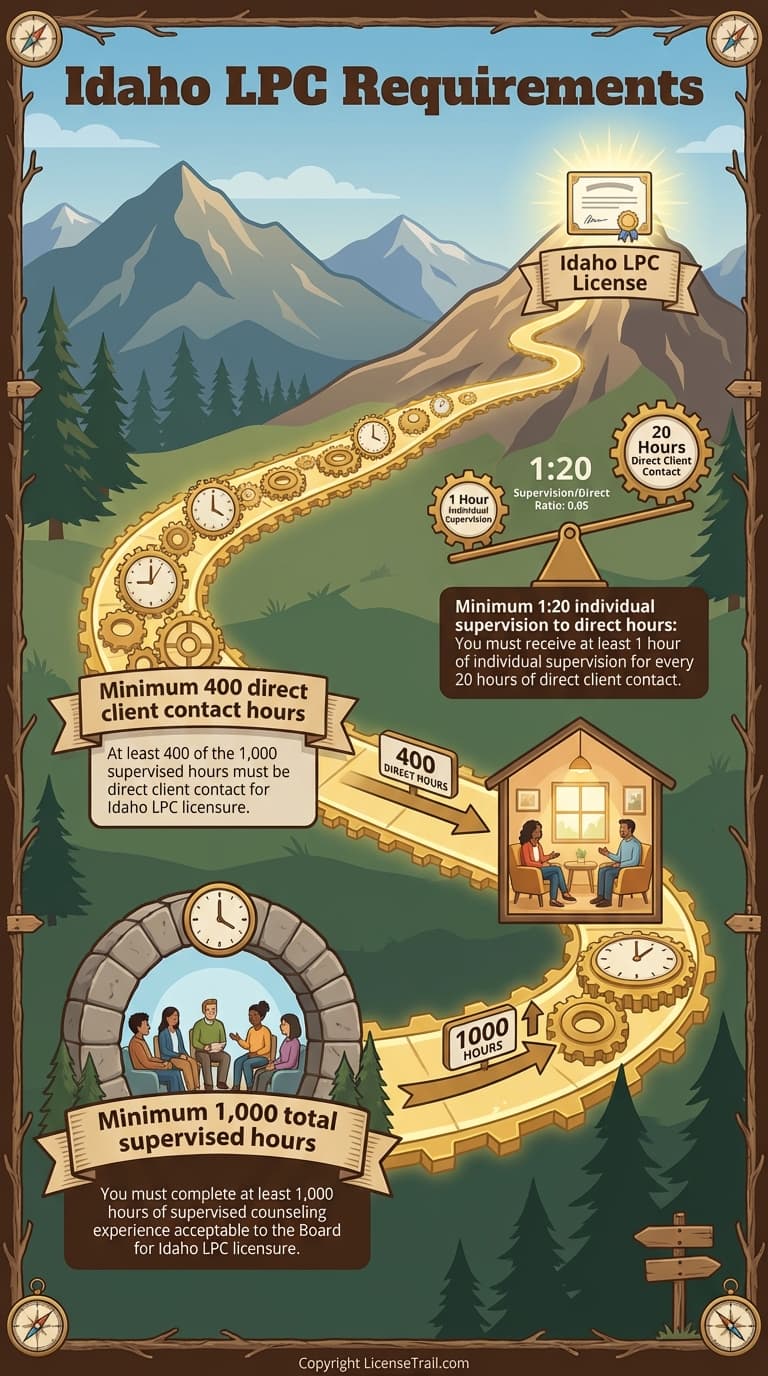
- Complete 1,000 clock hours supervised counseling experience in an acceptable setting, incl. ≥400 direct client contact hours
- Supervision minimums: 1 hr individual supervision per 20 hrs direct client contact (job/internship); practicum often 1:10 (per cited guidance)
- Supervised hours must be under a Board-approved supervisor (e.g., LPC/LCPC/LMFT registered as supervisor, psychologist, psychiatrist, etc.)
- If finishing hours post-degree/awaiting exam: must register as Post‑Graduate Intern; max 4 years unless Board grants good cause
- Apply with fees + official transcripts, NCE score, and verified supervision/hour logs (supervisor credentials/ratios documented)
License Details
Procedures
Licensure as a Licensed Professional Counselor (LPC) in Idaho is regulated by the Idaho Licensing Board of Professional Counselors and Marriage and Family Therapists under IDAPA 24.15.01 and related statutes. The core requirements fall into four categories: education, examination, supervised experience, and application/registration details.
Below is a structured walkthrough focused on the exact hour requirements and how the Board defines them.
1. Educational requirements
1.1. Degree and program
For LPC licensure, you must complete a graduate program that is:
- Primarily counseling in nature, and
- CACREP-accredited or substantially similar and approved by the Board. (law.cornell.edu)
The Board also expects:
- At least 60 semester credits (or 90 quarter credits) of graduate coursework in counseling, marriage and family therapy, or a closely related field, from an accredited institution. (dopl.idaho.gov)
1.2. Required advanced practicum
The Board’s published materials specify that your degree must include:
- One (1) year of an advanced counseling practicum with at least 280 hours of direct client contact. (dopl.idaho.gov)
These practicum hours are part of your degree and may also be counted toward the supervised‐experience requirement, as long as they meet the Board’s definitions and supervision standards (see Section 3.4 below). (law.cornell.edu)
2. Examination requirement
For LPC (not LCPC) in Idaho, the required examination is:
- National Counselor Examination (NCE), prepared by the National Board for Certified Counselors (NBCC). (law.cornell.edu)
The Administrative Code states, under “Professional Counselor – Required Examination”: “The National Counselor Examination prepared by the National Board of Certified Counselors (NBCC).” (law.cornell.edu)
A passing NCE score must be sent directly to the Board.
3. Supervised experience requirements (this is where the hours come in)
Idaho does not use a “1,500 direct + 1,500 supervised” type split. Instead, it has a single supervised-experience requirement with internal breakdowns.
3.1. Total supervised hours
The counseling rules set out a Supervised Experience Requirement of 1,000 hours:
- Rule language (Section 150, as quoted by Idaho programs) states:
“Supervised Experience Requirement. One thousand (1,000) hours of supervised experience in counseling acceptable to the Board.” (isu.edu)
This 1,000 hours is further defined as:
- “One thousand (1,000) hours is defined as one thousand (1,000) clock hours of experience working in a counseling setting…” (isu.edu)
So, the Board treats 1,000 hours as 1,000 actual clock hours of counseling work in approved settings.
3.2. Direct client contact hours inside the 1,000
Within these 1,000 supervised hours:
- At least 400 hours must be direct client contact.
The current Licensure rule (IDAPA 24.15.01.100) states:
- “Four hundred (400) of the one thousand (1,000) hours must be direct client contact…” (law.cornell.edu)
This means:
- Total supervised experience: 1,000 hours
- Minimum direct client contact within that total: 400 hours
- Remaining up to 600 hours: Other counseling duties in an approved counseling setting (e.g., documentation, staffings, certain assessments, non-contact clinical activities) so long as they meet the Board’s notion of “experience working in a counseling setting.” (isu.edu)
So, in Idaho the structure is:
1,000 hours supervised experience total, of which at least 400 hours are direct client contact.
It is not 1,500 + 1,500 or any similar split.
3.3. What “direct client contact” means in practice
The Board’s rules do not include a long narrative definition inside the licensure section, but Idaho‐focused licensure guidance summarizes “direct client contact” as face-to-face counseling, assessment, or intervention with clients (including secure telehealth), where you are actively providing therapeutic services. (research.com)
Indirect activities (team meetings, charting, case management, administrative tasks) generally do not count toward the 400 direct hours, though they may count toward the non‑direct portion of the 1,000 total if they occur within a counseling role in an approved setting. (isu.edu)
3.4. Supervision ratios and format
The Board is quite specific about how often you must receive supervision while earning those hours.
The licensure rule for Professional Counselor states:
- “…the supervised experience must include a minimum of one (1) hour of individual supervision for every twenty (20) hours of direct client contact.” (law.cornell.edu)
Earlier Board rule language (Section 150.02, still cited by Idaho universities) elaborates:
-
For job or internship experience (non‑practicum):
– Minimum 1 hour of face‑to‑face supervision for every 20 hours of job/internship experience in the counseling setting. (isu.edu) -
For counseling practicum experiences:
– Stricter ratio: 1 hour of supervision for every 10 hours spent in the practicum setting. (isu.edu)
Other key supervision details in the Board’s text:
- Supervision can be face-to-face in person or via secure live electronic connection (e.g., secure video). (isu.edu)
- “Individual” supervision is defined as one‑to‑one or one‑to‑two (supervisor-to-supervisee) meetings. (isu.edu)
3.5. Who can supervise your hours
The Board sets conditions for what counts as an approved supervisor for LPC licensure. As summarized in Idaho university guidance drawing directly from Rule 150, acceptable supervisors include: (boisestate.edu)
- Counselor education faculty member at an accredited college or university
- Licensed Professional Counselor (LPC) registered with the Board as a supervisor
- Licensed Clinical Professional Counselor (LCPC) registered with the Board as a supervisor
- Licensed Marriage and Family Therapist (LMFT) registered with the Board as a supervisor
- Clinical Social Worker registered as a supervisor with the Idaho Board of Social Work
- Licensed psychologist
- Licensed psychiatrist (Idaho license)
Additionally, the Board’s current Practice Standards clarify that:
- Registered interns obtaining supervised or postgraduate experience hours must be supervised by a Board‑approved supervisor and must explicitly identify themselves as interns in documentation and advertising. (law.cornell.edu)
3.6. Using practicum/internship hours toward the 1,000
The Licensure rule explicitly allows you to use graduate practicum or internship to help satisfy the 1,000 hours, provided they meet the Board’s standards:
- “A supervised graduate-level educational experience (i.e. practicum or internship) may be utilized to fulfill this requirement…” (law.cornell.edu)
Thus:
- Your advanced practicum (at least 280 direct client contact hours) counts both as part of your degree requirement and can be applied toward:
– the 400 direct client contact hours, and
– the 1,000 total supervised hours,
as long as the supervision ratios and supervisor qualifications are met.
Because most CACREP‑style programs provide 600+ practicum/internship hours, many Idaho applicants will complete a substantial part of the 1,000 hours before graduation, then finish any remaining hours as a Registered Post‑Graduate Intern.
4. Registered Post‑Graduate Intern status
If you still need supervised experience hours after your degree (or while awaiting exam results), Idaho requires that you be registered as an intern with the Board.
The licensure rules state that a post‑graduate intern registration is required to engage in the supervised practice of counseling or marriage and family therapy while completing supervised experience hours or awaiting examination results. (law.cornell.edu)
Key points:
- You must:
– Have an approved graduate degree, and
– Designate a Board‑approved supervisor on your registration. (law.cornell.edu) - You may not practice as an intern for more than four (4) years from the original date of registration unless you show good cause to the Board. (law.cornell.edu)
During this period, every hour you want to count toward licensure must meet:
- The setting requirement (counseling setting acceptable to the Board),
- The supervision ratios and supervisor qualifications, and
- The documentation requirements (intern logs, supervisor verification, etc.).
5. Application and documentation (high-level)
When you are ready to apply for LPC licensure, the Board expects a complete application file that typically includes: (dopl.idaho.gov)
- Completed application for LPC licensure and fees
- Official graduate transcripts showing:
– Degree conferral
– At least 60 semester credits (or 90 quarter credits)
– The advanced practicum with 280+ direct hours - Official NCE score sent directly from NBCC
- Detailed supervised‑experience documentation, usually including:
– Verification of 1,000 supervised hours (with at least 400 direct client contact)
– Supervisor’s license information and supervisor‑registration status
– Supervision logs showing ratios (20:1 for job/internship, 10:1 for practicum, where applicable)
The Board does not pre‑approve coursework or supervision plans; it reviews everything once you submit a complete application. (dopl.idaho.gov)
6. Quick reference: Idaho LPC hour requirements
Educational practicum requirement (within the degree)
- Advanced counseling practicum:
- ≥ 280 hours of direct client contact as part of at least one year of advanced practicum. (dopl.idaho.gov)
Supervised experience requirement for LPC licensure
- Total supervised counseling experience:
- 1,000 clock hours of supervised experience in counseling acceptable to the Board. (isu.edu)
- Direct client contact within that total:
- Minimum 400 hours of direct client contact. (law.cornell.edu)
Supervision ratios
- For job/internship (non‑practicum) experience:
- At least 1 hour of supervision for every 20 hours of counseling work (typically framed in terms of direct contact by the current licensure rule). (law.cornell.edu)
- For graduate practicum experiences:
- 1 hour of supervision for every 10 hours spent in the practicum setting. (isu.edu)
Who may supervise (examples) (boisestate.edu)
- Counselor education faculty
- LPC or LCPC registered as supervisor with the Board
- LMFT registered as supervisor
- Clinical social worker registered as supervisor (Board of Social Work)
- Licensed psychologist
- Licensed psychiatrist
Bottom line
To become an LPC in Idaho under the current Board rules, you must:
- Complete a 60‑credit graduate counseling degree with an advanced practicum of at least 280 direct client contact hours. (dopl.idaho.gov)
- Pass the NCE. (law.cornell.edu)
- Accumulate 1,000 clock hours of supervised counseling experience, of which at least 400 hours are direct client contact, under Board‑approved supervisors and the specified supervision ratios. (law.cornell.edu)
- Submit a complete application with transcripts, exam scores, and supervision documentation to the Idaho Licensing Board of Professional Counselors and Marriage and Family Therapists. (dopl.idaho.gov)
Track your LPC hours with confidence
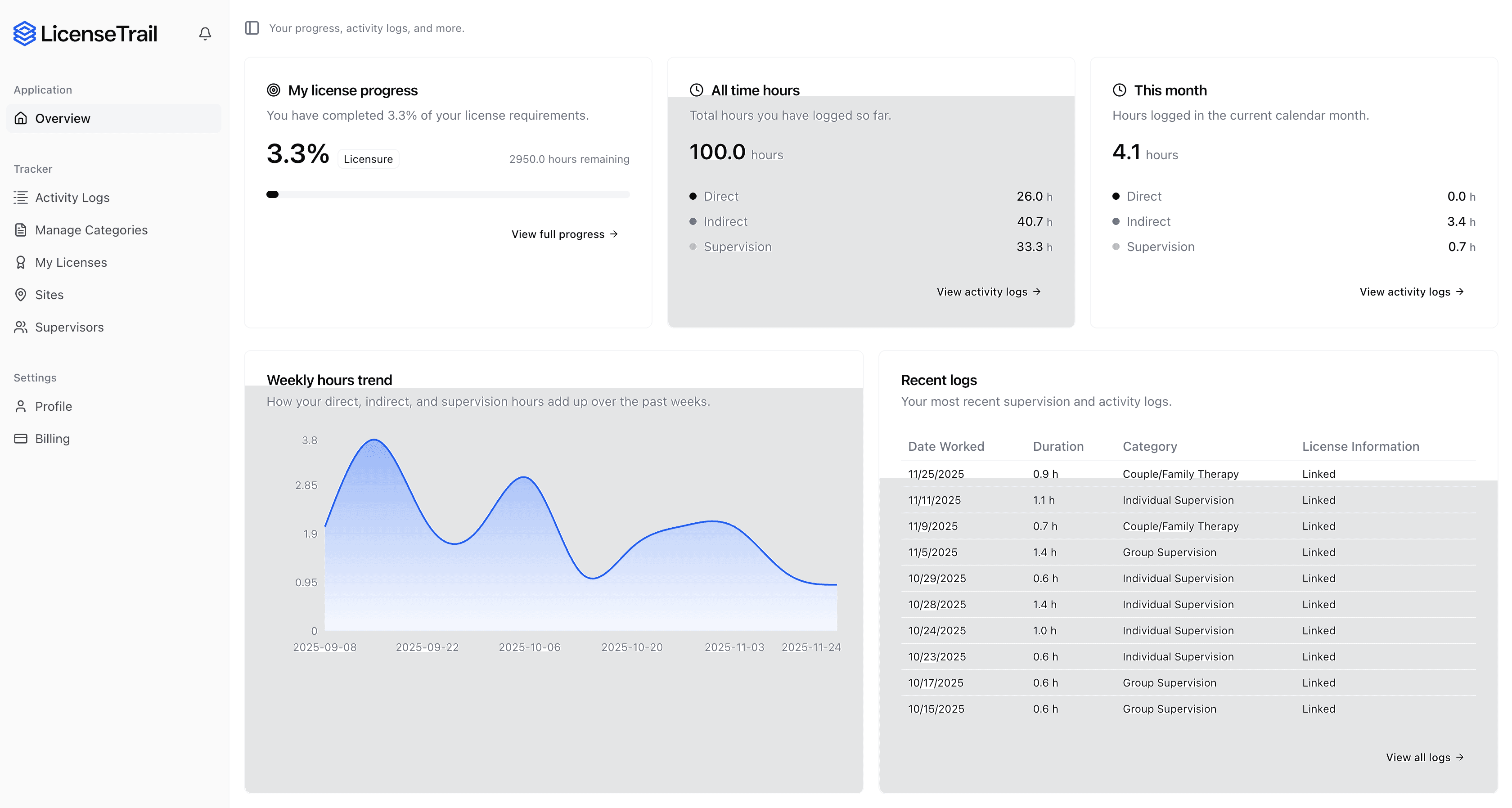
License Trail checks your direct, indirect, and supervision hours against Idaho LPC requirements continuously and flags mismatches before you submit.
 Start Tracking for Free
No credit card required · Free plan available
Is your spreadsheet hiding Idaho LPC risks?
Stop guessing if your categories match Idaho Licensing Board of Professional Counselors and Marriage and Family Therapists requirements. License Trail checks your direct, indirect, and supervision hours continuously and flags mismatches before you submit.
Import or log
Bring your spreadsheet or start fresh
Upload your existing tracking spreadsheet and we'll map every hour into the right Idaho Licensing Board of Professional Counselors and Marriage and Family Therapists categories automatically.
Verify against Idaho
Catch mismatches before the board does
License Trail checks your direct, indirect, and supervision hours against Idaho LPC requirements continuously.
Export board-ready
One-click clean reports
Generate professional, board-ready reports for supervision meetings and Idaho Licensing Board of Professional Counselors and Marriage and Family Therapists submissions in seconds.
No credit card required · Free plan available