
Idaho LCPC Requirements: Hours, Exams & Step-by-Step Guide
Stop guessing if your categories match Idaho requirements. License Trail checks your direct, indirect, and supervision hours against LCPC requirements continuously and flags mismatches before you submit.
No credit card required · Free plan available
Quick Requirements Overview
- Hold an active Idaho LPC in good standing (LCPC is second-tier; cannot apply directly).
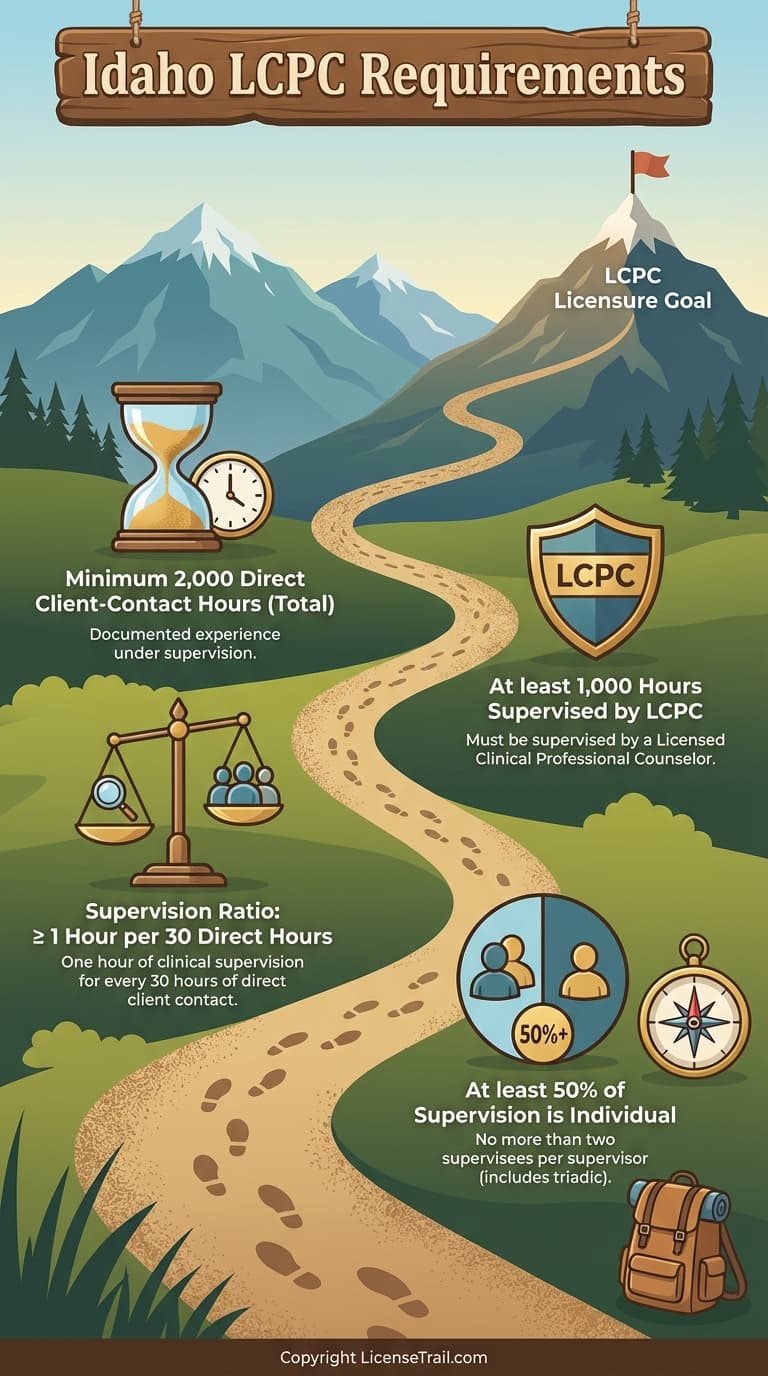
- Complete 2,000 hours of supervised direct client contact (no indirect/admin hours) over at least 2 years.
- Of the 2,000 hours, 1,000 must be supervised by an LCPC; the other 1,000 may be supervised by a qualified LCPC/LMFT/psychologist/LCSW/psychiatrist in good standing (and supervisor-approved where required).
- Supervision ratio for LCPC hours: 1 hour supervision per 30 direct client-contact hours (~67 total supervision hours for 2,000 DCC).
- At least 50% of supervision must be individual (individual = supervisor with ≤2 supervisees).
- Pass the NCMHCE (Board-approved clinical exam).
- Show diagnostic evaluation training (graduate course or Board-accepted equivalent).
License Details
Procedures
In Idaho, the Licensed Clinical Professional Counselor (LCPC) credential is the clinical, independent level of counseling licensure overseen by the Idaho Licensing Board of Professional Counselors and Marriage & Family Therapists. The requirements are set both in statute (Idaho Code Title 54, Chapter 34) and in the Board’s administrative rules (IDAPA 24.15.01).
Below is a focused guide to what’s required, with special attention to the exact hour requirements and how the Board defines supervision and supervisors.
1. Baseline: You must already be an LPC
Idaho law makes LCPC a second‑tier license: you cannot go straight to LCPC. You must first be licensed as a Licensed Professional Counselor (LPC) in good standing. (law.justia.com)
Key LPC elements (summarized briefly for context):
-
Education (for LPC)
The Board requires a graduate program that is:- Primarily counseling in nature, and
- CACREP‑accredited or substantially similar and approved by the Board. (law.cornell.edu)
State and national summaries of Idaho law also indicate you should have at least 60 semester hours in a counseling field and completion of a 6‑semester‑hour advanced counseling practicum as part of that degree. (ncbi.nlm.nih.gov)
-
LPC supervised experience
Board rule requires: (law.cornell.edu)- 1,000 total hours of supervised counseling experience.
- Of these, 400 hours must be direct client contact.
- Supervision must include at least 1 hour of individual supervision for every 20 hours of direct client contact.
- Graduate‑level practicum or internship can be used toward these 1,000 hours if properly supervised.
-
LPC exam
- You must pass the National Counselor Examination (NCE) from NBCC. (law.cornell.edu)
Once you hold the LPC and have met its supervised‑experience and examination requirements, you can begin accumulating the separate clinical hours required for LCPC.
2. Core statutory requirement for LCPC hours
Idaho Code §54‑3405A sets out the LCPC experience requirement in statute. It requires that an LCPC applicant: (law.justia.com)
- Hold a valid LPC license in good standing, and
- Document 2,000 hours of direct client‑contact experience under supervision, completed over at least a two‑year period, as defined by the chapter and Board rules, and
- Pass a Board‑approved written examination (the NCMHCE; see Section 4 below).
This is the starting point: every LCPC must show 2,000 supervised direct client‑contact hours, not a mixture such as 1,500 direct + 1,500 indirect. Idaho’s statute is explicit that the 2,000 hours are direct client contact and that they must be under supervision.
In practice, multiple summaries of Idaho law (including national compilations and state‑focused guides) interpret this as experience accumulated after LPC licensure, and the Board’s own materials describe it that way (e.g., “2 years/2,000 hours of supervised direct client‑contact experience accumulated after licensure in any state”). (ncbi.nlm.nih.gov)
3. How those 2,000 LCPC hours must be structured
The detailed breakdown of what counts and how it must be supervised comes from the Board’s rule at IDAPA 24.15.01.100(02).
3.1 Type of hours
For LCPC, all required hours must be:
- Direct client contact hours (i.e., you are directly providing counseling/clinical services to clients),
- Under supervision.
The rules and statute do not create a second category of “indirect” or “administrative” hours for LCPC the way some other states do. If you’re not in direct clinical contact (e.g., pure documentation, staff meetings), those activities do not count toward the 2,000‑hour LCPC requirement.
3.2 Required supervisory mix
The Board’s LCPC rule states: (law.cornell.edu)
- You must accrue 2,000 hours of direct client contact under supervision, and within those hours:
- 1,000 of the 2,000 hours must be supervised by a Licensed Clinical Professional Counselor (LCPC), and
- The remaining 1,000 hours may be supervised by any “supervisor” as defined in the rules.
The Board’s definition of “supervisor” (IDAPA 24.15.01.003) is: (regulations.justia.com)
- A clinical professional counselor, marriage and family therapist, psychologist, clinical social worker, or psychiatrist
- Whose license is active, current, and in good standing, and
- Who, when applicable, is approved as a supervisor in the state where the supervisee is practicing.
So the 2,000 hours can be supervised by a mix of:
- LCPCs (at least 1,000 hours must be under an LCPC), and
- Licensed LMFTs, LCSWs, psychologists, or psychiatrists who meet the “supervisor” definition for the remaining hours.
3.3 Supervision ratios and format
The Board’s rule specifies how intensive supervision must be for your LCPC hours: (law.cornell.edu)
-
Ratio:
- You must receive 1 hour of clinical supervision for every 30 hours of direct client contact.
- All 2,000 hours have to follow this 1:30 supervision ratio.
-
Individual vs. group supervision:
- At least half of your supervision hours must be individual supervision.
- Individual supervision is defined as supervision with no more than two supervisees to one supervisor.
- Group supervision is three or more supervisees per supervisor. (regulations.justia.com)
- So, for example, if you accumulate exactly 2,000 hours of LCPC‑level direct client contact:
- You must receive about 67 total hours of supervision (2,000 ÷ 30 ≈ 66.7),
- Of those 67 hours, at least half (about 33–34 hours) must be in an individual (1–2 supervisees) format.
-
Nature of supervision (“supervised experience”)
Idaho Code §54‑3401(11) defines “supervised experience” or “experience under supervision” as a face‑to‑face process in which an approved supervisor: (law.justia.com)- Facilitates the professional growth of the supervisee,
- Monitors clinical performance,
- Provides professional direction on knowledge, case conceptualization, ethics, boundaries, and dealing with personal issues as they affect clinical work, and
- Uses direct and indirect observation methods (e.g., live observation, review of audio/video recordings, etc.) to monitor services.
The key point is that supervision is not merely administrative oversight; it is deliberate, clinical teaching and monitoring tied to your counseling work with clients.
3.4 Timeframe: “No less than two years”
Idaho Code requires your LCPC hours to be spread over time; they cannot be compressed into a short, intensive period. Specifically, you must: (law.justia.com)
- Complete the 2,000 supervised direct client‑contact hours in no less than a two‑year period.
There is no explicit maximum timeframe in the LCPC rule similar to some other professions (e.g., some social work rules cap a 5‑year window), but you must at least meet this two‑year minimum.
4. LCPC examination requirement
Along with the supervised experience requirement, LCPC applicants must pass a Board‑approved clinical exam. The rules identify this as: (law.cornell.edu)
- The National Clinical Mental Health Counselor Examination (NCMHCE), prepared by the National Board for Certified Counselors (NBCC).
Passing the NCMHCE, coupled with your completed hours and an active LPC, is required for LCPC licensure.
5. Additional curricular requirement: Diagnostic evaluation training
Several detailed summaries of Idaho’s counselor‑licensure laws, including an Institute of Medicine/National Academies review and state‑specific licensure guides, describe an additional requirement specific to LCPC applicants: (ncbi.nlm.nih.gov)
- “Successful completion of a diagnostic‑evaluation graduate course or equivalent training/experience acceptable to the Board.”
While this phrase appears in compiled descriptions rather than the current brief text of IDAPA 24.15.01.100, it reflects how Idaho has long distinguished LCPC from LPC: LCPCs are expected to have formal training in diagnostic evaluation (e.g., DSM‑based assessment and differential diagnosis), either:
- As a graduate‑level course in diagnostic evaluation/psychopathology, or
- Through equivalent training or experience the Board deems acceptable.
In practice, most CACREP mental health counseling programs include this coursework, but if your transcript is non‑standard, Idaho may look for this specific competency when reviewing your LCPC application.
6. Putting the LCPC hour requirements into a simple numeric summary
For Idaho, the key LCPC numbers are:
-
LPC level (prerequisite) (law.cornell.edu)
- 1,000 hours of supervised counseling experience
- Of which 400 hours are direct client contact,
- With 1 hour of individual supervision per 20 hours of direct client contact.
- 1,000 hours of supervised counseling experience
-
LCPC level (post‑LPC clinical experience) (law.justia.com)
- 2,000 hours of direct client‑contact experience under supervision,
- No less than a 2‑year period to accumulate those 2,000 hours,
- Within those 2,000 hours:
- 1,000 hours must be supervised by an LCPC,
- 1,000 hours may be supervised by any qualified “supervisor” (LCPC, LMFT, psychologist, clinical social worker, or psychiatrist in good standing, approved as a supervisor when required),
- Supervision intensity:
- 1 hour of clinical supervision for every 30 hours of direct client contact, and
- At least half of those supervision hours must be individual supervision (no more than two supervisees per supervisor).
All of this sits on top of:
- A Board‑approved counseling graduate program (typically ≥60 credits with a 6‑credit advanced practicum),
- A completed LPC license in good standing, and
- Passing scores on both the NCE (for LPC) and the NCMHCE (for LCPC), plus evidence of diagnostic‑evaluation training acceptable to the Board. (law.cornell.edu)
Taken together, these statutes and rules define, in Idaho’s own terms, the specific type, number, and supervision structure of hours you must complete to become a Licensed Clinical Professional Counselor.
Track your LCPC hours with confidence
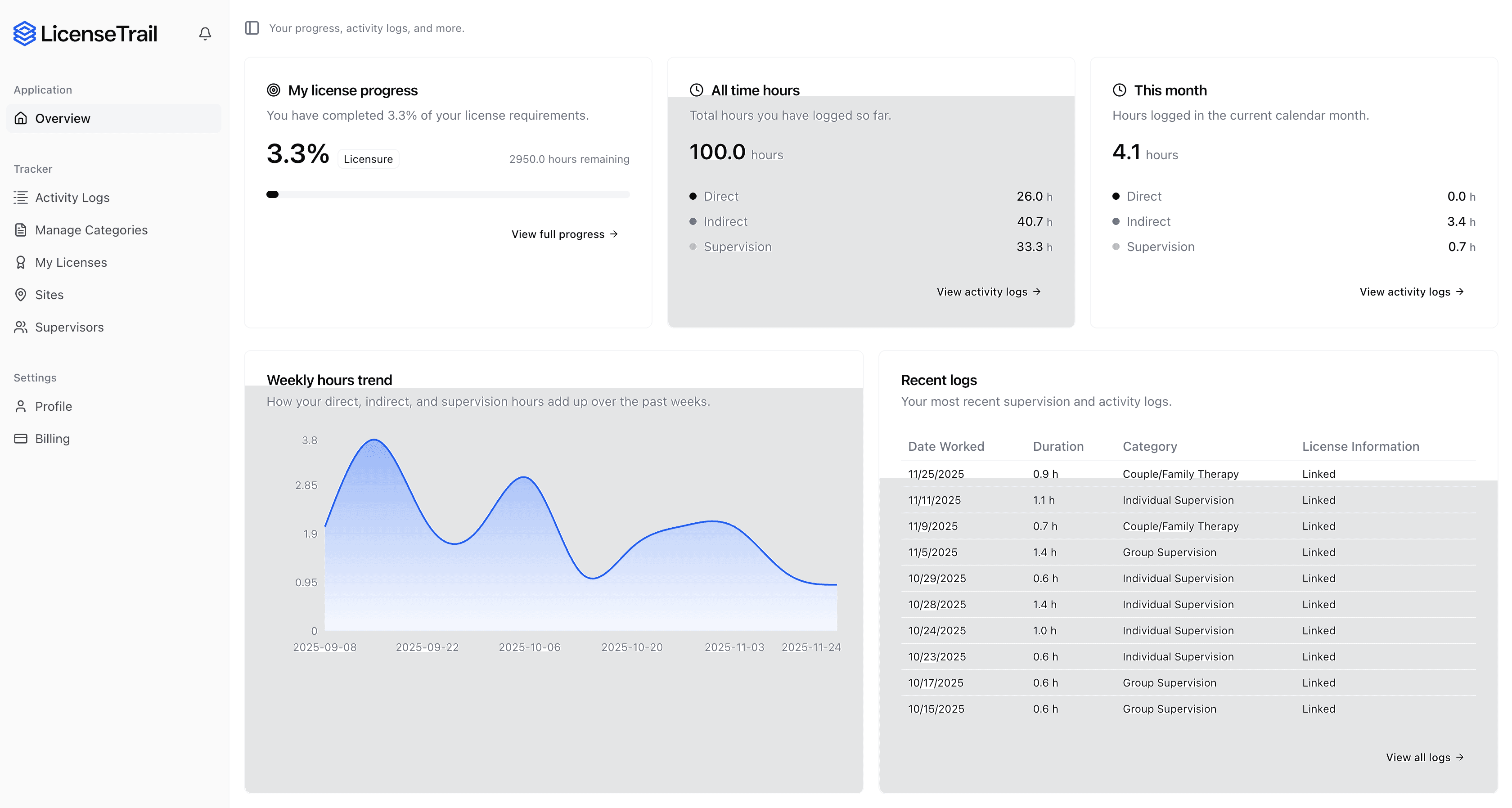
License Trail checks your direct, indirect, and supervision hours against Idaho LCPC requirements continuously and flags mismatches before you submit.
 Start Tracking for Free
No credit card required · Free plan available
Is your spreadsheet hiding Idaho LCPC risks?
Stop guessing if your categories match Idaho Board ofPC, MFT and Professional Counselors requirements. License Trail checks your direct, indirect, and supervision hours continuously and flags mismatches before you submit.
Import or log
Bring your spreadsheet or start fresh
Upload your existing tracking spreadsheet and we'll map every hour into the right Idaho Board ofPC, MFT and Professional Counselors categories automatically.
Verify against Idaho
Catch mismatches before the board does
License Trail checks your direct, indirect, and supervision hours against Idaho LCPC requirements continuously.
Export board-ready
One-click clean reports
Generate professional, board-ready reports for supervision meetings and Idaho Board ofPC, MFT and Professional Counselors submissions in seconds.
No credit card required · Free plan available