
Idaho LMFT Requirements: Hours, Exams & Step-by-Step Guide
Stop guessing if your categories match Idaho requirements. License Trail checks your direct, indirect, and supervision hours against LMFT requirements continuously and flags mismatches before you submit.
No credit card required · Free plan available
Quick Requirements Overview
- Graduate degree in MFT or related field; COAMFTE-accredited or Board-approved equivalent (IDAPA 24.15.01; rules effective 7/1/2024)
- Practicum: 12+ months; 300 direct client-contact hours, incl. 100 hours conjoint (2+ individuals in an ongoing relationship)
- Exam: Pass AMFTRB National Marital & Family Therapy Examination (or Board-approved equivalent)
- Post‑graduate intern registration required to practice while accruing hours/awaiting exam; must have approved degree + Board‑approved supervisor; intern status limited to 4 years (unless good cause)
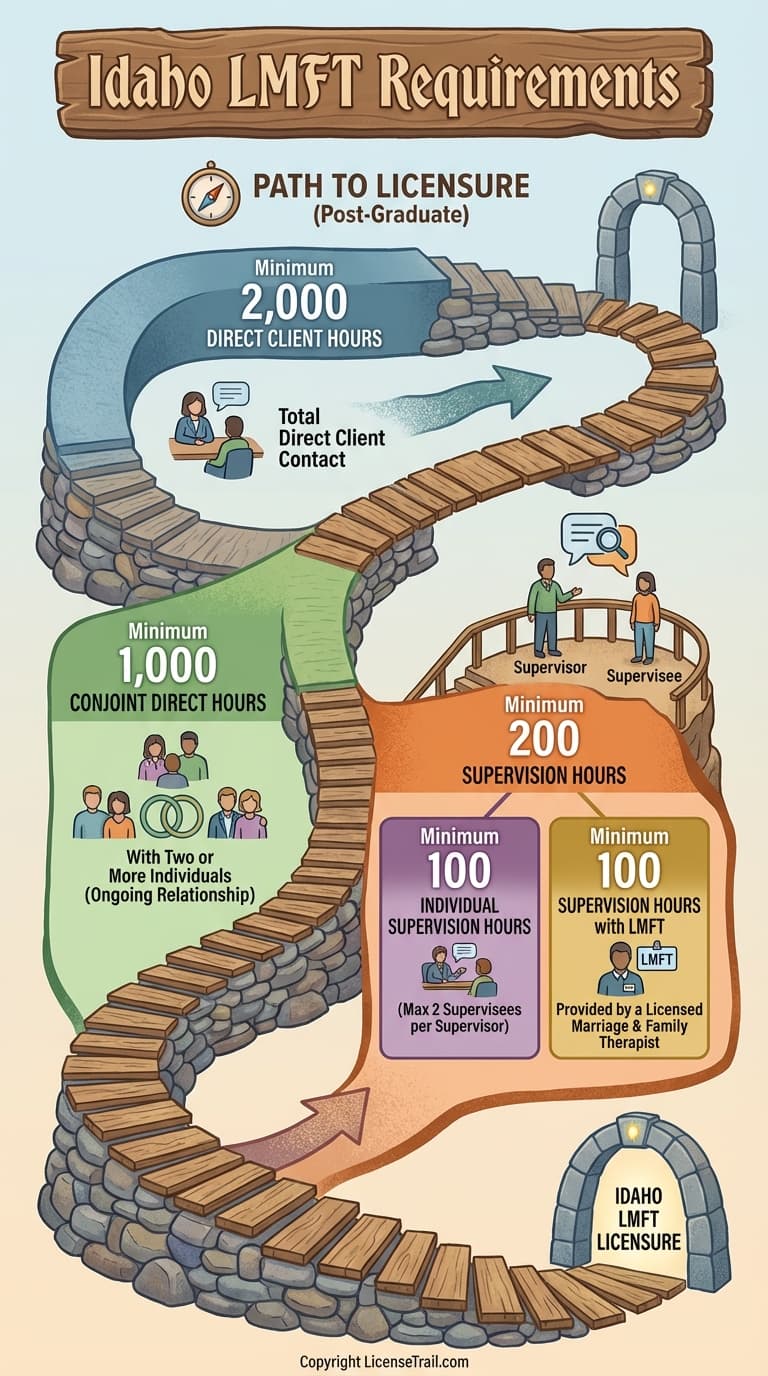
- Post‑grad experience: 2,000 direct client-contact hours over 2+ years, incl. 1,000 hours conjoint couple/family/system work
- Supervision: 200 hours total; 100 must be individual supervision (≤2 supervisees:1 supervisor)
- Supervisor requirements: 100 supervision hours must be by a licensed LMFT; remaining 100 by a supervisor with 2+ years practicing MFT (must meet Board “Supervisor” criteria)
- Renewal CE (each 24 months): 6 ethics hours, 3 boundaries hours, 3 suicide assessment/intervention hours
License Details
Procedures
In Idaho, licensure as a Licensed Marriage and Family Therapist (LMFT) is governed by the Idaho Licensing Board of Professional Counselors and Marriage and Family Therapists under IDAPA 24.15.01, with current LMFT rules effective July 1, 2024. (law.cornell.edu)
Below is a step‑by‑step guide focused on the exact hour requirements and the Board’s terminology.
1. Big‑picture path to LMFT in Idaho
To become fully licensed as an LMFT, you must:
- Complete an approved graduate program in marriage and family therapy (or a related field). (law.cornell.edu)
- Complete a practicum meeting the Board’s direct‑client‑contact requirements. (law.cornell.edu)
- Pass the national marital and family therapy examination. (law.cornell.edu)
- Register as a post‑graduate intern (or hold an associate MFT license, depending on your path) while you accrue supervised hours. (law.cornell.edu)
- Accrue the post‑graduate supervised experience required for LMFT. (law.cornell.edu)
- Apply to the Board for LMFT licensure and meet ongoing continuing‑education requirements. (law.cornell.edu)
2. Educational and practicum requirements
Approved graduate program
For LMFT, the rules require:
- “A graduate program in marriage and family therapy or a related field”
- The program must be accredited by COAMFTE or be “substantially similar and otherwise approved by the Board.” (law.cornell.edu)
This is the foundational degree for both Associate MFT and full LMFT.
Required practicum (pre‑ or early post‑graduate)
The Board defines a specific practicum requirement (referenced for LMFT at Rule 100.04.b by pointing back to 100.03.b): (law.cornell.edu)
- The practicum must occur over a period of twelve (12) months or longer.
- It must include “three hundred (300) hours of direct client contact”.
- Of those 300 hours, “at least one hundred (100) hours must be with two or more individuals conjointly who share an ongoing relationship beyond that which occurs in the therapeutic experience itself.”
- The rule allows these hours to be completed “as part of a practicum, registered intern supervised experience, or supervised experience in another jurisdiction.” (law.cornell.edu)
Key term here:
- Direct client contact – the rules don’t separately define this phrase, but in context it refers to face‑to‑face (or synchronous) therapeutic services provided directly to clients, as opposed to paperwork, training, or indirect services.
3. Required examination
For both the Associate Marriage and Family Therapist and full LMFT, Idaho requires: (law.cornell.edu)
- “The National Marital and Family Therapy Examination as approved by the Association of Marital and Family Therapy Regulatory Boards (AMFTRB) or another recognized competency examination in marriage and family therapy that is approved by the Board.”
You must pass this exam as part of the path to licensure.
4. Registration as a post‑graduate intern
To lawfully practice while completing your supervised experience, you must register as a post‑graduate intern (this applies to counseling and MFT under the same section): (law.cornell.edu)
The Board states:
- “A post‑graduate intern registration is required to engage in the supervised practice of counseling or marriage and family therapy while completing supervised experience hours or while awaiting examination results.”
- To register as an intern, you must:
- “have an approved graduate degree as defined in these Rules; and”
- “designate a supervisor approved by the Board.”
- “An individual may not practice as an intern for more than four (4) years from the original date of registration, unless good cause is demonstrated to the board.” (law.cornell.edu)
5. Board‑defined supervision terms (who can supervise and how)
The definitions section of the rules (IDAPA 24.15.01.003) clarifies supervision language that matters when you log hours: (regulations.justia.com)
-
Supervisor
- “A clinical professional counselor, marriage and family therapist, psychologist, clinical social worker, or psychiatrist, whose license is active, current, and in good standing and who, when applicable, is approved as a supervisor in the state where the supervisee is practicing.”
-
Individual Supervision
- “Supervision that occurs with no more than two supervisees to one supervisor.”
-
Group Supervision
- “Supervision that occurs with three or more supervisees to at least one supervisor.”
These definitions are important because the LMFT requirements distinguish between individual and group supervision hours.
6. Post‑graduate supervised experience for LMFT
The LMFT‑specific hour requirements appear in Rule 24.15.01.100(04)(c), titled “Required Postgraduate Supervised Experience” for Marriage and Family Therapists. (law.cornell.edu)
The rule states that you must complete:
-
Two thousand (2,000) hours of direct client contact over a period of at least two (2) years, which includes:
-
Direct client contact with couples/families
- “one thousand (1,000) direct client contact hours with two or more individuals conjointly who share an ongoing relationship beyond that which occurs in the therapeutic experience itself.”
-
Supervision hours
- “two hundred (200) hours of supervision, of which one hundred (100) hours must be individual, rather than group, supervision.”
- “One hundred (100) hours must be supervised by a licensed marriage and family therapist, with the remaining one hundred (100) hours of supervision provided by a supervisor who has at least two (2) years of experience practicing marriage and family therapy.”
-
Putting that into a clear breakdown:
6.1. Clinical contact hours
- 2,000 hours of direct client contact, accumulated over at least two years.
- Within those 2,000 hours:
- At least 1,000 hours must be conjoint work with “two or more individuals conjointly who share an ongoing relationship beyond that which occurs in the therapeutic experience itself.”
- The remaining up to 1,000 hours can be individual, couple, family, or other system‑based direct client contact, as long as it is direct clinical work.
6.2. Supervision hours (in addition to being tied to the above client work)
The rule frames supervision as part of the “required postgraduate supervised experience” and specifies:
- Total supervision:
- 200 hours of supervision associated with your clinical work.
- Type of supervision:
- 100 hours must be individual supervision (as defined: no more than two supervisees per supervisor). (regulations.justia.com)
- The remaining 100 hours may be group or individual, as long as it meets Board rules.
- Who must supervise:
- At least 100 of the 200 supervision hours must be provided by a licensed marriage and family therapist.
- The remaining 100 supervision hours must be provided by a supervisor who has at least two (2) years of experience practicing marriage and family therapy (this person may be an MFT or one of the other qualifying supervisor types, as long as they meet that practice requirement). (law.cornell.edu)
In practical terms, a compliant post‑graduate LMFT experience plan in Idaho must show both:
- The 2,000 direct client contact hours (with at least 1,000 conjoint couple/family/system hours), and
- The 200 documented supervision hours, properly divided between individual vs. group formats and LMFT vs. other qualified supervisors.
7. Summary of Idaho LMFT hour requirements
Educational practicum (pre‑ or early post‑graduate)
- 300 hours of direct client contact, over 12 months or more, including:
- 100 hours with two or more individuals conjointly in an ongoing relationship. (law.cornell.edu)
Post‑graduate supervised experience for LMFT
Over at least two years: (law.cornell.edu)
- Direct client contact hours
- 2,000 hours total direct client contact, including:
- 1,000 hours of conjoint couple/family/system work (two or more individuals with an ongoing relationship).
- 2,000 hours total direct client contact, including:
- Supervision hours (linked to that clinical work)
- 200 hours of supervision total, including:
- 100 hours of individual supervision (no more than two supervisees per supervisor).
- Up to 100 hours of group supervision (three or more supervisees) or additional individual supervision.
- 100 of the 200 supervision hours must be provided by a licensed marriage and family therapist.
- The remaining 100 hours must be provided by a supervisor with at least two years of experience practicing marriage and family therapy (who also meets the general “Supervisor” definition).
- 200 hours of supervision total, including:
8. Application and ongoing requirements
Once you have:
- Completed an approved graduate program and the required practicum;
- Passed the AMFTRB‑approved national marital and family therapy exam; and
- Documented the 2,000 direct client contact hours and 200 supervision hours as described,
you can apply to the Idaho Board for LMFT licensure under Rule 24.15.01.100(04). (law.cornell.edu)
For license renewal, Rule 100.07 currently requires that, in each 24‑month period preceding renewal, all licensees complete at least: (law.cornell.edu)
- 6 hours in ethics
- 3 hours in boundaries
- 3 hours in suicide assessment or intervention,
and comply with the continuing‑education and competence provisions of the relevant professional codes of ethics.
All of these requirements come directly from the Idaho Administrative Code, IDAPA 24.15.01.100 and 24.15.01.003, as updated effective July 1, 2024, which are the current rules governing LMFT licensure in Idaho. (law.cornell.edu)
Track your LMFT hours with confidence
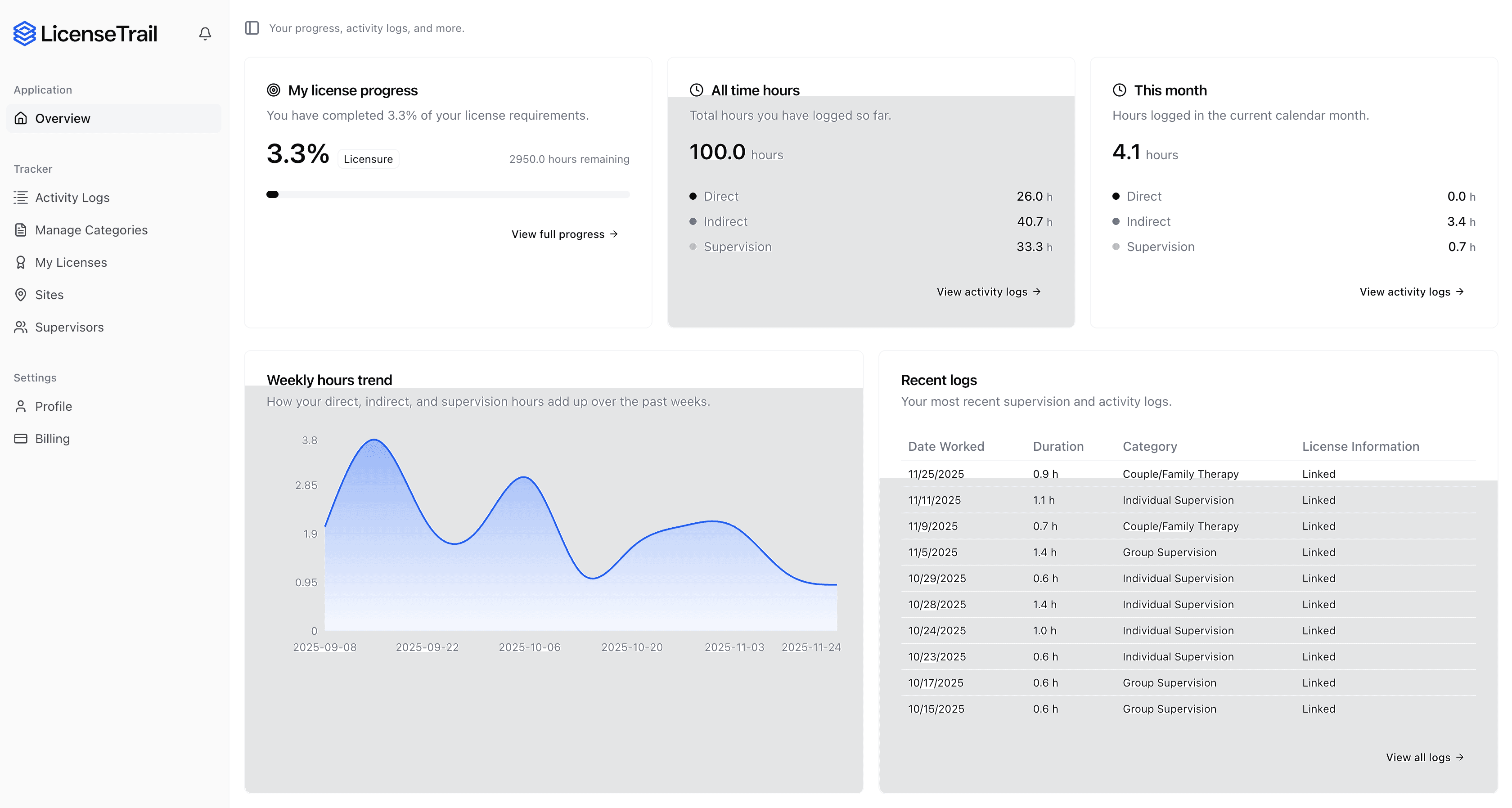
License Trail checks your direct, indirect, and supervision hours against Idaho LMFT requirements continuously and flags mismatches before you submit.
 Start Tracking for Free
No credit card required · Free plan available
Is your spreadsheet hiding Idaho LMFT risks?
Stop guessing if your categories match Idaho Licensing Board of Professional Counselors and Marriage and Family Therapists requirements. License Trail checks your direct, indirect, and supervision hours continuously and flags mismatches before you submit.
Import or log
Bring your spreadsheet or start fresh
Upload your existing tracking spreadsheet and we'll map every hour into the right Idaho Licensing Board of Professional Counselors and Marriage and Family Therapists categories automatically.
Verify against Idaho
Catch mismatches before the board does
License Trail checks your direct, indirect, and supervision hours against Idaho LMFT requirements continuously.
Export board-ready
One-click clean reports
Generate professional, board-ready reports for supervision meetings and Idaho Licensing Board of Professional Counselors and Marriage and Family Therapists submissions in seconds.
No credit card required · Free plan available