
Indiana LMFTA Requirements: Hours, Exams & Step-by-Step Guide
Stop guessing if your categories match Indiana requirements. License Trail checks your direct, indirect, and supervision hours against LMFTA requirements continuously and flags mismatches before you submit.
No credit card required · Free plan available
Quick Requirements Overview
- Board/Authority: IN Behavioral Health & Human Services Licensing Board (IC 25‑23.6; 839 IAC)
- License purpose: LMFTA = post‑master’s, pre‑independent license to accrue supervised post‑degree hours toward LMFT
- Education: Master’s/doctoral in MFT or Board‑approved related field; required graduate coursework verified (Form III + official transcripts)
- Pre‑LMFTA practicum: 300 client contact hours in an MFT setting over ≥12 months; includes ≥100 relational (couple/family/system) hours (Form P)
- Practicum supervision: 100 supervision hours (individual/group) by LMFT with 5+ years or Board‑approved equivalent
- Exam: Pass AMFTRB national MFT exam (score required/approval then score)
- Renewals/CE: LMFTA may be renewed twice; 15 CE hours per licensure year for renewal
- While LMFTA (toward LMFT): ≥24 months with 1,000 post‑degree clinical hours + 200 supervision hours (≥100 individual); ≥50% clients receiving MFT services; supervision by LMFT 5+ yrs/equivalent; up to 50% supervision may be virtual
License Details
Procedures
Indiana regulates marriage and family therapists through the Behavioral Health and Human Services Licensing Board under Indiana Code 25‑23.6 and Title 839 of the Indiana Administrative Code. The Licensed Marriage and Family Therapist Associate (LMFTA) is the post‑master’s, pre‑independent license you hold while you complete your required supervised clinical experience for full LMFT licensure.
Below is a step‑by‑step outline of the requirements, with a focus on hours, supervision, and the exact types of experience the Board specifies.
1. Role and purpose of the LMFTA in Indiana
The Board describes the associate license as follows:
- “An Associate Marriage and Family Therapist license is for individuals to obtain post degree experience and supervision.”
- “Associate licenses may only be renewed twice.” (in.gov)
In practical terms:
- You first complete your degree and required practicum hours and pass the national exam.
- You then obtain the LMFTA.
- Under the LMFTA you complete your postdegree clinical experience and supervision hours required to become a fully licensed LMFT.
2. Educational requirements for LMFTA
2.1 Degree requirement
To apply for an LMFTA, Indiana law requires that you:
- Have a master’s or doctoral degree in marriage and family therapy, or in a related area as determined by the board, from an “eligible postsecondary educational institution” meeting specific accreditation criteria. (inamft.org)
The Board’s LMFTA checklist repeats this, requiring Form III – Verification of Graduate Coursework, and specifying that all education must be from postsecondary coursework (certifications do not count). (in.gov)
2.2 Required coursework (overview)
Indiana Code 25‑23.6‑8‑2.5 lists the educational content areas. In summary, your graduate coursework must include at least:
- 27 semester or 41 quarter hours of graduate study in content areas such as:
- Theoretical foundations of marriage and family therapy
- Major models of marriage and family therapy
- Individual and family development
- Clinical problems
- Collaboration with other disciplines
- Sexuality, gender and sexual orientation
- Issues of ethnicity, race, socioeconomic status, and culture
- Therapy techniques
- Behavioral research as applied to clinical practice (inamft.org)
- At least one graduate-level course in:
- Legal, ethical, and professional standards in MFT
- Appraisal and assessment for individual or interpersonal disorder or dysfunction (inamft.org)
Your program and Form III must demonstrate these requirements.
3. Required pre‑licensure practicum hours (before LMFTA)
Before the Board will grant an LMFTA, you must document a supervised practicum, internship, or field experience in an MFT setting using Form P – Verification of Practicum.
3.1 Practicum / internship hour requirements
For LMFTA, the Board’s current instructions specify:
- At least one (1) supervised practicum, internship, or field experience in a marriage and family counseling setting.
- This experience must include a minimum of 300 hours of marriage and family therapy services, completed in no less than 12 months of clinical practice.
- Those 300 hours must be:
- 300 client contact hours (i.e., the whole practicum is direct client work), and
- Within that, at least 100 hours must be relational hours (work with couples, families, or other relational systems) (in.gov)
3.2 Required supervision during practicum
During that practicum/internship you must also have:
- 100 hours of supervision from a Licensed Marriage and Family Therapist (LMFT) with at least five (5) years of experience, or a qualified supervisor approved by the Board.
- Those 100 hours may be group, individual, or a combination. (in.gov)
This practicum requirement is what the Board looks at via Form P when you first apply for LMFTA.
4. Exam requirement for LMFTA
Indiana uses the Association of Marital and Family Therapy Regulatory Boards (AMFTRB) national MFT exam for both associate and full LMFT licensure. The Board’s LMFTA checklist requires:
- AMFTRB – Exam Score as part of the LMFTA application. (in.gov)
Indiana Code 25‑23.6‑8‑1.5 further provides that an applicant for a marriage and family therapist associate license must:
- “Pass an examination provided by the board.” (inamft.org)
Functionally:
- Your application is reviewed.
- If you have not yet taken the AMFTRB exam, the Board issues an examination approval.
- You take and pass the AMFTRB exam.
- Once your passing exam score is received, your LMFTA is issued. (in.gov)
5. Administrative checklist to obtain the LMFTA
Using the Board’s own checklist for “Marriage and Family Therapist Associate (LMFTA) – Master Level”, an LMFTA applicant who has not yet obtained post-degree experience or supervision must submit: (in.gov)
Required items:
- Completed online application
- Application fee: $50 (non‑refundable)
- Criminal Background Check
- Positive Response Documentation (if you answered “Yes” to any legal/disciplinary questions)
- Name Change Documentation (if your current name differs from your academic documents)
- Form III – Verification of Graduate Coursework
- Form P – Verification of Practicum (showing the 300 client contact hours, including 100 relational, and 100 hours of supervision)
- Official transcripts from each school listed on Form III (degree‑granting transcript must show degree awarded and date)
- AMFTRB exam score (or approval to sit for the exam and official passing score sent to the Board)
- License verification from other states, if you hold or have held other licenses
Once these are complete and the exam is passed, the Board issues your marriage and family therapist associate license. (in.gov)
6. What you must complete while holding an LMFTA to become an LMFT
Although these requirements are technically for full LMFT licensure, practically they define what you must accrue under the LMFTA. Indiana Code and the Board describe these hours very specifically.
6.1 Postdegree clinical experience hours
Indiana Code 25‑23.6‑8‑2.7(b) states that an applicant for a full LMFT license must have:
- At least two (2) years of postdegree clinical experience, during which at least 50% of the clients were receiving marriage and family therapy services.
- This clinical experience must include:
- 1,000 hours of postdegree clinical experience, and
- 200 hours of postdegree clinical supervision,
- of which 100 hours must be individual supervision. (inamft.org)
The Board’s LMFT checklist (Form II – Verification of Experience, and Form I – Verification of Supervision) restates and clarifies this:
- Experience:
- “Applicants must have at least two (2) years of supervised clinical experience, or twenty‑four (24) months, in the field of marriage and family therapy, during which at least fifty percent (50%) of your clients were receiving marriage and family therapy services.”
- “Two (2) years of this experience must include one thousand (1,000) hours of post degree clinical experience.” (in.gov)
- Supervision:
- “Applicants must show they have completed two (2) years of supervision acquired during their 1,000 hours of post‑graduate clinical experience. This supervision must be completed in no less than twenty‑four (24) months and show that they have acquired at least two hundred (200) hours of supervision of which one hundred (100) hours must be individual supervision.” (in.gov)
So in Indiana, the Board’s defined hour requirements for the post‑LMFTA phase are:
- 1,000 hours of postdegree clinical experience, and
- 200 hours of postdegree clinical supervision, including 100 hours of individual supervision,
- Accrued over at least 24 months, with at least 50% of your clients in MFT services.
6.2 Types of cases and settings during those hours
Indiana law further specifies that when obtaining the clinical experience for LMFT licensure, the applicant must provide direct individual, group, and family therapy and counseling to all of the following categories of cases:
- Unmarried couples
- Married couples
- Separating or divorcing couples
- Family groups, including children (inamft.org)
Additionally:
- Experience may be completed at or away from the supervising LMFT’s premises, but not as independent private practice without onsite supervision. (inamft.org)
- Up to 50% of supervised postdegree clinical experience hours may be accounted for through virtual supervision by a licensed marriage and family therapist or equivalent supervisor. (inamft.org)
6.3 Who can supervise your postdegree hours?
For MFT supervision related to the 1,000/200 hours, supervision must be provided by: (inamft.org)
- A Licensed Marriage and Family Therapist with at least five (5) years of experience, or
- An equivalent supervisor, which the Board defines as:
- An AAMFT‑approved supervisor,
- An AAMFT supervisor candidate, or
- A supervisor with at least a master’s degree in a mental health field, 5 years of post‑master’s professional practice, and who is supervising within their scope of experience and training.
The Board’s FAQ also emphasizes:
- “If you are working in Indiana and hold an Associate Marriage Family Therapist license, you must be supervised by a Licensed Marriage and Family Therapist who has at least five (5) years of experience or an equivalent supervisor.” (in.gov)
7. Timing rules, exam timing, and the associate license
A few additional timing points that affect how and when you can count hours:
-
When you may begin counting postdegree hours
Indiana law ties counting of postdegree hours to the examination:- If you take and pass the “first available examination” after graduation/moving to Indiana, you may count no more than 500 hours of clinical experience accrued before taking the exam. (inamft.org)
- If you do not take the first available exam, you cannot begin accumulating any postdegree clinical experience hours for licensure until you pass the exam. (inamft.org)
-
Associate license as the vehicle for those hours
The Board states:- “If you are working in Indiana, your post‑degree hours must be obtained under the Marriage and Family Therapist Associate license. You must hold your Associate license for two years.” (in.gov)
-
Duration and renewal limits for LMFTA
Indiana Code 25‑23.6‑8‑8.5 provides that:- A marriage and family therapist associate license is valid for the remainder of the renewal period in effect on the date issued.
- The license may be renewed two (2) times, with:
- Payment of the renewal fee, and
- Completion of at least 15 hours of continuing education each licensure year. (inamft.org)
After two renewals, further extensions are at Board discretion and limited by rule; practically, the expectation is that you complete your 1,000 clinical and 200 supervision hours within this window.
8. Summary of Indiana LMFTA and LMFT hour requirements
To qualify for the LMFTA itself (entry‑level associate license):
- Education:
- Master’s or doctoral degree in MFT or related field approved by the Board, from an accredited institution.
- Pre‑degree practicum / internship:
- 300 hours of marriage and family therapy services in an MFT setting, in no less than 12 months:
- 300 client contact hours total, including at least
- 100 relational hours (couples/families/relational work)
- 100 hours of supervision (group and/or individual) by an LMFT with 5+ years’ experience or Board‑approved equivalent. (in.gov)
- 300 hours of marriage and family therapy services in an MFT setting, in no less than 12 months:
- Exam:
- Pass the AMFTRB national MFT exam (the “examination provided by the board”). (inamft.org)
- Administrative items:
- Application, $50 fee, background check, positive response documentation (if needed), name change docs (if applicable), official transcripts, AMFTRB exam score, and any license verifications.
To move from LMFTA to full LMFT, while holding the LMFTA:
- Clinical experience:
- At least two (2) years (24 months) of postdegree clinical experience,
- During which at least 50% of clients are receiving marriage and family therapy services.
- Within that period, you must document 1,000 hours of postdegree clinical experience.
- Supervision:
- 200 hours of postdegree clinical supervision, of which:
- 100 hours must be individual supervision, and
- The remainder can be group or additional individual supervision.
- Supervision must occur over at least 24 months and be provided by an LMFT with at least 5 years' experience or another Board‑approved equivalent supervisor.
- 200 hours of postdegree clinical supervision, of which:
- Client populations and settings:
- Clinical experience must include work with:
- Unmarried couples
- Married couples
- Separating or divorcing couples
- Family groups, including children
- Up to 50% of supervision may be conducted virtually.
- Clinical experience must include work with:
- Licensure status:
- These hours must be completed under the LMFTA in Indiana (unless you qualify under different provisions, e.g., doctoral pathway or reciprocity). (inamft.org)
Taken together, Indiana’s defined path is: graduate education + 300/100 practicum and supervision hours + AMFTRB exam → LMFTA → 1,000 postdegree clinical hours + 200 supervision hours over at least 24 months → LMFT.
Track your LMFTA hours with confidence
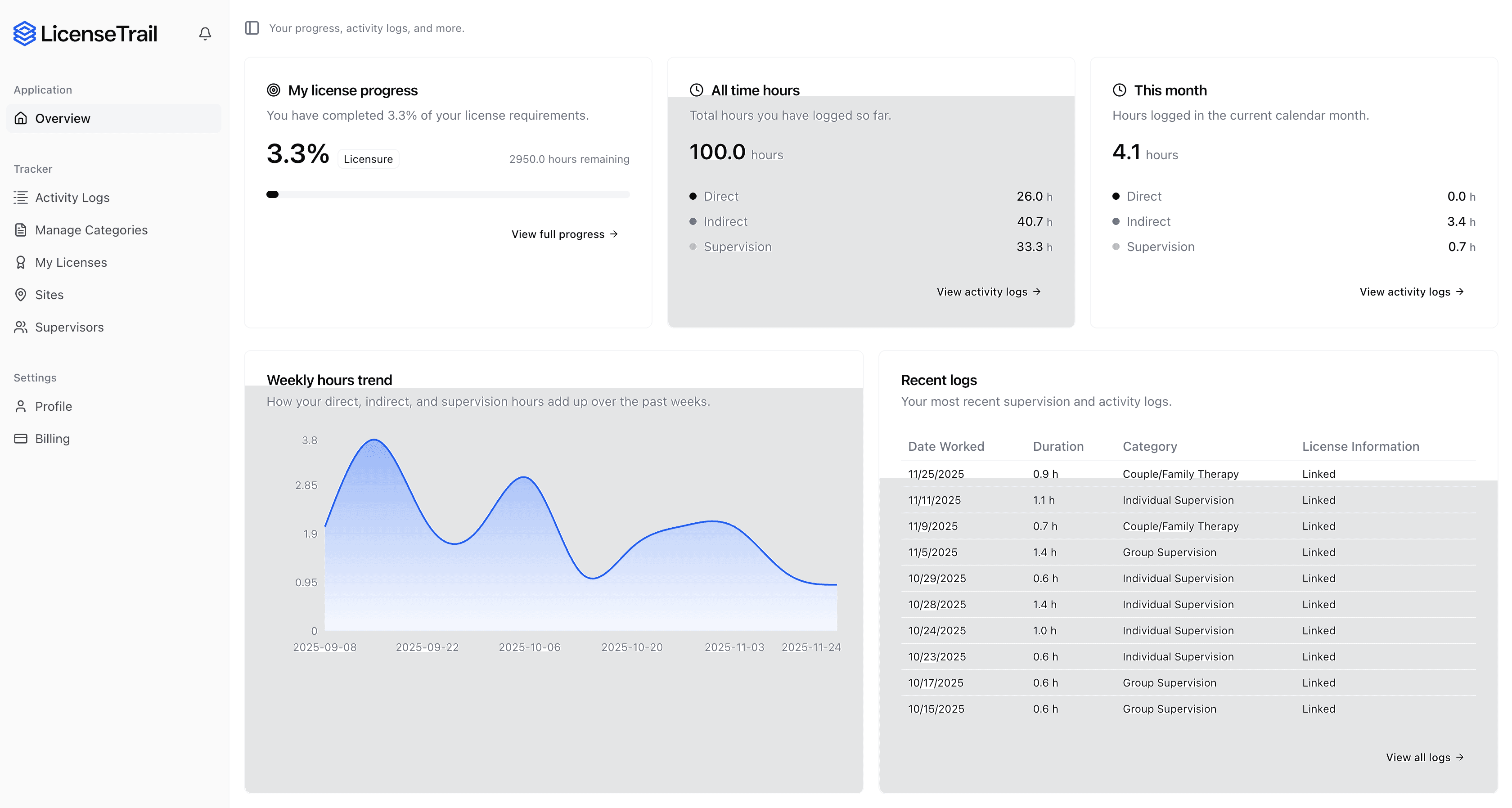
License Trail checks your direct, indirect, and supervision hours against Indiana LMFTA requirements continuously and flags mismatches before you submit.
 Start Tracking for Free
No credit card required · Free plan available
Is your spreadsheet hiding Indiana LMFTA risks?
Stop guessing if your categories match Indiana Behavioral Health and Human Services Licensing Board requirements. License Trail checks your direct, indirect, and supervision hours continuously and flags mismatches before you submit.
Import or log
Bring your spreadsheet or start fresh
Upload your existing tracking spreadsheet and we'll map every hour into the right Indiana Behavioral Health and Human Services Licensing Board categories automatically.
Verify against Indiana
Catch mismatches before the board does
License Trail checks your direct, indirect, and supervision hours against Indiana LMFTA requirements continuously.
Export board-ready
One-click clean reports
Generate professional, board-ready reports for supervision meetings and Indiana Behavioral Health and Human Services Licensing Board submissions in seconds.
No credit card required · Free plan available