
Indiana LMHCA Requirements: Hours, Exams & Step-by-Step Guide
Stop guessing if your categories match Indiana requirements. License Trail checks your direct, indirect, and supervision hours against LMHCA requirements continuously and flags mismatches before you submit.
No credit card required · Free plan available
Quick Requirements Overview
- Regulator: Indiana Behavioral Health & Human Services Licensing Board (BHHSLB) under IC 25‑23.6 and 839 IAC
- Pathway: LMHCA is the required associate license to accrue post‑graduate experience toward LMHC (generally required for grads after 7/1/2014)
- Education: Master’s/doctorate in mental health counseling (or related) from an eligible accredited/equivalent institution; 60 graduate semester hours covering required counseling content areas
- Degree clinical training (pre‑LMHCA): 1,000 clock hours supervised training (100 practicum / 600 internship / 300 advanced internship) incl. 100 hours face‑to‑face supervision
- Exam: Pass Board‑accepted NBCC NCE for LMHCA (NCMHCE is for LMHC, not equivalent)
- Application items/fees: Online application + $50 fee, background check, official transcripts, and Board forms C (coursework), P (practicum), I (internship); provide docs for any legal/disciplinary “yes” answers
- Renewal: Expires Apr 1 of even‑numbered years; LMHCA generally may be renewed only twice; renewal fee $50; 20 CE hours per licensure year required for renewal
- Post‑grad hours (for LMHC context): 3,000 hours over ≥2 years incl. 100 hours face‑to‑face supervision; if taking/passing first available LMHC exam, ≤1,500 hours may be pre‑exam hours counted toward the 3,000
License Details
Procedures
Indiana regulates Licensed Mental Health Counselor Associates (LMHCA) through the Behavioral Health and Human Services Licensing Board (BHHSLB) under Indiana Code 25‑23.6 and Title 839 of the Indiana Administrative Code. The LMHCA is the required first license on the way to becoming a Licensed Mental Health Counselor (LMHC); it is the credential you must hold while you accrue post‑graduate clinical experience.
Below is a step‑by‑step outline focused on what the Board and statute actually require, with particular attention to hours and how they’re defined.
1. Role of the LMHCA in Indiana’s two‑step pathway
Indiana law creates two levels:
- Licensed Mental Health Counselor Associate (LMHCA) – entry‑level license held while you are gaining post‑graduate clinical experience and supervision. The Board describes the associate license as “for individuals to obtain post degree experience and supervision,” and notes that associate licenses “may only be renewed twice.” (in.gov)
- Licensed Mental Health Counselor (LMHC) – independent license, granted after you complete required post‑graduate clinical hours and pass the LMHC‑level exam.
By statute, to become an LMHC you normally must first hold an LMHCA in good standing, unless you qualify through out‑of‑state licensure. (law.justia.com)
The LMHCA itself is awarded based on education, embedded clinical training hours in your graduate program, an exam, and a clean background/disciplinary record.
2. Educational requirements for LMHCA (including clinical hour minimums)
2.1 Degree and institution requirements
Indiana Code 25‑23.6‑8.5‑1.5 requires LMHCA applicants to show: (law.justia.com)
-
A master’s or doctoral degree in mental health counseling or a related area, from:
- An eligible postsecondary institution in the U.S. that was regionally accredited at the time of graduation; or
- A qualifying Canadian or other foreign institution that meets equivalency standards set out in IC 25‑23.6‑8.5‑2. (law.justia.com)
-
Completion of the educational requirements in IC 25‑23.6‑8.5‑3 (detailed below).
The Board’s LMHCA application checklist echoes this, stating that applicants must have “received a masters or doctorate degree in an area of mental health counseling from an eligible postsecondary educational institution that meets the requirements of the board,” verified via Form C – Verification of Graduate Coursework. (in.gov)
2.2 Required graduate coursework
Indiana Code requires at least 60 semester hours of graduate counseling coursework, including a master’s (minimum 48 semester hours) or a counseling doctorate. The coursework must cover these content areas: (law.justia.com)
- Human growth and development
- Social and cultural foundations of counseling
- Helping relationship (counseling theory and practice)
- Group dynamics, processes, counseling, and consultation
- Lifestyle and career development
- Assessment and appraisal of individuals
- Research and program evaluation
- Professional orientation and ethics
- Foundations of mental health counseling
- Contextual dimensions of mental health counseling
- Knowledge and skills for the practice of mental health counseling and psychotherapy
- Clinical instruction
These are codified in IC 25‑23.6‑8.5‑3(1). (law.justia.com)
2.3 Required practicum / internship / field experience hours (pre‑licensure clinical hours)
Indiana statute is very specific about the clinical training you must complete as part of your degree before you can qualify for LMHCA:
- You must complete “not less than one supervised clinical practicum, internship, or field experience in a counseling setting”.
- This must include a minimum of 1,000 clock hours, broken down as:
- 100 hours: practicum
- 600 hours: internship
- 300 hours: advanced internship
- Within those 1,000 hours, you must receive at least 100 hours of face‑to‑face supervision. (law.justia.com)
This structure appears in IC 25‑23.6‑8.5‑3(2). The Board’s own LMHCA application materials mirror this by requiring: (in.gov)
- Verification of Practicum (Form P)
- Verification of Internship (Form I)
These forms must be completed by your program and sent to the Board to document that you met the statutory clinical hour requirements.
Important distinction on hours:
These 1,000 clock hours are graduate‑program training hours, not your post‑graduate supervised experience toward full licensure. They are a prerequisite to getting the LMHCA.
3. Examination requirement for LMHCA
Indiana Code requires LMHCA applicants to pass “an examination provided by the board.” (law.justia.com)
The Board has formally adopted NBCC exams and states that: (in.gov)
- It “will accept the National Counselor Examination (NCE) to obtain the mental health associate counselor license.”
- It uses the National Clinical Mental Health Counseling Examination (NCMHCE) for LMHC licensure, and explicitly notes that the NCE is not equivalent to the NCMHCE for LMHC.
Thus, for LMHCA you must:
- Meet degree and course/clinical requirements; and
- Obtain a passing score on the NCE, as recognized by the Indiana BHHSLB.
Some schools describe this succinctly as: the LMHCA is obtained after a “satisfactory application and [a] passing score on the National Counselor Examination,” which is consistent with the Board’s exam policy. (bulletins.iu.edu)
4. Character and disciplinary history requirements
By statute, LMHCA applicants must also: (law.justia.com)
- Show they do not have a conviction for a crime that has a direct bearing on their ability to practice competently.
- Show they have not been the subject of disciplinary action by another state/jurisdiction on grounds that they could not practice as a mental health counselor associate without endangering the public.
- Submit to a criminal background check, as reflected in the Board’s LMHCA application checklist. (in.gov)
If there are “Yes” answers to legal/disciplinary questions, the Board requires detailed written explanations and supporting court or board documents with the application. (in.gov)
5. LMHCA application process and Board forms
The Indiana Professional Licensing Agency (IPLA) provides an LMHCA‑specific checklist under the BHHSLB. For applicants who have completed a master’s degree in mental health counseling and have not yet obtained post‑degree experience and supervision, the Board lists this LMHCA checklist: (in.gov)
You must submit:
- Online application for LMHCA
- $50 application fee (non‑refundable)
- Criminal Background Check
- Positive Response Documentation, if applicable
- Name change documentation, if your legal name differs from the name on your documents
- Official transcripts showing your qualifying degree
- Form C – Verification of Graduate Coursework
- Form P – Verification of Practicum
- Form I – Verification of Internship
The Board’s general licensure rules also require you to apply on official forms and show that all qualifying requirements in statute and rules are met. (regulations.justia.com)
The biennial license fee schedule confirms that the LMHCA license renewal fee is $50. (law.cornell.edu)
6. Post‑graduate clinical experience: what you accrue after LMHCA
Although your question is specifically about LMHCA, most people are interested in it because it is the required platform for counting post‑graduate hours toward LMHC. Indiana is quite prescriptive about those hours.
6.1 Statutory post‑graduate clinical experience requirement
Indiana Code 25‑23.6‑8.5‑4 sets the requirements for post‑graduate clinical experience that must be completed before you can become an LMHC. These hours are normally accrued while holding an LMHCA (with limited exceptions for certain doctoral routes and older transition provisions). (law.justia.com)
The statute requires:
- At least 3,000 hours of post‑graduate clinical experience over a minimum of two (2) years.
- Within the 3,000 hours, at least 100 hours of face‑to‑face supervision with a licensed mental health counselor or an equivalent supervisor (e.g., similarly qualified mental health professional approved by the Board). (law.justia.com)
Key statutory language describes these as:
- “post‑graduate clinical experience”
- and “face to face supervision”
Indiana’s statute does not break the 3,000 hours into a prescribed split such as “1,500 direct client hours and 1,500 other experience hours.” Instead, the law sets:
- One total clinical‑experience requirement: 3,000 hours
- Within that total, a minimum supervision requirement: 100 hours of face‑to‑face supervision with an approved supervisor
Programs or employers may impose their own internal standards for “direct client contact,” but the statute and Board materials do not define a specific numerical minimum of direct service within the 3,000 hours.
6.2 How the Board connects LMHCA to those post‑graduate hours
The Board’s own LMHC application instructions explicitly state: (in.gov)
- Applicants who graduated after July 1, 2014 “are required to obtain a mental health counselor associate license prior to accruing postgraduate clinical experience hours to count towards future mental health counselor licensure.”
- Under its FAQ, the Board clarifies that an associate mental health counseling license is for individuals to obtain post‑degree experience and supervision, and that associate licenses may only be renewed twice. (in.gov)
Indiana law also contains timing rules about how many hours can count before you pass the Board‑approved examination for LMHC:
- If you apply for, take, and pass the first available examination, you may not count more than 1,500 of the 3,000 hours that were accumulated before taking that exam toward LMHC licensure. (law.justia.com)
In other words:
- 3,000 total post‑graduate clinical hours are required for LMHC.
- Of those 3,000, no more than 1,500 may be pre‑exam hours if you take and pass the first exam for LMHC.
- Those hours must be accrued while licensed as an LMHCA (for most applicants) under appropriate supervision in settings that meet Board and statutory requirements.
A number of Indiana training programs and secondary summaries sometimes describe these as “3,000 hours of supervised clinical experience” over at least 21–24 months and up to four years; those interpretations are consistent with the statutory minimum of 3,000 hours over at least two years and Board practice. (counselingdegreeguide.org)
7. License duration, renewal limits, and continuing education for LMHCA
Indiana law distinguishes between the term of the license, the renewal cycle, and how many times you can renew an LMHCA:
- General renewal schedule. All licenses in this category (including LMHCA) expire on April 1 of even‑numbered years, and require payment of a renewal fee for each cycle. (regulations.justia.com)
- LMHCA‑specific limits. IC 25‑23.6‑8.5‑8.5 provides that: (law.justia.com)
- An LMHCA license is valid for the remainder of the renewal period in effect on the date it is issued.
- You may renew an LMHCA license two times by:
- Paying the renewal fee on or before expiration, and
- Completing at least 20 hours of continuing education per licensure year.
- The Board may renew an LMHCA license for additional periods based on circumstances it determines (i.e., there is some discretionary flexibility).
- If you fail to pay the renewal fee by the expiration date, the LMHCA becomes invalid; reinstatement rules are more limited for LMHCA than for LMHC. (law.justia.com)
The CE requirement for LMHCA is thus 20 hours per licensure year, which is the same annual CE rate that LMHCs must maintain (40 hours per biennium). (law.justia.com)
8. Hour requirements summarized
Putting the hour‑related requirements into one place:
A. Before LMHCA (embedded in the degree)
Required by IC 25‑23.6‑8.5‑3 and verified on Board forms (C, P, I): (law.justia.com)
- 1,000 clock hours of supervised clinical practicum/internship/field experience in a counseling setting, consisting of:
- 100 hours – practicum
- 600 hours – internship
- 300 hours – advanced internship
- Within those 1,000 hours:
- At least 100 hours of face‑to‑face supervision with qualified faculty/supervisors.
These hours are part of your graduate training, not your post‑graduate licensure experience.
B. Post‑graduate clinical experience (toward LMHC, accrued while LMHCA)
Required by IC 25‑23.6‑8.5‑4: (law.justia.com)
- 3,000 hours of post‑graduate clinical experience
- Over at least two (2) years
- Including a minimum of 100 hours of face‑to‑face supervision by an LMHC or approved equivalent supervisor
- No more than 1,500 hours of that 3,000 may count if they were accumulated before you take the first available LMHC exam (assuming you take and pass it).
Indiana law and Board publications do not divide the 3,000 hours into fixed categories like “direct client” vs “indirect” in specific numerical chunks. Instead, they define:
- A total clinical hours requirement (3,000), and
- A minimum supervision requirement (100 hours face‑to‑face) embedded within it.
Individual programs or employers may set additional expectations for how many of those hours must be direct client contact.
C. Continuing education while holding LMHCA
Required under IC 25‑23.6‑8.5‑8.5: (law.justia.com)
- 20 hours of CE per licensure year to renew LMHCA.
9. Practical sequence for becoming an LMHCA in Indiana
Putting all of this into a practical order:
-
Complete an approved counseling degree
- Master’s or doctoral degree in mental health counseling or a Board‑approved related area from a qualifying institution. (law.justia.com)
- Ensure your program includes the required content areas and the 1,000‑hour practicum/internship/advanced internship with 100 hours of face‑to‑face supervision.
-
Have your program complete the Board’s forms
- Form C – Verification of Graduate Coursework
- Form P – Verification of Practicum
- Form I – Verification of Internship
These must be submitted to the Indiana Professional Licensing Agency/Board, often directly from your school. (in.gov)
-
Apply for LMHCA
- Submit the online LMHCA application via IPLA.
- Pay the $50 non‑refundable application fee. (in.gov)
- Arrange for official transcripts.
- Complete the criminal background check once the Board processes your application and issues the appropriate service code. (in.gov)
- Submit any required explanations and documentation for “Yes” responses related to legal or disciplinary history.
-
Pass the LMHCA‑level exam
- Take and pass the National Counselor Examination (NCE) as recognized by the Indiana BHHSLB for LMHCA. (in.gov)
-
Receive and maintain your LMHCA
- Once the Board verifies that you meet educational, exam, and character requirements, it issues the LMHCA license. (law.justia.com)
- Use this license to begin accruing the 3,000 hours of post‑graduate clinical experience with at least 100 hours of face‑to‑face supervision, in accordance with IC 25‑23.6‑8.5‑4. (law.justia.com)
- Renew the license on the state’s schedule (April 1 of even‑numbered years), paying the renewal fee and completing 20 hours of CE per licensure year. Note you may generally renew an LMHCA only twice, absent special circumstances approved by the Board. (law.justia.com)
-
Later step to LMHC (for context)
- After accruing the required 3,000 post‑graduate clinical hours with the required supervision and timing, you then apply to upgrade to LMHC and pass the NCMHCE. (law.justia.com)
In summary, for LMHCA in Indiana, the only numeric “hour” requirements directly tied to obtaining the associate license itself are the 1,000 clock hours of supervised graduate clinical experience (100 practicum, 600 internship, 300 advanced internship, with 100 hours of face‑to‑face supervision) embedded in your degree, and then compliance with CE hours after licensure. The widely discussed 3,000 hours of post‑graduate clinical experience with at least 100 hours of face‑to‑face supervision belong to the LMHC stage, but must be accrued while holding an LMHCA (for most applicants) and are defined in statute using the terms “post‑graduate clinical experience” and “face to face supervision,” without a further state‑mandated split between “direct client” and other types of hours.
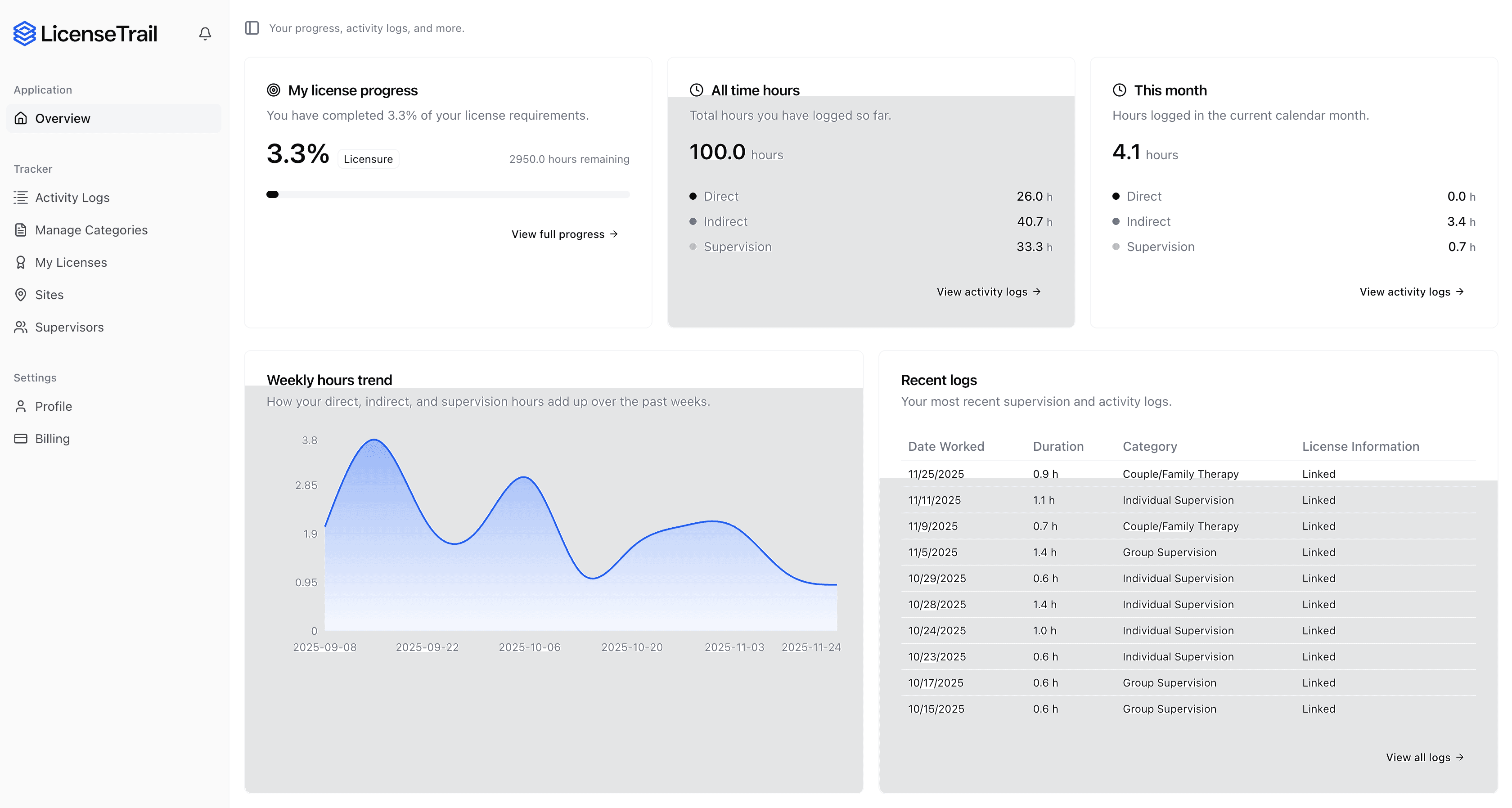
Track your LMHCA hours with confidence
License Trail checks your direct, indirect, and supervision hours against Indiana LMHCA requirements continuously and flags mismatches before you submit.
 Start Tracking for Free
No credit card required · Free plan available
Is your spreadsheet hiding Indiana LMHCA risks?
Stop guessing if your categories match Indiana Behavioral Health and Human Services Licensing Board requirements. License Trail checks your direct, indirect, and supervision hours continuously and flags mismatches before you submit.
Import or log
Bring your spreadsheet or start fresh
Upload your existing tracking spreadsheet and we'll map every hour into the right Indiana Behavioral Health and Human Services Licensing Board categories automatically.
Verify against Indiana
Catch mismatches before the board does
License Trail checks your direct, indirect, and supervision hours against Indiana LMHCA requirements continuously.
Export board-ready
One-click clean reports
Generate professional, board-ready reports for supervision meetings and Indiana Behavioral Health and Human Services Licensing Board submissions in seconds.
No credit card required · Free plan available