
Indiana LSW Requirements: Hours, Exams & Step-by-Step Guide
Stop guessing if your categories match Indiana requirements. License Trail checks your direct, indirect, and supervision hours against LSW requirements continuously and flags mismatches before you submit.
No credit card required · Free plan available
Quick Requirements Overview
- MSW required; submit official transcripts showing degree conferral date (final-semester applicants may use a school “letter of good standing” for early exam approval).
- Apply online via IPLA/BHHS Board; $50 nonrefundable fee.
- Criminal background check required; provide documentation for any “yes” background/disciplinary responses; name-change docs if applicable.
- Pass ASWB Master’s exam; board must approve to test and approval expires if exam not taken within 1 year.
- No post-degree supervised practice hours required to obtain the LSW in Indiana.
- If licensed/credentialed in another state, submit official license verification and/or ASWB score transfer as required.
- After licensure: practice must be supervised by an Indiana LCSW; renew with 40 CE/2-year cycle (≥20 Category I; ≥2 ethics; reduced CE possible at first renewal depending on time licensed).
License Details
Procedures
Indiana’s Licensed Social Worker (LSW) credential is the master’s‑level social work license issued by the Indiana Professional Licensing Agency (IPLA) through the Behavioral Health and Human Services Licensing Board. It is the standard license for MSW‑level practice and the platform you must stand on if you later want to qualify as a Licensed Clinical Social Worker (LCSW).
A key point from the outset: Indiana does not require any post‑degree practice hours to obtain the LSW itself. The detailed hour requirements you often hear about (thousands of clinical hours, monthly supervision) apply to the LCSW level, which you can only pursue after you already hold an LSW and have practiced under supervision. (in.gov)
Below is a step‑by‑step guide built directly from the Board’s own application instructions and FAQs.
1. Eligibility for the LSW in Indiana
Education
To be eligible for the LSW, you must have:
- A Master of Social Work (MSW) degree. The Board’s checklist states this license is “for applicants who have graduated with a Master of Social Work Degree,” and you must provide official transcripts showing the degree and conferral date. (in.gov)
While the Board’s page does not spell out “CSWE‑accredited” in the LSW section, MSW programs that prepare students for licensure are generally CSWE‑accredited; your school’s accreditation will show on the transcript and is what most national guidance assumes. (online.simmons.edu)
If you are in your last semester of your MSW and want to sit for the national exam before graduation, Indiana allows this if your school provides a “letter of good standing” confirming you are on track to complete the degree. (in.gov)
2. Examination Requirement (ASWB Master’s Level)
Indiana uses the Association of Social Work Boards (ASWB) exams for social work licensure. For the LSW, the required exam is the ASWB Master’s level exam. (in.gov)
The Board’s process is:
-
Board approval to test
- You submit your LSW application and supporting documents.
- Once the application is complete and approved, the Board issues “exam approval”, and you have one (1) calendar year from the date of that approval to take the exam. If you do not take it within that year, the approval expires and you must reapply. (in.gov)
-
Register and sit for the ASWB Master exam
- After approval, you register with ASWB and schedule your exam at a testing center.
- The exam is administered in computer format and is offered six days a week at multiple locations, according to the Board’s “Social Worker Examination” section. (in.gov)
-
Score reporting and licensure issuance
- The Board states that once you complete the ASWB Master’s exam, results are released to their office the following week.
- If you pass, your “master of social work license will be issued.” If you fail, the Board emails instructions on how to reapply to retake the exam. (in.gov)
3. LSW Application Components and Process
For an initial LSW by examination (Master’s level), the Board lists the following checklist: (in.gov)
Core items to submit:
- Completed online application
- Application fee of $50 (paid by credit or debit card; nonrefundable)
- Criminal Background Check
- Positive Response Documentation
- If you answer “Yes” to any background or disciplinary questions, you must provide a written explanation including violation, location, date, cause number, disposition, and supporting court documents.
- Name Change Documentation (if applicable)
- E.g., marriage certificate or divorce decree if your legal name has changed.
- Official Transcripts
- An official transcript from your MSW program must be uploaded; it must show that all requirements for graduation are met and the date the degree was conferred.
- Letter of Good Standing (only if you are still in your last semester and seeking early exam approval)
- License Verification (if you already hold another professional license in another state)
- If you hold any license or certification in another state, you must provide official verification from that state’s board; photocopies of license cards are not accepted.
Exam approval and results:
- Once all documentation is accepted, the Board will issue exam approval.
- If you have already passed the ASWB Master exam in another jurisdiction, you must have ASWB send an official score report directly to the Indiana Board or upload it via your portal. (in.gov)
When the Board receives a passing score, they process it and issue the LSW license—typically within about a week of receiving scores, according to their description. (in.gov)
4. Required Hours and Supervision: What Applies to LSW vs. LCSW
4.1. Hours to obtain the LSW
For the LSW itself, Indiana does not require any additional, Board‑counted post‑degree practice hours beyond what you complete in your accredited MSW program.
The Social Work FAQ on the Board’s site is explicit:
- “Supervision is not required to obtain the Bachelor or Master license,” meaning you do not need post‑degree supervised hours in order to be licensed as an LBSW or LSW. (in.gov)
In other words, once you have:
- MSW degree (or are in your final semester with a letter of good standing),
- Completed the application and background requirements,
- Passed the ASWB Master’s exam,
the Board can issue your LSW without you first accruing a specific number of clinical practice hours.
4.2. Supervision while practicing as an LSW (post‑licensure)
Even though supervised hours are not an application requirement, the Board makes clear that LSWs must practice under clinical supervision:
- If you are working in Indiana and hold an LSW, you “must be supervised by an individual holding an Indiana Licensed Clinical Social Worker (LCSW) license.” (in.gov)
The Board FAQ also states that “post-licensure supervision of practice is required” for LSW and LBSW levels. (in.gov)
The Board’s FAQ does not assign a specific monthly supervision hour minimum for general LSW practice that is not being counted toward LCSW. But if your goal is eventually to upgrade to LCSW (and to be able to diagnose and practice independently), your supervision must meet the much more detailed hour requirements described below.
4.3. Post‑licensure hours required to become an LCSW (built on your LSW)
These are often the hours people associate with “Indiana LSW requirements,” but technically they are LCSW requirements. They must be accrued after you hold your LSW (or temporary LSW permit) and are working under supervision.
The Board’s Clinical Social Worker (LCSW) section requires: (in.gov)
1. Two years of post‑degree clinical experience
- You must show “two (2) years of experience in the practice of clinical social work in counseling of clients in a clinical setting.”
- If the hours are earned in Indiana, they must be earned under an Active LSW license or a Temporary LSW Permit.
- The experience must be paid, full‑time and supervised; part‑time experience “will be considered by the Board.”
- The Board adds: “One thousand five hundred hours (1,500) equals one (1) year of experience,” and the full requirement may not be completed in less than twenty‑four (24) months.
From this, the actual hour structure is:
- Total experience hours required: at least 3,000 hours
- 2 years × 1,500 hours/year (per the Board’s 1,500‑hours‑per‑year equivalence).
- Minimum time span: at least 24 months; you cannot compress the 3,000 hours into a shorter timespan and still qualify.
2. Direct client service requirement
The same LCSW experience form states that, to qualify as experience, you must have been providing clinical social work services, including assessment and evaluation, and that at least fifty percent (50%) of this time must consist of providing services directly to clients. (in.gov)
Applied to the 3,000 total hours:
- At least 1,500 hours must be in direct client services (because at least 50% of your 3,000 experience hours must involve directly providing services to clients).
3. Supervision hours requirement
For supervision, the Board’s Form I (Verification of Supervision) states that LCSW applicants must: (in.gov)
- Document “at least four (4) hours of face to face supervision per each month of experience”,
- Supervision must be provided by a licensed clinical social worker (LCSW),
- This supervision must be completed while you are employed and must span no less than twenty‑four (24) months.
From that, you can infer:
- Over the required 24‑month minimum, you need at least 4 hours/month × 24 months = 96 hours of face‑to‑face clinical supervision by an LCSW, tied to the same time period as your qualifying experience.
4. Documentation forms tied to these hours
When you later apply for the LCSW, the Board uses separate forms to document this experience and supervision:
- Form II – Verification of Experience
- Verifies the two years (3,000 hours) of clinical social work experience, confirming the work was paid, supervised, and in a clinical setting, with at least half of your time providing direct client services. (in.gov)
- Form I – Verification of Supervision
- Verifies that you received at least four hours per month of face‑to‑face supervision from an LCSW over a minimum of 24 months. (in.gov)
The FAQ also reminds applicants that “Form I verifies your post-degree supervision while you were employed. Form II verifies your post-degree experience and employment,” and that the time frames on these forms must match. (in.gov)
5. Continuing Education Hours After You Are Licensed
To maintain your LSW once it is issued, the Board requires continuing education (CE) each renewal cycle:
- 40 hours of CE per renewal cycle, which is a two‑year period—equivalent to 20 hours per year.
- At least 20 of those 40 hours must be Category I activities.
- At least 2 hours per cycle must be in ethics (1 hour per year). (in.gov)
If you have been licensed:
- Less than 24 months at your first renewal, you only need 20 hours.
- Less than 12 months, you do not need any CE for that first renewal. (in.gov)
These requirements apply equally at the LSW and LCSW levels.
6. Putting It Together: Practical Pathway from MSW to LSW (and Beyond)
Summarizing the Indiana Board’s own structure:
-
Complete an MSW
- Ensure your program is appropriate for licensure; obtain your official transcript.
-
Apply for the LSW
- Submit the online application, pay the $50 fee, complete a criminal background check, upload any positive‑response or name‑change documentation, and upload official transcripts. (in.gov)
-
Obtain exam approval and pass the ASWB Master exam
- The Board approves you to test; you have one year to take the exam.
- Pass the ASWB Master exam; scores are sent to the Board; your LSW is issued. (in.gov)
-
Practice as an LSW under LCSW supervision
- Supervision is not a condition for obtaining the LSW, but once licensed you must be supervised in practice by an Indiana LCSW. (in.gov)
-
If you want the LCSW later, build your hours while licensed as an LSW
- Accrue at least 3,000 hours of paid, supervised clinical social work experience over no fewer than 24 months, with at least 1,500 hours of direct client services and 4 hours of face‑to‑face LCSW supervision per month (for at least 96 total supervision hours). (in.gov)
- Document this on Form I (supervision) and Form II (experience), then apply for the LCSW and take the ASWB Clinical exam.
-
Maintain your license with continuing education
- Complete the CE hours each renewal cycle, including the required ethics content, and renew by the Board’s deadlines. (in.gov)
In short, to become an LSW in Indiana, you need an MSW, a clean (or fully documented) background, completion of the Board’s application requirements, and a passing score on the ASWB Master’s exam—no post‑degree experience hours are required at that stage. The detailed hour requirements (3,000 experience hours, at least 1,500 direct client hours, and at least 96 hours of documented LCSW supervision) come into play when you later move from LSW to LCSW and pursue independent clinical practice.
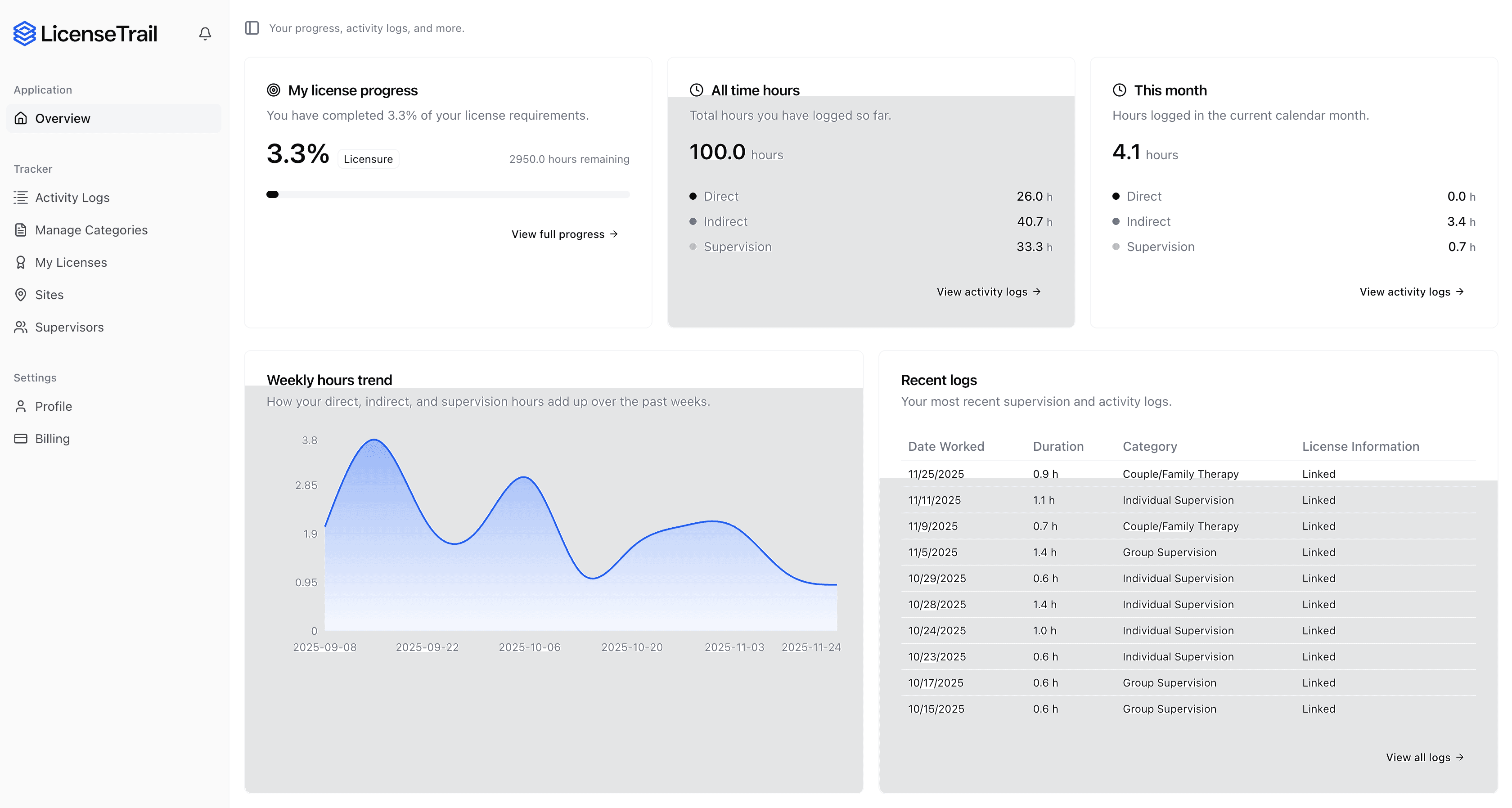
Track your LSW hours with confidence
License Trail checks your direct, indirect, and supervision hours against Indiana LSW requirements continuously and flags mismatches before you submit.
 Start Tracking for Free
No credit card required · Free plan available
Is your spreadsheet hiding Indiana LSW risks?
Stop guessing if your categories match Indiana Behavioral Health and Human Services Licensing Board requirements. License Trail checks your direct, indirect, and supervision hours continuously and flags mismatches before you submit.
Import or log
Bring your spreadsheet or start fresh
Upload your existing tracking spreadsheet and we'll map every hour into the right Indiana Behavioral Health and Human Services Licensing Board categories automatically.
Verify against Indiana
Catch mismatches before the board does
License Trail checks your direct, indirect, and supervision hours against Indiana LSW requirements continuously.
Export board-ready
One-click clean reports
Generate professional, board-ready reports for supervision meetings and Indiana Behavioral Health and Human Services Licensing Board submissions in seconds.
No credit card required · Free plan available