
Iowa LBA / LaBA Requirements: Hours, Exams & Step-by-Step Guide
Stop guessing if your categories match Iowa requirements. License Trail checks your direct, indirect, and supervision hours against LBA / LaBA requirements continuously and flags mismatches before you submit.
No credit card required · Free plan available
Quick Requirements Overview
- Regulator: Iowa DIAL (Board of Behavioral Health Professionals) under Iowa Code Ch. 154D
- LBA eligibility: must hold current BACB certification as BCBA or BCBA‑D (Iowa doesn’t set separate hour totals)
- LaBA eligibility: must hold current BACB certification as BCaBA; must practice under LBA supervision
- Application: submit DIAL application + proof of current BACB credential + pay nonrefundable fee (noted as $120)
- Hours: Iowa relies on BACB supervised fieldwork requirements (BCBA/BCBA‑D or BCaBA); no Iowa-specific hour breakdowns
- License term/renewal: Iowa license expires/renews concurrent with BACB certification expiration date
- Training exemption: unlicensed individuals may accrue BACB-supervised experience hours while pursuing certification (per Iowa Code §154D.4(3)(g))
License Details
Procedures
Licensing as a behavior analyst in Iowa is essentially a two‑step process:
- qualify for national certification through the Behavior Analyst Certification Board (BACB), and
- use that certification to obtain an Iowa license.
Iowa does not set its own hour totals (e.g., “1,500 hours of direct experience”) in statute or rule. Instead, the Board requires you to hold specific BACB credentials, and those credentials carry defined supervised fieldwork hour requirements.
Below is a step‑by‑step guide, with the Iowa legal language and the relevant hour structures spelled out.
1. Who regulates behavior analysts in Iowa?
-
Statutory authority. Behavior analysts and assistant behavior analysts are regulated under Iowa Code chapter 154D (Behavioral Science). Section 154D.1 defines:
- “Licensed behavior analyst” as a person licensed to practice applied behavior analysis under chapters 147 and 154D.
- “Licensed assistant behavior analyst” as a person licensed to practice ABA under the supervision of a licensed behavior analyst. (law.justia.com)
-
Licensing board. The Board of Behavioral Science has been consolidated into the Board of Behavioral Health Professionals within the Iowa Department of Inspections, Appeals & Licensing (DIAL), which now oversees behavior analyst licensure. (dial.iowa.gov)
2. Core legal standard for Iowa licensure (LBA and LaBA)
Iowa’s licensure statute is very simple and entirely tied to national certification:
-
Behavior Analyst (LBA)
Iowa Code §154D.2A(1): an applicant “shall be granted a license” as a behavior analyst by the board upon submitting proof of current certification as a behavior analyst or behavior analyst‑doctoral by a certifying entity (i.e., the BACB or another accredited certifier). (law.justia.com) -
Assistant Behavior Analyst (LaBA)
Iowa Code §154D.2A(2): an applicant “shall be granted a license” as an assistant behavior analyst upon submitting proof of current certification as an assistant behavior analyst by a certifying entity. (law.justia.com)
The implementing administrative rule (now under DIAL, Agency 481, chapter 891) mirrors this:
- Iowa Admin. Code r. 481‑891.9(1)–(2) requires:
- A completed application and nonrefundable fee, and
- For behavior analysts: proof of current BACB certification as a Board Certified Behavior Analyst (BCBA) or BCBA‑Doctoral;
for assistant behavior analysts: proof of current BACB certification as a Board Certified Assistant Behavior Analyst (BCaBA). (regulations.justia.com)
DIAL’s licensure page summarizes this operationally as:
“Submit proof of current BACB certification” and pay the application fee (currently $120). (dial.iowa.gov)
Key point:
Iowa does not list its own supervised‑experience hour numbers. Instead, it treats BACB certification (with its supervised fieldwork requirements) as the gatekeeper for licensure.
3. Pathway to Iowa Licensed Behavior Analyst (LBA)
3.1. Meet BACB requirements for BCBA or BCBA‑D
To qualify for an Iowa LBA, you must first qualify for—and obtain—BACB certification as a BCBA (or BCBA‑D). Iowa’s own rules describe a BCBA as someone who has an acceptable graduate degree, has completed acceptable graduate coursework in behavior analysis, has completed “a defined period of supervised practical experience”, and has passed the BCBA examination. (rules.iowa.gov)
In practice, that “defined period” consists of fieldwork hours structured by the BACB. As of 2024–2025, the BCBA fieldwork options are:
Option 1 – Supervised Fieldwork
- Total fieldwork hours: 2,000 hours in applied behavior analysis. (studocu.com)
- Supervision intensity: at least 5% of your hours each month directly supervised by a qualified BCBA. (studocu.com)
- Supervised vs. independent hours (minimums):
- 5% of 2,000 hours = at least 100 hours of directly supervised time.
- Up to 1,900 hours may be independent fieldwork (still under an overarching supervision arrangement).
Option 2 – Concentrated Supervised Fieldwork
- Total fieldwork hours: 1,500 hours. (studocu.com)
- Supervision intensity: at least 10% of your hours monthly.
- Supervised vs. independent hours (minimums):
- 10% of 1,500 hours = at least 150 hours of directly supervised time.
- Up to 1,350 hours can be independent fieldwork activities.
For both BCBA fieldwork pathways (under current BACB rules):
- You must accrue 20–130 hours of fieldwork per month, within a maximum window of five years. (studocu.com)
- “Fieldwork hours” include both:
- Restricted activities (direct client services such as implementing interventions), and
- Unrestricted activities (higher‑level tasks like assessment, treatment planning, data analysis, staff training).
BACB caps restricted hours and requires that at least 60% be unrestricted, but Iowa law does not subdivide the hours itself. (operationsarmy.com)
Once you complete the required fieldwork and pass the BCBA exam, you hold the national certification Iowa requires.
3.2. Apply for Iowa LBA licensure
After you have BCBA (or BCBA‑D) certification:
- Create an account and apply online through DIAL’s mental & behavioral health licensing portal. (dial.iowa.gov)
- Submit proof of current BACB certification as a BCBA or BCBA‑D (upload or email as directed). (dial.iowa.gov)
- Pay the nonrefundable application fee (listed as $120 on the current DIAL page). (dial.iowa.gov)
Once the Board verifies your certification and application, it issues the Iowa behavior analyst license (often informally referenced as “LBA”).
3.3. Keeping an LBA license active
Iowa ties your license term directly to your BACB certification:
- Initial license expiration: “with the same expiration date as the applicant’s current certification issued by BACB.”
- Renewal period: runs concurrent with BACB certification; each renewal receives the same expiration date shown on your current BACB certificate. (regulations.justia.com)
Practically, this means:
- You must maintain BCBA/BCBA‑D certification (including BACB continuing education and ethics requirements), and
- You must renew your Iowa license through DIAL whenever your national certification cycle renews.
4. Pathway to Iowa Licensed Assistant Behavior Analyst (LaBA)
4.1. Statutory role and supervision requirement
Iowa law emphasizes that assistant behavior analysts are supervised practitioners:
- Definition: A “licensed assistant behavior analyst” is “a person licensed to practice applied behavior analysis under the supervision of a licensed behavior analyst.” (law.justia.com)
Medicaid regulations reinforce this by stating that a licensed assistant behavior analyst must:
- Hold current certification as an assistant behavior analyst, and
- “Provide treatment under the supervision of a behavior analyst licensed pursuant to Iowa Code chapter 154D,” with claims submitted by the supervising behavior analyst. (regulations.justia.com)
So even after you are licensed as an LaBA, Iowa expects you to work under a licensed behavior analyst’s supervision.
4.2. Meet BACB requirements for BCaBA
For Iowa LaBA licensure, you must first qualify as a BCaBA. Iowa regulations define a BCaBA as a person who has:
- A bachelor’s degree,
- Completed approved behavior‑analytic coursework,
- Completed a defined period of supervised practical experience, and
- Passed the BCaBA exam. (rules.iowa.gov)
As of 2024–2025, the BCaBA fieldwork requirements are:
Option 1 – Supervised Fieldwork
- Total fieldwork hours: 1,300 hours in applied behavior analysis. (americanbehavioralsolutions.com)
- Supervision intensity: at least 5% of your hours each month.
- Supervised vs. independent hours (minimums):
- 5% of 1,300 hours = at least 65 hours of directly supervised time.
- Up to 1,235 hours may be independent fieldwork.
Option 2 – Concentrated Supervised Fieldwork
- Total fieldwork hours: 1,000 hours. (americanbehavioralsolutions.com)
- Supervision intensity: at least 10% of your hours per month.
- Supervised vs. independent hours (minimums):
- 10% of 1,000 hours = at least 100 hours of directly supervised time.
- Up to 900 hours can be independent fieldwork.
As with BCBA fieldwork:
- You typically accrue 20–130 hours per month and must complete all hours within a five‑year window. (americanbehavioralsolutions.com)
- BACB also limits the proportion of purely direct (“restricted”) work; generally no more than 60% of BCaBA fieldwork may be restricted, with at least 40% in broader “unrestricted” activities (treatment planning, data analysis, etc.). (theabanetwork.org)
After fulfilling the fieldwork requirement and passing the BCaBA exam, you hold the national certification Iowa uses as its licensure benchmark.
4.3. Apply for Iowa LaBA licensure
Once certified as a BCaBA:
- Apply online to DIAL for an assistant behavior analyst license and pay the nonrefundable fee. (regulations.justia.com)
- Submit proof of current BACB certification as a BCaBA (Board Certified Assistant Behavior Analyst).
The rule states that “for licensure as an assistant behavior analyst, the applicant shall submit proof of current BACB certification as a board‑certified assistant behavior analyst.” (regulations.justia.com)
The Board then issues an Iowa assistant behavior analyst license (commonly referred to as “LaBA”).
4.4. Maintaining LaBA status and supervision
- License term: as with LBAs, the initial and renewal expiration dates for LaBAs match the BCaBA certificate expiration shown by BACB. (regulations.justia.com)
- Supervision in practice: by statutory definition and Medicaid rules, a licensed assistant behavior analyst must continue to practice under the supervision of a licensed behavior analyst, who generally also bills for services rendered by the LaBA. (law.justia.com)
5. How “hours” fit into Iowa’s framework
To directly address the question about hour types and state‑board wording:
-
Iowa’s statutes and rules do not prescribe numeric hour totals (e.g., “1,500 hours of direct experience and 1,500 hours of supervised experience”) for LBA or LaBA licensure.
- The operative Iowa language is that the board “shall be granted a license” upon proof of current certification by the BACB (BCBA/BCBA‑D for behavior analysts; BCaBA for assistant behavior analysts). (law.justia.com)
-
The only Iowa‑level description of experience is generic, referring to a BCBA or BCaBA as someone who has completed “a defined period of supervised practical experience” required by the certifying entity. (rules.iowa.gov)
-
Concrete, numeric hour requirements are entirely defined by the BACB, and as of 2024–2025 those are:
-
BCBA (for Iowa LBA):
- 2,000 hours of supervised fieldwork with at least 5% supervised (≥100 supervised hours), or
- 1,500 hours of concentrated supervised fieldwork with at least 10% supervised (≥150 supervised hours). (studocu.com)
-
BCaBA (for Iowa LaBA):
- 1,300 hours of supervised fieldwork with at least 5% supervised (≥65 supervised hours), or
- 1,000 hours of concentrated supervised fieldwork with at least 10% supervised (≥100 supervised hours). (americanbehavioralsolutions.com)
-
-
Iowa expressly allows unlicensed individuals to accrue those supervised experience hours as long as they follow the BACB’s supervision rules:
- Iowa Code §154D.4(3)(g) exempts from licensure “unlicensed persons pursuing supervised experience in applied behavior analysis consistent with the experience requirements of a certifying entity,” provided they are supervised according to that entity’s requirements. (law.justia.com)
In practical terms, if you meet the BACB’s hour and supervision standards, Iowa will treat those hours as sufficient; the Board does not add any state‑specific hour requirements on top of BACB certification for either LBAs or LaBAs.
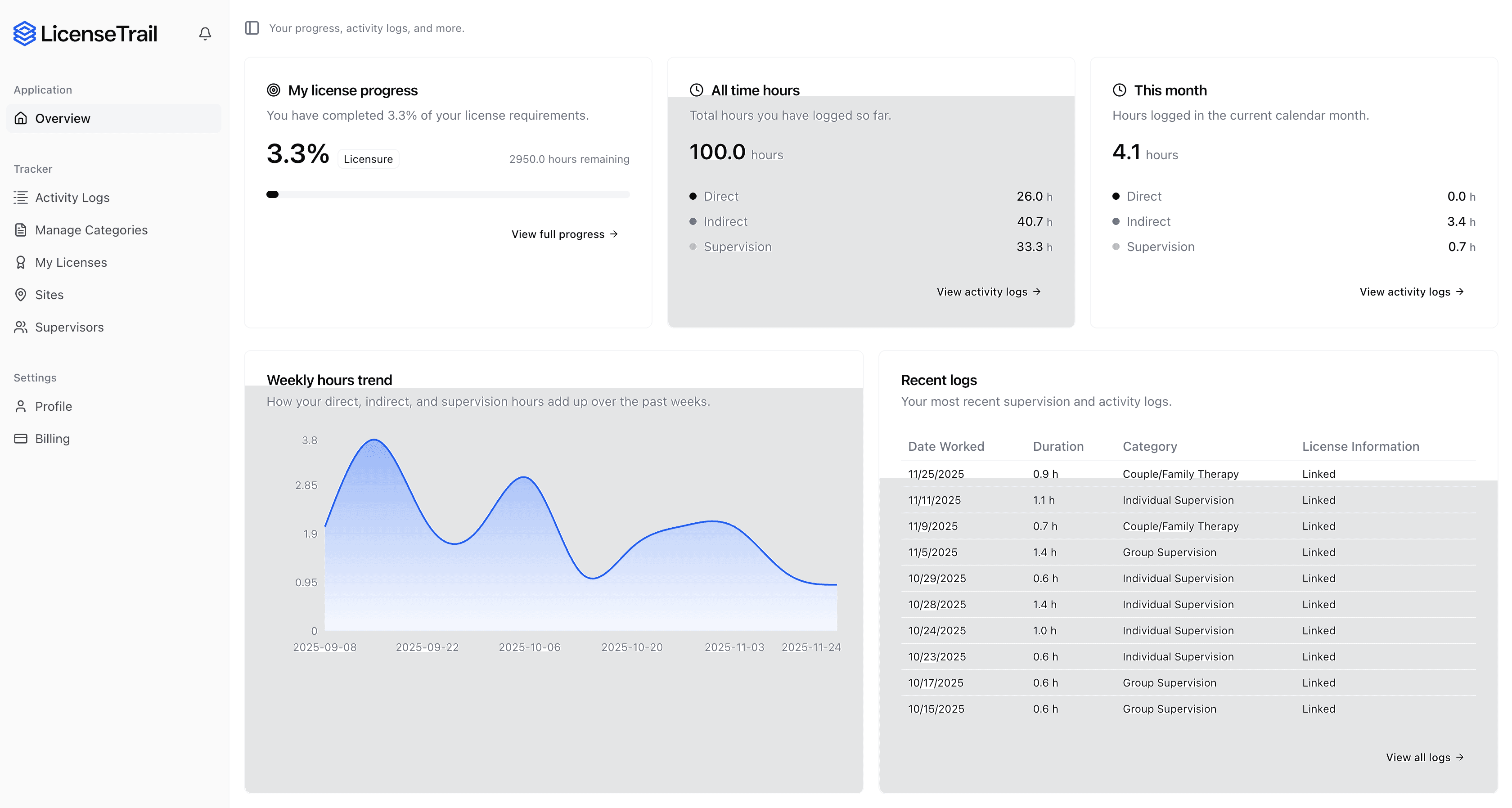
Track your LBA / LaBA hours with confidence
License Trail checks your direct, indirect, and supervision hours against Iowa LBA / LaBA requirements continuously and flags mismatches before you submit.
 Start Tracking for Free
No credit card required · Free plan available
Is your spreadsheet hiding Iowa LBA / LaBA risks?
Stop guessing if your categories match Iowa Board of Behavioral Science requirements. License Trail checks your direct, indirect, and supervision hours continuously and flags mismatches before you submit.
Import or log
Bring your spreadsheet or start fresh
Upload your existing tracking spreadsheet and we'll map every hour into the right Iowa Board of Behavioral Science categories automatically.
Verify against Iowa
Catch mismatches before the board does
License Trail checks your direct, indirect, and supervision hours against Iowa LBA / LaBA requirements continuously.
Export board-ready
One-click clean reports
Generate professional, board-ready reports for supervision meetings and Iowa Board of Behavioral Science submissions in seconds.
No credit card required · Free plan available