
Iowa LMHC Requirements: Hours, Exams & Step-by-Step Guide
Stop guessing if your categories match Iowa requirements. License Trail checks your direct, indirect, and supervision hours against LMHC requirements continuously and flags mismatches before you submit.
No credit card required · Free plan available
Quick Requirements Overview
- Education: CACREP mental health counseling emphasis—Master’s 60 semester hrs (or Doctorate); 45 hrs if entered pre‑7/1/2012; non‑CACREP requires CCE content‑equivalency sent to board
- Exam: NCMHCE required for permanent LMHC (temporary may use NCE or NCMHCE); scores sent directly from NBCC
- Supervised clinical experience (post‑grad): Start after all coursework complete (thesis excepted); minimum 2 years
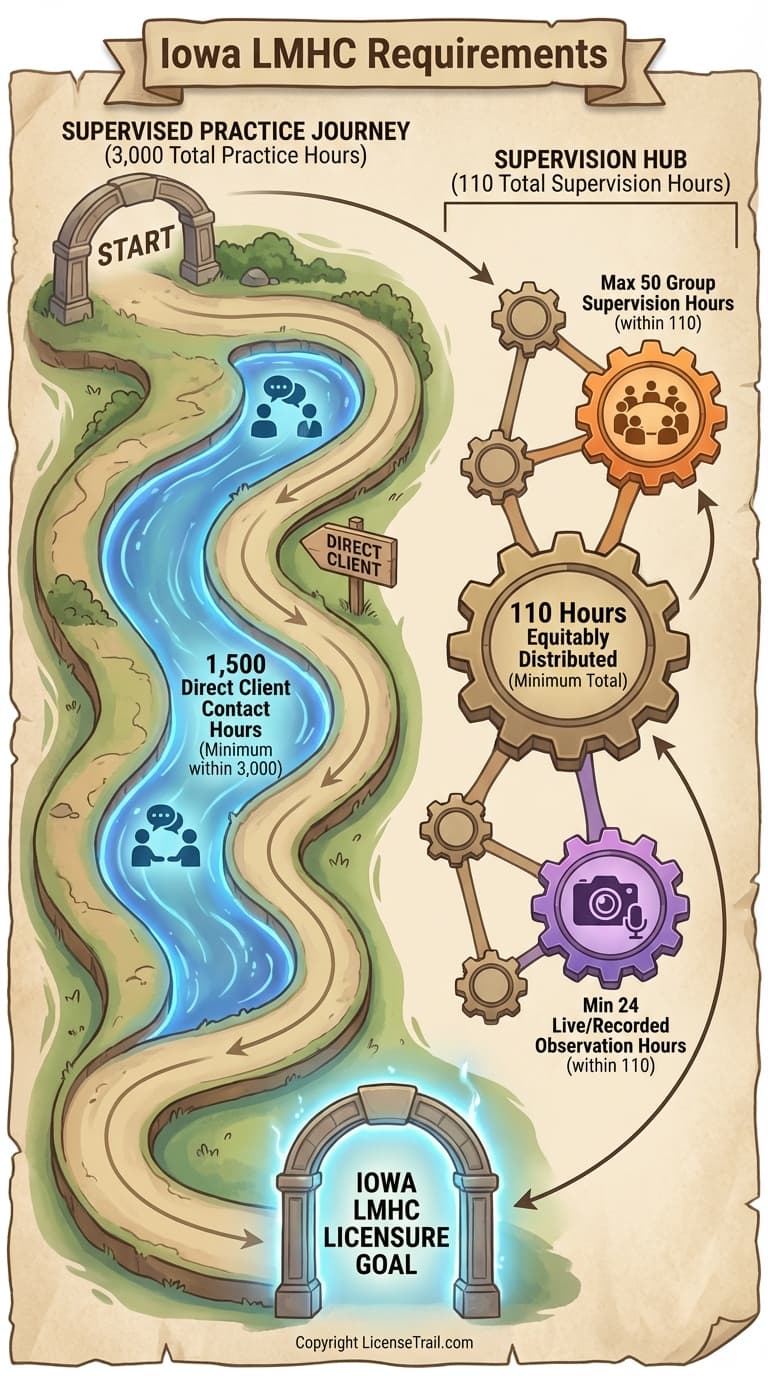
- Hours: 3,000 supervised practice hrs incl. 1,500 direct client contact; 110 direct supervision hrs incl. 24 live/recorded observation; ≤50 group supervision hrs
- Supervision requirements: Supervisor is IA‑licensed LMHC/LISW/LMFT, 3+ yrs independent practice, 6‑hr supervision CE or grad course; ≤4 supervisors at a time; file written supervision plan before starting
- Temporary license: Typically held while accruing hours; valid 3 years (renewable at board discretion); must remain supervised until permanent issued
- Application (permanent): Online application + $120 fee; fingerprints/background check (DCI/FBI); official transcripts/CCE eval, exam scores, and supervision attestation submitted to board (many sent directly)
License Details
Procedures
Licensed Mental Health Counselors (LMHCs) in Iowa are regulated by the Iowa Board of Behavioral Science, with detailed requirements laid out in Iowa Administrative Code chapter 645–31 and parallel rules in chapter 481–880/891 under the Department of Inspections, Appeals, and Licensing (DIAL). To obtain a permanent LMHC license, you must meet requirements in four main areas:
- Education
- National examination
- Post‑graduate supervised clinical experience (under a temporary license)
- Application, documentation, and background check
Below is a step‑by‑step description, with the specific hour requirements and the board’s own terminology.
1. Educational requirements
Degree type and semester hours
Iowa Admin. Code r. 645‑31.6 (and mirror rule 481‑891.6) sets out the education standard. In summary, you must:(law.cornell.edu)
-
Hold either
- a master’s degree (minimum 60 semester hours) in counseling with an emphasis in mental health counseling from a CACREP‑accredited mental health counseling program, or
- a doctoral degree in counseling with an emphasis in mental health counseling from a CACREP‑accredited program.
-
If you entered your program before July 1, 2012, the minimum is 45 semester hours instead of 60.(law.cornell.edu)
-
If your program is not CACREP‑accredited, it must be “content‑equivalent to a master’s degree in counseling with emphasis in mental health counseling.” In that case you must obtain a content equivalency evaluation from the Center for Credentialing and Education (CCE), submitted directly to the board.(law.cornell.edu)
The rules also require three semester credits of graduate coursework in each of multiple specified content areas, with no course double‑counted for more than one area.(law.cornell.edu)
2. Examination requirements
For LMHCs, Iowa requires passage of a National Board for Certified Counselors (NBCC) exam.
Which exam is required?
The current rules (645‑31.3 and 481‑880.3) and the DIAL application page together provide the following:(rules.iowa.gov)
-
For a temporary mental health counselor license:
- You may take either the National Counselor Examination (NCE) or the National Clinical Mental Health Counselor Examination (NCMHCE) of the NBCC.
-
For a permanent LMHC license:
- You must have passed the NCMHCE.
- If you already passed the NCMHCE to obtain your temporary license, you do not have to retake it for the permanent license.(rules.iowa.gov)
Exam score reports must be sent directly to the board office by the testing service.(dial.iowa.gov)
3. Supervised clinical experience (post‑graduate)
You cannot receive a permanent LMHC license in Iowa without completing a board‑defined supervised clinical experience under supervision, typically while holding a temporary license.
When supervision can start
Iowa Admin. Code r. 645‑31.7 and 481‑891.7 state that the:
“supervised clinical experience cannot begin until after all graduate coursework has been completed with the exception of the thesis.” (law.cornell.edu)
So:
- You must finish all required coursework for your degree first (a thesis may remain in progress).
- Hours accumulated before that point do not count toward the Iowa supervised clinical experience requirement.
Minimum duration
The rules further require that:
“The supervised clinical experience must be for a minimum of two years.” (law.cornell.edu)
This is at least two years of supervised practice, whether full‑time or part‑time (part‑time can be prorated).
Required hours – exact Iowa Board language and structure
The Iowa Board does not split hours as “X direct experience and Y supervised experience.” Instead, the supervised clinical experience is defined with three separate quantitative components:
-
Total practice hours
- The supervised clinical experience “must consist of at least 3,000 hours of practice.” (law.cornell.edu)
“Practice” here refers to professional mental health counseling work within the scope of LMHC practice (including both direct and certain indirect clinical activities) performed under supervision.
-
Direct client contact hours
- Within those 3,000 hours, the experience “will consist of at least 1,500 hours of direct client contact.” (law.cornell.edu)
Key points about direct client contact:
- It is client‑facing clinical work (counseling individuals, couples, or families) rather than administrative or solely educational tasks.
- Earlier versions of Iowa’s rules expressly required face‑to‑face sessions; the current formulation uses “direct client contact” and allows telehealth, as long as it is legitimate clinical service within your scope and under supervision.
-
Direct supervision hours
-
In addition, the supervised clinical experience “will consist of at least 110 hours of direct supervision equitably distributed throughout the supervised clinical experience, including at least 24 hours of live or recorded direct observation of client interaction.” (law.cornell.edu)
-
A maximum of 50 hours of the 110 may be obtained through group supervision; the rest must be individual.(law.cornell.edu)
-
Direct supervision can occur in person or by videoconferencing. (law.cornell.edu)
-
After the 110 hours of direct supervision are complete, “ongoing direct supervision will continue to occur for the remainder of the supervised clinical experience.” (law.cornell.edu)
The rules do not explicitly say whether the 110 supervision hours are inside or in addition to the 3,000 practice hours; what is clear is that you must meet all three numeric thresholds: 3,000 total practice hours, 1,500 direct client hours, and 110 hours of direct supervision.
-
Summary of Iowa’s current LMHC hour requirements
Under current Iowa administrative rules (as of late 2025), your supervised clinical experience for LMHC permanent licensure must include at minimum:(law.cornell.edu)
- 3,000 hours of supervised clinical practice
- Of which 1,500 hours must be direct client contact
- Plus 110 hours of direct supervision, including
- Up to 50 hours in group supervision, and
- At least 24 hours of live or recorded direct observation of client interaction
All of this is spread over at least two years, beginning after completion of all graduate coursework (except thesis).
Content of the supervised clinical experience
The Board specifies what your supervised work must actually involve. The supervised clinical experience must:(law.cornell.edu)
- Involve performing psychosocial assessments
- Include diagnostic practice using the current DSM‑5‑TR
- Include treatment activities, such as:
- Establishing treatment goals
- Providing psychosocial therapy using evidence‑based therapeutic modalities
- Doing differential treatment planning
- Prepare you for independent practice and include training in:
- Practice management
- Ethical standards
- Legal and regulatory requirements
- Documentation
- Coordination of care
- Self‑care
This content description is important: even if your raw hours add up, the Board expects the clinical activities to match this scope.
Supervisor qualifications and limits
The same rules (645‑31.7 and 481‑880.7/891.7) define who may supervise you and in what configuration:(law.cornell.edu)
-
A supervisor must:
- Hold an active license in Iowa as:
- an independent level social worker (LISW), or
- a mental health counselor (LMHC), or
- a marital and family therapist (LMFT); and
- Have at least three years of independent practice; and
- Have completed at least a six‑hour continuing education course in supervision or one graduate‑level course in supervision; and
- Be knowledgeable about the ethical code and licensing rules governing you as the supervisee.
- Hold an active license in Iowa as:
-
You may have no more than four supervisors at any given time.(law.cornell.edu)
-
The supervisor decides how many supervisees they can “safely and competently” supervise and may not exceed that number.(law.cornell.edu)
Supervision plan and reporting
Before hours will be recognized, you must file a written supervision plan with the Board:
- 645‑31.7(3) requires that “prior to beginning supervision, the supervisee will submit a written supervision plan to the board using the current form published by the board.” (law.cornell.edu)
For temporary licensees, the parallel DIAL rules require that, within 30 days of completing the supervised experience, your supervisor(s) submit the attestation of supervised clinical experience to the Board.(rules.iowa.gov)
4. Temporary LMHC license and supervised experience window
Because the 3,000 hours must be post‑degree and supervised, most candidates hold a temporary mental health counselor license while accumulating them.
Iowa’s rules on license types (645‑31.2 and 481‑880.2/891.2) specify:(law.cornell.edu)
- You must submit a supervision plan before a temporary license is issued.
- The temporary license is valid for three years and can be renewed at the board’s discretion.
- Its sole purpose is to allow you to complete the postgraduate supervised clinical experience.
- You must remain under supervision until a permanent license is issued.
In practice, the sequence is:
- Complete your degree requirements.
- Obtain a temporary LMHC license.
- Work under approved supervision while accruing the required 3,000/1,500/110 hours over at least two years.
- Once hours are fully met and attested, apply for permanent licensure.
5. Application for permanent LMHC license
When you have met the education, exam, and supervised experience requirements, you apply for the permanent license.
Core application requirements
Under 645‑31.2 and 481‑880.2/891.2, and as summarized on the DIAL “How Do I Apply for a Mental Health Counselor Permanent License?” page, you must:(law.cornell.edu)
-
Submit a completed online application for licensure.
- Application fee is currently $120 and is nonrefundable.(dial.iowa.gov)
-
Undergo a criminal background check:
- Submit two fingerprint cards and a signed waiver to allow a national criminal history background check by the Iowa Division of Criminal Investigation (DCI) and the FBI.
- You pay the cost of the background check.(law.cornell.edu)
-
Have official transcripts sent directly from your school to the Board (or an official CCE equivalency evaluation for non‑CACREP programs).(law.cornell.edu)
-
Have exam scores sent directly from NBCC documenting passage of the NCMHCE (or NCE + NCMHCE where applicable).(rules.iowa.gov)
-
Submit attestation of supervised clinical experience:
- Your supervisor(s) must complete and submit the Board’s supervision attestation form(s) documenting that you have met the supervised clinical experience requirements in rule 645‑31.7 (and 481‑891.7).(law.cornell.edu)
Only when all of these items are received and accepted does the Board issue the permanent LMHC license.
6. Out‑of‑state licensees (briefly)
If you are already licensed as an LMHC/LCPC/etc. in another state, Iowa offers pathways via licensure by endorsement or verification:
- The DIAL site and Iowa Admin. Code 481‑891.2/891.8 require that you:
- Meet Iowa’s education and examination standards or certain alternative criteria; and
- Provide official license verification from every state where you hold or have held a credential, including status and any disciplinary history.(dial.iowa.gov)
This can modify how your previous supervised experience is evaluated, but the Board still looks for the equivalent of Iowa’s supervised clinical experience and exam requirements.
Practical takeaway on hours
For an Iowa permanent LMHC license, the Board’s current rules do not say “1,500 hours direct experience + 1,500 hours supervised experience” as a simple split. Instead, they require all of the following within your supervised clinical experience:
- At least 3,000 hours of supervised practice in mental health counseling
- At least 1,500 of those hours as direct client contact
- At least 110 hours of direct supervision, with:
- 24+ hours of live or recorded observation of client sessions
- No more than 50 hours completed as group supervision
All of it must occur over a minimum of two years, beginning after your graduate coursework is complete (other than a thesis), under qualified supervisors approved through a written supervision plan on file with the Board. (law.cornell.edu)
Because Iowa has active rulemaking in this area, it is wise to confirm the current text of 645‑31.6 and 645‑31.7 (or their 481‑891 counterparts) on the official Iowa rules site or the DIAL/Board of Behavioral Science webpages shortly before you finalize your supervision plan or submit your permanent license application.
Track your LMHC hours with confidence
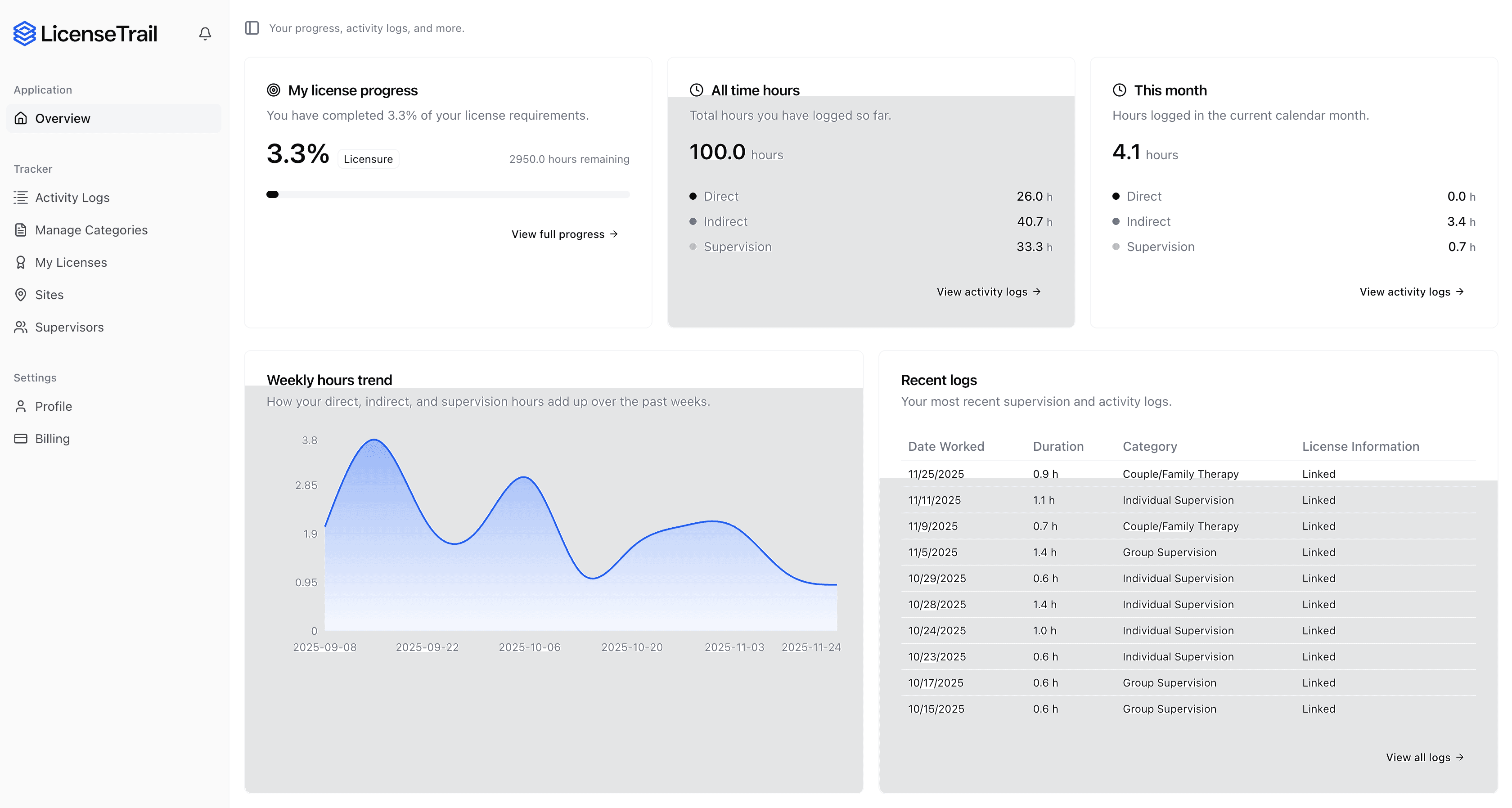
License Trail checks your direct, indirect, and supervision hours against Iowa LMHC requirements continuously and flags mismatches before you submit.
 Start Tracking for Free
No credit card required · Free plan available
Is your spreadsheet hiding Iowa LMHC risks?
Stop guessing if your categories match Iowa Board of Behavioral Science requirements. License Trail checks your direct, indirect, and supervision hours continuously and flags mismatches before you submit.
Import or log
Bring your spreadsheet or start fresh
Upload your existing tracking spreadsheet and we'll map every hour into the right Iowa Board of Behavioral Science categories automatically.
Verify against Iowa
Catch mismatches before the board does
License Trail checks your direct, indirect, and supervision hours against Iowa LMHC requirements continuously.
Export board-ready
One-click clean reports
Generate professional, board-ready reports for supervision meetings and Iowa Board of Behavioral Science submissions in seconds.
No credit card required · Free plan available