
Kansas LAC Requirements: Hours, Exams & Step-by-Step Guide
Stop guessing if your categories match Kansas requirements. License Trail checks your direct, indirect, and supervision hours against LAC requirements continuously and flags mismatches before you submit.
No credit card required · Free plan available
Quick Requirements Overview
- Provided source text describes Arkansas LAC requirements, not Kansas (KS)—can’t reliably produce a KS LAC requirements snapshot from it.
- To generate KS LAC snapshot, need Kansas Behavioral Sciences Regulatory Board (BSRB) LAC rules (education, exams, supervision, background check, fees).
- Confirm KS LAC degree/credit-hour minimums (program type/accreditation; required coursework/practicum).
- Confirm KS LAC required exam(s) (e.g., NCE/NCMHCE) and any KS jurisprudence requirement.
- Confirm KS LAC supervision prerequisites (approved supervisor, supervision plan approval timing, practice restrictions).
- Confirm KS LAC post-licensure supervised experience (total hours; direct vs indirect; supervision hours/ratio; timeframe) for advancement.
License Details
Procedures
Licensing as a Licensed Associate Counselor (LAC) in Arkansas is tightly defined in the Rules of the Arkansas Board of Examiners in Counseling and Marriage & Family Therapy. Those rules lay out both:
- what you must have in place to be issued an LAC license, and
- the specific mix of client-contact and supervision hours you must complete as an LAC before you can move up to Licensed Professional Counselor (LPC).
Below is an organized walk‑through based directly on the current Arkansas Administrative Code and recent rule revisions. (law.cornell.edu)
1. Snapshot: What Arkansas Requires for LAC and Post‑LAC Hours
To be licensed as a Licensed Associate Counselor (LAC), you must:
- Hold a graduate degree (master’s or higher) that is primarily professional counseling in content from a regionally accredited institution.
- Complete at least 60 graduate semester hours in counseling/therapy content that meet CACREP‑based core curriculum standards, including at least 1 graduate credit hour in Technology‑Assisted Counseling. (law.cornell.edu)
- Pass a national counseling exam: either the National Counselor Examination (NCE) or the National Clinical Mental Health Counselor Examination (NCMHCE) (unless you qualify for a limited endorsement provision). (law.cornell.edu)
- Pass the Arkansas Counseling Board Jurisprudence Exam. (law.cornell.edu)
- Complete a criminal background check as required by Arkansas law. (law.cornell.edu)
- Arrange supervision with a Board‑approved LAC supervisor (an LPC with approved supervisor status, in good standing) and have the supervision agreement approved by the Board before any counseling services are provided. (law.cornell.edu)
To move from LAC to LPC, the baseline supervised practice requirement is:
- 3,000 Client Contact Hours (CCH) of supervised professional counseling after the master’s, acceptable to the Board. (law.cornell.edu)
- Within those 3,000 CCH:
- At least 2,200 hours must be direct client contact.
- No more than 800 hours may be indirect client contact. (law.cornell.edu)
- All 3,000 CCH must be accrued under supervision, with a total of 175 clock hours of supervision, broken down by level and supervision ratio (see Section 4 below). (law.cornell.edu)
Arkansas treats the LAC as a training license, not a permanent one; the supervised experience is explicitly intended to prepare you for independent LPC practice. (law.cornell.edu)
2. Educational Requirements for LAC
The Board’s rules require that: (law.cornell.edu)
-
Your graduate degree must be:
- From a regionally accredited institution, and
- Primarily professional counseling in content.
-
You must document at least 60 graduate semester hours of counseling/therapy coursework meeting current CACREP standards and Arkansas core curriculum requirements. The core for LAC/LPC includes, at minimum, graduate coursework in:
- Professional Identity and Ethics
- Social and Cultural Diversity
- Human Growth and Development
- Career Development
- Helping Relations
- Group Work
- Assessment
- Research and Program Evaluation
- Practicum/Internships (minimum 9 graduate credits over at least 6 months)
- Abnormal Psychology/Psychopathology (DSM/ICD)
- Family and Relationship
- Technology‑Assisted Counseling (at least 1 graduate credit)
-
All graduate course hours used toward licensure must carry a grade of B‑ or better; grades of C+ or below are not accepted for licensure. (law.cornell.edu)
Programs that are not CACREP‑accredited may still qualify if they are regionally accredited and you provide catalogs and syllabi to show equivalence to the Board’s adopted standards. (law.cornell.edu)
3. Examinations and Background Checks
National examinations
The Board contracts annually to administer: (regulations.justia.com)
- NCE (National Counselor Examination)
- NCMHCE (National Clinical Mental Health Counseling Examination)
- The Arkansas Jurisprudence Exam (administered through NBCC)
Counselor applicants (LAC/LPC) must successfully complete either the NCE or the NCMHCE to meet the national exam requirement, unless they qualify under a specific endorsement or mobility provision in Section 9.1 of the rules. (law.cornell.edu)
The Board may also require oral interviews when it deems them necessary. (regulations.justia.com)
Jurisprudence exam
All applicants must provide proof of a passing score on the Board’s Arkansas Jurisprudence Exam, which covers state law and Board rules. (law.cornell.edu)
Criminal background check
Before licensure, you must complete a criminal background check under Arkansas Code §17‑27‑313 (and related general licensing background provisions). (law.cornell.edu)
The Board also allows prospective applicants to request a pre‑licensure determination as to whether a criminal record would disqualify them or could be waived. (law.cornell.edu)
4. Supervision and Hour Requirements While You Are an LAC
This is the heart of Arkansas’s LAC structure and the area where the Board’s terminology matters most.
4.1. Supervisor and supervision agreement
-
Supervisor for an LAC must be:
- A Licensed Professional Counselor (LPC) in Arkansas,
- Holding approved supervisor status from the Board, and
- In good standing (license current and not under disciplinary suspension). (law.cornell.edu)
-
You must have a Board‑approved supervision agreement/plan on file before seeing any clients.
- Any counseling services provided without a current, Board‑approved supervision plan are considered unlicensed practice and can lead to suspension or revocation of the LAC. (law.cornell.edu)
-
Both supervisor and supervisee are responsible for:
- Keeping the supervision agreement current, and
- Submitting supervision reports roughly every six months, as required in the supervision sections of the Board’s rules. (law.cornell.edu)
4.2. Definitions: direct vs. indirect hours
The Board uses Client Contact Hours (CCH) as the basic unit for supervised experience. Under the current rule revision: (law.cornell.edu)
-
A direct client contact hour is defined as:
- Face‑to‑face contact with a client or clients in a therapeutic interaction (individuals or groups).
-
Indirect client contact includes:
- Consultation, case management, paperwork, staffing, billing, and test administration when you are not face‑to‑face with the client, but the work is directly related to that client’s care.
These definitions apply to counting hours toward the 3,000 CCH requirement.
4.3. Total hours and breakdown by type
Under Section 3.3 and Section 4.1 of the current rules, the Board requires: (law.cornell.edu)
-
Total supervised experience requirement for LPC via LAC route:
- 3,000 Client Contact Hours (CCH) of supervised professional counseling experience.
-
Direct vs. indirect split:
- The Board states that LACs (and LAMFTs) are required to have:
- At least 3,000 hours of client contact,
- With 2,200 hours defined as direct client contact, and
- No more than 800 hours of indirect client contact may be counted. (law.cornell.edu)
- The Board states that LACs (and LAMFTs) are required to have:
-
Level structure:
-
The supervised experience is currently organized into two levels: (law.cornell.edu)
-
Level 1
- First 500 direct client contact hours.
- Supervision ratio: 1 hour of supervision for every 10 hours of client contact (1:10).
- No indirect hours may be counted in Level 1; all 500 must be direct, face‑to‑face client work.
-
Level 2
- Remaining 2,500 client contact hours (combining direct and indirect, but still within the 2,200 direct / 800 indirect limits overall).
- Supervision ratio: 1 hour of supervision for every 20 CCH (1:20).
- Up to 800 of these 2,500 hours may be indirect; the rest must be direct.
-
-
-
Total required supervision hours:
- The Board specifies that the total hours of supervised practice are 175 clock hours of supervision. (law.cornell.edu)
- That figure is consistent with:
- 500 hours at 1:10 = 50 supervision hours (Level 1), plus
- 2,500 hours at 1:20 = 125 supervision hours (Level 2), for 50 + 125 = 175.
-
Group and technology‑assisted supervision limitations:
- Group supervision may not exceed half of the 175 supervision hours. A group is defined as 3–6 supervisees with the contracted supervisor. (law.cornell.edu)
- Dyadic supervision (one supervisor with two supervisees) is counted as individual supervision for Board purposes. (law.cornell.edu)
- Technology‑assisted supervision (e.g., video) cannot exceed 50% of supervision hours in Level 1, but may be used in both levels within that limit. (law.cornell.edu)
Putting that together in the kind of breakdown you asked for:
- Arkansas requires 3,000 hours of supervised client contact after the master’s degree, structured as:
- 2,200 hours of direct, face‑to‑face clinical experience; and
- Up to 800 hours of indirect, client‑related activities (case notes, staffing, etc.).
- All 3,000 hours must be under Board‑approved supervision, with a total of 175 hours of supervision (50 hours during the first 500 direct‑contact hours and 125 hours during the remaining 2,500 hours). (law.cornell.edu)
4.4. Time frame for completing supervision
Earlier Board language, still published in the “Revisions to the Rules of the Board,” states that the three years of supervision required for LAC (described there as Phases I–III) should be completed within six calendar years from the date the LAC license is issued, unless the Board grants an extension for documented extenuating circumstances. (law.cornell.edu)
In practice, this means:
- The Board expects you to complete your 3,000 supervised CCH as an LAC within a six‑year window from your initial LAC issue date, or
- You must demonstrate circumstances that persuade the Board to extend that period.
5. Substitutions That Can Reduce the Number of Hours
Arkansas allows limited substitution of additional graduate coursework and a passing NCMHCE score for part of the client‑contact and supervision requirements.
Under the current supervision rule: (law.cornell.edu)
-
Additional graduate coursework beyond the master’s
- You may gain 100 CCH of credit for each 3 graduate semester hours earned beyond the master’s degree, so long as:
- The coursework is clearly related to counseling or marriage and family therapy, and
- It is acceptable to the Board.
- You may count up to 2,000 CCH this way (i.e., up to 60 graduate semester hours beyond the master’s).
- You may gain 100 CCH of credit for each 3 graduate semester hours earned beyond the master’s degree, so long as:
-
NCMHCE option during LAC supervision
- After completing Level 1 (first 500 direct client hours), an LAC can petition the Board in writing—with the contracted supervisor’s recommendation—to take the NCMHCE.
- A passing NCMHCE score reduces the total CCH required by 500.
The Board’s language indicates that these options reduce both the Client Contact Hours and the associated supervision hours required. However, the underlying rules still require that your experience remain consistent with your Statement of Intent and Board minimum standards, including the minimum direct‑contact thresholds, so your specific allowable reductions should be planned with your supervisor and, if in doubt, confirmed with the Board.
6. The Non‑Permanent Nature of the LAC License
A consistent theme in Arkansas rules is that LAC is a temporary, training‑level license.
- The Board explicitly states that the LAC license “is not intended to be a permanent license”; its purpose is to enable you to complete the supervised experience leading to LPC. (law.cornell.edu)
- If you do not complete the required supervised experience within the allowed time (generally three years of supervision within a six‑year period from LAC issue), the LAC license may not be renewed unless you persuade the Board that there are extenuating circumstances justifying an extension. (law.cornell.edu)
7. Practical Checklist
Summarizing the path in concrete terms:
-
Earn the right kind of master’s degree
- 60+ graduate hours, counseling‑focused, CACREP‑standard curriculum (or Board‑approved equivalent), including technology‑assisted counseling. (law.cornell.edu)
-
Complete background check and submit application
- Include transcripts, Statement of Intent, and any required documentation.
-
Pass exams
- National exam: NCE or NCMHCE.
- Arkansas Jurisprudence Exam.
- Complete any oral interview the Board requires. (law.cornell.edu)
-
Obtain LAC license
- Arrange for an LPC‑Supervisor with Board‑approved supervisor status.
- Get a supervision agreement approved before you begin seeing clients.
-
Accrue supervised hours as an LAC
- Baseline requirement: 3,000 supervised Client Contact Hours.
- Within that: at least 2,200 direct and no more than 800 indirect hours.
- Supervision: 175 hours total, following the 1:10 (first 500 hours) and 1:20 (remaining 2,500 hours) ratios. (law.cornell.edu)
-
Use permitted substitutions if applicable
- Additional graduate coursework (up to 2,000 CCH) and/or NCMHCE (500 CCH) may reduce your total hour and supervision requirements, subject to Board approval. (law.cornell.edu)
-
Apply to upgrade to LPC
- Once you have completed the required supervised CCH (after accounting for any approved substitutions) and met all Board conditions, you may petition to be licensed as an LPC, at which point ongoing supervision is no longer required. (law.cornell.edu)
All of these requirements are specified in detail in the Arkansas Administrative Code provisions governing the Board of Examiners in Counseling and its most recent rule revisions; because these are regulatory requirements, it is wise to confirm exact interpretations with the Board before relying on any substitution or close call about hours.
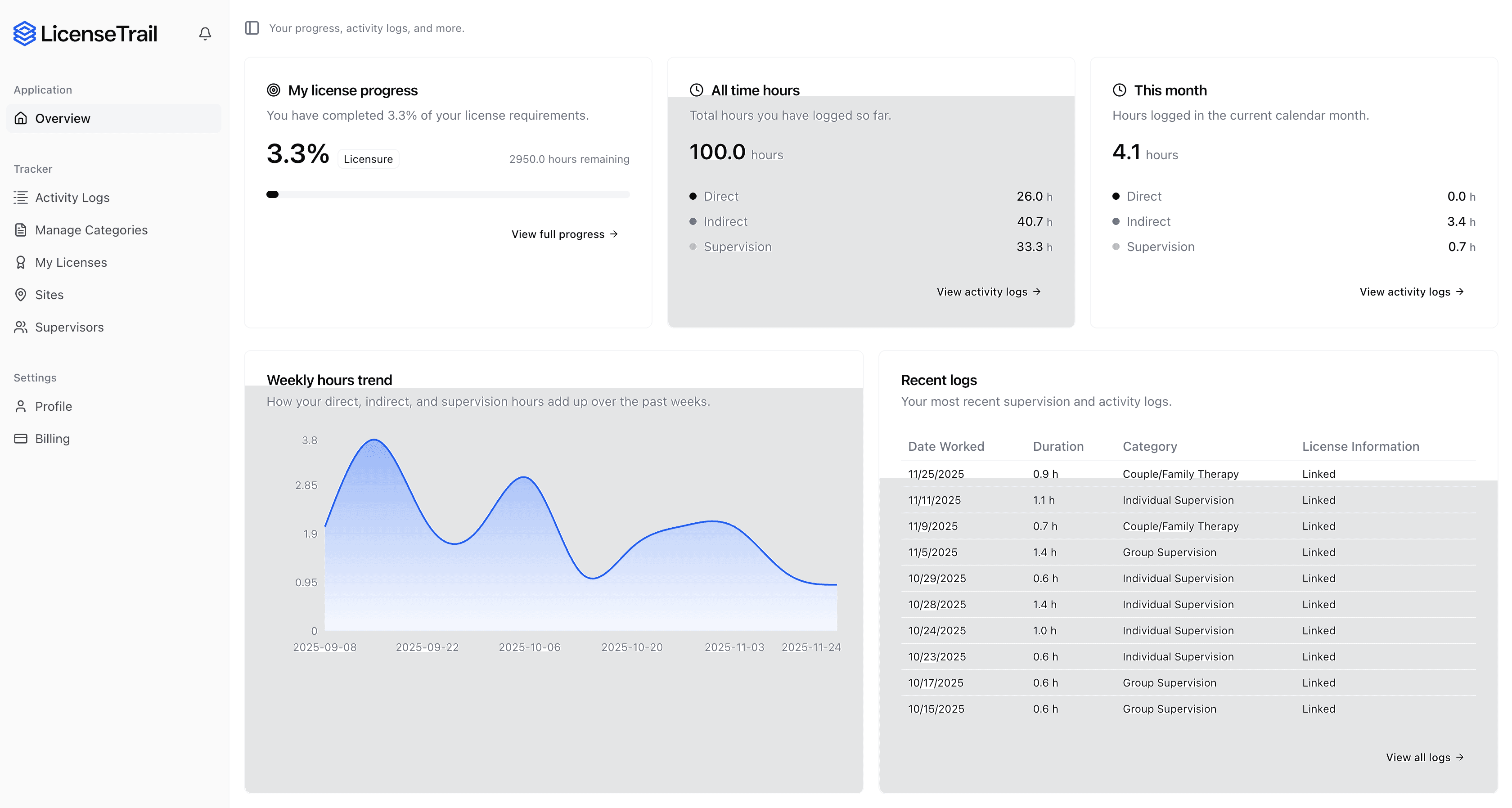
Track your LAC hours with confidence
License Trail checks your direct, indirect, and supervision hours against Kansas LAC requirements continuously and flags mismatches before you submit.
 Start Tracking for Free
No credit card required · Free plan available
Is your spreadsheet hiding Kansas LAC risks?
Stop guessing if your categories match Arkansas Board of Examiners in Counseling and Marriage & Family Therapy requirements. License Trail checks your direct, indirect, and supervision hours continuously and flags mismatches before you submit.
Import or log
Bring your spreadsheet or start fresh
Upload your existing tracking spreadsheet and we'll map every hour into the right Arkansas Board of Examiners in Counseling and Marriage & Family Therapy categories automatically.
Verify against Kansas
Catch mismatches before the board does
License Trail checks your direct, indirect, and supervision hours against Kansas LAC requirements continuously.
Export board-ready
One-click clean reports
Generate professional, board-ready reports for supervision meetings and Arkansas Board of Examiners in Counseling and Marriage & Family Therapy submissions in seconds.
No credit card required · Free plan available