
Kansas LPE Requirements: Hours, Exams & Step-by-Step Guide
Stop guessing if your categories match Kansas requirements. License Trail checks your direct, indirect, and supervision hours against LPE requirements continuously and flags mismatches before you submit.
No credit card required · Free plan available
Quick Requirements Overview
- Provided text describes Arkansas LPE (Psychological Examiner) rules, not Kansas (KS)—can’t extract KS-specific licensing requirements from it.
- Master’s degree in psychology or closely related field required (AR).
- Minimum 45 graduate semester hours (or 75 quarter hours) with specified core coursework (AR).
- 600 clock-hour supervised internship required; at least 25% direct client contact (≥125 hours) (AR).
- Internship supervision: ≥1 hour/week face-to-face individual supervision; complete within 24 months (AR).
- References + Statement of Intent required (AR).
- Exams: EPPP (LPE level) + Board oral exam/interview (AR).
- Independent practice: historically 3,000 supervised clinical hours, but no independent status for licensees after 12/31/2024 (AR).
License Details
Procedures
Licensure as a Licensed Psychological Examiner (LPE) in Arkansas is governed by the Arkansas Psychology Board’s Rules and Arkansas Code §17‑97‑303. The Board’s rules still use the term “psychological examiner,” while the license is commonly referred to as Licensed Psychological Examiner (LPE); they are the same credential for licensing purposes. (regulations.justia.com)
As of late 2025, these are the core, hour‑based and other requirements.
1. Big‑picture snapshot of LPE requirements
To become licensed as an LPE/psychological examiner in Arkansas you must:
- Hold a qualifying master’s degree in psychology or a closely related field. (regulations.justia.com)
- Complete at least 45 graduate semester hours in psychology (or 75 quarter hours), including specified core coursework. (regulations.justia.com)
- Complete a formal internship totaling a minimum of 600 clock hours of supervised experience directly related to your intended practice. (regulations.justia.com)
- At least 25% of this internship must be in direct contact with clients (the rule notes a minimum of 125 hours). (regulations.justia.com)
- Submit required references from qualified psychologists and program officials. (regulations.justia.com)
- Pass the EPPP (Examination for Professional Practice in Psychology) at the psychological examiner level and then pass an oral examination/interview with the Board. (regulations.justia.com)
- Meet all statutory fitness and background criteria in Arkansas Code §17‑97‑303 (criminal background, ethics, etc.). (law.justia.com)
For Independent Practice status (LPE‑I):
- Historically, LPEs licensed after 12/31/1997 needed a plan of supervision for 3,000 hours of clinical training, defined by the Board as direct and indirect client service, under a Board‑approved supervisor. (regulations.justia.com)
- However, state law now bars independent status for anyone licensed after December 31, 2024:
“A psychological examiner licensed after December 31, 2024, shall not be granted independent practice status …” (law.justia.com)
There is no Arkansas requirement that splits experience into something like 1,500 hours of direct and 1,500 hours of supervised experience. The only explicit pre‑licensure hour totals for the LPE are the 600‑hour supervised internship (with a 25% direct‑contact requirement) and, for qualifying LPEs seeking independent status under older rules, 3,000 hours of supervised clinical training.
2. Educational requirements for the LPE
2.1 Degree and program structure
Under Section 5.3 of the Board’s Rules, an applicant for licensure as a psychological examiner/LPE must: (regulations.justia.com)
- Have a master’s degree in psychology or a closely related field from an accredited institution recognized by the Board.
- Complete a program that:
- Is a “recognizable coherent entity within the institution” (i.e., an organized psychology program).
- Is an integrated, organized sequence of study (not random coursework).
- Has an identifiable psychology faculty and a matriculated body of students in that program.
- Includes a supervised practicum or internship, or field laboratory training appropriate to the practice of psychology. (regulations.justia.com)
2.2 Minimum graduate hours and core content
The rules specify that your program of study must include: (regulations.justia.com)
- At least 45 graduate semester hours (or 75 quarter hours) with an average grade of “B” or better.
- Graduate‑level coursework (3 semester hours each) with a grade of “B” or above in at least seven of a list of core psychological areas, including (among others):
- Learning (theories or processes)
- Statistics (descriptive and inferential)
- Individual Intelligence Testing with practicum
- Individual Personality Appraisal
- Behavior Deviation/Abnormal Psychology
- Personality Theories
- Developmental Psychology
- Psychotherapy Theories & Techniques
- Social Psychology
- Industrial/Organizational Psychology
- Research Design
- Behavior Theory/Behavior Techniques
- Physiological Psychology or Sensation and Perception
- Ethics and/or Professional Issues
Additionally, at least 15 graduate semester hours must specifically support your Statement of Intent to practice psychology (the areas of practice you are proposing to the Board). (regulations.justia.com)
3. Required supervised experience hours for initial LPE licensure
The only explicit pre‑licensure hour requirement for the LPE itself in Board rules is the internship requirement in Section 5.3.C. (regulations.justia.com)
3.1 The 600‑hour supervised internship
The rules require:
- “A minimum of 600 clock hours of supervised experience” obtained through a formal internship,
- The experience must be “directly related to the intended use of the license as defined by the Statement of Intent”. (regulations.justia.com)
This 600‑hour internship is not broken into separate direct‑ vs indirect‑experience totals the way some other states do. Instead, the Board controls the mix of activities via more general conditions.
3.2 Distribution of hours and direct client contact
Within those 600 hours, the internship must meet several conditions; the hour‑related ones are: (regulations.justia.com)
- The internship must provide training in a range of assessment and treatment activities with persons receiving health services or in school‑based assessment/treatment planning.
- At least 25% of the intern’s time must be in direct contact with persons served; the rule notes a minimum of 125 hours of direct contact.
- The internship must include at least one hour per week of regularly scheduled, formal, face‑to‑face individual supervision that specifically addresses services rendered directly by the intern.
- The internship must be completed within 24 months.
These internship hours are, by definition, supervised experience. Arkansas does not add a separate requirement such as 1,500 unsupervised direct hours plus 1,500 supervised hours; instead, it requires one block of 600 supervised internship hours with the 25% direct‑contact minimum.
4. Application and documentation requirements
4.1 Application process (Board practice)
On its website, the Board explains that applicants must first request an Application Request Form by email; the Board then sends the full application packet, which must be returned by mail with a small check (currently $10) to the Board office. (psychologyboard.arkansas.gov)
All LPE requirements themselves, the Board emphasizes, are found in Section 5 of the Rules and in Subchapter 3 (Licensing) of Chapter 97 of the Arkansas Code, along with the Act that created/updated the LPE (Act 573). (psychologyboard.arkansas.gov)
4.2 References and supporting documents
The Rules require: (regulations.justia.com)
- A reference from the Director of your academic training program documenting successful completion.
- Three professional references from qualified psychologists who have direct and comprehensive knowledge of your competence.
- A complete Statement of Intent to practice psychology, describing:
- Your intended populations,
- Types of services,
- Settings in which you will practice.
You must also meet statutory conditions in §17‑97‑303, including: (law.justia.com)
- Criminal background check with no disqualifying offenses.
- Demonstrated competence via examination.
- No recent failed Board exam (within the previous 6 months).
5. Examination and interview requirements
5.1 Written examination (EPPP)
Section 8 of the Rules requires all applicants (including LPEs) to pass the Examination for Professional Practice in Psychology (EPPP). The Board describes this as assessing your range of knowledge of psychological principles, techniques, and ethics. (regulations.justia.com)
For scoring:
- The Board’s written‑exam cut‑off is 60% for Psychological Examiners (LPE level).
- These percentage cut‑offs are being replaced with ASPPB’s standard scores: 450 for Licensed Psychological Examiner (and 500 for Psychologist) when Arkansas fully adopts that scale. (regulations.justia.com)
5.2 Oral examination
Those who pass the written exam must sit for: (regulations.justia.com)
- A formal interview/oral examination before at least two Board‑licensed examiners (one current Board member).
- The oral exam covers ethics, your Statement of Intent, your use of title, supervision issues, your knowledge of Arkansas statutes, and may include review of work samples.
A passing written exam is required to be eligible for the oral exam; failing to appear for the scheduled oral can delay licensure by six months.
6. Supervision requirements after LPE licensure
Once licensed as an LPE, you do not automatically practice fully independently in all domains.
Board rules and Arkansas Code require that: (regulations.justia.com)
- Psychological examiners can practice psychoeducational evaluation and diagnosis without supervision.
- But for “overall personality appraisal or classification, personality counseling, psychotherapy, or personality adjustment techniques,” an LPE must practice under supervision by a licensed psychologist.
- The Board requires an annual Supervision Report for any LPE whose practice includes activities that, by law, require supervision, documenting supervision frequency and content. (regulations.justia.com)
These supervision rules govern activities, not a fixed number of post‑licensure hours, except in the context of applying for independent status (below).
7. Independent Practice (LPE‑I) and the 3,000‑hour requirement
7.1 Traditional LPE‑I pathway and hours
Section 5.3.5 of the Rules creates “Requirements for Licensure As a Psychological Examiner With Independent Practice Privileges (LPE‑I).” (regulations.justia.com)
At any point in their careers, LPEs who meet the timing constraints can apply for independent status:
- Prerequisite: You must already hold an LPE license or meet all LPE requirements with a master’s degree in psychology. (regulations.justia.com)
- Licensed prior to 12/31/1997:
- Submit a letter requesting independent practice and a revised Statement of Intent for Independent Practice.
- Independent practice must exclude neuropsychological assessment and projective personality assessment.
- No additional supervised hours are required. (regulations.justia.com)
- Licensed after 12/31/1997 (but before the 2024 cutoff described below):
- Submit a revised Statement of Intent (again excluding independent neuropsychological and projective personality assessment).
- Submit “a plan of supervision of 3000 hours of clinical training, defined as direct and indirect client service, by a Board approved supervisor.”
- The plan must be approved by the Board before you begin accruing those 3,000 hours. (regulations.justia.com)
In statute, parallel language in Arkansas Code §17‑97‑303(d)(2) requires that a psychological examiner seeking independent status after 12/31/1997 must have “completed three thousand (3,000) hours of approved clinical supervised training” after applying for independent practice. (law.justia.com)
So, for qualifying LPEs under the earlier framework, the key independent‑practice hour requirement is:
- 3,000 hours of supervised clinical training (direct + indirect client service) after Board approval of the supervision plan.
Again, this is a single total; the law does not split it into separate hour buckets like 1,500 direct + 1,500 supervised.
7.2 New statutory bar on independent status for post‑2024 licensees
Act 573 of 2023 amended Arkansas Code §17‑97‑303 to add: (law.justia.com)
- “A psychological examiner licensed after December 31, 2024, shall not be granted independent practice status if he or she submits an application to the board for independent practice.”
That means:
- If you are licensed as an LPE after 12/31/2024, current law does not allow you to obtain LPE‑I independent practice status, regardless of how many supervised hours you complete.
- If you were licensed on or before 12/31/2024, the older independent‑practice framework (including the 3,000‑hour requirement for post‑1997 licensees) still applies unless further rules change.
8. Practical step‑by‑step roadmap
Putting the rules and statutes together, an aspiring LPE in Arkansas would typically:
-
Complete a qualifying master’s program
- Ensure it is in psychology or a closely related field and meets the Board’s program criteria (coherent entity, organized sequence, practicum/internship). (regulations.justia.com)
- Accumulate at least 45 graduate semester hours and the required spread of core courses.
-
Complete the 600‑hour supervised internship
- Make sure the internship meets all Rule 5.3.C criteria, including:
- Minimum 600 clock hours total supervised experience.
- At least 25% (≥125 hours) direct client contact.
- At least 1 hour/week of formal, face‑to‑face supervision. (regulations.justia.com)
- Make sure the internship meets all Rule 5.3.C criteria, including:
-
Request an application packet from the Arkansas Psychology Board
- Email the Board for the Application Request Form; complete it to receive the full application.
- Return the completed application packet by mail with the required application fee/check. (psychologyboard.arkansas.gov)
-
Gather references and documentation
- Obtain the program director’s reference and three references from qualified psychologists who know your competence. (regulations.justia.com)
- Prepare your Statement of Intent describing your proposed areas of practice.
-
Undergo background and fitness review
- Apply for and pass the required state and national criminal background check and meet the ethical/fitness requirements in §17‑97‑303. (law.justia.com)
-
Pass the EPPP at the psychological‑examiner level
- Sit for the EPPP, achieving at least the Board’s cut‑off for Psychological Examiners (currently 60% or standard score 450 once fully implemented). (regulations.justia.com)
-
Pass the oral examination/interview
- Attend the scheduled oral exam/interview with Board examiners and demonstrate competence in ethics, law, and your proposed practice. (regulations.justia.com)
-
Maintain appropriate supervision in practice
- Once licensed, practice within your Statement of Intent and under supervision when required (e.g., for psychotherapy, personality appraisal), filing annual supervision reports as applicable. (regulations.justia.com)
-
(If eligible) Decide on independent practice (LPE‑I)
- If you were licensed on or before 12/31/2024, you may consider applying for LPE‑I:
- Pre‑1997 licensees: letter + revised Statement of Intent (no extra hours).
- Post‑1997 but pre‑2025 licensees: letter + revised Statement of Intent + 3,000 hours of supervised clinical training under an approved plan. (regulations.justia.com)
- If you are licensed after 12/31/2024, current law does not permit you to obtain independent status, even with 3,000 hours.
- If you were licensed on or before 12/31/2024, you may consider applying for LPE‑I:
Bottom line on hours
- Initial LPE licensure in Arkansas hinges on:
- A formal internship of at least 600 clock hours of supervised experience,
- With at least 25% of those hours in direct client contact and weekly face‑to‑face supervision. (regulations.justia.com)
- There is no Arkansas requirement that breaks this into something like 1,500 direct hours and 1,500 supervised hours.
- Independent practice (LPE‑I) historically required 3,000 hours of supervised clinical training, but no independent status is available to LPEs first licensed after December 31, 2024 under current statute. (regulations.justia.com)
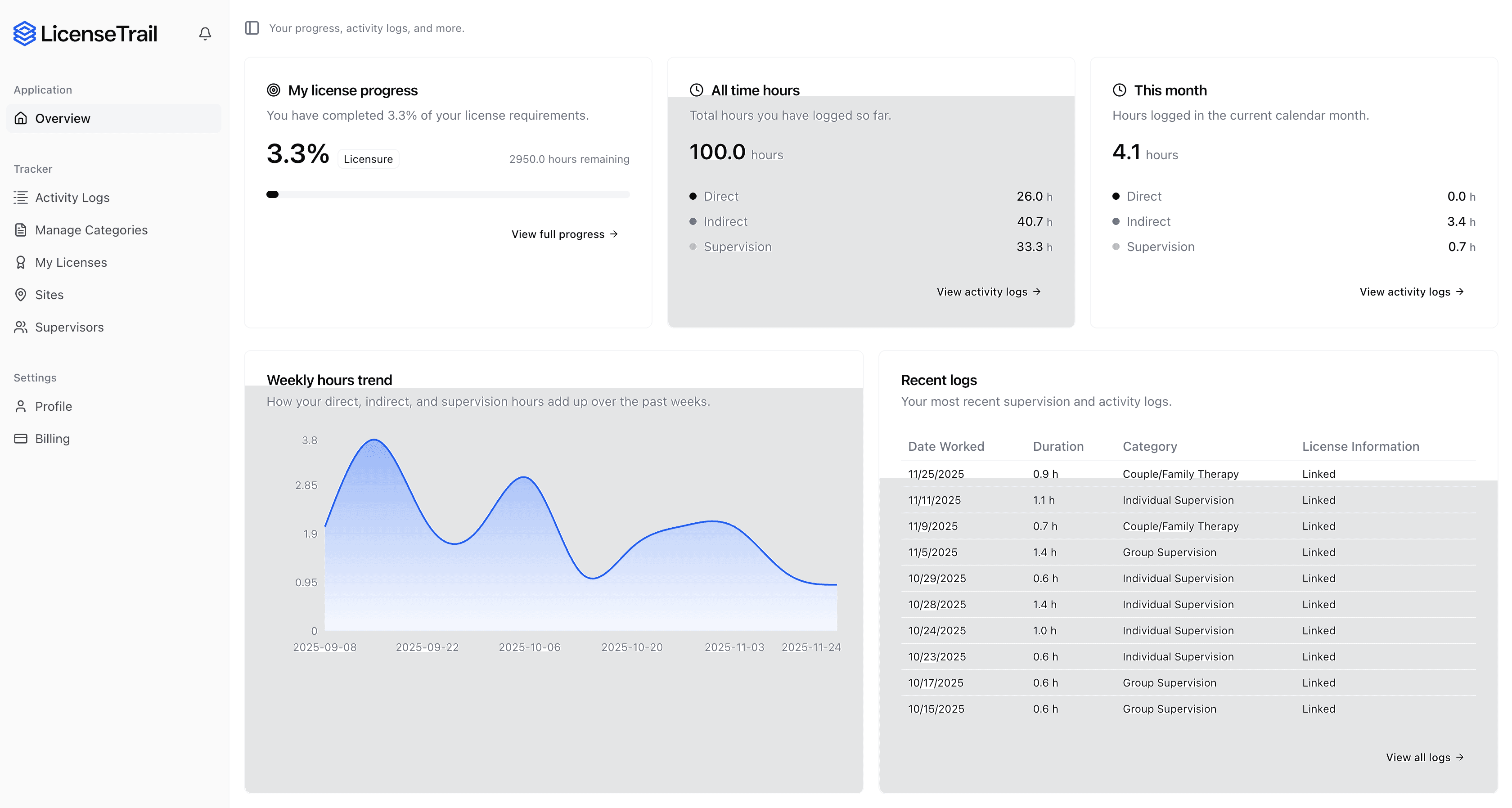
Track your LPE hours with confidence
License Trail checks your direct, indirect, and supervision hours against Kansas LPE requirements continuously and flags mismatches before you submit.
 Start Tracking for Free
No credit card required · Free plan available
Is your spreadsheet hiding Kansas LPE risks?
Stop guessing if your categories match Arkansas Psychology Board requirements. License Trail checks your direct, indirect, and supervision hours continuously and flags mismatches before you submit.
Import or log
Bring your spreadsheet or start fresh
Upload your existing tracking spreadsheet and we'll map every hour into the right Arkansas Psychology Board categories automatically.
Verify against Kansas
Catch mismatches before the board does
License Trail checks your direct, indirect, and supervision hours against Kansas LPE requirements continuously.
Export board-ready
One-click clean reports
Generate professional, board-ready reports for supervision meetings and Arkansas Psychology Board submissions in seconds.
No credit card required · Free plan available