
Louisiana ETR Requirements: Hours, Exams & Step-by-Step Guide
Stop guessing if your categories match Louisiana requirements. License Trail checks your direct, indirect, and supervision hours against ETR requirements continuously and flags mismatches before you submit.
No credit card required · Free plan available
Quick Requirements Overview
- Must hold a current, unrestricted doctoral-level psychologist license in another U.S. jurisdiction (no LA-specific supervised-hour minimums for ETR).
- Must be responding to a Louisiana Governor-declared emergency, in direct response, and tied to an organized relief effort.
- Services must be gratuitous only (no fees or revenue from LA services under ETR).
- Duration: up to 60 days, with up to two additional 60-day extensions (max 180 days), at Board discretion.
- Apply via LSBEP online portal selecting Emergency Temporary Registration (ETR) and submit required ID/photo/license verification and notarized agreement.
- Expect to complete the Louisiana Jurisprudence Exam per LSBEP temporary registration workflow.
- Must comply with LA laws/rules, practice within competence; LSBEP may terminate ETR immediately for noncompliance and may notify other jurisdictions.
License Details
Procedures
Louisiana’s Emergency Temporary Registration (ETR) for psychologists is a narrowly defined, time‑limited permission for already‑licensed, doctoral‑level psychologists from other U.S. jurisdictions to provide gratuitous psychological services in Louisiana during a declared emergency. It is not a training license and does not impose its own practicum or supervised‑experience hour requirements beyond whatever was required for your home state license.
Below is a structured overview of what the Louisiana State Board of Examiners of Psychologists (LSBEP) requires, with emphasis on time limits and any “hours” or duration requirements that actually apply.
1. What the Emergency Temporary Registration (ETR) Is
Louisiana law authorizes the LSBEP to grant an emergency temporary registration to psychologists from other U.S. jurisdictions so they can practice psychology in Louisiana during a declared public health emergency under R.S. 29:769(E).(law.cornell.edu)
Key points:
- It is restricted to licensed psychologists from other U.S. jurisdictions responding to a declared emergency in Louisiana.(law.cornell.edu)
- It is time‑limited (see Section 3 below) and meant only for the period of the emergency.
- It is intended for disaster response / recovery, not routine or long‑term practice.
2. Baseline Eligibility: What You Must Already Have
2.1 Licensure in another U.S. jurisdiction
To qualify for ETR you must:
- Hold a current, unrestricted license at the doctoral level as a psychologist in another U.S. jurisdiction (your state of residence).(law.cornell.edu)
The ETR rules do not add new clinical hour benchmarks (e.g., “1,500 direct + 1,500 supervised hours”). Instead, Louisiana relies on the fact that your home state license already required appropriate education and supervised experience.
For context only (this is about full Louisiana licensure, not ETR): Louisiana’s own permanent psychologist license requires “two years of full‑time (4,000 hours) supervised and documented experience,” of which up to 2,000 hours of an acceptable predoctoral internship may count; the rest must be postdoctoral.(law.cornell.edu) Those hours matter if you later seek permanent licensure in Louisiana, but they are not re‑imposed for ETR.
2.2 Connection to the declared emergency and nature of services
Louisiana distinguishes ETR from ordinary temporary registration by imposing three additional emergency‑specific conditions. To use the ETR pathway, you must:(lsbep.org)
- Be responding to a Declaration of Emergency issued by the Governor of Louisiana.
- Come to Louisiana in direct response to that emergency and be associated with an organized relief effort (e.g., Red Cross, Louisiana Volunteers in Action).
- Provide psychological services gratuitously—no fee, no revenue of any kind derived from services in Louisiana.
These criteria appear in both the LAC §1002 emergency registration rule and LSBEP’s “Steps Toward Temporary Registration” guidance document under the “Emergency Temporary Registration” description.(lsbep.org)
3. Time Limits and “Hours” of Practice Allowed
There are no clinical training‑hour requirements stated for ETR. Instead, Louisiana regulates:
- How long the ETR authority can last overall, and
- For regular Temporary Registration (TR), how many days per year you may practice.
Because ETR is a subtype of temporary registration, it is helpful to separate the two.
3.1 Emergency Temporary Registration (ETR) – Duration
Under LAC 46:LXIII §1002, the board’s emergency authority:
- Applies for a period not to exceed 60 days, and
- May be extended for up to two additional periods, each up to 60 days, if the board determines it is appropriate and necessary.(law.cornell.edu)
In other words, ETR authority is:
- Initial period: up to 60 days, and
- Possible extension: up to an additional 120 days (two 60‑day extensions), at the board’s discretion.
This is a calendar‑day limit, not a requirement to complete a certain number of clinical hours.
3.2 Standard Temporary Registration (TR) – Practice‑day limits (for comparison)
For a regular Temporary Registration (non‑emergency), Louisiana law states that an out‑of‑state, doctoral‑level psychologist may practice “for a period not to exceed 30 days in any one calendar year” in Louisiana under temporary registration, or until the expiration of the home license, whichever comes first.(law.cornell.edu)
The Board’s “Steps Toward Temporary Registration” guidance further explains that:
- Practice under a TR may not exceed 30 practice dates in a calendar year, and the dates do not have to be consecutive.(lsbep.org)
- Temporary Registration may be granted for up to three calendar years, but there is no traditional renewal; you re‑apply if you need additional years.(lsbep.org)
Again, these are limits on how much you may practice, not additional supervised‑experience requirements.
4. Application and Documentation for ETR
4.1 Where and how to apply
The LSBEP handles all license and registration types—including Temporary Registration and Emergency Temporary Registration—through its online licensing portal. The general “Applications” page specifies that you can obtain a Temporary Registration or Emergency Temporary Registration through this portal.(lsbep.org)
From the Board’s “Steps Toward Temporary Registration” guidance (rev. 11/2024):(lsbep.org)
- Create an online account in the LSBEP Licensing Portal (new applicants) or use your existing portal account.
- Under “License or Registration Type,” select:
- “Emergency Temporary Registration (ETR) (Disaster Recovery/Response in Louisiana, Doctoral Level).”(lsbep.org)
- Complete the Online Application Form, ensuring all fields and dates are accurate.
- Pay the application fee (the Steps document lists $200 for Temporary Registration; fee schedules can change, so you should confirm the current amount in the portal or the “Summary of Fees”).(lsbep.org)
4.2 Required documents
The Steps Toward Temporary Registration document lays out a set of required items for temporary registration applicants, which are also applicable to ETR applicants. These include:(lsbep.org)
- Color photograph (passport‑style or professional headshot) uploaded to your dashboard.
- Online Application Engagement Agreement (the “Notarized Statement”): downloaded from LSBEP, signed and notarized, uploaded to your portal, and the original mailed to the Board.
- State‑issued photo ID (driver’s license or other state ID showing residence; a passport is explicitly not accepted as a substitute).
- Official verification of your current, unrestricted psychologist license from your home jurisdiction, sent directly from that board to LSBEP (email is accepted if sent directly by the other board).
- Any additional identification or fitness‑to‑practice information the Board requests under §1002(G).(law.cornell.edu)
4.3 Jurisprudence examination
The “Steps Toward Temporary Registration” document specifies that applicants must complete the Louisiana Jurisprudence Examination, taken online through CANVAS, with a separate non‑refundable exam fee. The document notes that this is required for “all applications” within the described scope.(lsbep.org)
In practice, this means that if the Board processes your ETR using the same temporary registration workflow, you should expect to:
- Receive an email link to register and pay for the jurisprudence exam once your online application, notarized statement, and fee are received.(lsbep.org)
The text of §1002 itself does not spell out the jurisprudence exam, but it does allow the Board to impose “additional requirements” tailored to a particular emergency, which matches the practice described in the Steps document.(law.cornell.edu)
5. Substantive Practice Requirements While on ETR
Once your ETR is granted, you must follow several substantive conditions:
-
Engagement in a legitimate relief effort
You must be actively involved in a legitimate relief effort during the emergency and provide satisfactory documentation of your practice sites (where you will be providing services).(law.cornell.edu) -
Compliance with Louisiana law and scope of competence
You must comply with:- Louisiana’s psychologist licensing law (R.S. Title 37, Chapter 28),
- The Louisiana Administrative Code, Title 46, Part LXIII, and
- Other applicable laws,
and practice in good faith within the reasonable scope of your skills, training, and ability.(law.cornell.edu)
-
Gratuitous services only
You must render psychological services on a gratuitous basis, with “no revenue of any kind” derived from services in Louisiana under the ETR.(law.cornell.edu) -
Board’s enforcement authority
- If you fail to comply with any requirement or condition of the ETR rule, the board may immediately terminate your registration.
- Any jurisdiction in which you hold a license may be notified of any complaint, investigation, or disciplinary proceeding by the Louisiana board.(law.cornell.edu)
- If you practice psychology in Louisiana without any registration (ETR or otherwise), that conduct is treated as the unlawful practice of psychology and is subject to prosecution.(law.cornell.edu)
6. How This Differs from Full Louisiana Licensure and Supervised Hours
To clarify the “hours” question:
-
ETR
- Does not require Louisiana‑specific training or supervision hours.
- Relies on your existing, unrestricted doctoral‑level license from another U.S. jurisdiction.
- Limits are in days of authority (60‑day blocks) and the fact that services are emergency‑related and gratuitous.
-
Full Louisiana psychologist license (if you later apply for permanent licensure):
- Requires two years of full‑time (4,000 hours) supervised and documented experience. Up to 2,000 of those hours may be an acceptable predoctoral internship; remaining hours must be postdoctoral.(law.cornell.edu)
- Each supervised assignment must be at least 500 hours and at least half‑time; all supervised practice must be completed within five calendar years.(law.cornell.edu)
Those supervised‑experience numbers (4,000 total hours, etc.) are not part of the ETR rule itself. They become relevant only if you decide to convert from temporary/emergency practice to full, permanent licensure in Louisiana.
7. Summary of “Hours” or Time‑Related Requirements Specific to ETR
For the Emergency Temporary Registration itself, the Louisiana State Board’s rules and guidance can be summarized as follows:
-
Clinical training hours:
- No Louisiana‑specific minimums for direct, indirect, or supervised hours are listed for ETR. The Board instead requires that you already hold a current, unrestricted doctoral‑level psychologist license in another U.S. jurisdiction.(law.cornell.edu)
-
Practice duration under ETR:
- Authority initially valid for up to 60 days,
- With potential for up to two additional 60‑day extensions at the Board’s discretion (maximum three 60‑day periods tied to the emergency).(law.cornell.edu)
-
Practice days under regular Temporary Registration (for comparison):
- Not to exceed 30 practice days in any one calendar year; temporary registration may be granted for up to three consecutive years, but requires re‑application rather than a simple renewal.(lsbep.org)
In short, Louisiana’s ETR is a time‑limited, emergency‑only authorization based on your existing license, rather than a training track with specified new supervised‑experience hour quotas.
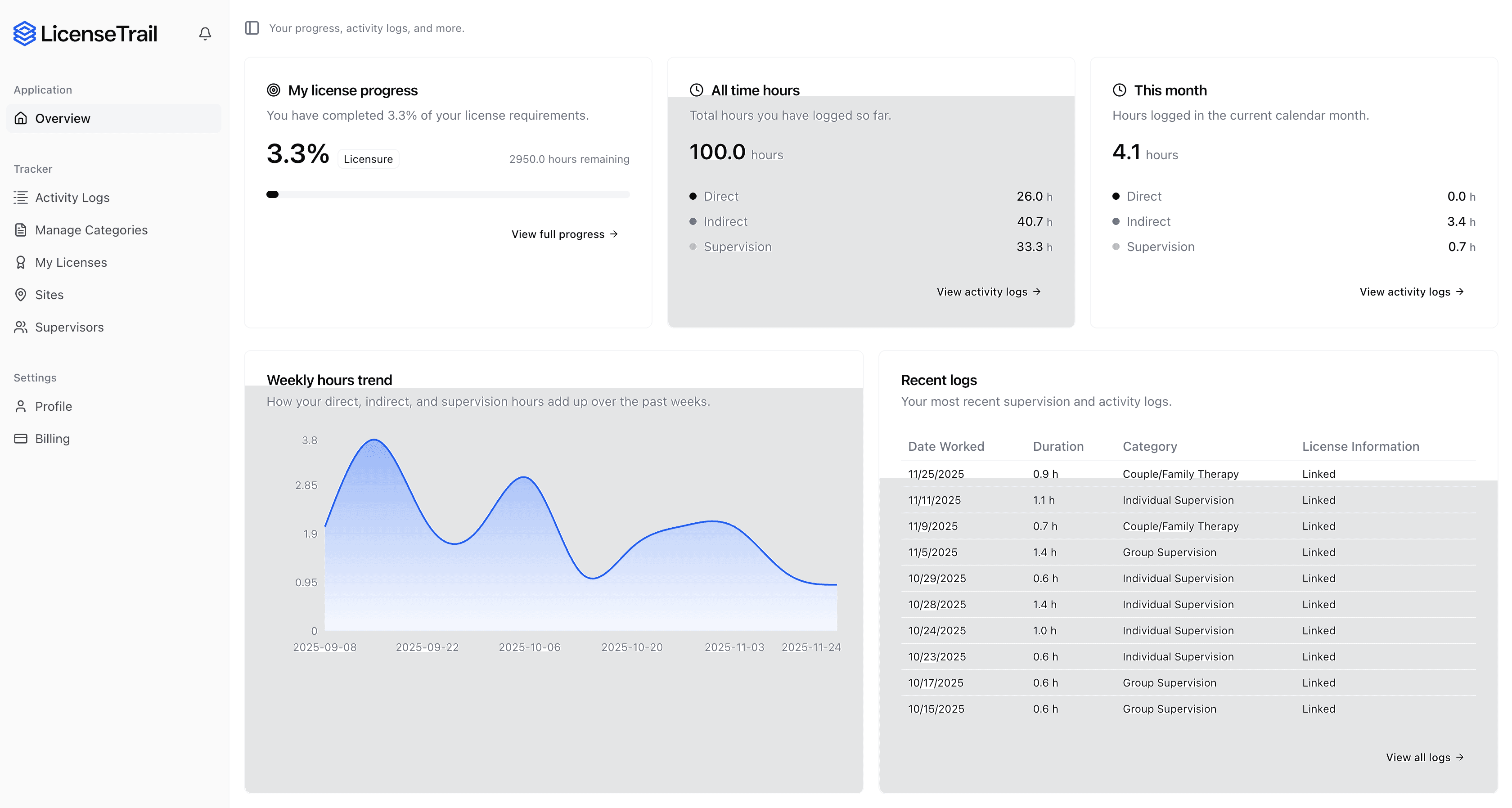
Track your ETR hours with confidence
License Trail checks your direct, indirect, and supervision hours against Louisiana ETR requirements continuously and flags mismatches before you submit.
 Start Tracking for Free
No credit card required · Free plan available
Is your spreadsheet hiding Louisiana ETR risks?
Stop guessing if your categories match Louisiana State Board of Examiners of Psychologists requirements. License Trail checks your direct, indirect, and supervision hours continuously and flags mismatches before you submit.
Import or log
Bring your spreadsheet or start fresh
Upload your existing tracking spreadsheet and we'll map every hour into the right Louisiana State Board of Examiners of Psychologists categories automatically.
Verify against Louisiana
Catch mismatches before the board does
License Trail checks your direct, indirect, and supervision hours against Louisiana ETR requirements continuously.
Export board-ready
One-click clean reports
Generate professional, board-ready reports for supervision meetings and Louisiana State Board of Examiners of Psychologists submissions in seconds.
No credit card required · Free plan available