
Louisiana PLMFT Requirements: Hours, Exams & Step-by-Step Guide
Stop guessing if your categories match Louisiana requirements. License Trail checks your direct, indirect, and supervision hours against PLMFT requirements continuously and flags mismatches before you submit.
No credit card required · Free plan available
Quick Requirements Overview
- Eligibility: Age 21+; good moral character; graduate degree (COAMFTE program or Board‑approved 60‑semester‑hour degree) in MFT or related clinical mental health field from regionally accredited institution
- Practice limits: May use PLMFT title only; must practice under direction/active supervision of Board‑approved supervisor; no independent practice/advertising
- Start rule: No client services or hour accrual until Board issues official PLMFT approval letter; no retroactive hours (except limited grad credits below)
- Clinical experience: 3,000 total clinical service hours (individual/couple/family/group)
- Direct vs. indirect: 2,000 direct required (face‑to‑face therapy); 1,000 indirect/approved professional activities (case management, admin, consultation, etc.)
- Graduate credit limits: Up to 500 direct hours from a systemically oriented grad program may count toward the 2,000 direct requirement
- Supervision: 200 hours qualified supervision (≥100 individual; remainder may be group); up to 100 grad supervision hours may count (max 50 as individual); admin supervision doesn’t count
- Time/renewal: Supervised experience must be 2–6 years; must be approved for LMFT within 6 years of PLMFT approval or forfeit hours; renew biennially (Oct) with 20 CE hours (incl. 1.5 ethics, 1.5 social/cultural, 1.5 diagnosis) and continue NMFTE attempts until passed
License Details
Procedures
In Louisiana, the Provisional Licensed Marriage and Family Therapist (PLMFT) credential is the mandatory post‑graduate step on the way to becoming a Licensed Marriage and Family Therapist (LMFT). It is issued and regulated by the Louisiana Licensed Professional Counselors Board of Examiners and is tightly defined in statute and administrative rule.
Below is a step‑by‑step outline of what the Board requires, with emphasis on the exact types and amounts of hours you must complete and the terminology the Board itself uses.
1. What a PLMFT Is (and Is Not) Allowed to Do
Louisiana law defines a “provisional licensed marriage and family therapist” as a person who has met the Board’s provisional qualifications and been issued a provisional license that is in force. PLMFTs:
- May use the title “provisional licensed marriage and family therapist” and the initials PLMFT.
- May only practice under the direction and active supervision of a board‑approved supervisor.
- “Shall not, under any circumstances, … provide or advertise that [they are] authorized to provide marriage and family therapy independently.” (law.justia.com)
This means you cannot hold yourself out as an independent LMFT or “fully licensed” therapist while provisionally licensed. (law.cornell.edu)
2. Baseline Eligibility and Education Requirements
To be issued a PLMFT, the Board requires at minimum that you: (law.justia.com)
- Are at least 21 years old.
- Are of good moral character and in compliance with applicable laws and Board regulations.
- Possess a graduate degree in:
- Marriage and family therapy, or
- A related clinical mental health field
from a regionally accredited institution, or a qualifying postgraduate training institute in marriage and family therapy.
The LPC Board’s application page further specifies that for PLMFT you must have:
- A COAMFTE‑approved graduate degree program, or
- A 60‑semester‑hour approved graduate degree in marriage and family therapy/counseling or a related clinical mental health field from a regionally‑accredited institution. (lpcboard.org)
Your program must be “systemically oriented” (focused on relational/systemic work with couples and families) for certain hour‑transfer allowances discussed below. (law.cornell.edu)
3. Applying for the PLMFT License
At a high level, to become a PLMFT you must:
- Complete the qualifying graduate degree described above.
- Submit a PLMFT application to the LPC Board (online via the Board’s application portal).
- Undergo a criminal records check and related character/fitness review as required by R.S. 37:1116(C). (law.justia.com)
- Receive an official letter from the Board approving you as a PLMFT.
The rules stress that:
- Applicants “shall not provide psychotherapeutic services to clients” as PLMFTs until they have received an official letter from the Board qualifying them to do so, unless some other mental health license independently authorizes them. (law.cornell.edu)
- If you want to continue in a clinical setting immediately after graduation, you have 60 days from your graduation date to apply for provisional licensure. (law.cornell.edu)
4. The Core Hour Requirements Under a PLMFT
Once you hold the PLMFT, you are working toward full LMFT licensure. The Board’s rules call this your “postgraduate clinical experience in marriage and family therapy” and lay out very specific hour categories and definitions.
4.1 Total Clinical Hours
Louisiana requires a PLMFT to complete at least 3,000 hours of clinical services:
“A PLMFT must complete qualified postgraduate clinical experience … that includes at least 3,000 hours of clinical services to individuals, couples, families, or groups.” (law.cornell.edu)
These 3,000 hours are broken down into “direct work experience” and “indirect work experience,” plus separate qualified supervision hours (discussed in §4.3).
4.2 Direct vs. Indirect Work Experience
The Board defines these terms in its rules:
-
Direct Work Experience –
“Psychotherapeutic services delivered face‑to‑face to individuals, couples, families, or groups in a setting and in a manner approved by the advisory committee as part of the supervisee’s plan of supervision.” (law.cornell.edu) -
Indirect Work Experience –
“Collateral services rendered to clients that relate to proper case management, such as telephone contact, case planning, observation of therapy, record keeping, travel, administrative activities, consultation with community members or professionals, or supervision.” (law.cornell.edu)
In other words:
- Direct = actual, face‑to‑face therapy sessions with clients.
- Indirect = clinically related, non‑session activities on behalf of clients and your professional role.
4.3 Required Distribution of Clinical Hours
The rules specify the exact distribution this way: (law.cornell.edu)
- At least 1,500 hours must qualify as direct work experience.
- Up to 500 hours of direct work experience earned during a systemically oriented graduate program may be counted toward a required 2,000 hours of direct work experience.
- The remaining 1,000 hours (to reach 3,000) may be indirect work experience or other professional activities such as:
- Qualified supervision
- Workshops
- Public relations
- Administrative tasks
- Consulting with referral sources
if approved by the advisory committee.
Functionally, the Board expects:
- 2,000 hours of direct work experience total
- At least 1,500 direct hours must be post‑graduate as a PLMFT.
- Up to 500 direct hours may come from your graduate practicum/internship, if that program is systemically oriented and approved for transfer.
- 1,000 hours of indirect work experience and related professional activities.
All of this must occur under “qualified supervision” (see §4.4) in an approved practice setting, and as reflected in a Board‑approved Plan of Supervision. (law.cornell.edu)
4.4 Qualified Supervision Hours
On top of the 3,000 clinical hours, Louisiana requires separate, dedicated supervision hours:
“The postgraduate clinical experience must include at least 200 hours of qualified supervision, of which at least 100 hours must be individual supervision. The remaining 100 hours may be group supervision.” (law.cornell.edu)
Key supervision rules:
- Qualified Supervision is defined as supervision of the PLMFT’s clinical services by a board‑approved supervisor or LMFT‑registered supervisor candidate according to the approved plan of supervision. (law.cornell.edu)
- Administrative supervision (e.g., a director evaluating job performance) does not count as “qualified supervision.” (law.cornell.edu)
- Up to 100 hours of face‑to‑face supervisor contact from your qualifying graduate program may be counted toward the 200 hours, but:
- Only 50 of those hours may be credited as individual supervision.
- All 100 may be obtained via synchronous videoconferencing on a HIPAA‑compliant platform if they otherwise meet the criteria. (law.cornell.edu)
In summary, for supervision you must have:
- 200 total hours of qualified supervision, including
- 100+ hours of individual supervision, and
- Up to 100 hours of group supervision (2–6 supervisees per supervisor). (law.cornell.edu)
These supervision hours are in addition to the 3,000 clinical hours (though supervision time itself may be counted as indirect work experience where the rules allow).
5. Time Frames and Limits on Accruing Hours
5.1 Minimum and Maximum Time
The Board states that applicants must complete “a minimum of two years of postgraduate clinical experience in marriage and family therapy” under qualified supervision. (law.cornell.edu)
Separately, Board FAQ guidance clarifies that PLMFTs must remain under active Board‑approved supervision for no less than two years and no more than six years, and must remain under supervision until fully licensed if they are providing mental health counseling or MFT services—even if they have already completed 3,000 hours and passed the national exam. (lpcboard.org)
5.2 Six‑Year Cap and Forfeiture of Hours
The rules impose a hard deadline:
- “The provisional licensee must apply and be approved for licensure within six years from date of approval as a provisional licensed marriage and family therapist. After six years, the licensee will forfeit all supervised experience hours accrued and must reapply for provisional licensure under current requirements and submit recent CEHs as part of reapplication.” (law.cornell.edu)
5.3 When You Can Start Counting Hours
The Board is explicit on when hours begin:
- “The supervisee may begin accruing client‑ and supervisor‑contact hours only after the supervisee has received an official letter of approval as a provisional licensed marriage and family therapist from the board.” (law.cornell.edu)
It also notes:
- Retroactive supervision experience hours are not permitted. (law.cornell.edu)
So, aside from the limited graduate‑program hours that may transfer (up to 500 direct client hours and up to 100 supervision hours), you cannot retroactively count work or supervision obtained before your PLMFT approval date.
6. Practice Setting and Plan of Supervision
Although the detailed practice‑setting rules are developed more fully for PLPCs, the PLMFT rules likewise require that you: (law.cornell.edu)
- Work only in practice settings approved by the Board (via your plan of supervision).
- Have a Plan of Supervision for PLMFTs—a written agreement between you and your LMFT board‑approved supervisor describing:
- The supervisory framework for your postgraduate clinical experience.
- The expectations and responsibilities of both supervisor and supervisee.
- Submit this plan to the advisory committee for approval before accruing hours.
You must also:
- Maintain documentation of all supervised experience hours “by employment location and type of hour (indirect, direct, and face‑to‑face supervision)” and are advised to get your supervisor’s signed review at regular intervals. (law.cornell.edu)
7. Renewal and Continuing Education While Provisionally Licensed
A PLMFT license is not a one‑time status; you must maintain it properly.
7.1 Renewal
PLMFTs must: (law.cornell.edu)
- Renew every two years in the month of October, and
- At each renewal:
- Submit the renewal fee.
- Provide documentation of supervised experience hours accrued since approval/last renewal (direct, indirect, and face‑to‑face supervision).
- Provide 20 clock hours of continuing education (see below).
- Request that scores for the National Marriage and Family Therapy Examination (NMFTE) be sent to the Board, and continue to sit for the exam at least once per renewal period until a passing score is achieved.
Failure to renew on time can cause the provisional license to lapse, during which you may not practice or accrue supervised hours; after 90 days you may forfeit hours accrued in that period and need to reapply. (law.cornell.edu)
7.2 Continuing Education Requirements
For each two‑year renewal period, PLMFTs must complete 20 clock hours of continuing education, including at least: (law.cornell.edu)
- 1.5 hours in ethics specific to marriage and family therapy.
- 1.5 hours in social and cultural foundations.
- 1.5 hours in diagnosis (assessment, diagnosis, and treatment under DSM‑5).
At least 10 of the 20 hours must be in areas of marriage and family therapy with an emphasis on systemic approaches, theory, research, or practice of systemic psychotherapeutic work with couples or families. (law.cornell.edu)
8. Summary of Hour Requirements at a Glance
To put Louisiana’s PLMFT requirements in the concrete form you asked for:
-
Clinical Services (Post‑Graduate + Limited Graduate Credit)
- Total clinical services:
- 3,000 hours of clinical services to individuals, couples, families, or groups.
- Direct work experience (face‑to‑face therapy):
- At least 1,500 hours must be post‑graduate direct work experience as a PLMFT.
- Up to 500 additional direct hours may be carried over from a systemically oriented graduate program, counting toward a required 2,000 hours of direct work experience.
- Indirect work experience / professional activities:
- 1,000 hours may be indirect work experience or other professional activities (including some qualified supervision, workshops, administrative tasks, consultation, etc.) as approved by the advisory committee. (law.cornell.edu)
- Total clinical services:
-
Qualified Supervision
- 200 hours of qualified supervision total, including:
- 100 hours minimum of individual supervision, and
- Up to 100 hours of group supervision.
- Up to 100 hours of supervision from a qualifying, systemically oriented graduate program may be applied to this 200‑hour requirement, but no more than 50 of those may count as individual supervision. (law.cornell.edu)
- 200 hours of qualified supervision total, including:
-
Time frame:
- Supervised practice must span at least two years and no more than six years from PLMFT approval.
- You must apply for and be approved for LMFT licensure within six years of PLMFT approval or forfeit all supervised experience hours and reapply under then‑current rules. (law.cornell.edu)
Taken together, these requirements define the supervised training period that the Louisiana Licensed Professional Counselors Board of Examiners expects every PLMFT to complete before qualifying as a fully licensed LMFT in the state.
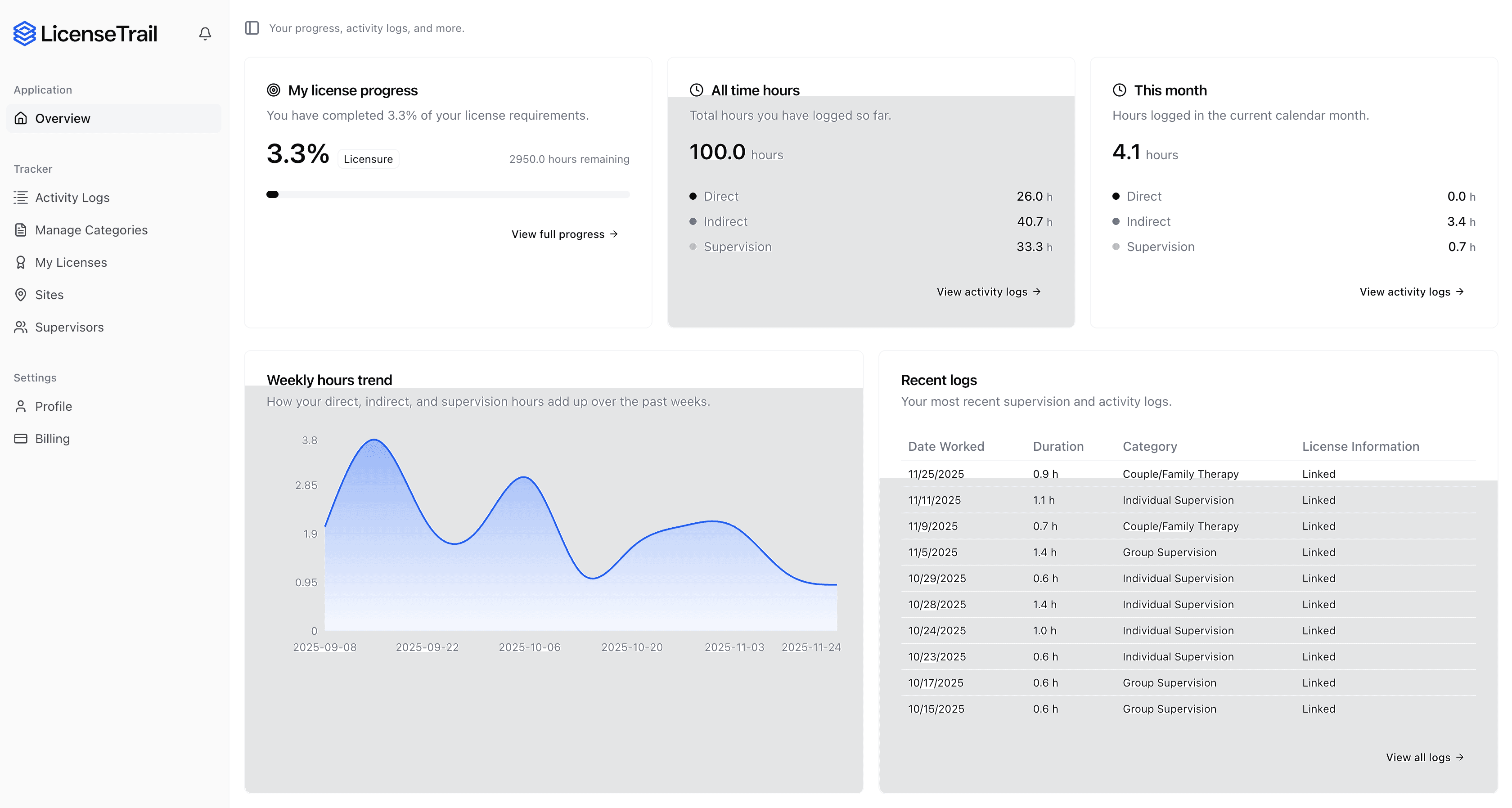
Track your PLMFT hours with confidence
License Trail checks your direct, indirect, and supervision hours against Louisiana PLMFT requirements continuously and flags mismatches before you submit.
 Start Tracking for Free
No credit card required · Free plan available
Is your spreadsheet hiding Louisiana PLMFT risks?
Stop guessing if your categories match Louisiana Licensed Professional Counselors Board of Examiners requirements. License Trail checks your direct, indirect, and supervision hours continuously and flags mismatches before you submit.
Import or log
Bring your spreadsheet or start fresh
Upload your existing tracking spreadsheet and we'll map every hour into the right Louisiana Licensed Professional Counselors Board of Examiners categories automatically.
Verify against Louisiana
Catch mismatches before the board does
License Trail checks your direct, indirect, and supervision hours against Louisiana PLMFT requirements continuously.
Export board-ready
One-click clean reports
Generate professional, board-ready reports for supervision meetings and Louisiana Licensed Professional Counselors Board of Examiners submissions in seconds.
No credit card required · Free plan available