
Louisiana PLP Requirements: Hours, Exams & Step-by-Step Guide
Stop guessing if your categories match Louisiana requirements. License Trail checks your direct, indirect, and supervision hours against PLP requirements continuously and flags mismatches before you submit.
No credit card required · Free plan available
Quick Requirements Overview
- Purpose/role: PLP allows practice only under continuing supervision while completing the final postdoctoral supervised year and enables early admittance to the EPPP
- Education prerequisite: Doctoral degree (major in psychology) from a Board-recognized school/college
- Experience prerequisite to be issued PLP: 1 year (~2,000 hrs) supervised experience or an approved predoctoral internship completed before applying
- Total supervised experience for full licensure: 4,000 hrs (2 full-time years); up to 2,000 hrs may be credited from acceptable predoctoral internship; remainder postdoctoral (often under PLP)
- Supervised experience structure: Each setting/assignment must be ≥500 hrs and ≥half-time; all supervised experience must be completed within 5 calendar years (extensions only for cause)
- Scope limits/title: Must represent as “provisional licensed psychologist”; no independent practice/contracting, no advertising as independently licensed, and no supervising others/independent evaluations
- Renewal/time limits: PLP may be renewed no more than 3 times (up to ~4 years total); must renew timely (missed renewal lapses and practice must stop)
- Admin/compliance: Requires application/fee + documentation (transcripts, internship verification, supervised practice plan, references), jurisprudence exam, criminal background check, and meeting CPD/continuing education for renewals
License Details
Procedures
In Louisiana, the “provisional licensed psychologist” (PLP) is the status you hold while you are finishing the supervised experience required for full, independent licensure as a psychologist. The role is tightly defined in statute (La. R.S. 37:2356.2) and in the Louisiana Administrative Code (LAC 46:LXIII), and it sits inside a larger 4,000‑hour supervised‑practice model.
Below is a step‑by‑step description framed around hours, supervision, and the exact legal/verbal requirements the Board uses.
1. Big‑picture hour requirements for Louisiana psychologists
Louisiana does not use a “1,500 direct / 1,500 indirect” style formula. Instead, the Board’s core model is:
-
Two years of full‑time supervised experience = 4,000 hours.
The Louisiana Administrative Code states:“Two years of full-time (4,000 hours) supervised and documented experience shall be required for licensure.” (law.cornell.edu)
-
Up to one full‑time year (2,000 hours) may be satisfied by an acceptable predoctoral internship.
The same rule continues:“Up to one year full-time (2,000 hours) of an acceptable internship may be applied to this requirement, however all remaining supervision must be post-doctoral.” (law.cornell.edu)
-
The remaining supervised hours must be postdoctoral, typically while you are a PLP.
In practice, most candidates complete:- Predoctoral internship: 1,500–2,000 hours that meet Board standards, and
- Postdoctoral supervised practice: about 2,000 hours after the doctorate, usually under provisional licensure.
So the PLP is the mechanism to finish roughly the second 2,000 hours of this 4,000‑hour supervised sequence and to sit for the written exam while you do it.
2. Supervised experience structure in Board terms
The Board’s rules give more structure to how those 4,000 hours must be accumulated:
-
Definition of full-time and distribution of settings
- Two years full‑time = 4,000 hours total.
- Each supervised assignment must be at least 500 hours in duration and at least half‑time to count toward the 4,000 hours. (law.cornell.edu)
- All supervised practice (internship + postdoc) must be completed within five calendar years, with any extensions granted only “for cause shown” by the Board. (law.cornell.edu)
-
How internship hours typically look (Board‑based summaries) For health‑service psychology doctoral degrees, Board‑aligned guidance summarizes that training must include at least:
- 300 hours of supervised practicum, and
- 1,500 supervised internship hours in a healthcare setting,
with the internship structured as an organized program that includes:- About 2 hours per week of individual supervision,
- About 2 hours per week of didactic activities, and
- At least 375 hours of “service‑related activities” (direct services, case management, documentation, and similar clinical work). (psychologydegree411.com)
These practicum and internship hours are supervised professional experience that feed into, or prepare you for, the 4,000‑hour supervised‑practice requirement and for eligibility as a PLP.
3. Statutory eligibility requirements to be issued a PLP
The controlling statute is La. R.S. 37:2356.2 (“Provisional licensed psychologist; renewal; continuing education”). It provides that the Board “shall issue a provisional license” to a person who files the prescribed application and fee and who furnishes evidence that they meet all of the following: (law.justia.com)
-
Age
- “Is at least twenty‑one years of age.”
-
Character
- “Is of good moral character.”
-
Citizenship
- “Is a citizen of the United States or has declared his intention to become a citizen.”
- A sworn statement that you are a citizen or intend to apply for citizenship when eligible is “sufficient proof.”
-
Discipline/ethics status
- “Is not in violation of any of the provisions of this Chapter and the rules and regulations adopted by the board.”
-
Educational degree
- “Holds a doctoral degree with a major in psychology from a school or college as defined in this Chapter.”
(“School or college” is defined elsewhere as a regionally accredited university offering a full‑time doctoral course of study in psychology approved by the Board. (law.justia.com))
- “Holds a doctoral degree with a major in psychology from a school or college as defined in this Chapter.”
-
Supervised experience or internship prerequisite
- The statute uses the key phrase:
“Has completed a minimum of one year of experience practicing psychology under the supervision of a licensed psychologist or has completed an approved predoctoral internship as defined in the rules and regulations of the board.” (law.justia.com)
- Given that the Board explicitly defines two full‑time years as 4,000 hours and one year as 2,000 hours, this “minimum of one year” is functionally about 2,000 hours of supervised experience (internship or equivalent supervised practice) by the time you apply for PLP. (law.cornell.edu)
- The statute uses the key phrase:
-
Knowledge of Louisiana law and rules
- “Demonstrates professional knowledge of laws and rules regarding the practice of psychology in Louisiana.” (law.justia.com)
- In practice, the Board operationalizes this through a jurisprudence examination, a take‑home exam you must complete and return within a set timeframe as part of the provisional licensure process. (lsbep.org)
These are the legal minimums; the application packet and flow chart add procedural details.
4. How those hour requirements interact with PLP status
Putting the legal pieces together, the hour‑related expectations around PLP look like this:
-
Before you can become a PLP, you must already have either:
- At least one year (≈2,000 hours) of supervised experience practicing psychology under a licensed psychologist, or
- An approved predoctoral internship (typically around 1,500–2,000 hours) that meets all Board‑defined internship criteria. (law.justia.com)
-
While you are a PLP, you complete the “final year” of postdoctoral supervision.
- The Administrative Code defines the PLP’s role this way:
“A provisional license is required for a Candidate’s early admittance to the written examination for licensure, while completing the final year of postdoctoral supervision.” (law.cornell.edu)
- Because the total requirement is 4,000 hours and at most 2,000 may come from internship, the “final year” of postdoctoral supervision under PLP status is typically about 2,000 postdoctoral supervised hours.
- The Administrative Code defines the PLP’s role this way:
-
The supervised practice itself must satisfy the Chapter 7 rules.
- “Two years of full-time (4,000 hours) supervised and documented experience shall be required for licensure.”
- “To be credited toward the two years full-time requirements each assignment in a setting or integrated program shall be of at least 500 hours in duration and at least half‑time for that setting or integrated program.” (law.cornell.edu)
In other words:
- To get the PLP, you must already be through the first year’s worth of supervised practice (internship or equivalent supervised experience).
- While holding the PLP, you are expected to complete the remaining supervised hours (roughly another 2,000 postdoc hours) under a Board‑approved Supervised Practice Plan, and you are allowed to sit for the written licensing exam during that time.
5. Application steps and documentation (Board flow‑chart view)
The Board’s “Provisional Licensure Application Flow Chart” and PLP information page spell out the concrete steps and documents. (lsbep.org)
Core application components
To open a PLP application file, you submit:
- Notarized Application for Provisional License with the current application fee.
- Official doctoral transcripts sent directly from the university (not from you).
- Internship Documentation Form sent directly by the Director of Internship Training, not by the applicant.
- Verification of Completion of Doctoral Degree (required if any postdoctoral supervision began before the degree was formally conferred).
- Supervised Practice Plan – Provisional Licensure (outlining your postdoctoral supervision arrangement).
- Doctoral Program Form if the degree is not APA‑accredited, to allow the Board to verify curriculum and training.
- Practicum Documentation Form (to substantiate pre‑internship supervised experience, particularly relevant for specialty areas).
References
Once your application and fee are received:
- LSBEP opens a file and sends reference forms to the individuals you listed.
- You must provide three professional psychologists (licensed) “who are well acquainted with your work.”
Jurisprudence exam
- The Board sends you the jurisprudence examination; you must return it within the Board’s specified deadline (commonly 30 days). (lsbep.org)
Criminal background check
- A criminal background check (CBC) is required and can be initiated after you’ve submitted your application for licensure; the Board provides a CBC instruction packet with the steps.
File review and provisional license
- Once all documents are in (application, transcripts, internship and practicum documentation, Supervised Practice Plan, references, jurisprudence exam, background check), the Board reviews the file for provisional licensure.
- If deficiencies are found, you are notified in writing and given the chance to clarify or supplement the record.
- When PLP is granted:
- You are formally designated a “provisional licensed psychologist” and
- You are “invited to take the EPPP” (Examination for Professional Practice in Psychology). (lsbep.org)
6. What you can and cannot do as a PLP (Board verbiage)
The definition section of the Administrative Code (LAC 46:LXIII‑107) sets out the scope and limitations of PLP practice: (law.cornell.edu)
-
Definition and purpose
- “A provisional licensed psychologist is a person who has been issued a provisional license under the provision of R.S. 37:2356.2.”
- “A provisionally licensed psychologist may practice psychology as defined under R.S. 37:2352(7) while under the continuing professional supervision of a licensed psychologist.”
-
Title and representation
- PLPs must use the title “provisional licensed psychologist” in representing themselves and their services.
- They must disclose their supervisory relationships to clients/patients and to third parties involved in professional activities.
-
Prohibitions
- PLPs may not:
- “Contract directly with individuals, couples, families, agencies or institutions for clinical services, consultation, supervision or educational services,” and
- “Claim to be independently licensed, in private practice or otherwise advertise as such.”
- PLPs may not:
-
Supervision requirements
- PLPs “must practice psychology under the continuing professional supervision of a licensed psychologist and in accordance with the requirements of Chapter 7 of this Part.”
- PLPs “shall not supervise other mental health professionals or independently evaluate persons.”
-
Billing
- “The supervising licensed psychologist, or the agency, hospital, or corporation that employs the supervising licensed psychologist, may bill for psychological services performed by the provisional licensed psychologist.”
-
Termination of supervision
- When the supervisory relationship ends, “the termination… must be immediately reported to the board… Following termination, the provisional license shall be considered lapsed, and the provisional licensed psychologist may not practice under these provisions until an approved supervisory relationship… has been approved by the board.”
While specific weekly supervision‑hour minimums are described more fully in the Board’s guidance and training documents, common Board‑aligned summaries indicate at least one hour of supervision weekly during postdoctoral practice and more extensive supervision (2–4 hours/week, at least 1 hour face‑to‑face) during internship. (onlinepsychologyprograms.org)
7. Renewal, continuing education, and time limits for a PLP
Statute and Board rules put strict outer limits on how long you can remain provisionally licensed:
-
Maximum renewals / total duration
- LAC 46:LXIII‑107: “A provisional license may be renewed no more than three times. A provisional license that is not renewed in accordance with the provisions of this Part shall lapse.” (law.cornell.edu)
- Functionally, that gives you up to four years total (initial year plus three renewals) in PLP status, assuming you meet all renewal conditions.
-
Annual renewal date and lapse
- The Board’s renewal guidance states that a provisional licensee must have a valid supervisor and an updated Supervised Practice Plan to be eligible to renew.
- Provisional licenses renew on the same fiscal cycle as other licenses, and “A provisional license that is not renewed by July 31 is considered lapsed as of August 1… The individual is prohibited from engaging in the practice of psychology or representing to the public that they are qualified to practice psychology in Louisiana.” (lsbep.org)
-
Continuing Professional Development (CPD)
- Provisional licensees must meet CPD (continuing education) requirements established by the Board. LAC 46:LXIII‑806 notes that a PLP who fails to meet CPD requirements by June 30 of their reporting year “shall be subject to the provisions of R.S. 37:2356.2,” including potential lapse of the provisional license. (law.cornell.edu)
8. Summary of hour‑related benchmarks tied to PLP
Putting the key numbers in one place:
-
Predoctoral practicum (before internship)
- At least 300 hours of supervised practicum in a relevant setting (for health‑service psychology programs). (psychologydegree411.com)
-
Predoctoral internship (to meet the “one year”/internship requirement for PLP)
- At least 1,500 supervised internship hours in a healthcare setting, with:
- Approximately 2 hours/week of individual supervision,
- Approximately 2 hours/week of didactic activities, and
- At least 375 hours of service‑related activities (direct client services and associated clinical work). (psychologydegree411.com)
- At least 1,500 supervised internship hours in a healthcare setting, with:
-
Global supervised‑experience requirement for full licensure
- 4,000 hours total supervised and documented practice in psychology, consisting of:
- Up to 2,000 hours from an acceptable predoctoral internship, and
- The remainder (typically about 2,000 hours) as postdoctoral supervised practice completed after the degree is conferred. (law.cornell.edu)
- 4,000 hours total supervised and documented practice in psychology, consisting of:
-
PLP‑specific supervised‑experience threshold
- To be eligible for the PLP itself, you must have at least one year (~2,000 hours) of supervised experience practicing psychology under a licensed psychologist or an approved predoctoral internship at the time of application. (law.justia.com)
Once you understand that framework, the PLP is best seen as the bridge year (or years): you have already completed at least the first supervised year (internship or equivalent), you obtain provisional licensure, you take the written exam while provisionally licensed, and you finish the remaining supervised hours and oral/jurisprudence requirements on the way to full independent licensure.
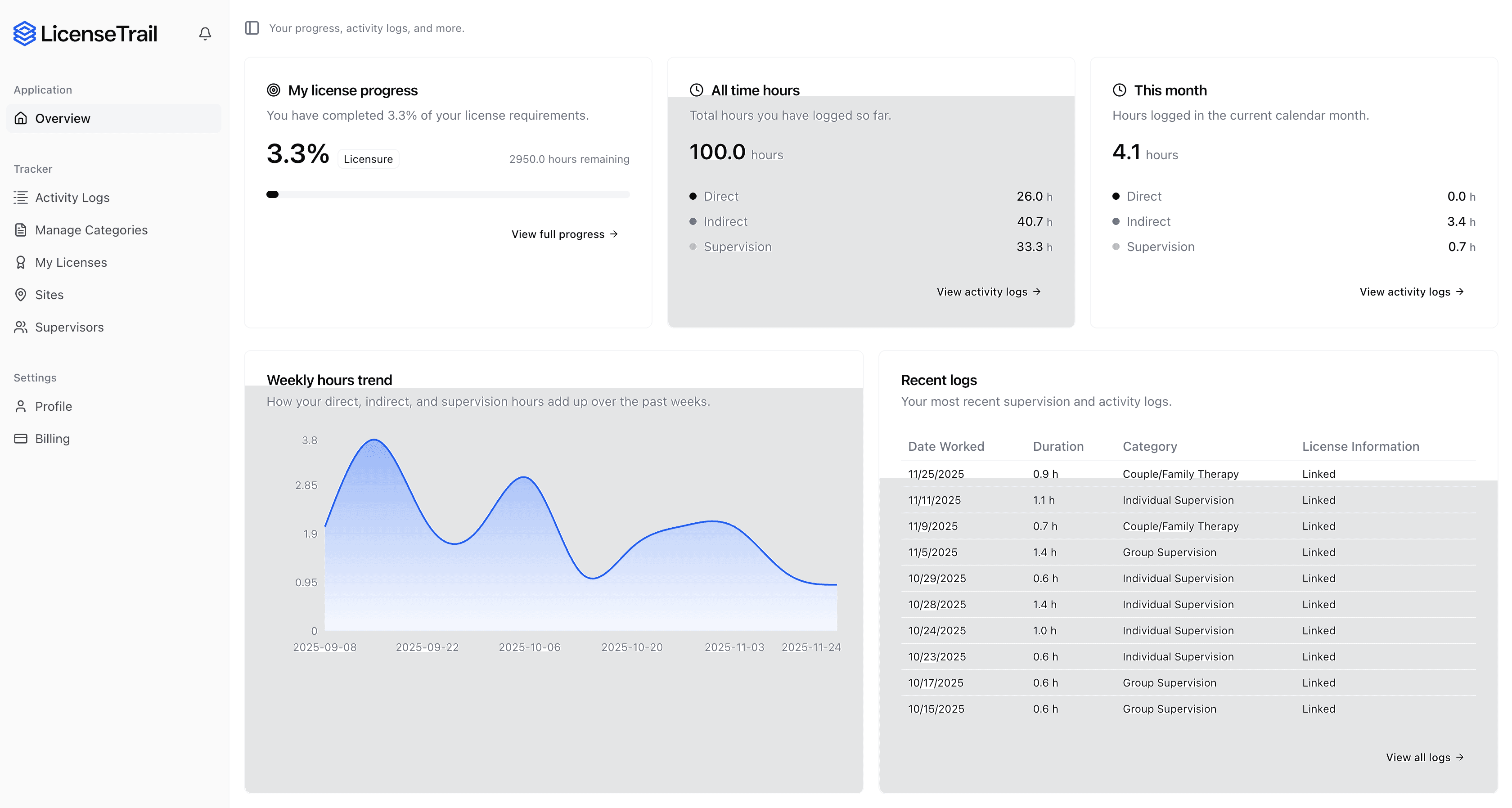
Track your PLP hours with confidence
License Trail checks your direct, indirect, and supervision hours against Louisiana PLP requirements continuously and flags mismatches before you submit.
 Start Tracking for Free
No credit card required · Free plan available
Is your spreadsheet hiding Louisiana PLP risks?
Stop guessing if your categories match Louisiana State Board of Examiners of Psychologists requirements. License Trail checks your direct, indirect, and supervision hours continuously and flags mismatches before you submit.
Import or log
Bring your spreadsheet or start fresh
Upload your existing tracking spreadsheet and we'll map every hour into the right Louisiana State Board of Examiners of Psychologists categories automatically.
Verify against Louisiana
Catch mismatches before the board does
License Trail checks your direct, indirect, and supervision hours against Louisiana PLP requirements continuously.
Export board-ready
One-click clean reports
Generate professional, board-ready reports for supervision meetings and Louisiana State Board of Examiners of Psychologists submissions in seconds.
No credit card required · Free plan available