
Minnesota LADC Requirements: Hours, Exams & Step-by-Step Guide
Stop guessing if your categories match Minnesota requirements. License Trail checks your direct, indirect, and supervision hours against LADC requirements continuously and flags mismatches before you submit.
No credit card required · Free plan available
Quick Requirements Overview
- Issuing board: Minnesota Board of Behavioral Health and Therapy (BBHT)
- Degree: Bachelor’s or Master’s from an accredited school/program
- Coursework: 18 semester credits / 270 clock hours in alcohol & drug counseling (required content areas per statute/BBHT)
- Practicum: 880 clock hours supervised alcohol & drug counseling practicum as part of an accredited program (licensed/exempt supervisor)
- Exam (Method D – Standard): Pass written comprehensive exam or written + oral exam; no required post-degree hours beyond practicum
- Supervised practice option (Method I – Supervision Alternative): Pass written exam + 2,000 post-degree supervised practice hours
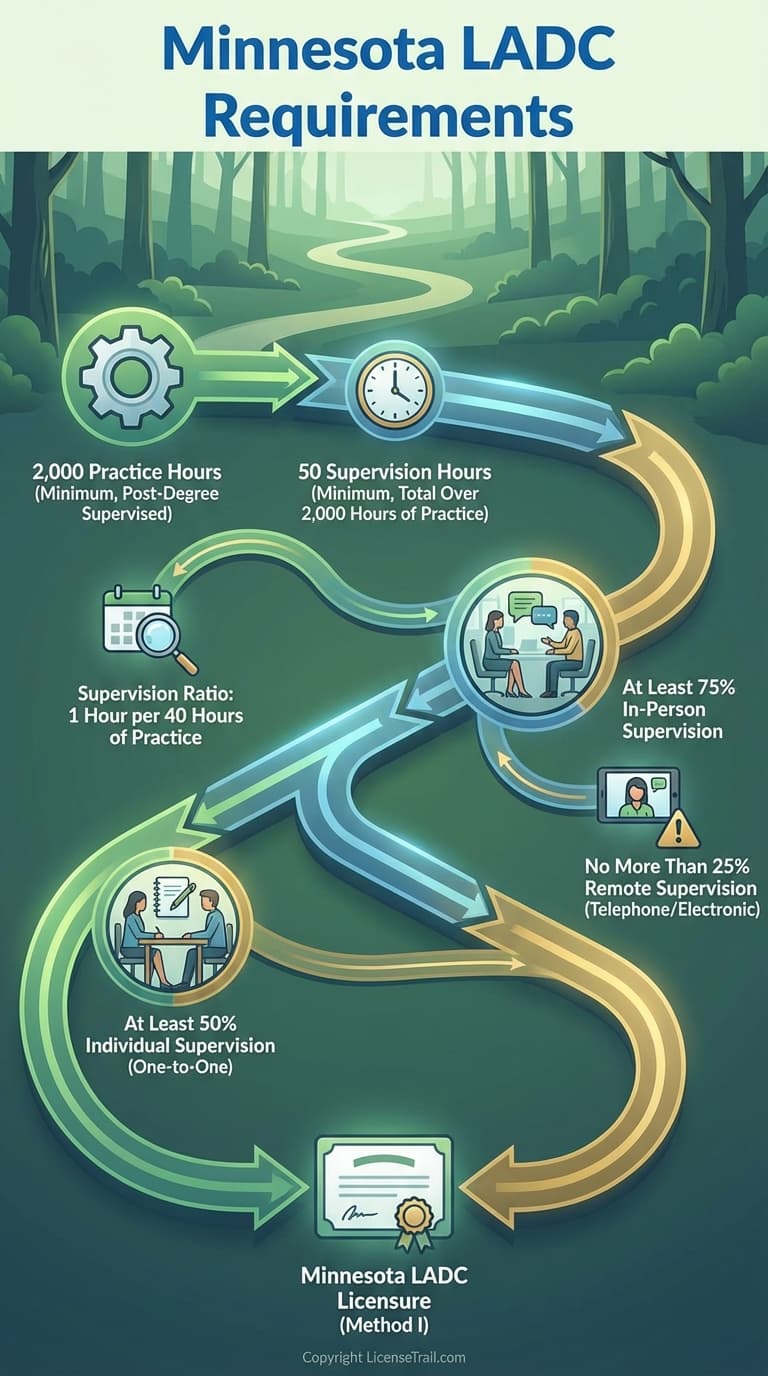
- If Method I: Supervision within the 2,000 hours = 50 hours (1 per 40); 12–36 months; ≥75% in-person; ≥50% individual; supervisor must meet BBHT qualifications
- Other requirements: Application/fee, official transcripts & exam verification, and criminal/background investigation (CBC)
License Details
Procedures
Minnesota licenses Alcohol and Drug Counselors (LADCs) through the Minnesota Board of Behavioral Health and Therapy (BBHT). To obtain this license you must satisfy specific education, practicum, examination, and (optionally) supervised post‑degree practice requirements that are written directly into Minnesota Statutes chapter 148F and BBHT’s application materials.
Below is a structured walkthrough of those requirements, with emphasis on the exact hour types and terminology the Board uses.
1. Core education and practicum requirements
1.1 Degree requirement
Minnesota Statutes section 148F.025, subdivision 2, requires that an applicant:
- Have “a bachelor’s or master’s degree from an accredited school or educational program.” (revisor.mn.gov)
BBHT also emphasizes that all educational requirements for licensure (degree, coursework, and practicum) must be completed through an accredited school. (mn.gov)
1.2 Alcohol and drug counseling coursework – 270 clock hours
The same statute requires that an applicant has:
- “18 semester credits or 270 clock hours of academic course work” in alcohol and drug counseling from an accredited school or educational program. (revisor.mn.gov)
BBHT’s LADC application page summarizes this as:
- “18‑semester credits (270 clock hours) of specific alcohol and drug counseling coursework.” (mn.gov)
The coursework must cover the following content areas (the wording below is taken from statute and BBHT, with minor paraphrasing for clarity) (revisor.mn.gov):
- Overview of the transdisciplinary foundations of alcohol and drug counseling, including theories of chemical dependency, the continuum of care, and the process of change
- Pharmacology of substance use disorders and the dynamics of addiction, including substance use disorder treatment with medications for opioid use disorder
- Professional and ethical responsibilities
- Multicultural aspects of chemical dependency
- Co‑occurring disorders
- The “core functions” of alcohol and drug counseling defined in Minn. Stat. 148F.01, subd. 10 (screening, intake, orientation, assessment, treatment planning, counseling, case management, crisis intervention, client education, referral, reports and record‑keeping, and consultation with other professionals). (mn.gov)
1.3 Practicum – 880 clock hours of supervised alcohol and drug counseling
Statute and BBHT both require that an applicant has completed:
- “880 clock hours of supervised alcohol and drug counseling practicum” from an accredited school or educational program. (revisor.mn.gov)
“Alcohol and drug counseling practicum” is defined in Minn. Stat. 148F.01, subd. 4, as formal experience gained by a student as part of an accredited program, supervised by a person licensed under chapter 148F or exempt under its provisions. (revisor.mn.gov)
In other words:
- These 880 hours are student practicum hours, not post‑degree employment hours.
- They must be supervised in a way that meets the statutory definition (licensed/exempt supervisor, part of an accredited program).
2. Examination requirements
Under Minn. Stat. 148F.025, subdivision 3, an applicant must meet one of two testing routes: (revisor.mn.gov)
-
Single written comprehensive exam route
- “Satisfactorily pass the International Certification and Reciprocity Consortium Alcohol and Other Drug Abuse Counselor (IC&RC AODA) written examination … or other equivalent examination as determined by the board.”
- BBHT’s site calls this “a passing score on a written comprehensive exam OR a passing score on a written and oral exam” for Method D. (mn.gov)
-
Written exam plus either oral exam or supervised practice route
- “Satisfactorily pass a written examination for licensure as an alcohol and drug counselor, as determined by the board, and one of the following:” (revisor.mn.gov)
- Written case presentation + oral exam demonstrating competence in the core functions, or
- “2,000 hours of postdegree supervised professional practice” under Minn. Stat. 148F.04. (revisor.mn.gov)
- “Satisfactorily pass a written examination for licensure as an alcohol and drug counselor, as determined by the board, and one of the following:” (revisor.mn.gov)
BBHT translates these into two main initial licensure “methods,” detailed below.
3. Licensure pathways and exactly what hours they require
3.1 Method D – “Standard Method”
BBHT’s “Apply for LADC” page describes Method D – Standard Method as requiring: (mn.gov)
- Bachelor’s degree
- 18 semester credits / 270 clock hours of specific alcohol and drug counseling coursework
- 880‑hour alcohol and drug counseling practicum
- Passing score on a written comprehensive exam OR passing score on a written and oral exam
Key point about hours under Method D:
- Beyond the 880 supervised practicum hours, there is no additional numeric requirement for post‑degree hours written into Method D.
- Your “hours” requirement under this route is entirely the 270 clock hours of coursework plus 880 clock hours of supervised practicum.
3.2 Method I – “Supervision Alternative”
BBHT describes Method I – Supervision Alternative as: (mn.gov)
- Bachelor’s degree
- 18 semester credits / 270 clock hours of specific alcohol and drug counseling coursework
- 880 hours of alcohol and drug counseling practicum
- Passing score on a written exam (not a comprehensive exam)
- “2,000 hours of supervised professional practice acceptable to the board”
The 2,000 hours of supervised professional practice is defined and structured in Minn. Stat. 148F.04: (revisor.mn.gov)
- It must be “postdegree professional practice”:
- Paid or volunteer work experience and training
- Occurring after graduation from an accredited program
- Done under professional oversight by a supervisor approved by the board
- It must total 2,000 hours of supervised professional practice.
- Supervision requirements for those 2,000 hours include:
- Rate: Supervision “must be obtained at the rate of one hour of supervision per 40 hours of professional practice, for a total of 50 hours of supervision.”
- Format:
- At least 75% of the 50 supervision hours must be received in person; up to 25% may be by phone or audio/audiovisual electronic device.
- At least 50% of the supervision hours must be individual; up to 50% may be in a group setting.
- Timing window: Supervised practice “must be completed in no fewer than 12 consecutive months and no more than 36 consecutive months.” (revisor.mn.gov)
Supervisor qualifications for this 2,000‑hour practice:
- The supervisor must:
- Be a licensed alcohol and drug counselor or other qualified professional as determined by the board.
- Have three years of experience providing alcohol and drug counseling services.
- Have at least 12 hours of training in clinical and ethical supervision (via coursework, CE, workshops, or a combination). (revisor.mn.gov)
From the Board’s own supervised‑practice page:
- BBHT frames this as “2000 Hours of Supervised Postdegree Professional Practice for LADC Licensure”, emphasizing that it can be used “in lieu of the oral exam” and that a Supervision Plan must be submitted and approved by the Board before supervision begins. (mn.gov)
In practical terms, for Method I you must complete:
- 2,000 total hours of post‑degree alcohol and drug counseling practice
- Within those 2,000 hours, at least 50 hours of structured supervision that meet all content, format, and timing requirements above.
4. Temporary permit (ADC‑T) and how its hours fit in
Many people work under a temporary permit (Alcohol and Drug Counseling – Temporary Permit, sometimes referred to as ADC‑T) before obtaining full LADC licensure.
Under Minn. Stat. 148F.035 and BBHT’s “Apply for a Temporary Permit” page, an individual may receive a temporary permit if they have: (mn.gov)
- Academic degree: An associate degree or the equivalent (60 semester credits)
- Coursework: Documentation of 270 clock hours (18 semester credits) of specific alcohol and drug counseling coursework
- Practicum: 880‑hour alcohol and drug counseling practicum
- Supervision: Must be supervised by a Minnesota LADC or other licensed professional practicing alcohol and drug counseling under Minn. Stat. 148F.11
Key distinctions:
- The temporary permit is not the same as LADC licensure; it allows you to practice as an Alcohol and Drug Counselor‑Trainee under supervision.
- The hours you work under a temporary permit may count toward the 2,000 post‑degree supervised professional practice if:
- They occur after you have your qualifying degree, and
- They meet all supervision and documentation requirements in 148F.04 and BBHT’s supervision policies. (revisor.mn.gov)
5. Background check and other non‑hour requirements
In addition to the hour and education requirements, Minn. Stat. 148F.025 requires: (revisor.mn.gov)
- Notarized application form on BBHT’s forms, with non‑refundable fee.
- Background investigation: You must sign a release allowing the Board to obtain criminal and maltreatment information from specified agencies.
- Criminal Background Check (CBC): BBHT notes that every applicant must complete a CBC; the state’s Criminal Background Check Program contacts you after you apply.
- Exam verification: Official passing exam results must be submitted.
- Official transcripts: Sent directly from the accredited school to BBHT, documenting your degree, 270 clock hours/18 credits of coursework, and 880‑hour practicum.
6. Putting it all together – hour requirements at a glance
For a first‑time Minnesota LADC applicant (not using reciprocity), the Board‑defined hours break down as follows:
Education & Practicum (both Method D and Method I): (revisor.mn.gov)
- 270 clock hours (18 semester credits) of specific alcohol and drug counseling academic course work
- 880 clock hours of supervised alcohol and drug counseling practicum (student practicum as defined in statute)
Method D – Standard Method (no post‑degree hour minimum beyond practicum): (mn.gov)
- 270 hours coursework
- 880 hours practicum
- Passing comprehensive written exam (or written + oral exam)
- No statutory requirement for a specific number of post‑degree practice hours, separate from employment and normal practice, under this method
Method I – Supervision Alternative (adds a supervised post‑degree requirement): (mn.gov)
- 270 hours coursework
- 880 hours practicum
- Passing written exam (not necessarily comprehensive)
- 2,000 hours of “postdegree supervised professional practice” in alcohol and drug counseling
- With 50 hours of supervision (1 hour per 40 hours of professional practice)
- Supervision spread over 12–36 consecutive months
- At least 75% of supervision hours in person; at least 50% individual
Temporary Permit (ADC‑T) – can precede full licensure: (mn.gov)
- Associate degree (or 60 semester credits)
- 270 clock hours of alcohol and drug counseling coursework
- 880‑hour alcohol and drug counseling practicum
- Supervised practice under an LADC or other qualifying licensed professional
These are the current, statute‑based and Board‑published requirements that define the exact types and amounts of hours you need to become licensed as a Minnesota LADC.
Track your LADC hours with confidence
License Trail checks your direct, indirect, and supervision hours against Minnesota LADC requirements continuously and flags mismatches before you submit.
 Start Tracking for Free
No credit card required · Free plan available
Is your spreadsheet hiding Minnesota LADC risks?
Stop guessing if your categories match Minnesota Board of Behavioral Health and Therapy requirements. License Trail checks your direct, indirect, and supervision hours continuously and flags mismatches before you submit.
Import or log
Bring your spreadsheet or start fresh
Upload your existing tracking spreadsheet and we'll map every hour into the right Minnesota Board of Behavioral Health and Therapy categories automatically.
Verify against Minnesota
Catch mismatches before the board does
License Trail checks your direct, indirect, and supervision hours against Minnesota LADC requirements continuously.
Export board-ready
One-click clean reports
Generate professional, board-ready reports for supervision meetings and Minnesota Board of Behavioral Health and Therapy submissions in seconds.
No credit card required · Free plan available