
Minnesota LPCC Requirements: Hours, Exams & Step-by-Step Guide
Stop guessing if your categories match Minnesota requirements. License Trail checks your direct, indirect, and supervision hours against LPCC requirements continuously and flags mismatches before you submit.
No credit card required · Free plan available
Quick Requirements Overview
- Master’s/doctoral in counseling or related field; CACREP program or CHEA-recognized regional accreditation; ≥48 semester credits (72 quarter)
- Graduate program includes ≥700 hours supervised field experience (practicum/internship)
- ≥24 semester credits in clinical coursework areas
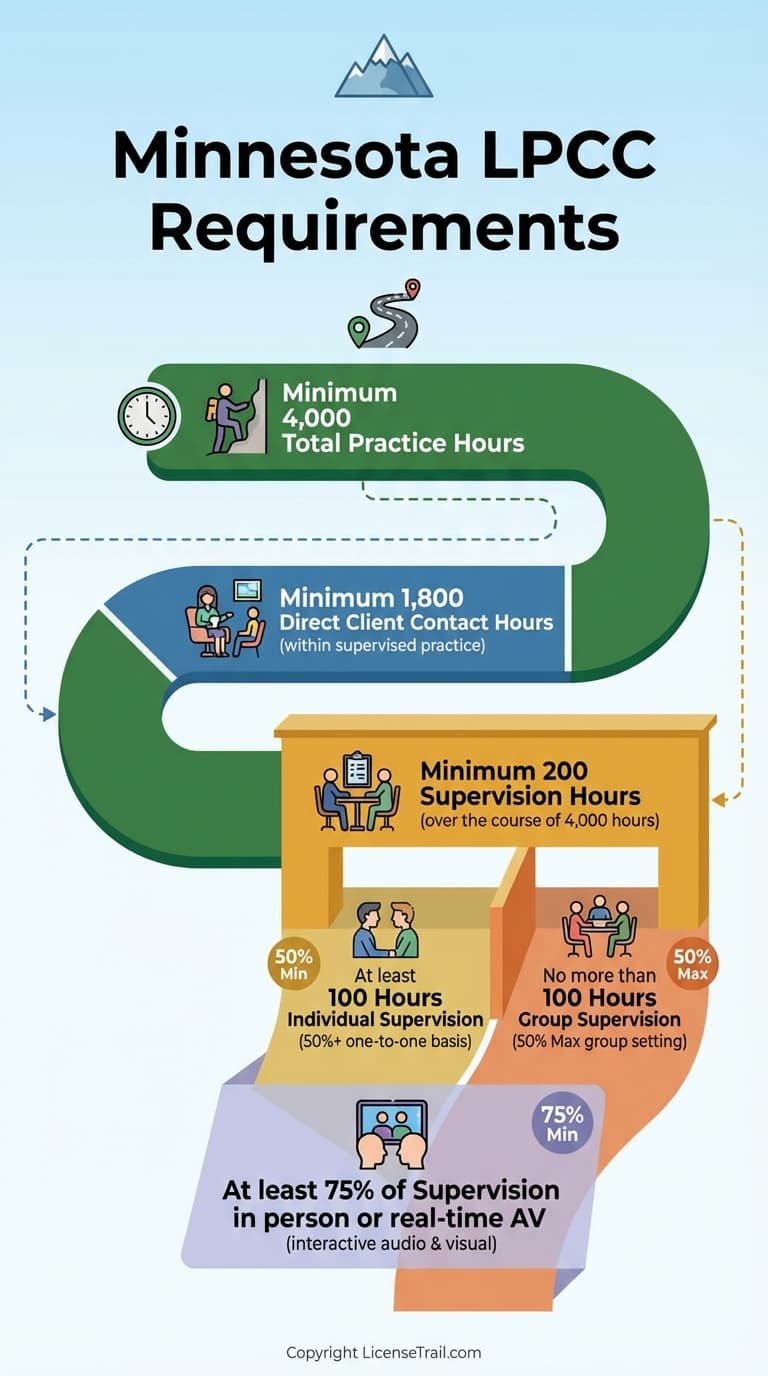
- Post-master’s 4,000 hours supervised clinical professional practice (diagnosis & treatment; children and adults)
- Within 4,000: ≥1,800 direct/clinical client contact hours
- Supervision: 2 hours per 40 hours of practice = 200 total supervision hours, evenly distributed
- Of supervision: ≥50% individual (1:1); remaining may be group; ≥75% in-person or real-time A/V (≤25% phone/other audio/a/v)
- Pass NCMHCE; supervision must be under a written contract with a qualified/board-approved supervisor
License Details
Procedures
Becoming a Licensed Professional Clinical Counselor (LPCC) in Minnesota involves meeting very specific education, supervised practice, and examination requirements set by the Minnesota Board of Behavioral Health and Therapy (BBHT) and Minnesota Statutes §148B.5301. This guide focuses on the exact “hours” and supervision structure, using the Board’s own terminology wherever possible.
1. Overview of LPCC Licensure in Minnesota
The LPCC is a master’s-level independent license. Minnesota describes it as requiring:
- A qualifying master’s or doctoral degree in counseling or a related field;
- 4,000 hours of supervised, post-master’s clinical professional practice; and
- Passing the National Clinical Mental Health Counseling Examination (NCMHCE). (mn.gov)
You can apply by:
- General Method (most common route);
- Conversion (if you already hold a Minnesota LPC); or
- Reciprocity (if licensed in another state with substantially similar requirements). (mn.gov)
2. Education and Practicum Requirements
2.1 Degree level and accreditation
For LPCC (General and Conversion methods), Minnesota requires: (mn.gov)
- A master’s or doctoral degree in counseling or a related field;
- From:
- A program recognized by CACREP, or
- An institution accredited by a regional accreditor recognized by CHEA;
- With at least 48 semester credits (or 72 quarter credits).
2.2 Supervised field experience during the degree
The degree must include at least:
- “a minimum of 700 hours of supervised field experience” in counseling. (mn.gov)
This 700-hour field experience (practicum/internship) is separate from the 4,000 hours of post-master’s supervised professional practice required for LPCC licensure.
2.3 Clinical coursework
For LPCC, the Board further requires that you have:
- 24 semester credits in clinical coursework areas, on top of the other academic content requirements. (mn.gov)
3. Post‑Master’s Supervised Professional Practice: The 4,000 Hours
The central quantitative requirement for LPCC is:
4,000 hours of supervised, post‑master’s clinical professional practice (also called “post‑master’s degree supervised professional practice”). (mn.gov)
Minnesota law describes it as:
“4,000 hours of post-master's degree supervised professional practice in the delivery of clinical services in the diagnosis and treatment of mental illnesses and disorders in both children and adults.” (law.justia.com)
3.1 Breakdown of the 4,000 hours
Within those 4,000 hours of supervised post‑master’s practice, the Board requires: (mn.gov)
- At least 1,800 hours of direct clinical client contact (“clinical client contact” or “direct client contact hours”); and
- A specific pattern of supervision hours tied to the total hours of professional practice.
The BBHT’s LPCC page states:
- “Completion of 4,000 hours of supervised, post master's clinical practice;
– Supervision must be obtained at a rate of 2 hours per 40 hours of professional practice, for a total of 200 supervision hours.
– 1,800 direct client contact hours.” (mn.gov)
In other words:
- Total supervised post‑master’s practice: 4,000 hours
- Of this, at least 1,800 hours must be direct client contact (face-to-face or synchronous clinical work with clients, as defined by the Board).
- You must receive 200 hours of supervision, derived from the statutory supervision rate.
4. Supervision Requirements and Verbiage
4.1 Supervision rate and total supervision hours
Minnesota Statutes specify the supervision ratio:
“The supervision must be obtained at the rate of two hours of supervision per 40 hours of professional practice.” (law.justia.com)
When applied to 4,000 total hours, this yields:
- 200 total hours of supervision (4,000 ÷ 40 × 2 = 200).
The Board restates this as:
- “Supervision must be obtained at a rate of 2 hours per 40 hours of professional practice, for a total of 200 supervision hours.” (mn.gov)
4.2 Distribution and modality of supervision
The statute requires that supervision be:
- Evenly distributed over the course of the supervised practice; and
- Primarily in-person or synchronous audio‑visual.
Specifically:
“At least 75 percent of the required supervision hours must be received in person or through real-time, two-way interactive audio and visual communication … The remaining 25 percent … may be received by telephone or by audio or audiovisual electronic device.” (law.justia.com)
4.3 Individual vs group supervision
Minnesota also sets requirements for individual versus group supervision:
“At least 50 percent of the required hours of supervision must be received on an individual basis. The remaining 50 percent may be received in a group setting.” (law.justia.com)
The BBHT’s LPCC page tracks this exactly:
- “At least 50 percent of those [200] hours must be individual, 1:1, supervision.” (mn.gov)
So, in practical terms:
- Of the 200 supervision hours:
- ≥100 hours must be individual (1:1);
- Up to 100 hours can be group supervision;
- ≥150 hours must be in-person or real-time video;
- ≤50 hours can be via phone or other audio/audiovisual methods.
4.4 Nature of supervised practice (clinical focus)
The supervised practice “must be clinical practice.” Minnesota describes supervision as including:
“the observation by the supervisor of the successful application of professional counseling knowledge, skills, and values in the differential diagnosis and treatment of psychosocial function, disability, or impairment, including addictions and emotional, mental, and behavioral disorders.” (law.justia.com)
This language emphasizes that your 4,000 hours must be clinical and directly related to diagnosis and treatment of mental health disorders in children and adults.
5. Supervision Contracts and Approved Supervisors
5.1 Supervision contract requirement
Supervision must be under a written contract:
“The supervision must have been received under a contract that defines clinical practice and supervision…” (law.justia.com)
The BBHT provides an LPCC Supervision Contract form and instructs applicants who have “yet to accomplish supervision” to use this form to ensure compliance with BBHT requirements. (mn.gov)
5.2 Who can supervise
Statute and Board rule require that supervision come from a qualified professional:
- A mental health professional as defined in Minnesota law (sections 245I.04 or related definitions); or
- A board-approved supervisor who meets LPCC/LPC supervisor criteria and
- Has at least two years of post‑licensure experience delivering clinical services in the diagnosis and treatment of mental illnesses and disorders. (law.justia.com)
The Board’s supervisor page clarifies LPCC-supervisor requirements:
- Licensed professional clinical counselor (or other qualified professional approved by the Board);
- Four years of professional counseling experience;
- Two years of post‑licensure experience;
- Minimum 45 hours of training in clinical supervision. (mn.gov)
6. Direct Client Contact Hours: Definition and Amount
Minnesota’s LPCC requirements explicitly call out “clinical client contact”:
“The supervised practice must include at least 1,800 hours of clinical client contact.” (law.justia.com)
The Board’s summary aligns with that:
- “1,800 direct client contact hours” within the 4,000 supervised hours. (mn.gov)
While the statute does not provide a long formal definition within §148B.5301, Board materials and common usage indicate that “direct client contact” (or “clinical client contact”) means in-person or real-time therapeutic interaction with clients for clinical assessment, diagnosis, or treatment, as opposed to purely administrative work, charting, or training.
7. Application Pathways and How the Hours Apply
7.1 General Method (no prior LPC required)
For applicants who are not already LPCs in Minnesota:
- Complete the qualifying degree and 700-hour supervised field experience; (mn.gov)
- Accumulate 4,000 hours of supervised post‑master’s clinical practice, including:
- 1,800 direct client contact hours;
- 200 total hours of supervision at the required ratio; (mn.gov)
- Pass the NCMHCE; (mn.gov)
- Submit the LPCC application, verification of supervision, and fees.
7.2 Conversion Method (for current Minnesota LPCs)
If you already hold a Minnesota LPC, you may convert to LPCC after meeting additional clinical requirements. The Board’s LPCC conversion language states that an applicant must show:
- A current, active LPC license in good standing;
- A qualifying CACREP/CHEA degree with the same credit and content requirements listed above; and
- Completion of 4,000 hours of supervised, post‑master's professional practice which includes:
- 200 supervision hours, at least 100 of which must be individual 1:1 supervision;
- 1,800 direct client contact hours. (mn.gov)
For LPCs who already have 2,000 hours of supervised practice and independent LPC status, the Board notes:
- You “only need to document an additional 2,000 hours, 100 supervision hours (of which 50 must be individual 1:1), and 900 direct client contact hours,” so that the **combined LPC + LPCC hours equal 4,000 total hours, 200 supervision hours, and 1,800 direct client contact hours. (mn.gov)
7.3 Reciprocity Method (licensed in another state)
Applicants with a license/credential in another jurisdiction may be eligible for reciprocity if:
- The out-of-state license is active and in good standing; and
- The requirements for that license are “substantially similar” to Minnesota’s LPCC requirements. (mn.gov)
The Board maintains a reciprocity list and still applies Minnesota’s continuing education and degree-credit expectations, especially if the original degree was less than 60 credits.
8. Practical Steps to Document the Required Hours
The Board’s LPCC Supervised Professional Practice page outlines how to proceed and verify hours: (mn.gov)
-
Before you start accumulating hours
- Find a Board Approved LPCC Supervisor using the Board’s online supervisor lookup.
- Complete an LPCC Supervision Contract that “ensures that supervision is completed in compliance with BBHT supervision requirements.”
-
During the 4,000 hours
- Track:
- Total hours of professional practice;
- Direct client contact hours;
- Supervision hours (with dates, duration, individual vs group, modality).
- Track:
-
After completing 4,000 hours
- Your supervisor must submit a Verification of Completed Supervised Professional Clinical Practice form directly to the Board (mailed or emailed). (mn.gov)
For those converting from LPC, there is a specific “LPCC Conversion – Verification of Completed Supervised Professional Practice” form, with the same requirement that it be sent directly from the supervisor to the Board. (mn.gov)
9. Summary of Key Quantitative Requirements
Using the Board’s and statute’s own language, the LPCC requirements in Minnesota break down as follows:
-
Supervised field experience during degree
- At least “700 hours of supervised field experience” in counseling (part of the graduate program). (mn.gov)
-
Post‑master’s supervised professional practice (prior to LPCC licensure)
- 4,000 hours of “post-master's degree supervised professional practice in the delivery of clinical services in the diagnosis and treatment of mental illnesses and disorders in both children and adults.” (law.justia.com)
- Of these, at least 1,800 hours must be “clinical client contact” / “direct client contact hours.” (mn.gov)
- Supervision must be at “two hours of supervision per 40 hours of professional practice”, totaling 200 supervision hours. (mn.gov)
- At least 50% of the 200 supervision hours must be individual (1:1); up to 50% may be group. (mn.gov)
- At least 75% of supervision must be in-person or real-time, two-way audio‑visual; up to 25% can be via telephone or other audio/audiovisual methods. (law.justia.com)
-
Exam requirement
- Passing the National Clinical Mental Health Counseling Examination (NCMHCE) is required by Minnesota Statutes §148B.5301 for LPCC licensure. (mn.gov)
These are the core, hour‑based and supervision‑based requirements defined by the Minnesota Board of Behavioral Health and Therapy and codified in Minnesota Statutes for the LPCC license.
Track your LPCC hours with confidence
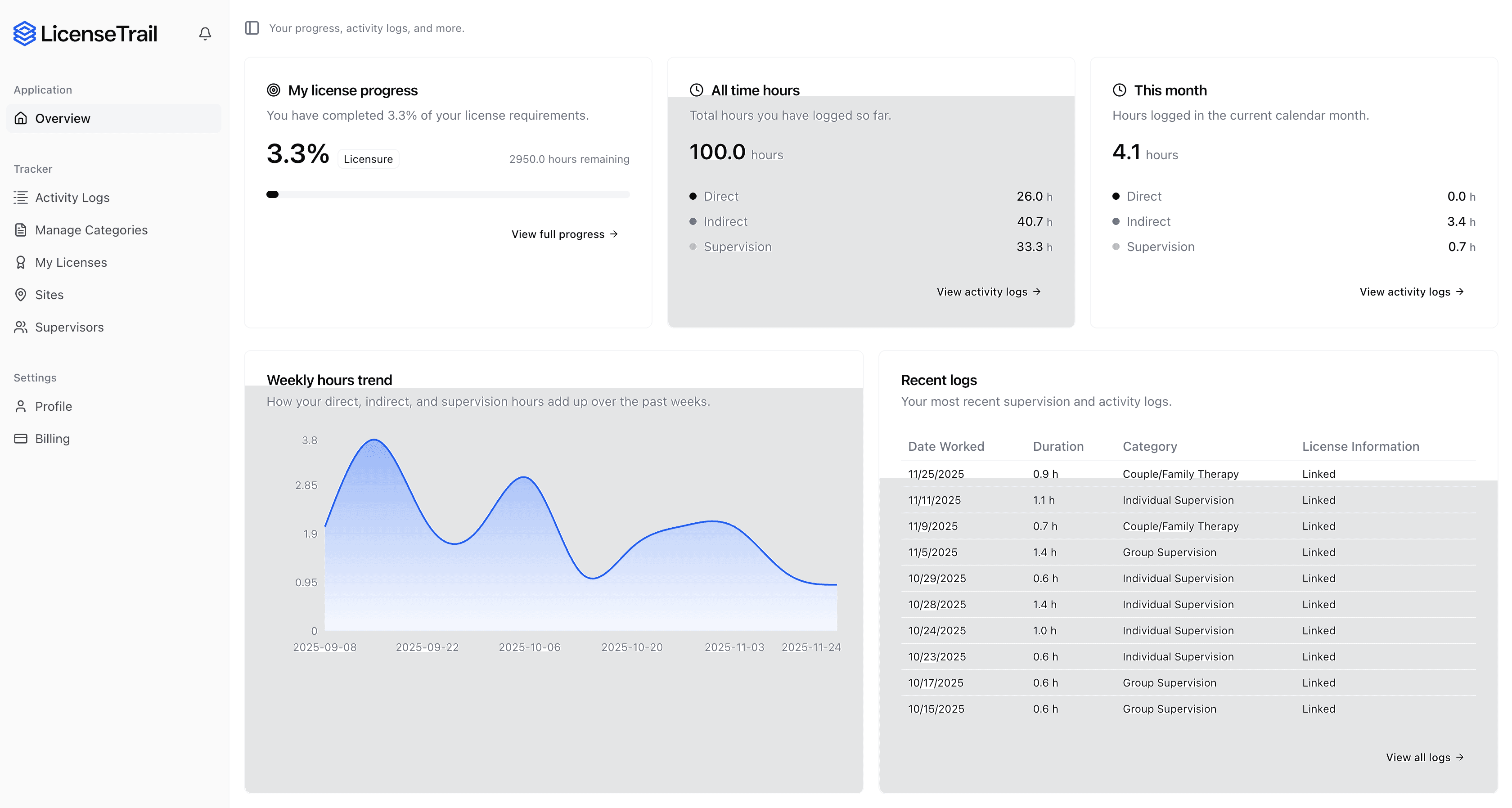
License Trail checks your direct, indirect, and supervision hours against Minnesota LPCC requirements continuously and flags mismatches before you submit.
 Start Tracking for Free
No credit card required · Free plan available
Is your spreadsheet hiding Minnesota LPCC risks?
Stop guessing if your categories match Minnesota Board of Behavioral Health and Therapy requirements. License Trail checks your direct, indirect, and supervision hours continuously and flags mismatches before you submit.
Import or log
Bring your spreadsheet or start fresh
Upload your existing tracking spreadsheet and we'll map every hour into the right Minnesota Board of Behavioral Health and Therapy categories automatically.
Verify against Minnesota
Catch mismatches before the board does
License Trail checks your direct, indirect, and supervision hours against Minnesota LPCC requirements continuously.
Export board-ready
One-click clean reports
Generate professional, board-ready reports for supervision meetings and Minnesota Board of Behavioral Health and Therapy submissions in seconds.
No credit card required · Free plan available