
Minnesota LPC Requirements: Hours, Exams & Step-by-Step Guide
Stop guessing if your categories match Minnesota requirements. License Trail checks your direct, indirect, and supervision hours against LPC requirements continuously and flags mismatches before you submit.
No credit card required · Free plan available
Quick Requirements Overview
- Regulator/authority: Minnesota Board of Behavioral Health and Therapy (BBHT); governed by MN Statutes 148B.53 & 148B.56
- Degree: Master’s/Doctoral in counseling or related field from CACREP or CHEA-recognized accredited institution
- Credits & coursework: 48 semester (72 quarter) credits minimum + coursework across 10 core content areas
- In-program fieldwork: 700 hours minimum “graduate program supervised field experience” (practicum/internship); school may need to verify hours in clock hours
- Exam: Pass a BBHT-accepted national exam (NCE, NCMHCE, CRC, or EPPP)
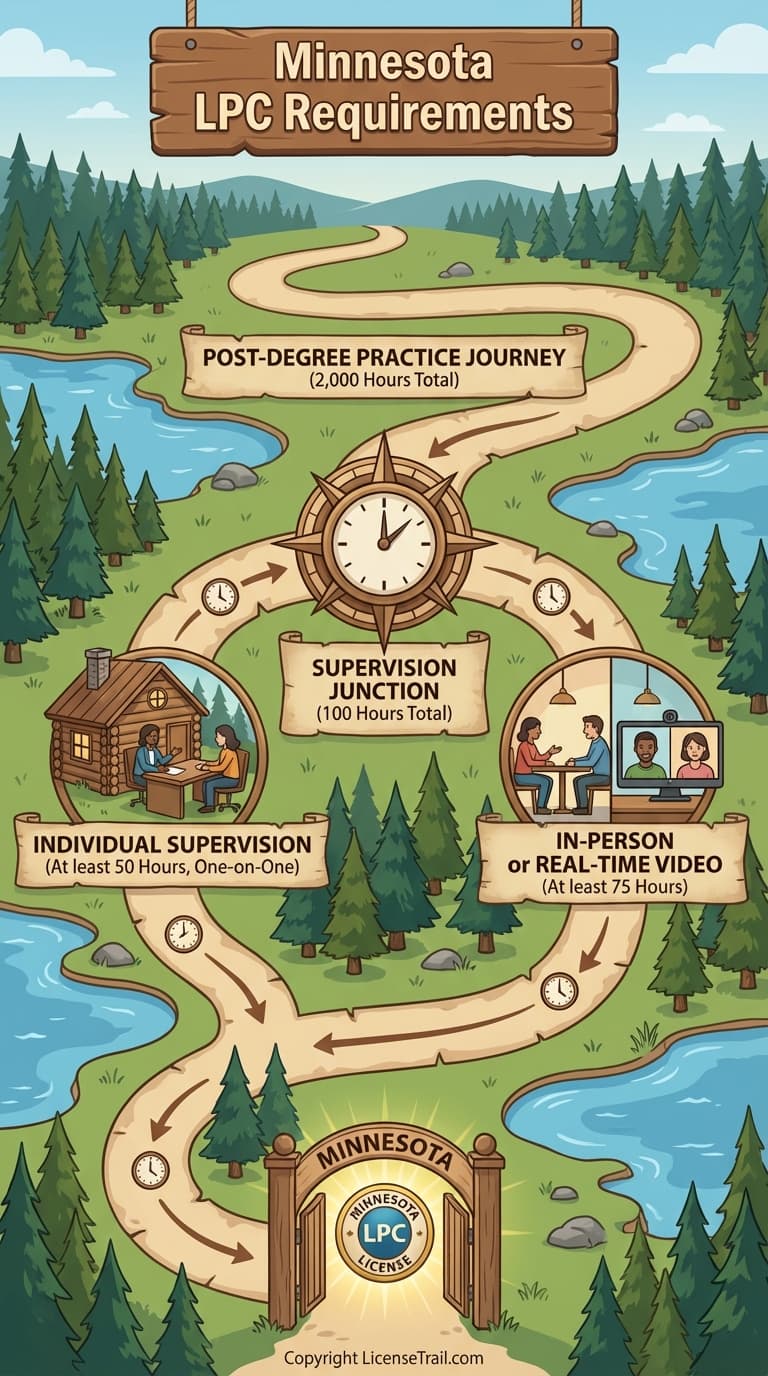
- Post-degree practice: 2,000 hours “supervised post-degree professional practice” (no required direct/indirect hour split stated for LPC)
- Supervision within post-degree hours: 2 hrs supervision per 40 hrs practice = 100 supervision hrs total; ≥50% individual (≥50 hrs)
- Supervisor: Must be a BBHT Board Approved Supervisor (generally LPC/other approved professional with 4 years experience + 45 hrs supervision training); hours can be completed pre-licensure or under LPC-Supervised → LPC-Independent pathway
License Details
Procedures
In Minnesota, the Licensed Professional Counselor (LPC) credential is a master’s-level license regulated by the Minnesota Board of Behavioral Health and Therapy (BBHT). The Board sets specific requirements for education, practicum/field experience, supervised post-degree hours, and examination, all grounded in Minnesota Statutes sections 148B.53 and 148B.56. (mn.gov)
Below is a step-by-step breakdown focused on the exact types and amounts of hours Minnesota requires, using the Board’s terminology.
1. Educational foundation
To qualify for LPC licensure by examination, you must have either: (mn.gov)
- A master’s or doctoral degree in counseling or a related field,
- From a CACREP-accredited program or from an institution accredited by an organization recognized by the Council for Higher Education Accreditation (CHEA).
The degree used for licensure must include:
- At least 48 semester credits (or 72 quarter credits), and
- Specific coursework in ten core academic content areas (helping relationship, human growth and development, lifestyle and career development, group dynamics, assessment, social and cultural foundations, etiology/treatment planning/prevention of mental and emotional disorders, family counseling/therapy, research and evaluation, and professional counseling orientation and ethics). (mn.gov)
These academic requirements are in addition to the hour-based experience described below.
2. Pre-degree “graduate program supervised field experience” (practicum/internship)
Minnesota requires a substantial supervised field placement as part of your graduate program. The Board’s LPC requirements specify: (mn.gov)
- At least 700 hours of “graduate program supervised field experience.”
Key points:
- This 700-hour requirement refers to your practicum and/or internship experiences built into the degree program.
- The Board does not further subdivide these 700 hours into “direct client” vs. “indirect” activities on the LPC requirements page; it simply requires that you document a minimum of 700 supervised field hours as part of the program used for licensure.
When you apply, if your transcript does not clearly list your field experience in clock hours, you must have your program send an official letter verifying the total hours directly to BBHT. (mn.gov)
3. Exam requirement
For LPC, you must pass one of several national exams accepted by the Board. The BBHT states that applicants must pass a national exam accepted by the Board after completing their qualifying graduate degree. (mn.gov)
For LPC, the Board currently accepts:
- National Counselor Examination (NCE)
- National Clinical Mental Health Counseling Examination (NCMHCE)
- Certified Rehabilitation Counselor Examination (CRC)
- Examination for the Professional Practice of Psychology (EPPP)
(If you may later seek the Licensed Professional Clinical Counselor (LPCC) credential, the NCMHCE is specifically recommended.)
4. Post-degree hours: “supervised post-degree professional practice”
This is where most of the hour counting happens for LPC.
4.1 Total supervised post-degree hours
Under Minnesota Statutes 148B.53 and BBHT’s LPC application instructions, applicants must complete: (mn.gov)
- 2,000 hours of “supervised post-degree professional practice” (also referred to as “post-masters professional practice”).
Important details:
- These 2,000 hours are in addition to the 700 hours of graduate field experience.
- The Board does not divide the 2,000 LPC hours into separate “direct client contact” vs. “indirect” categories.
- In other words, Minnesota does not say, for example, “1,500 direct client hours and 500 indirect hours” for LPC.
- Instead, it requires 2,000 total hours of supervised post-degree professional practice, defined and overseen under Board rules and statutes.
- The practice must be professional counseling practice and must meet BBHT’s supervision requirements.
By contrast, for the LPCC (independent clinical) license, Minnesota explicitly requires 4,000 hours of supervised post-master’s clinical practice that must include 1,800 direct client contact hours and 200 hours of supervision. That direct-contact breakdown applies to LPCC, not LPC. (mn.gov)
4.2 Supervision requirements within the 2,000 hours
Within your 2,000 hours of supervised post-degree professional practice, Minnesota requires a specific amount and structure of supervision. BBHT states that: (mn.gov)
- Supervision must be obtained at a rate of 2 hours of supervision per 40 hours of professional practice.
- Across 2,000 hours, this produces 100 total hours of supervision.
- At least 50% of those supervision hours must be individual, one-to-one supervision (at least 50 hours).
- The remaining supervision hours can be in other approved formats (e.g., group supervision), so long as they comply with Board rules.
Supervised practice must be completed under a BBHT Board Approved Supervisor, and supervision must conform to the Board’s supervision requirements to be accepted toward licensure. (mn.gov)
5. How the supervised hours relate to licensure status
Minnesota allows flexibility in whether you complete the 2,000 supervised post-degree hours before or after LPC licensure, but it treats your license differently depending on when you finish the hours. (mn.gov)
5.1 If you complete the 2,000 supervised hours before LPC licensure
- You complete 2,000 hours of supervised, post-master’s professional practice under a Board Approved Supervisor before applying for an LPC license.
- Your supervisor completes a Verification of Supervision Plan Completion form and sends it directly to the Board.
- Assuming all other requirements are met, your LPC can be issued without a “supervised” status—you will be at full LPC-Independent level once licensed.
5.2 If you complete the 2,000 supervised hours after LPC licensure
- You apply for LPC licensure before having all 2,000 supervised hours.
- You must:
- Find a Board Approved LPC/LPCC supervisor, and
- Submit a supervision plan (part of the LPC application) that outlines how you will complete the required 2,000 hours under Board-approved supervision.
- The Board can issue your license under this plan as LPC-Supervised.
- After you complete all 2,000 supervised hours and the associated 100 supervision hours:
- Your supervisor submits the Verification of Completed Supervised Practice form directly to BBHT.
- The Board then converts your license from LPC-Supervised to LPC-Independent status.
6. Supervision: who can supervise and what “Board Approved Supervisor” means
The Board is explicit that LPC and LPCC applicants must complete their post-degree supervised professional practice under a Board Approved Supervisor. For LPC supervision specifically, a Board Approved Supervisor must: (mn.gov)
- Be a Licensed Professional Counselor (LPC) or other qualified professional as determined by the Board,
- Have four years of professional counseling experience, and
- Have completed at least 45 hours of training in clinical supervision (which can include CE courses, workshops, or university courses).
Once approved, LPC supervisors can supervise:
- Individuals pursuing LPC licensure, and
- Individuals pursuing LPCC licensure via the conversion method (LPC-to-LPCC).
Applicants and supervisors should also be aware that Board rules and statutes (referenced in the supervision pages) govern things like:
- Acceptable supervision formats (individual vs. group)
- Documentation standards
- Required content of supervision (e.g., case review, ethics, skills)
While these details are in the statutes/rules and not fully reprinted on the application pages, your supervision plan and verification forms must demonstrate compliance with them.
7. Alternate application routes and how hours apply
Minnesota provides three application methods for LPC licensure: by examination, with a current LP license, and by reciprocity. The hour requirements show up slightly differently in each route, but the core expectations are consistent. (mn.gov)
7.1 Apply by examination (most common route)
- You qualify based on:
- A CACREP/CHEA-compliant counseling or related degree (≥48 semester credits),
- At least 700 supervised field hours in the graduate program,
- Completion of 2,000 hours of supervised post-degree professional practice (with 100 hours of supervision at the 2-per-40-hour ratio; ≥50 hours individual), and
- Passing a Board-accepted exam (NCE, NCMHCE, CRC, or EPPP).
7.2 Apply with a current LP license
If you already hold a current Minnesota Licensed Psychologist (LP) license:
- The Board requires 2,000 hours of supervised professional practice, but
- Supervision that was already completed and accepted for your LP is accepted as meeting the 2,000-hour LPC requirement, provided the Board receives proper verification from the Minnesota Board of Psychology. (mn.gov)
Your LPC will be based on the same qualifying degree that underlies your LP license.
7.3 Apply by reciprocity
If you are licensed in another state:
- Your out-of-state license must have requirements that BBHT has determined to be substantially similar to Minnesota’s LPC requirements and scope of practice.
- You still must meet Minnesota’s degree/credit and continuing education expectations; if your degree is under 60 credits, you must complete additional graduate credits during the first four years of Minnesota licensure. (mn.gov)
The exact way your prior supervised hours transfer depends on how similar your prior state’s requirements are to Minnesota’s statutory requirements.
8. Summary of Minnesota LPC hour requirements (by category)
Pulling all of this together, the key Minnesota LPC hour requirements, using the Board’s own categories, are:
-
Graduate program supervised field experience
- 700 hours minimum of “graduate program supervised field experience” (practicum/internship) built into the counseling or related master’s/doctoral degree. (mn.gov)
-
Supervised post-degree professional practice
- 2,000 hours of “supervised post-degree professional practice” (or post-master’s professional practice), completed either before licensure or under an approved supervision plan after licensure. (mn.gov)
-
Supervision embedded in the 2,000 post-degree hours
- 100 total hours of supervision, based on
- A ratio of 2 hours of supervision for every 40 hours of professional practice, and
- At least half (≥50 hours) of the supervision being individual, one-to-one supervision. (mn.gov)
- 100 total hours of supervision, based on
-
Supervisor qualification
- Supervision must be provided by a Board Approved Supervisor, which for LPC means an LPC (or other Board-approved professional) with 4 years of professional counseling experience and 45 hours of supervision training. (mn.gov)
Unlike some states, Minnesota does not split the 2,000 LPC post-degree hours into separate numerical requirements for “direct client contact” vs. “indirect” hours. The one place Minnesota uses a direct-client breakdown is in the LPCC requirements (4,000 total hours with 1,800 direct client contact hours and 200 supervision hours), which applies to the clinical license rather than the LPC. (mn.gov)
These are the controlling Minnesota Board of Behavioral Health and Therapy requirements as of the 2025 statutes and current BBHT guidance. For any application in progress, it is wise to cross-check your specific supervision plan and documentation against the BBHT forms and statute references cited on the Board’s LPC application and supervision pages.
Track your LPC hours with confidence
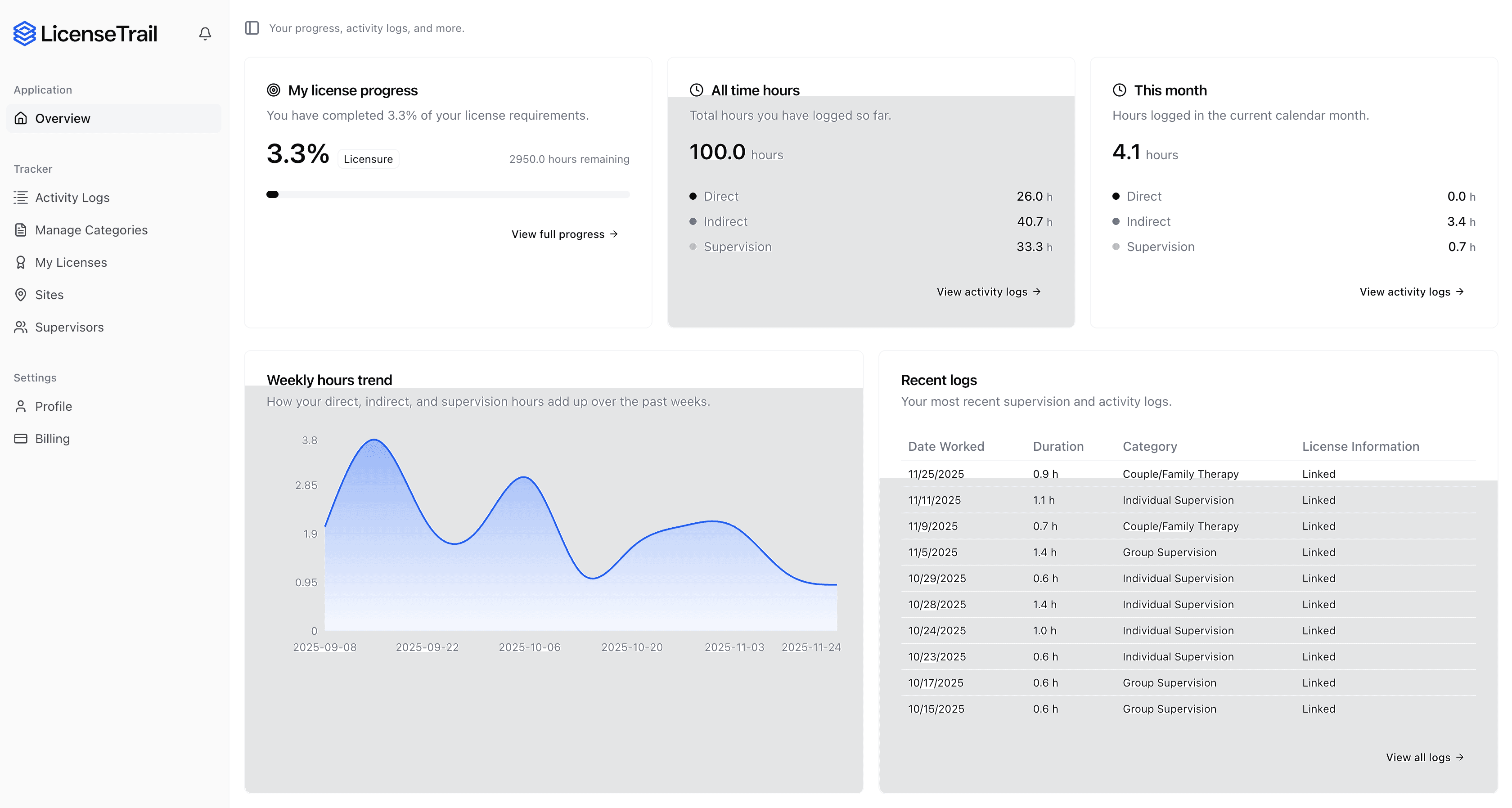
License Trail checks your direct, indirect, and supervision hours against Minnesota LPC requirements continuously and flags mismatches before you submit.
 Start Tracking for Free
No credit card required · Free plan available
Is your spreadsheet hiding Minnesota LPC risks?
Stop guessing if your categories match Minnesota Board of Behavioral Health and Therapy requirements. License Trail checks your direct, indirect, and supervision hours continuously and flags mismatches before you submit.
Import or log
Bring your spreadsheet or start fresh
Upload your existing tracking spreadsheet and we'll map every hour into the right Minnesota Board of Behavioral Health and Therapy categories automatically.
Verify against Minnesota
Catch mismatches before the board does
License Trail checks your direct, indirect, and supervision hours against Minnesota LPC requirements continuously.
Export board-ready
One-click clean reports
Generate professional, board-ready reports for supervision meetings and Minnesota Board of Behavioral Health and Therapy submissions in seconds.
No credit card required · Free plan available