
Minnesota LBA Requirements: Hours, Exams & Step-by-Step Guide
Stop guessing if your categories match Minnesota requirements. License Trail checks your direct, indirect, and supervision hours against LBA requirements continuously and flags mismatches before you submit.
No credit card required · Free plan available
Quick Requirements Overview
- Regulator: Minnesota Board of Psychology under the Behavior Analyst Practice Act (Minn. Stat. §§148.9981–148.9995)
- Effective 1/1/2025: must be licensed (or exempt) to practice ABA/use the “Licensed Behavior Analyst” title in MN
- Eligibility: hold current, active BCBA/BCBA-D (BACB) certification, or equivalent requirements + psychometrically valid exam via accredited credentialing org
- Application: submit Board application + fees; BACB certification is primary-source verified by the Board
- Background check required under Minn. Stat. §214.075 (FBI/BCA study)
- Discipline review: primary-source verifications required for any other licenses/credentials; must have no disqualifying issues
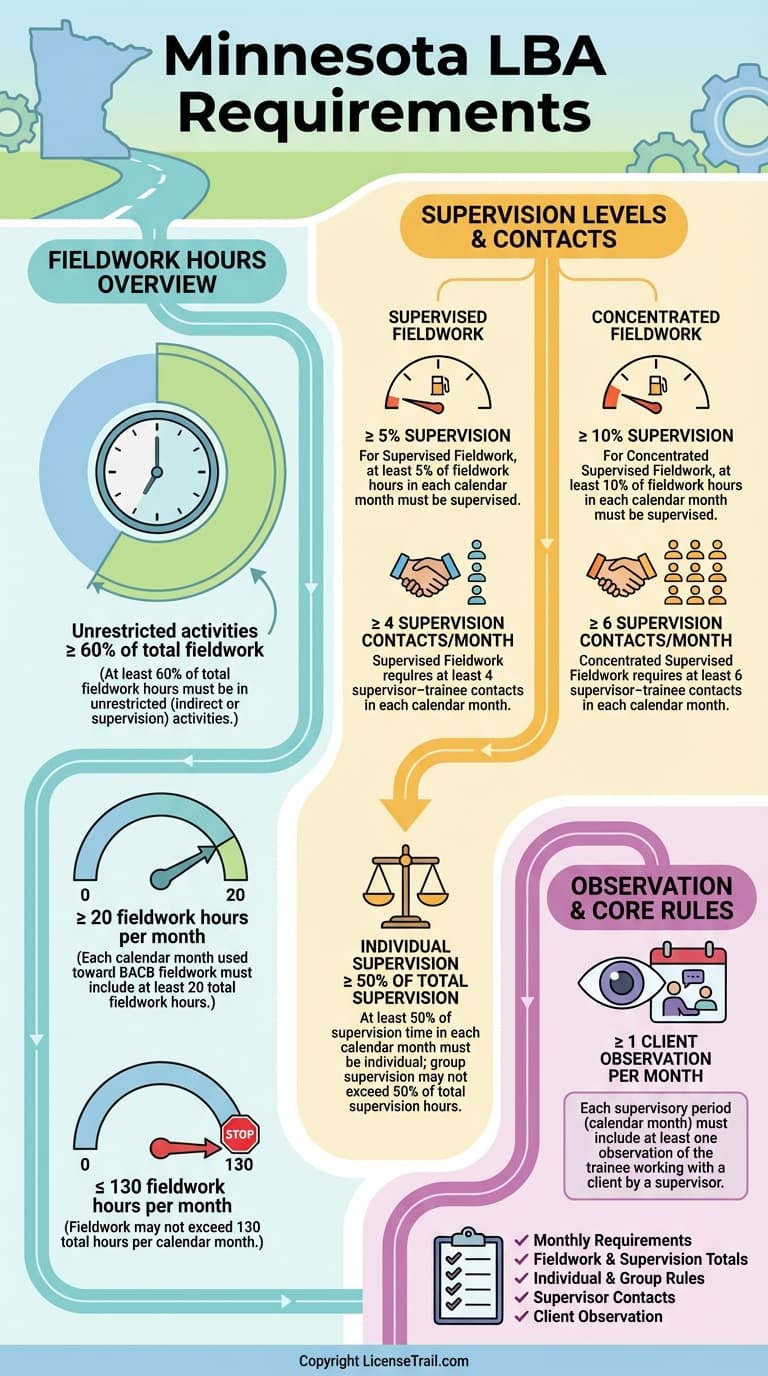
- Hours: MN sets no state-specific hour totals; BCBA fieldwork effectively applies (2,000 supervised or 1,500 concentrated; ≥60% unrestricted / ≤40% restricted)
- Renewal: license valid 2 years; biennial renewal (fee) and maintain active BCBA/BCBA-D certification
License Details
Procedures
Minnesota’s Licensed Behavior Analyst (LBA) credential is regulated by the Minnesota Board of Psychology under the “Behavior Analyst Practice Act” (Minn. Stat. §§148.9981–148.9995). The state has chosen to tie its licensing requirements directly to Board Certified Behavior Analyst (BCBA) certification rather than create its own hour-by-hour training standard.
Below is a step‑by‑step guide framed around what the Minnesota Board and statutes actually say, followed by how many hours and what types of experience the BCBA pathway requires in practice.
1. Big‑picture overview and effective dates
- Minnesota defines a “licensed behavior analyst” as someone who holds a valid license under §§148.9981–148.9995 to engage in the practice of applied behavior analysis. (codes.findlaw.com)
- The “certifying entity” for behavior analysts is the Behavior Analyst Certification Board (BACB), or a successor organization approved by the Board. (codes.findlaw.com)
- Effective January 1, 2025, a person “must not engage in the practice of applied behavior analysis” or use the title “licensed behavior analyst” unless licensed under §§148.9981–148.9995 or exempt. (revisor.mn.gov)
In other words, to legally practice ABA independently in Minnesota (outside the listed exemptions), you need an LBA license from the Board of Psychology.
2. Core legal requirements for LBA licensure in Minnesota
2.1 Statutory licensure requirements (Minn. Stat. §148.9983)
Minnesota law states that an applicant for licensure as a behavior analyst must: (revisor.mn.gov)
-
Submit an application and fee
- “Complete and submit a written application on forms provided by the board together with the appropriate fee” (referenced again on the Board’s website). (revisor.mn.gov)
-
Show BCBA‑level national certification OR equivalent
- Provide evidence that you either:
- Hold a “current and active national certification as a board‑certified behavior analyst issued by the certifying entity”, or (revisor.mn.gov)
- Have completed equivalent requirements for certification by that entity, including passing a psychometrically valid examination administered by a nationally accredited credentialing organization. (revisor.mn.gov)
- Provide evidence that you either:
-
Complete a criminal background check
- You must complete a background investigation under Minn. Stat. §214.075. (revisor.mn.gov)
The Board’s own “Applying for Licensed Behavior Analyst” page and checklist restate these points almost verbatim and explicitly tie them to Minnesota Statute §148.9983. (mn.gov)
2.2 What the Board’s LBA checklist adds
The Initial BA (Behavior Analyst) Application for Licensure Checklist from the Board of Psychology translates the statute into concrete application steps: (mn.gov)
-
File the BA application and pay fees
- Submit the online application.
- Pay a $225 application fee (non‑refundable).
- Pay FBI and BCA background study fees ($17 and $15, respectively).
-
Prove your national certification
- Provide evidence of active national certification (BCBA or BCBA‑D credential number).
- The Board will obtain primary‑source verification of your BACB certification directly from the BACB.
-
Show there is no pending discipline
- If you are licensed or credentialed in behavior analysis, psychology, or any other health/education profession in any state or country, you must submit primary‑source license verifications so the Board can review any discipline or complaints.
-
Board review and license issuance
- Board staff review all submitted documentation.
- Ethical or disciplinary concerns may trigger additional Board review.
- If everything is satisfactory, “Licensed Behavior Analyst (LBA)” is issued.
-
License duration and renewal
- The LBA license is valid for two years.
- Biennial renewal is required, with a $225 renewal fee, under Minn. Stat. §148.9984, subd. 1. (mn.gov)
2.3 What Minnesota does not specify
Notice what’s not in Minnesota law or the Board’s checklist:
- There is no Minnesota‑specific requirement that says, for example,
“1,500 hours of direct experience and 1,500 hours of supervised experience,”
or any other explicit hour counts. - Instead, Minnesota’s requirement is structural: you must already have met the BACB’s degree, fieldwork, and exam standards (BCBA or equivalent). (revisor.mn.gov)
So, to understand the specific hour requirements that matter for LBA licensure, you must look to what it takes to become a BCBA, because that is the credential Minnesota is requiring.
3. Hours and experience: what BCBA certification requires (which Minnesota adopts)
3.1 Education and accreditation
Under Minnesota’s definitions, an “accredited school or educational program” is a postsecondary program accredited by a regional body with standards comparable to North Central or a similar accrediting agency for behavior analysis, psychology, or education. (codes.findlaw.com)
In practice, to earn BCBA certification as of 2025, you must: (bacb.com)
- Hold at least a master’s degree in behavior analysis, psychology, education, or a related field from an accredited institution.
- Complete a BACB‑approved course sequence in behavior analysis aligned with the current BCBA Task List.
- Complete supervised fieldwork (hours detailed below).
- Pass the BCBA examination.
Minnesota does not separately police the degree’s content; it relies on the BACB as the “certifying entity” to ensure coursework and practicum meet national standards. (codes.findlaw.com)
3.2 Supervised fieldwork hour options (BCBA pathways)
The BACB offers two main fieldwork pathways for BCBA eligibility. Minnesota’s LBA license accepts either, because it only checks that you hold BCBA‑level national certification. (revisor.mn.gov)
Option A – Supervised Fieldwork (abaunleashed.com)
- Total hours required:
- 2,000 hours of supervised fieldwork in applied behavior analysis.
- Supervision intensity:
- At least 5% of your fieldwork hours each month must be supervised (i.e., direct contact with your supervisor, including observation, feedback, and discussion).
- Minimum of 4 supervisor–trainee contacts per month, with at least one observation of you working with a client.
- Time distribution:
- No fewer than 20 and no more than 130 fieldwork hours may be counted in a given month.
Option B – Concentrated Supervised Fieldwork (abaunleashed.com)
- Total hours required:
- 1,500 hours of concentrated supervised fieldwork.
- Supervision intensity:
- At least 10% of your fieldwork hours each month must be supervised.
- Minimum of 6 supervisor–trainee contacts per month, with at least one observation of you working with a client.
- Time distribution:
- Same monthly minimum and maximum (generally 20–130 hours per month).
In both pathways, all hours are considered supervised fieldwork, but a proportion of that time is spent in direct supervision contacts (5% or 10%), and the remainder in independent behavior‑analytic work under agreed supervision arrangements.
3.3 Types of hours: restricted vs. unrestricted activities
The BACB further divides fieldwork into restricted and unrestricted activities: (bacb.com)
-
Restricted activities
- Direct delivery of behavior‑analytic services to clients (e.g., implementing treatment plans one‑on‑one).
- For BCBA fieldwork, no more than 40% of your total hours may be in restricted activities.
-
Unrestricted activities
- Activities that support and inform service delivery, such as:
- Conducting behavior assessments
- Designing and revising behavior intervention plans
- Data analysis and graphing
- Training staff or caregivers
- Writing reports and treatment plans
- These should be at least 60% of your total fieldwork hours.
- Activities that support and inform service delivery, such as:
This “restricted vs. unrestricted” distinction is essentially the BCBA version of “direct” vs. “indirect” or “clinical” vs. “programmatic” hours. Minnesota does not restate these categories in statute; it simply imports them by requiring BCBA‑level certification from the BACB.
3.4 How this translates for Minnesota LBA licensure
Putting it together:
- Minnesota does not say “1,500 hours of direct experience and 1,500 hours of supervised experience.”
- Instead, for you to qualify for an LBA license, you must already have: (revisor.mn.gov)
- Either 2,000 hours of supervised fieldwork (with ≥5% of those hours supervised each month) or
- 1,500 hours of concentrated supervised fieldwork (with ≥10% supervised each month),
- With at least 60% of hours in unrestricted (higher‑level professional) activities and no more than 40% in restricted/direct service. (abaunleashed.com)
Those are BACB requirements, but because Minnesota law requires BCBA‑level certification, they function as the de facto hour requirements for an LBA.
4. Application process to the Minnesota Board of Psychology, step by step
-
Complete BCBA requirements and obtain certification
- Finish your qualifying degree and BACB‑approved coursework.
- Accrue the required 2,000 or 1,500 supervised fieldwork hours under a qualified BCBA or other allowed supervisor, meeting supervision and activity‑type rules. (bacb.com)
- Pass the BCBA exam and receive BCBA or BCBA‑D certification from the BACB. (bacb.com)
-
Prepare for Minnesota’s LBA application
- Gather your BACB credential information (BCBA or BCBA‑D number).
- List all jurisdictions where you are (or were) licensed in behavior analysis, psychology, or related health/education professions so you can request primary‑source license verifications. (mn.gov)
-
Create an account and submit the online LBA application
- Go to the Board’s “Apply for Licensed Behavior Analyst” page and follow the “Go to Online Applications” link to register and log in to the e‑licensing system. (mn.gov)
- Complete the LBA application and submit it electronically.
-
Pay required fees (mn.gov)
- $225 application fee to the Board (non‑refundable).
- $17 FBI and $15 BCA criminal background study fees.
-
Complete the background check
- Follow instructions from the Board to complete fingerprinting and criminal background checks under Minn. Stat. §214.075. (mn.gov)
-
Provide any required license verifications and disciplinary history
- Have each jurisdiction where you hold or held a license send verification directly to the Board.
- The Board reviews for pending discipline, complaints, or ethical concerns. (mn.gov)
-
Wait for Board review and license issuance
- Board staff review your file and may refer it for further review if there are ethical or disciplinary questions.
- If requirements are met and no disqualifying issues exist, the Board issues your Licensed Behavior Analyst (LBA) license. (mn.gov)
-
Maintain and renew your LBA license
- The license is valid for two years.
- To renew, you must: (mn.gov)
- Complete the Board’s renewal process every two years.
- Pay the $225 renewal fee.
- Maintain a current, active BCBA/BCBA‑D certification, since that was a condition of licensure and is subject to continuing education and ethical requirements under the BACB’s BCBA Handbook. (revisor.mn.gov)
5. Key exceptions and special cases
Minnesota law includes specific exceptions where individuals can provide behavior analysis services without an LBA license (for example, licensed psychologists practicing ABA within their scope; some school district employees; other state‑licensed professionals working within their own scope). (revisor.mn.gov)
However, these exceptions do not create an alternative pathway to LBA licensure; they simply describe who may legally provide certain ABA‑related services without holding the LBA title.
6. Summary of hours and wording, in plain terms
From the Minnesota Board’s perspective, the requirements to become an LBA are:
- Hold and maintain BCBA (or BCBA‑D) certification from the BACB (the “certifying entity”). (mn.gov)
- Complete an online application, pay the state fees, and pass a criminal background check under §214.075. (revisor.mn.gov)
- Have no disqualifying discipline or unresolved complaints in any jurisdiction. (mn.gov)
The specific hour requirements are those built into BCBA certification and, as of 2025, amount to:
- Either 2,000 hours of supervised fieldwork with ≥5% supervised each month,
- Or 1,500 hours of concentrated supervised fieldwork with ≥10% supervised each month,
- With at least 60% of all hours in unrestricted (higher‑level professional) activities and no more than 40% in direct/restricted client work. (abaunleashed.com)
Minnesota does not create its own separate numbers such as “1,500 hours of direct experience and 1,500 hours of supervised experience”; it simply requires you to have already satisfied BACB’s BCBA requirements, then apply, pass the background check, and remain in good standing with both the BACB and the Minnesota Board of Psychology.
Track your LBA hours with confidence
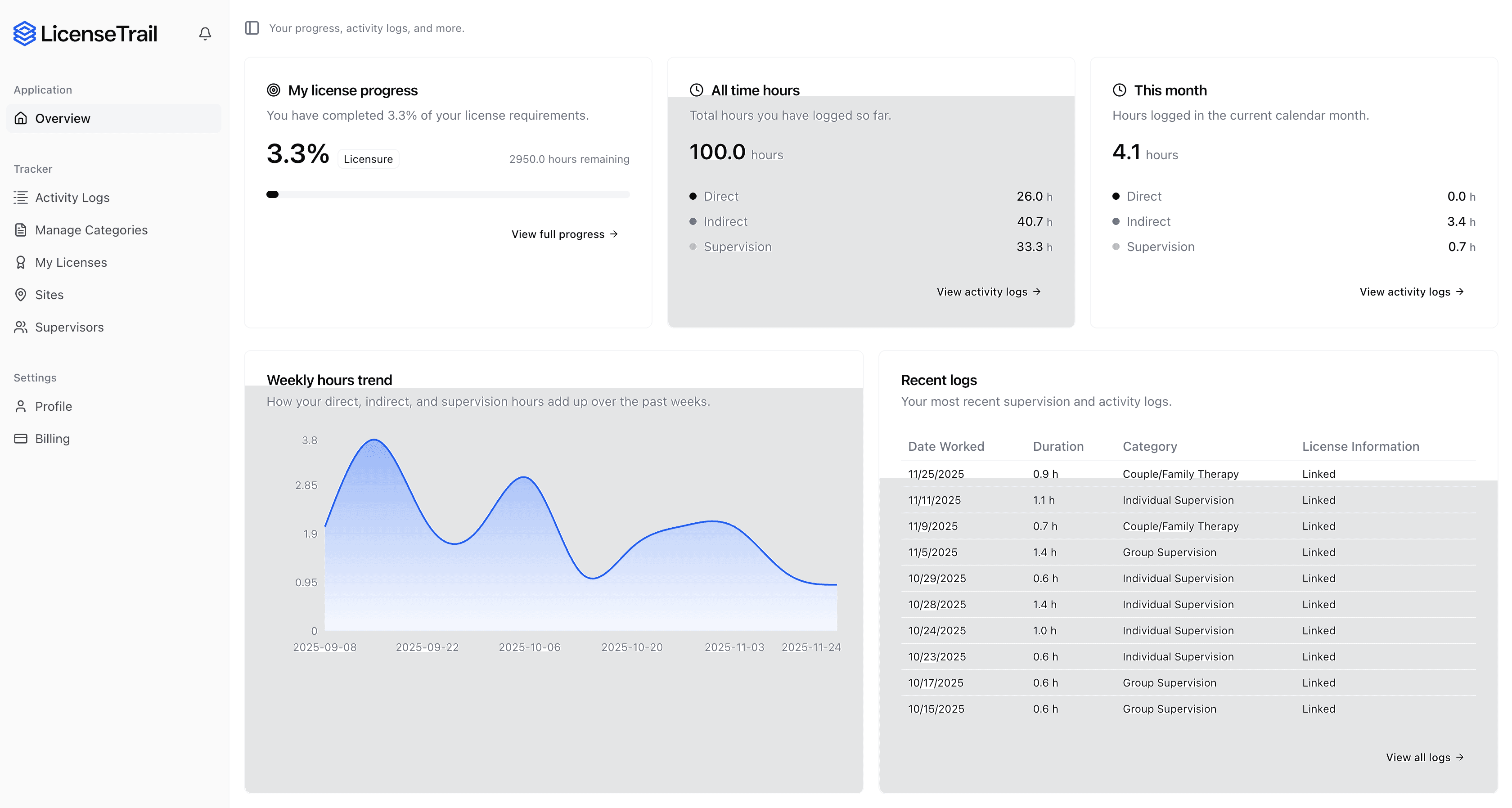
License Trail checks your direct, indirect, and supervision hours against Minnesota LBA requirements continuously and flags mismatches before you submit.
 Start Tracking for Free
No credit card required · Free plan available
Related Licenses
Is your spreadsheet hiding Minnesota LBA risks?
Stop guessing if your categories match Minnesota Board of Psychology requirements. License Trail checks your direct, indirect, and supervision hours continuously and flags mismatches before you submit.
Import or log
Bring your spreadsheet or start fresh
Upload your existing tracking spreadsheet and we'll map every hour into the right Minnesota Board of Psychology categories automatically.
Verify against Minnesota
Catch mismatches before the board does
License Trail checks your direct, indirect, and supervision hours against Minnesota LBA requirements continuously.
Export board-ready
One-click clean reports
Generate professional, board-ready reports for supervision meetings and Minnesota Board of Psychology submissions in seconds.
No credit card required · Free plan available