
Minnesota LPV Requirements: Hours, Exams & Step-by-Step Guide
Stop guessing if your categories match Minnesota requirements. License Trail checks your direct, indirect, and supervision hours against LPV requirements continuously and flags mismatches before you submit.
No credit card required · Free plan available
Quick Requirements Overview
- Eligibility: Must be a retired provider who is/was licensed, certified, or registered to practice psychology in any jurisdiction (MN or elsewhere).
- Practice limits: Volunteer/pro bono only (no remuneration; reasonable expense reimbursement allowed); cannot hold LP and LP‑V simultaneously.
- Application: Submit a notarized LP‑V application (mail per Board process) and required documentation.
- Discipline/character: Must be of good moral character with no pending complaints or corrective/disciplinary action in any jurisdiction.
- Exams: If not currently licensed by MN, must pass the Board’s professional responsibility (jurisprudence/ethics) exam (and pay exam fee).
- Education/experience (same as LP): Must meet MN LP requirements (original MN requirements if previously MN‑licensed; otherwise current requirements).
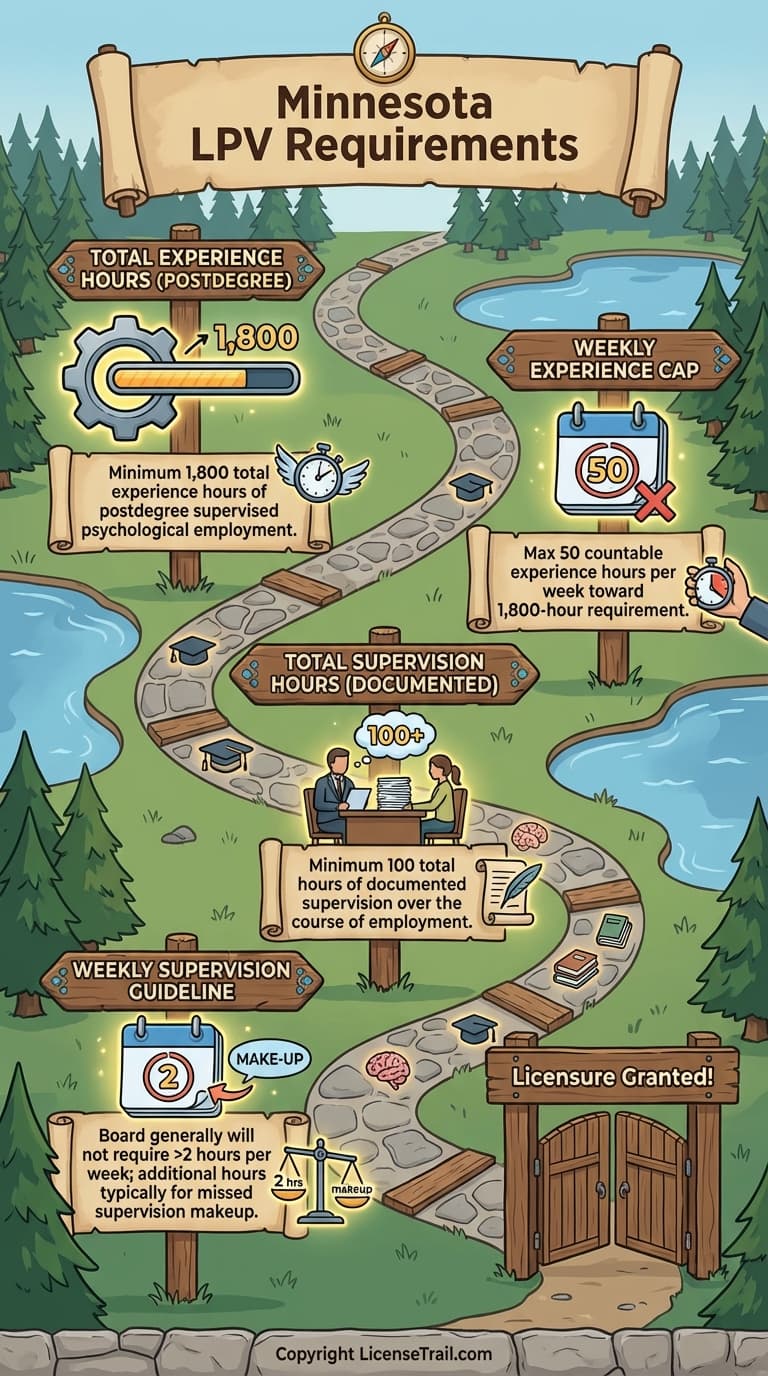
- Key hours behind LP standards: 1,800-hour predoctoral internship (12–30 months; required weekly supervision) + 1,800-hour postdegree supervised employment (12–30 months; 100 total supervision hours; weekly supervision minimums; no credit >50 hrs/week).
- Fees & renewal: LP‑V fee is 50% of LP fee (no special board fees); must complete 40 hours CE per renewal period, incl. 4 hours in cultural/human diversity.
License Details
Procedures
Becoming an LP‑V (Licensed Psychologist‑Volunteer) through the Minnesota Board of Psychology is essentially a two‑part question:
- Are you eligible to hold this special “volunteer only” psychologist license?
- Do you already meet, or can you document that you meet, Minnesota’s full licensed psychologist (LP) education, training, and hour requirements?
The LP‑V credential does not have its own separate clinical‑hour minimums. Instead, you must meet the same education, training, and supervised‑experience requirements that apply to a standard Licensed Psychologist, and then you obtain a volunteer‑only license based on that background. (revisor.mn.gov)
Below is a structured guide, with emphasis on the exact types of hours Minnesota requires and the key terms used in statute and rule.
1. What the LP‑V License Is
Minnesota law creates a specific category called “licensure for volunteer practice” for psychologists who want to provide services without pay. (revisor.mn.gov)
Key features:
- It is expressly for “retired providers who are or were licensed, certified, or registered to practice psychology in any jurisdiction.” (revisor.mn.gov)
- Holders use the designation “LP‑V” (licensed psychologist‑volunteer), in addition to any other allowed professional descriptions. (revisor.mn.gov)
- All services must be pro bono: you may not receive a commission, rebate, or other remuneration, but you may be reimbursed for “reasonable expenses incurred due to the provision of volunteer psychological services.” (revisor.mn.gov)
- You cannot hold an LP and LP‑V license at the same time; you either practice fully as an LP or as an LP‑V. (revisor.mn.gov)
2. Core Statutory Eligibility for LP‑V
Minn. Stat. § 148.909 lays out the basic LP‑V requirements. In plain language, you must: (revisor.mn.gov)
-
Be a retired provider
- You must be a retired psychologist who is or was licensed, certified, or registered to practice psychology somewhere (Minnesota or another jurisdiction).
-
Submit a notarized LP‑V application to the Board
- Statute requires a “notarized application for licensure as a licensed psychologist‑volunteer.” (revisor.mn.gov)
- The Board’s own payment/processing instructions specify that LP‑V applicants must mail a notarized copy of their application to the Board’s office. (mn.gov)
-
Meet character and disciplinary criteria
- You must be “of good moral character” with “no complaints or corrective or disciplinary action pending in any jurisdiction.” (revisor.mn.gov)
-
Pass the professional responsibility examination, if required
- If you are not currently licensed by the Minnesota Board, you must pass “the most recent version of the professional responsibility examination administered by the board” and pay the associated exam fee. (revisor.mn.gov)
-
Meet education, training, and experience requirements
- If you were previously licensed by the Minnesota Board, you must still meet “the education, training, and experience requirements that were in place at the time of the original license.”
- If you were not formerly licensed by the Board, you must meet “the current requirements for licensure.” (revisor.mn.gov)
-
Pay the license fee
- The LP‑V fee is 50% of the fee for licensure as a licensed psychologist, and LP‑V licensees “shall not be subject to special board fees.” (revisor.mn.gov)
-
Comply with the Psychology Practice Act and CE
- An LP‑V is subject to all provisions of the Minnesota Psychology Practice Act, and violation is grounds for discipline. (revisor.mn.gov)
- Current law (through the general continuing education statute and rules) subjects all licensees to continuing education requirements (see Section 5 below). (revisor.mn.gov)
3. “Current Requirements for Licensure” – The Hour Requirements Behind LP and LP‑V
For an LP‑V applicant who was not previously licensed by the Minnesota Board, the phrase “current requirements for licensure” points you to the same standards that apply to a full Licensed Psychologist under Minn. Stat. § 148.907 and Chapter 7200 of the Minnesota Rules. (revisor.mn.gov)
Those standards have two major “hour” components:
- Predoctoral supervised experience (internship / practicum)
- Postdegree supervised employment
Minnesota does not divide these into “1,500 direct client hours + 1,500 supervised hours,” as some other states do. Instead, it sets total hour minimums and spells out how the supervision must be structured and what activities may count as supervised experience.
3.1 Predoctoral Supervised Experience (Internship / Practicum)
Under Minn. R. 7200.1300, subp. C, anyone qualifying for licensure must complete a predegree supervised experience in psychology that meets very specific hour and supervision standards. (revisor.mn.gov)
For doctoral‑level licensure (the standard current route):
- Minimum 1,800 hours in a predoctoral internship in psychology.
- At least 20 hours per week of supervised experience.
- The internship must be completed in no fewer than 12 and within 30 consecutive months.
- Supervision requirements during the internship:
- At least 2 hours of regularly scheduled supervision per week up to a 40‑hour work week.
- For hours beyond 40 per week, at least 1 hour of supervision for each 20 hours (or fraction) worked.
- At least 1 hour per week must be individual, in‑person supervision with the primary supervisor; the remaining supervision may be individual or group and may involve a designated supervisor. (revisor.mn.gov)
What “counts” toward the 1,800 internship hours?
The rules refer to these as “predegree supervised professional experience” and specify that qualifying hours may include not just direct client contact, but also: supervision time, research, teaching, record keeping, report writing, staff meetings, client care conferences, and required training sessions, as well as direct client services. (revisor.mn.gov)
For older master’s‑based pathways, the rules describe a 600‑hour practicum with its own weekly and supervision requirements (minimum 15 hours per week, one hour of supervision per 20 hours, all supervision by the primary supervisor, 6–12 consecutive months). (revisor.mn.gov) Today, however, Minn. Stat. § 148.907, subd. 2, requires a doctoral degree with a major in psychology for new LP applicants, so the 1,800‑hour internship standard is the key route for current LP‑V candidates. (revisor.mn.gov)
3.2 Postdegree Supervised Employment – The 1,800‑Hour Requirement
In addition to the predoctoral internship, Minnesota requires postdegree supervised employment for licensure as a licensed psychologist. This is governed primarily by Minn. R. 7200.2000 and Minn. Stat. § 148.925. (revisor.mn.gov)
Amount and timing of postdegree experience
Minn. R. 7200.2000, subp. 1, states that:
- Every applicant must complete “one full year of postdegree supervised employment or the equivalent in part‑time employment.”
- Employment must consist of at least 1,800 hours of actual work experience.
- These 1,800 hours must be accrued in no less than 12 months and no more than 30 months from the first date of employment. (regulations.justia.com)
This is the key “experience hours” number behind LP licensure, and therefore behind LP‑V eligibility if you are coming in under current requirements:
Postdegree supervised employment: minimum 1,800 hours of actual work experience over 12–30 months.
The rule describes this as “actual work experience” rather than splitting it into fixed minimums of “direct” versus “indirect” hours. Minnesota focuses on the total hours and the quality and structure of supervision, not on a prescribed number of face‑to‑face client hours. (regulations.justia.com)
Required supervision during postdegree experience
Minn. R. 7200.2000, subp. 2, and Minn. Stat. § 148.925 make supervision central to how these hours must be accrued: (regulations.justia.com)
- All postdegree employment must be supervised.
- Supervision must meet all of the statutory standards in Minn. Stat. § 148.925, including who may serve as a supervisor (licensed psychologists with appropriate training, certain doctoral psychologists in approved institutions, or properly qualified supervisors from other jurisdictions). (revisor.mn.gov)
Minn. R. 7200.2000, subp. 2(B)–(C), specifies the minimum weekly supervision:
- At least 1 hour of regularly scheduled supervision per week for up to 20 hours worked that week.
- An additional 1 hour of supervision for each 20 hours (or portion) worked beyond 20 hours per week.
- Hours worked beyond 50 in a week do not count toward the 1,800‑hour total.
- At least 1 hour per week must be provided by the primary supervisor on an individual, in‑person basis; any required supervision beyond that may be delivered individually or in a group format and may involve designated supervisors. (regulations.justia.com)
On top of that weekly pattern, Minn. Stat. § 148.925, subd. 5, requires that supervisory consultation for an applicant:
- “must total 100 hours” over the postdegree supervised psychological employment, and
- must include two hours per week of regularly scheduled in‑person consultations for full‑time experience (one hour with the primary supervisor individually, one hour that may be with a designated supervisor).
- The statute allows limited exceptions for illness and permits prorating for part‑time work; the Board may not require more than two hours of supervision per week for licensure purposes, except when the supervisee is making up missed hours. (revisor.mn.gov)
In practice, that means:
- Total postdegree experience: at least 1,800 hours of actual work over 12–30 months.
- Supervision within that experience: at least 100 hours of supervisory consultation, ordinarily delivered as 2 hours per week for a full‑time supervisee, with at least 1 hour/week of individual, in‑person supervision by the primary supervisor.
Again, Minnesota’s rules talk about “postdegree supervised employment” and “supervised professional experience” rather than imposing a separate minimum for “direct clinical” hours within the 1,800‑hour total. (regulations.justia.com)
4. Examination Requirements Behind LP and LP‑V
To be licensed as an LP (and thus to qualify for LP‑V under current requirements), Minn. Stat. § 148.907 requires that an applicant: (revisor.mn.gov)
- Pass an examination in psychology (this is typically the EPPP or a similar national exam approved by the Board).
- Pass a professional responsibility examination on the practice of psychology (Minnesota’s jurisprudence/ethics exam).
- Pass any other examinations required by Board rules.
For LP‑V applicants specifically, Minn. Stat. § 148.909 requires that if you are not currently licensed by the Minnesota Board, you must pass the most recent version of the professional responsibility exam and pay the associated fee, even if you have taken such an exam in the past in another jurisdiction. (revisor.mn.gov)
5. Continuing Education (CE) Requirements for LP‑V
Continuing education for psychologists in Minnesota is governed primarily by Minn. Stat. § 148.911 and Minnesota Rules 7200.3810–7200.3820, along with the Board’s CE policies. LP‑V licensees are treated as licensees for these purposes.
5.1 Statutory and rule requirements
Minn. Stat. § 148.911 provides that, upon license renewal, a licensee must show satisfactory evidence of having completed the continuing education requirements established by the Board. It also requires that at least four hours of CE in each renewal period be focused on competently addressing the psychological needs of individuals from diverse socioeconomic and cultural backgrounds (including culture, social diversity and oppression, cultural humility, and a broad understanding of human diversity). (revisor.mn.gov)
Minn. R. 7200.3820 states, in its entirety:
- “As a requirement for license renewal, each licensee shall have completed during the preceding renewal period a minimum of 40 hours of continuing education activities approved by the board.” (regulations.justia.com)
The Board’s CE webpage summarizes this in the same terms:
- Minimum 40 hours of CE per renewal period (typically a two‑year cycle),
- One CE hour equals 60 minutes, and
- Credit is granted in half‑hour increments. (mn.gov)
Historically, Minn. Stat. § 148.909, subd. 7, explicitly stated that an LP‑V “is subject to the same continuing education requirements as a licensed psychologist under section 148.911.” That subdivision has since been repealed as redundant, but it reflects the intent that LP‑V licensees follow the same CE rules as LPs. (revisor.mn.gov)
6. Administrative Details and Practical Steps
Putting the pieces together, an LP‑V applicant through the Minnesota Board of Psychology typically proceeds as follows:
-
Confirm your status as a retired provider
- Verify that you are “retired” from active, paid practice and that you are or were licensed, certified, or registered to practice psychology somewhere. (revisor.mn.gov)
-
Confirm you meet the LP standards in effect for you
- If you previously held a Minnesota LP license, you must still meet the education, training, and experience requirements that applied when you were originally licensed (including the internship and supervised employment you previously documented). (revisor.mn.gov)
- If you have never been licensed by the Minnesota Board, review the current LP standards:
- Doctoral degree in psychology from a regionally accredited institution; (revisor.mn.gov)
- At least 1,800 hours of predoctoral internship with the required supervision structure; (revisor.mn.gov)
- At least 1,800 hours of postdegree supervised employment, with 100 hours of supervisory consultation and the weekly supervision pattern described above. (regulations.justia.com)
-
Document your supervised experience and hours
- Ensure you can document your predegree and postdegree supervised experience in a way that fits the Board’s rules.
- The Board provides a Supervision Log and related forms as tools; applicants are not required to use the Board’s form but must be able to present data about settings, dates, weekly hours, and supervision that demonstrate compliance with the Psychology Practice Act. (mn.gov)
-
Complete required examinations
- If you have never been licensed in Minnesota, be prepared to sit for the professional responsibility examination (jurisprudence/ethics exam) and any other exams the Board requires at the time of your application. (revisor.mn.gov)
-
Submit a notarized LP‑V application and fee
- Complete the Board’s LP‑V application form, have it notarized, and mail it to the Board, along with your fee payment. (mn.gov)
- The LP‑V fee is 50% of the standard LP licensure fee. (revisor.mn.gov)
-
Abide by LP‑V practice limits and renew with CE
- Once licensed, ensure that all psychological services you provide under the LP‑V license are strictly pro bono, apart from reimbursement for reasonable expenses. (revisor.mn.gov)
- Maintain at least 40 hours of Board‑approved CE per renewal period, including a minimum of four hours focused on cultural and human diversity requirements under § 148.911. (revisor.mn.gov)
7. Summary of the Key Hour Requirements
For clarity, the primary Board‑defined hours that underlie LP‑V eligibility (through LP standards) are:
-
Predoctoral internship (doctoral route)
- 1,800 hours of predegree supervised professional experience in an organized internship,
- 20+ hours/week, completed in 12–30 consecutive months,
- Structured supervision: at least 2 hours/week up to a 40‑hour week, plus 1 hour per 20 hours beyond 40; at least 1 hour/week must be individual, in‑person supervision with the primary supervisor. (revisor.mn.gov)
-
Postdegree supervised employment
- 1,800 hours of postdegree supervised employment over 12–30 months (actual work experience),
- All employment must be supervised according to Minn. Stat. § 148.925,
- Weekly supervision: at least 1 hour/week up to 20 work hours, plus 1 hour per 20 additional work hours (or portion), with at least 1 hour/week individual, in‑person supervision by the primary supervisor, and no credit for hours worked beyond 50 in a week,
- Supervisory consultation must total 100 hours, typically delivered as 2 hours/week for full‑time experience. (regulations.justia.com)
Minnesota does not phrase its requirements as “X hours of direct experience and Y hours of supervised experience.” Instead, it requires:
- Specific total hour minimums (1,800 predoctoral + 1,800 postdegree),
- Detailed supervision structures (weekly supervision and 100 total supervisory hours), and
- Broad definitions of what activities can count as supervised professional experience, which include both direct client contact and related professional duties under supervision. (revisor.mn.gov)
Those are the underlying experience and supervision standards you must be able to demonstrate in order to qualify for Minnesota’s LP‑V (Licensed Psychologist‑Volunteer) license through the Board of Psychology.
Track your LPV hours with confidence
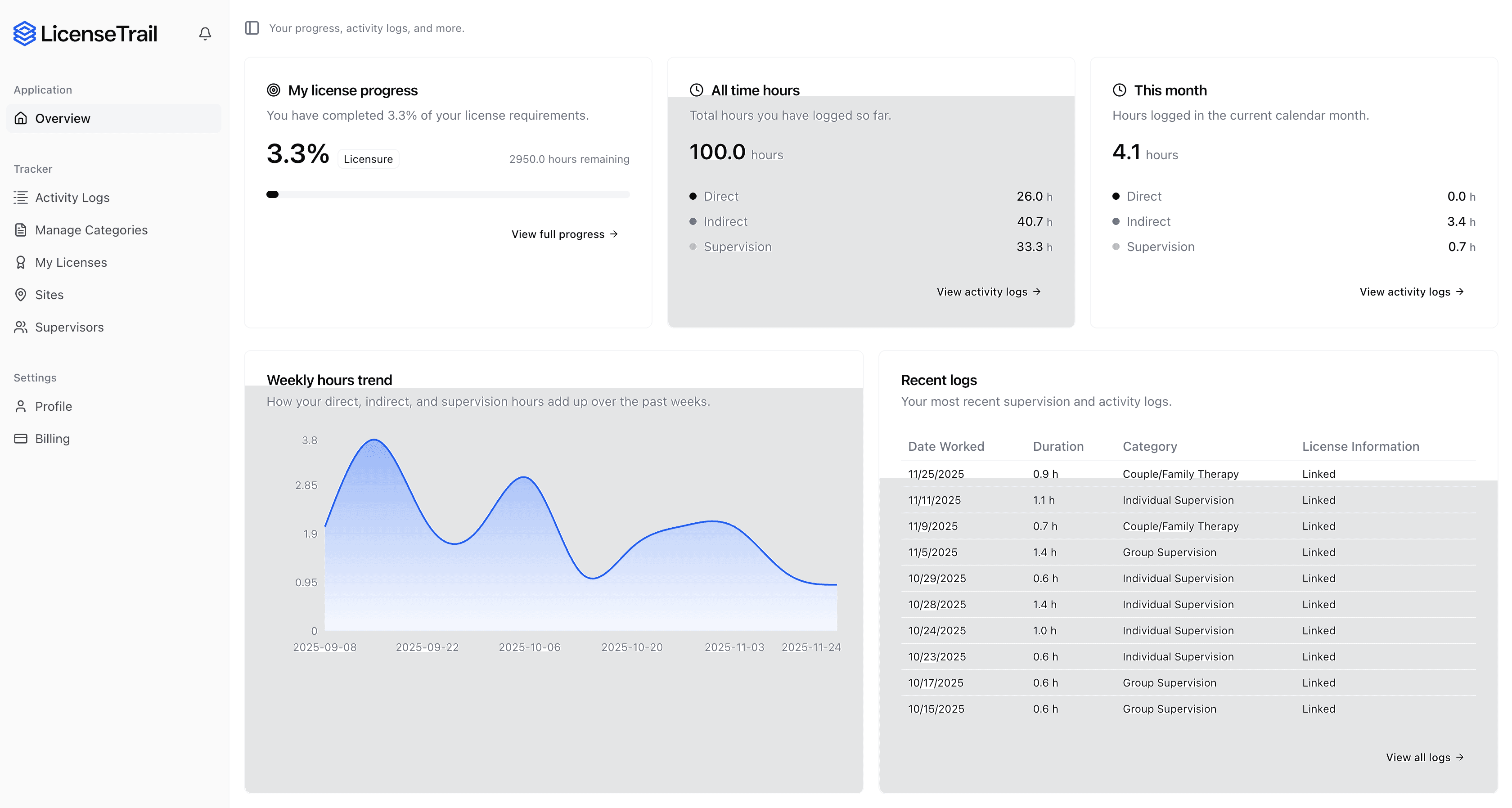
License Trail checks your direct, indirect, and supervision hours against Minnesota LPV requirements continuously and flags mismatches before you submit.
 Start Tracking for Free
No credit card required · Free plan available
Related Licenses
Is your spreadsheet hiding Minnesota LPV risks?
Stop guessing if your categories match Minnesota Board of Psychology requirements. License Trail checks your direct, indirect, and supervision hours continuously and flags mismatches before you submit.
Import or log
Bring your spreadsheet or start fresh
Upload your existing tracking spreadsheet and we'll map every hour into the right Minnesota Board of Psychology categories automatically.
Verify against Minnesota
Catch mismatches before the board does
License Trail checks your direct, indirect, and supervision hours against Minnesota LPV requirements continuously.
Export board-ready
One-click clean reports
Generate professional, board-ready reports for supervision meetings and Minnesota Board of Psychology submissions in seconds.
No credit card required · Free plan available