
Mississippi LMFTA Requirements: Hours, Exams & Step-by-Step Guide
Stop guessing if your categories match Mississippi requirements. License Trail checks your direct, indirect, and supervision hours against LMFTA requirements continuously and flags mismatches before you submit.
No credit card required · Free plan available
Quick Requirements Overview
- Degree: Master’s or doctoral in Marriage & Family Therapy from COAMFTE-accredited program (or candidacy-to-accredited)
- Practicum length: ≥12 consecutive months clinical MFT practicum
- Practicum hours: 500 client contact hours total, incl. ≥300 direct + ≥100 relational direct (couples/families)
- Practicum supervision: 100 hours supervised by AAMFT Approved Supervisor (or Supervisor Candidate under Approved Supervisor); group max 8
- Exam: Pass AMFTRB National MFT Exam (required before LMFTA licensure)
- Practice setting: Agency/institution only under a Board-approved supervision contract/plan (no independent practice)
- Application packet: Notarized application; official transcripts; practicum verification; exam verification; 3 professional references (sent directly); photo; fingerprint-based state + national background check (clearance within 180 days); fee
License Details
Procedures
Mississippi regulates marriage and family therapists through the Mississippi Board of Examiners for Social Workers and Marriage & Family Therapists under Title 30, Part 1903 of the Administrative Code. This framework creates two MFT licenses:
- LMFTA – Licensed Marriage and Family Therapy Associate
- LMFT – Licensed Marriage and Family Therapist (independent practice) (sos.ms.gov)
An LMFTA is the early‑career license. You qualify after graduate training and the national exam, then complete your post‑graduate clinical hours under supervision on the way to LMFT.
Below is a step‑by‑step guide focused on LMFTA requirements, with the exact types of hours and board terminology, followed by a brief explanation of the post‑LMFTA hours you must complete to become an LMFT.
1. Understand what an LMFTA is in Mississippi
The Board defines a “Licensed Marriage and Family Therapy Associate (LMFTA)” as a person to whom an associate license has been issued under Section 73‑53‑8, whose license is in force and not suspended or revoked. (sos.ms.gov)
Under Rule 2.1:
- An LMFTA is the license “granted to an individual who has met and maintained all the qualifications necessary for licensure and for the renewal of the license.”
- An LMFTA “must practice in an agency setting under a ‘Board Approved’ supervision contract.” (sos.ms.gov)
In other words, the associate license allows you to practice only under Board‑approved supervision in an agency, institution, or similar setting, not independently.
2. Baseline eligibility for LMFTA (applies to both LMFT and LMFTA)
Under Rule 2.2(B), a person seeking either LMFT or LMFTA must submit evidence that they: (sos.ms.gov)
- Are of good moral character (as defined in Part 1901).
- Have an acceptable statewide and nationwide criminal history records check using fingerprint identification, and an acceptable sex‑offender check, as prescribed by the Board.
- Have not engaged in conduct that violates Board standards of conduct.
- Meet all qualifications for licensure, including education, experience, passing examination scores, physical and mental abilities, and have no addiction or dependency that would endanger the public or impair competence.
- Have not acquired their education, experience, exam scores, references, or other qualifying factors by deception or fraud.
- Have no unresolved complaints or disciplinary actions by another professional association or jurisdiction (or the Board may delay action until resolved).
- Are at least 21 years of age.
- Meet all other requirements outlined in the rules.
These are global eligibility criteria; the LMFTA‑specific requirements layer on top of them.
3. Educational and practicum requirements (the core “hours” you must already have)
3.1 Graduate degree program
For licensure as LMFT or LMFTA, the rules are written in terms of LMFT education, but the same qualifying graduate program and practicum are required when you apply as an LMFTA. (sos.ms.gov)
You must hold:
- A master’s or doctoral degree in marriage and family therapy from a program accredited by COAMFTE, or
- A master’s or doctoral degree in marriage and family therapy from a program that held COAMFTE candidacy and later achieved accreditation, with a qualifying practicum.
3.2 Board‑defined “client contact hours” and “direct” hours
The Board defines these key terms:
-
“Client contact hours” means both
- direct client contact hours and
- administrative and supportive client‑associated hours as defined by the accredited institution. (sos.ms.gov)
-
“Direct Client Contact” means face‑to‑face interaction, in person or via secure video, with an individual, couple, or family. (sos.ms.gov)
So, when Mississippi talks about 500 client contact hours, that number includes both direct therapy time and certain client‑related administrative/supportive activities—but they further specify a minimum portion that must be direct and relational.
3.3 Required practicum hours for LMFTA eligibility
To be eligible for LMFTA, you must document completion of a clinical practicum in marriage and family therapy of no less than 12 consecutive months, which: (sos.ms.gov)
- Provided face‑to‑face clinical practice (in‑person or secure video) with individuals, couples, and families.
- Allowed you to apply classroom learning to actual MFT practice in a field setting that provided live supervision.
- Included all of the following minimum hour requirements:
-
500 client contact hours total, which must include:
- At least 300 direct client contact hours, and
- At least 100 relational direct client contact hours with couples and/or families.
-
100 hours of supervision of that practicum experience.
-
Supervision conditions for the practicum:
- Supervision must be by an AAMFT Approved Supervisor or an AAMFT Supervisor Candidate under supervision of an AAMFT Approved Supervisor.
- Practicum supervision groups must be limited to a maximum of eight (8) supervisees per supervisor per group. (sos.ms.gov)
These practicum hours are the only specific hour counts required to obtain the LMFTA license itself. Mississippi does not require you to have thousands of post‑graduate hours before becoming an LMFTA; those come later, as you work toward LMFT.
4. National examination requirement
Mississippi requires the National Examination in Marital and Family Therapy administered under the Association of Marital and Family Therapy Regulatory Boards (AMFTRB).
Key points:
- The rules state that an applicant “may not be licensed as a Marriage and Family Therapy Associate or a Licensed Marriage and Family Therapist without passing the required examination.” (sos.ms.gov)
- The Board must have satisfactory evidence that you passed the AMFTRB Examination in Marital and Family Therapy before it will consider your LMFTA application. (sos.ms.gov)
- Candidates in a COAMFTE‑accredited graduate program may sit for the exam up to 90 days prior to graduation with written approval from their program director. (sos.ms.gov)
Practically, your sequence is:
- Complete (or be very near completing) your COAMFTE‑aligned MFT program and practicum.
- Take and pass the AMFTRB national exam.
- Then submit your LMFTA application; the Board will not act on it until it has verification of your passing score.
5. LMFTA application requirements: documents and supervision plan
Rule 2.2(E) lists the specific documentation you must submit to be licensed as an LMFTA. (sos.ms.gov)
In addition to having passed the national exam, you must ensure the Board receives:
- Original signed, notarized, completed LMFTA application form.
- Official graduate transcripts mailed directly from your institution(s), if the most current transcripts are not already on file.
- Practicum documentation showing:
- 12 consecutive months of MFT practicum,
- At least 500 client contact hours, including
- 300+ direct client contact hours, and
- 100+ relational direct client contact hours with couples and/or families, and
- 100 hours of supervision of that practicum under an AAMFT Approved Supervisor or Supervisor Candidate (with group size limits of eight supervisees per supervisor).
- Documentation of a passing score on the National Examination in Marital and Family Therapy.
- Documentation of an acceptable supervision plan that has been approved by the Board.
- This is the Board‑approved plan under which you will practice as an LMFTA.
- Three acceptable letters of professional reference:
- From licensed mental health professionals who have known you at least one year;
- Letters must be sent directly to the Board by the professionals.
- A recent photograph of you.
- Proof you have completed a statewide and nationwide criminal history and background check using fingerprint identification, with:
- Criminal background clearance received within 180 calendar days of your completed application;
- The background check must be received directly by the Board from the governmental authority, not from you.
- Payment of the non‑refundable application fee.
These requirements are in addition to the baseline eligibility conditions in Section 2 above.
6. How Mississippi defines and structures supervision for associates
Several definitions in the rules govern how supervision must occur for practicum and post‑graduate work: (sos.ms.gov)
- Clinical Supervision: “Direct clinical review” by a supervisor of the supervisee’s interaction with a client, for training or teaching purposes.
- Face‑to‑Face Supervision: Supervision conducted in person or via secure video conferencing.
- Individual Supervision:
- A maximum of two supervisees or associates in a clinical setting per supervision hour (a supervision hour is 50 minutes).
- Group Supervision:
- A minimum of three and no more than eight supervisees or associates per supervision hour (50 minutes) in a clinical setting.
While these definitions apply both to practicum and post‑graduate supervision, for LMFTA licensure what you must demonstrate is:
- Completion of at least 100 hours of supervision of your graduate practicum, under an AAMFT‑approved supervisor or supervisor candidate. (sos.ms.gov)
- A Board‑approved supervision plan under which you will practice as an associate.
7. Post‑LMFTA hours required to move up to LMFT (for context)
Although your question focuses on LMFTA, most applicants care about the full pathway. Once you are licensed as an LMFTA and working under your supervision contract, Mississippi requires post‑graduate clinical experience and supervision hours to become an LMFT.
Under Rule 2.2(C)(2)–(3) for LMFT: (sos.ms.gov)
7.1 Post‑graduate clinical experience (client hours)
After your first qualifying graduate degree, under an approved supervision plan, you must complete:
- Two (2) years of documented post‑graduate clinical experience in the practice of marriage and family therapy, in an agency, institution, or group‑practice setting.
- This experience must include a minimum of 1,000 documented face‑to‑face direct client contact hours, in person or via secure video.
- Documentation must be sent directly to the Board by the agency or person providing the clinical supervision.
So, the main post‑LMFTA “experience” requirement is:
1,000 direct client contact hours (face‑to‑face) in at least two years of supervised post‑graduate clinical practice.
(This is different from some states that, for example, require 1,500 direct plus 1,500 supervised hours; Mississippi’s regulation specifies 1,000 direct client contact hours plus separate supervision hour requirements below, not 1,500/1,500.)
7.2 Post‑graduate supervision hours
In addition to the 1,000 direct client hours, you must complete formal supervision hours:
- Total supervision: At least 200 hours of marriage and family therapy clinical supervision.
- Individual vs group:
- At least 50 hours must be individual supervision (no more than two supervisees per supervision hour).
- AAMFT supervision requirement:
- At least 100 of the 200 supervision hours must be completed with an AAMFT Approved Supervisor.
- Credit from graduate training:
- Up to 100 hours of acceptable clinical supervision accumulated during graduate training may be counted toward the 200 required, but
- All remaining post‑graduate supervision hours must be with a Board Approved Supervisor.
Some COAMFTE‑approved doctoral internships may count toward the two years of post‑graduate clinical experience if they involve provision of clinical MFT services in a mental health treatment setting under AAMFT‑type supervision; teaching or non‑clinical internships do not count. (sos.ms.gov)
8. Titles and practice restrictions for LMFTA
Under Rule 3.1, persons licensed to practice as Marriage and Family Therapy Associates in Mississippi: (sos.ms.gov)
- May use the title “Licensed Marriage and Family Therapy Associate” and the initials LMFTA as professional identification.
- Must remain within the scope of an LMFTA (agency setting, under Board‑approved supervision) and cannot represent themselves as independent LMFTs.
9. Practical checklist for becoming an LMFTA in Mississippi
Putting the rules into a simple sequence:
- Complete a qualifying MFT graduate degree (COAMFTE‑accredited or candidacy‑to‑accredited program).
- Complete the practicum:
- 12 consecutive months;
- 500 client contact hours, including:
- 300+ direct client contact hours;
- 100+ relational direct hours with couples and/or families;
- 100 supervision hours of the practicum under an AAMFT Approved Supervisor (or Supervisor Candidate under an Approved Supervisor).
- Pass the AMFTRB National Examination in Marital and Family Therapy.
- Develop and obtain Board approval of a supervision plan for your associate practice (using the Board’s supervision contract and related forms).
- Submit your LMFTA application packet, including:
- Notarized application form;
- Official transcripts;
- Practicum verification (with hour breakdown and supervision details);
- Exam score verification;
- Board‑approved supervision plan;
- Three professional reference letters;
- Recent photo;
- Fingerprint‑based state and national background checks (with clearance within 180 days of your completed application);
- Application fee.
- Once approved and you pay the initial license fee, you’ll be issued an LMFTA license, can use the LMFTA title, and may practice in approved settings under supervision, accruing the 1,000 direct client contact hours and 200 supervision hours required later for LMFT.
That set of requirements reflects the Board’s current rules (Title 30, Part 1903) as amended through November 17, 2022, and in effect as of November 23, 2025. (swmft.ms.gov)
Track your LMFTA hours with confidence
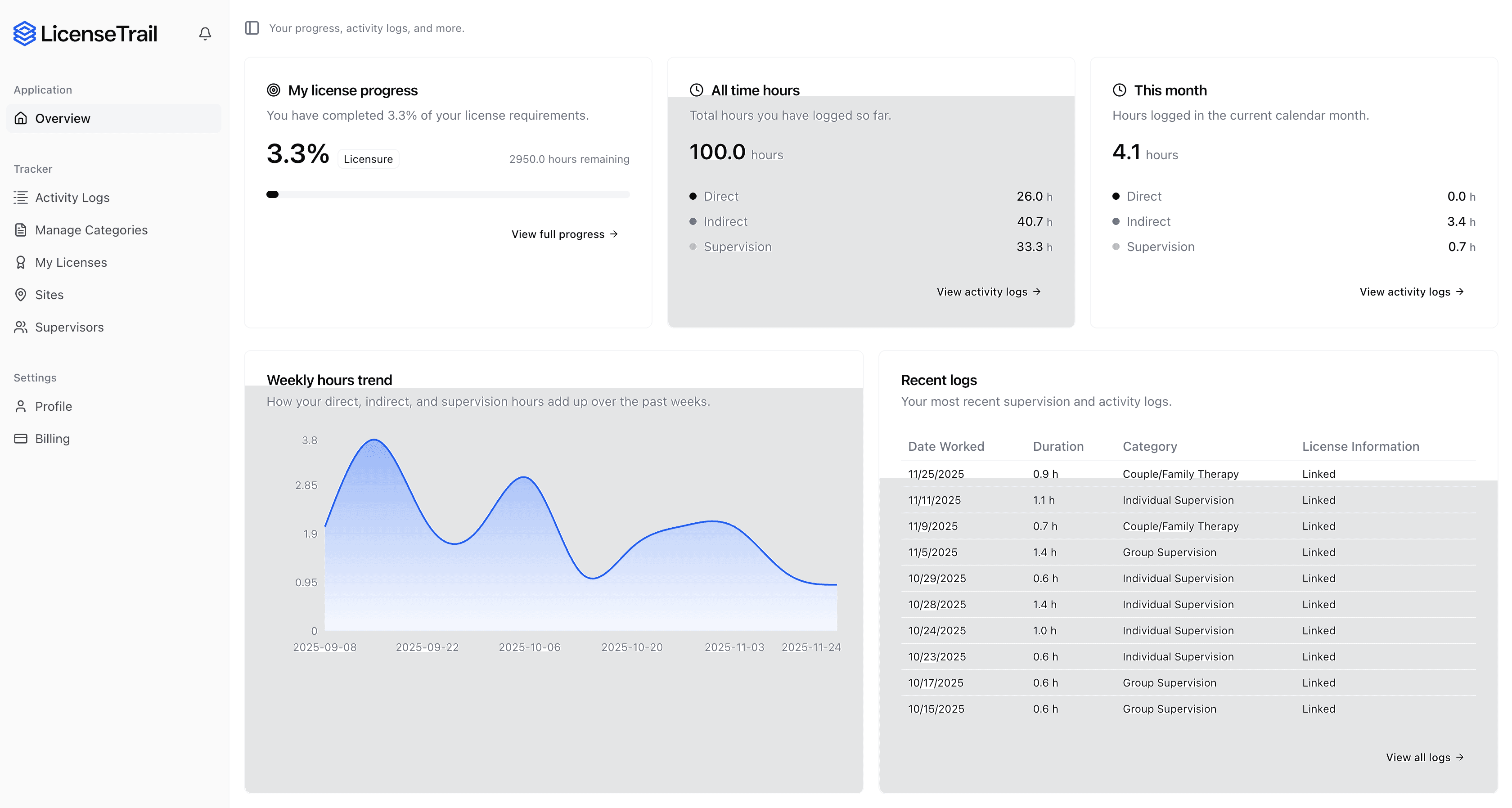
License Trail checks your direct, indirect, and supervision hours against Mississippi LMFTA requirements continuously and flags mismatches before you submit.
 Start Tracking for Free
No credit card required · Free plan available
Is your spreadsheet hiding Mississippi LMFTA risks?
Stop guessing if your categories match Mississippi Board of Examiners for Social Workers and Marriage & Family Therapists requirements. License Trail checks your direct, indirect, and supervision hours continuously and flags mismatches before you submit.
Import or log
Bring your spreadsheet or start fresh
Upload your existing tracking spreadsheet and we'll map every hour into the right Mississippi Board of Examiners for Social Workers and Marriage & Family Therapists categories automatically.
Verify against Mississippi
Catch mismatches before the board does
License Trail checks your direct, indirect, and supervision hours against Mississippi LMFTA requirements continuously.
Export board-ready
One-click clean reports
Generate professional, board-ready reports for supervision meetings and Mississippi Board of Examiners for Social Workers and Marriage & Family Therapists submissions in seconds.
No credit card required · Free plan available