
Mississippi LMSW Requirements: Hours, Exams & Step-by-Step Guide
Stop guessing if your categories match Mississippi requirements. License Trail checks your direct, indirect, and supervision hours against LMSW requirements continuously and flags mismatches before you submit.
No credit card required · Free plan available
Quick Requirements Overview
- MSW (or doctorate) in social work from a CSWE-accredited program (education verification/transcript required; practicum hours are part of the degree)
- No post-graduate supervised practice hours required to obtain the Mississippi LMSW
- Pass the ASWB Masters exam (board approval to test; ASWB sends scores to the Board)
- Meet statutory eligibility: 21+, good moral character, U.S. citizen/legal resident, no disqualifying felony (past 10 years), mentally competent, no alcohol/drug dependency
- Complete fingerprint-based background check + sex-offender check (Board fee $50; results must be received within 180 days of completed application)
- Apply via the Board online portal with required items (photo, education verification, fingerprint request) and pay fees online
- Pay $110 initial LMSW license fee; no practice until a license number is issued
- Maintain license: 40 CE hours every 2 years (incl. 4 ethics, 2 cultural competency, 1 mandated reporting)
License Details
Procedures
Mississippi’s Licensed Master Social Worker (LMSW) credential sits at the master’s level between the Licensed Social Worker (LSW) and the Licensed Certified Social Worker (LCSW). It authorizes independent practice at the master’s level (within the LMSW scope) and is the mandatory stepping‑stone to the LCSW.
A key point up front:
- There are no post‑graduate practice hours required to obtain the LMSW license itself in Mississippi.
- All of the “1,000 hours + 100 hours supervision” requirements apply only if an LMSW later pursues the LCSW.
Below is a step‑by‑step guide, with emphasis on what the Mississippi Board of Examiners for Social Workers and Marriage & Family Therapists (MBOE) actually requires and how it describes those requirements.
1. Understand the Mississippi LMSW license
Mississippi law recognizes three social work licenses: Licensed Social Worker (LSW), Licensed Master’s Social Worker (LMSW), and Licensed Certified Social Worker (LCSW).(law.cornell.edu)
In statute, the LMSW is referred to as “licensed master’s social worker.” The law states that:
“A license as a ‘licensed master’s social worker’ shall be issued to an applicant who…
(i) Has a doctorate or master’s degree from a school of social work accredited by the Council on Social Work Education; and
(ii) Has satisfactorily completed the ASWB examination for this license; or
(iii) Has a comparable license or registration from another state or territory…” (legiscan.com)
There is no mention of required post‑degree practice hours for this level in the statute or the Board’s LMSW licensure materials.
2. Meet the educational requirement
To qualify for LMSW by examination, you must hold:
- A master’s (MSW) or doctorate in social work from a CSWE‑accredited program.(legiscan.com)
The Board’s Initial Application Checklist states that to apply for licensure by examination in Mississippi, an applicant must:
- Possess a bachelor’s or master’s degree in social work from an accredited CSWE program (the master’s pathway is what leads to LMSW).(swmft.ms.gov)
The Board’s Verification of Education form (Form 267) is used to confirm:
- The degree conferred and accreditation (CSWE or SACS), and
- Dates and total hours of practicum/internship completed as part of the degree program.(swmft.ms.gov)
The practicum hours are educational field hours, not additional Board‑mandated license hours beyond what your accredited MSW already required.
3. Satisfy character, legal, and background‑check requirements
Mississippi statute imposes general conditions for all social work licenses (LSW, LMSW, LCSW). An applicant must show, “to the board’s satisfaction” that they meet all of the following:(legiscan.com)
- Age: At least 21 years old.
- Good moral character (expressly described as a continuing requirement for licensure).
- Citizenship or legal residency: United States citizenship or status as a legal resident alien.
- No disqualifying felony:
- Absence of conviction of a felony related to the practice of social work for the last ten (10) years. Conviction is defined broadly to include deferred convictions, deferred prosecution, deferred sentences, findings or verdicts of guilt, guilty pleas, and pleas of nolo contendere.
- Mental competency: The applicant has not been declared mentally incompetent by a court (or, if so, that decree has since been changed).
- Freedom from dependency on alcohol or drugs.
- Complete criminal history records check, including fingerprints and an acceptable sex‑offender check, by appropriate governmental authorities.
The Initial Application Packet implements this statute by requiring:(swmft.ms.gov)
- A Request for Fingerprint Card Form and a $50.00 processing fee for the Board to conduct:
- A fingerprint‑based criminal history check via the Mississippi Criminal Information Center and FBI, and
- A sex‑offender registry check.
- The criminal history and sex‑offender checks must be received within 180 days of the completed application.
These criminal‑history requirements apply to all levels, including Licensed Master Social Worker (LMSW).(swmft.ms.gov)
4. Apply through the Board’s online portal
The Board now processes LMSW applications primarily through its Initial Application Portal.(swmft.ms.gov)
For an LMSW by examination, you must complete (summarizing from the Board’s Initial Application Checklist and social work forms page):
- Online Initial Application via the Applicant Portal.(swmft.ms.gov)
- Verification of Education Form (Form 267) or an official sealed transcript (or electronic transcript sent directly from the institution to [email protected]).(swmft.ms.gov)
- Passport‑type photo (color, head‑and‑shoulders).(swmft.ms.gov)
- Request for Fingerprint Card Form so the Board can post the fingerprint fee in the portal and mail you a fingerprint card.(swmft.ms.gov)
- Application and background‑check fees paid online (the checklist notes that all fees must be paid online).(swmft.ms.gov)
Once your application and education verification are received and deemed complete, the Board sends you an exam approval letter authorizing you to register for the ASWB exam.(swmft.ms.gov)
5. Take and pass the ASWB Masters exam
For the LMSW, Mississippi requires you to “satisfactorily [complete] the ASWB examination for this license”—i.e., the ASWB Masters‑level examination.(legiscan.com)
Key points:
- You schedule and pay for the ASWB exam through ASWB’s process after receiving the Board’s approval.
- After you test, ASWB sends your score directly to the Board; the Initial Application Packet notes that scores generally reach the office within about two weeks.(swmft.ms.gov)
There is no separate state‑developed exam; passing the appropriate ASWB exam is mandatory.
6. Pay the initial LMSW license fee and receive your license
Once the Board receives your passing exam score and your background checks clear, it posts your remaining fees in the portal. For an LMSW, the checklist specifies:(swmft.ms.gov)
- Initial license fee:
- “$110.00 initial license fee for LMSW or LCSW; or $32 if upgrading a current license from LSW to LMSW or LMSW to LCSW.”
The Board emphasizes that you may not practice as a social worker in Mississippi until you have actually been issued a license number by the Board, and employers are directed to verify licenses via the Board’s online license search.(swmft.ms.gov)
At this point, assuming all requirements are satisfied, you are a Licensed Master Social Worker (LMSW) in Mississippi.
7. Hours connected to the LMSW: what is and is not required
A. Hours not required for LMSW licensure
From the Board’s legal framework and licensure disclosures:
- The statute defining the LMSW prerequisites lists only:
- Degree (MSW/DSW from CSWE school) and
- Passing the ASWB exam (or holding a substantially similar out‑of‑state license).(legiscan.com)
- The Board’s own licensure disclosure (as summarized for Mississippi) lists, for the Master Social Worker License:
- Postgraduate training or coursework: None
- Postgraduate work experience: None
- Exam: “Relevant Association of Social Work Boards Examination”(waldenu.edu)
That is, Mississippi does not require a set number of post‑degree practice hours (such as 1,500 direct + 1,500 supervised hours) to obtain the LMSW.
The only “hours” connected to earning the LMSW at the outset are the practicum/internship hours built into your accredited MSW program, which your school reports to the Board on the education verification form. Those are controlled by CSWE standards, not by a separate Mississippi numeric requirement.(swmft.ms.gov)
B. Hours required after LMSW if you pursue LCSW
Once you hold an LMSW and seek to become an LCSW, the Board imposes detailed supervision and practice‑hour requirements that are often confused with LMSW requirements. These apply only to LMSWs in the LCSW supervision track.
From the Board’s A Guide to Supervision for Licensed Master Social Workers and its Initial Application Packet:(swmft.ms.gov)
-
Minimum supervision period and hours (LCSW track)
- Supervision must last a minimum of 24 months and may not ordinarily exceed 36 months (with a possible limited extension for documented extenuating circumstances).
- Supervision must occur at a minimum of one hour per week of face‑to‑face supervision, which the Board states “equates to a total of one hundred (100) hours of required supervision.” (swmft.ms.gov)
- At least 50% of those supervisory interactions must be individual, face‑to‑face (maximum of two supervisees with one supervisor in those sessions); the rest may be in small‑group supervision (up to seven supervisees).(swmft.ms.gov)
- Up to one‑quarter of the required supervision hours (25 hours) may be conducted by approved audio or audiovisual electronic means, provided the interaction is live and interactive; at least three‑quarters must still be direct, in‑person or equivalent face‑to‑face contact.(swmft.ms.gov)
-
Minimum client‑contact hours (LCSW track)
- During the supervision period, the Board requires the LMSW supervisee to complete “a minimum of one thousand (1,000) hours of face to face client contact.”(swmft.ms.gov)
- These hours must be documented on the Board’s Verification of Face to Face Client Contact form and submitted with supervision termination materials when applying for LCSW status.(swmft.ms.gov)
-
Who may supervise and where
- The supervisor must be a Board‑approved Licensed Certified Social Worker (LCSW) with at least two years of verifiable practice at the LCSW level.(swmft.ms.gov)
- Supervision must occur within an agency, institution, or group practice setting; an LMSW practicing independently outside such a setting is considered to be practicing outside Board regulations and cannot receive creditable supervision toward LCSW.(swmft.ms.gov)
In other words:
- To get the LMSW license: Mississippi does not require a specific number of post‑degree clinical or supervised practice hours.
- To progress from LMSW to LCSW: Mississippi requires 100 hours of approved supervision (mostly individual, in‑person) spread over at least 24 months, plus at least 1,000 hours of face‑to‑face client contact under that supervision, all within a Board‑approved plan.
Those hour‑based requirements belong to the LCSW supervision process, not to the initial LMSW license.
8. Continuing education hours for LMSWs
After you are licensed, you must complete continuing education (CE) to renew. Current summaries of Board requirements (and Board‑linked guidance) indicate that all Mississippi social workers (LSW, LMSW, LCSW) must complete:(msweducation.org)
- 40 hours of CE every 2 years, with:
- 4 hours in professional ethics
- 2 hours in cultural diversity / multicultural issues / cultural competency
- 1 hour in mandated reporting (effective July 1, 2020)
The Board’s CE guides and CE‑approval system implement this structure, and CE hours are recorded and auditable through its LARS licensee portal.(swmft.ms.gov)
These CE hours are maintenance requirements for an LMSW license, distinct from the LCSW supervision and client‑contact hours described above.
Summary of hour‑related requirements for a Mississippi LMSW
- No fixed post‑graduate practice‑hour requirement to obtain initial LMSW licensure.
- Education hours (field/practicum) are embedded in your CSWE‑accredited MSW and documented by your school; the Board does not set a separate numeric minimum.
- Criminal‑history and sex‑offender check must be completed within 180 days of application (driven by fingerprint‑processing timelines, not practice hours).(swmft.ms.gov)
- If you later pursue LCSW as an LMSW in good standing, you must complete:
- At least 100 hours of Board‑approved LCSW supervision, usually one hour per week over 24–36 months.(swmft.ms.gov)
- At least 1,000 hours of face‑to‑face client contact during that supervision.(swmft.ms.gov)
- Ongoing: 40 CE hours every 2 years, including specified ethics, cultural‑competence, and mandated‑reporting content, to maintain the LMSW license.(msweducation.org)
If you’re planning your own path, the practical takeaway is that Mississippi’s LMSW license is exam‑ and education‑based, and all the substantial “hour counting” enters once you use the LMSW as the platform to become an LCSW.
Track your LMSW hours with confidence
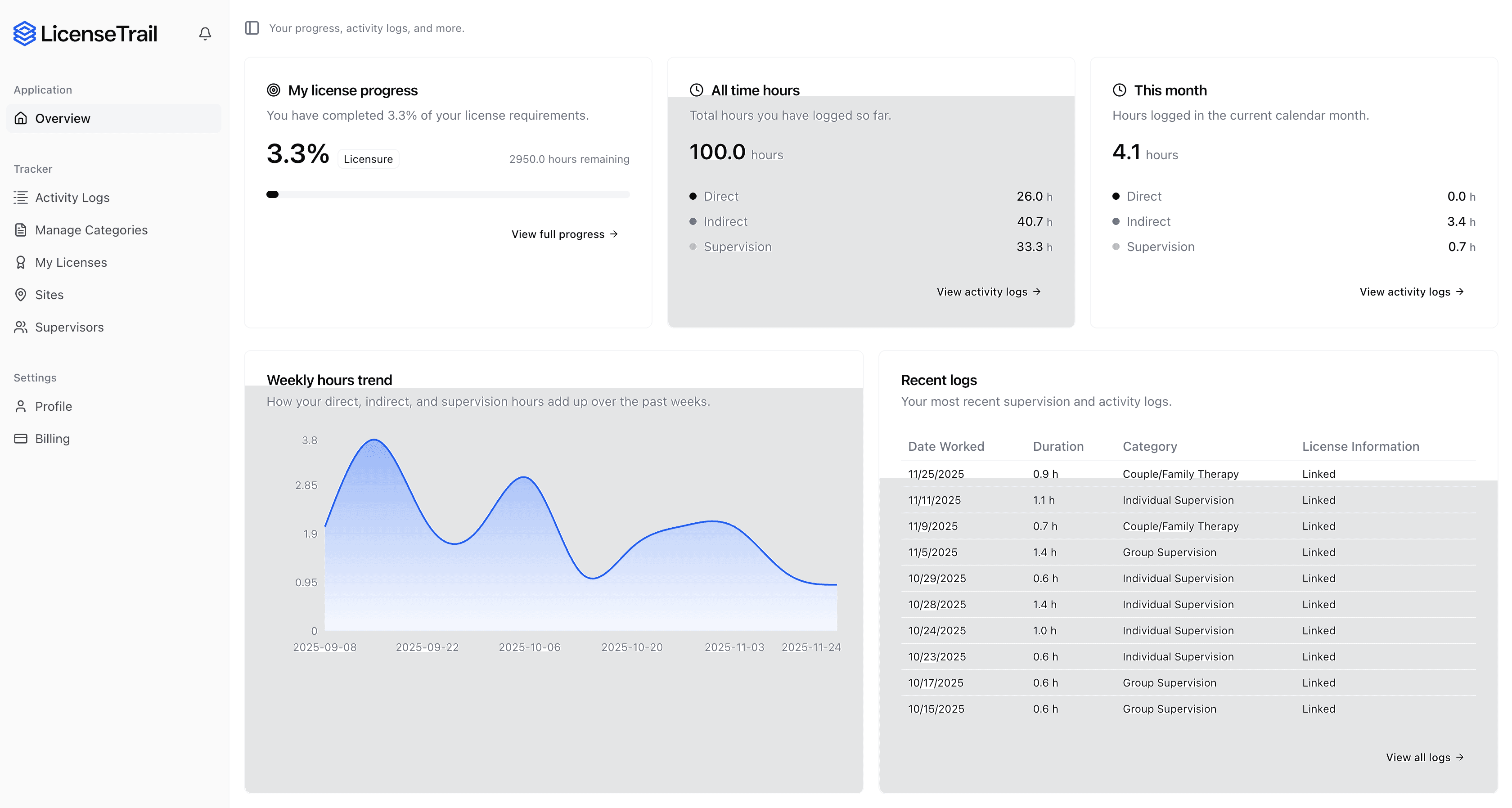
License Trail checks your direct, indirect, and supervision hours against Mississippi LMSW requirements continuously and flags mismatches before you submit.
 Start Tracking for Free
No credit card required · Free plan available
Is your spreadsheet hiding Mississippi LMSW risks?
Stop guessing if your categories match Mississippi Board of Examiners for Social Workers and Marriage & Family Therapists requirements. License Trail checks your direct, indirect, and supervision hours continuously and flags mismatches before you submit.
Import or log
Bring your spreadsheet or start fresh
Upload your existing tracking spreadsheet and we'll map every hour into the right Mississippi Board of Examiners for Social Workers and Marriage & Family Therapists categories automatically.
Verify against Mississippi
Catch mismatches before the board does
License Trail checks your direct, indirect, and supervision hours against Mississippi LMSW requirements continuously.
Export board-ready
One-click clean reports
Generate professional, board-ready reports for supervision meetings and Mississippi Board of Examiners for Social Workers and Marriage & Family Therapists submissions in seconds.
No credit card required · Free plan available