
Nebraska CMFT Requirements: Hours, Exams & Step-by-Step Guide
Stop guessing if your categories match Nebraska requirements. License Trail checks your direct, indirect, and supervision hours against CMFT requirements continuously and flags mismatches before you submit.
No credit card required · Free plan available
Quick Requirements Overview
- Composite structure: Hold LMHP (often via PLMHP while accruing hours) + add CMFT certification; this allows use of CMFT/LMFT titles
- LMHP education: Master’s/doctoral degree from approved mental health program incl. practicum/internship with ≥300 direct client-contact hours
- CMFT education: Master’s/doctoral in MFT or related graduate degree + Board-accepted equivalent MFT coursework; approved MFT program includes ≥6 semester-hour practicum with 300 supervised direct client-contact hours (≤150 individual)
- LMHP post-degree experience: 3,000 supervised hours (post-degree): 1,500 direct client + 1,500 indirect; supervision ≥1 hr/week face-to-face evaluative
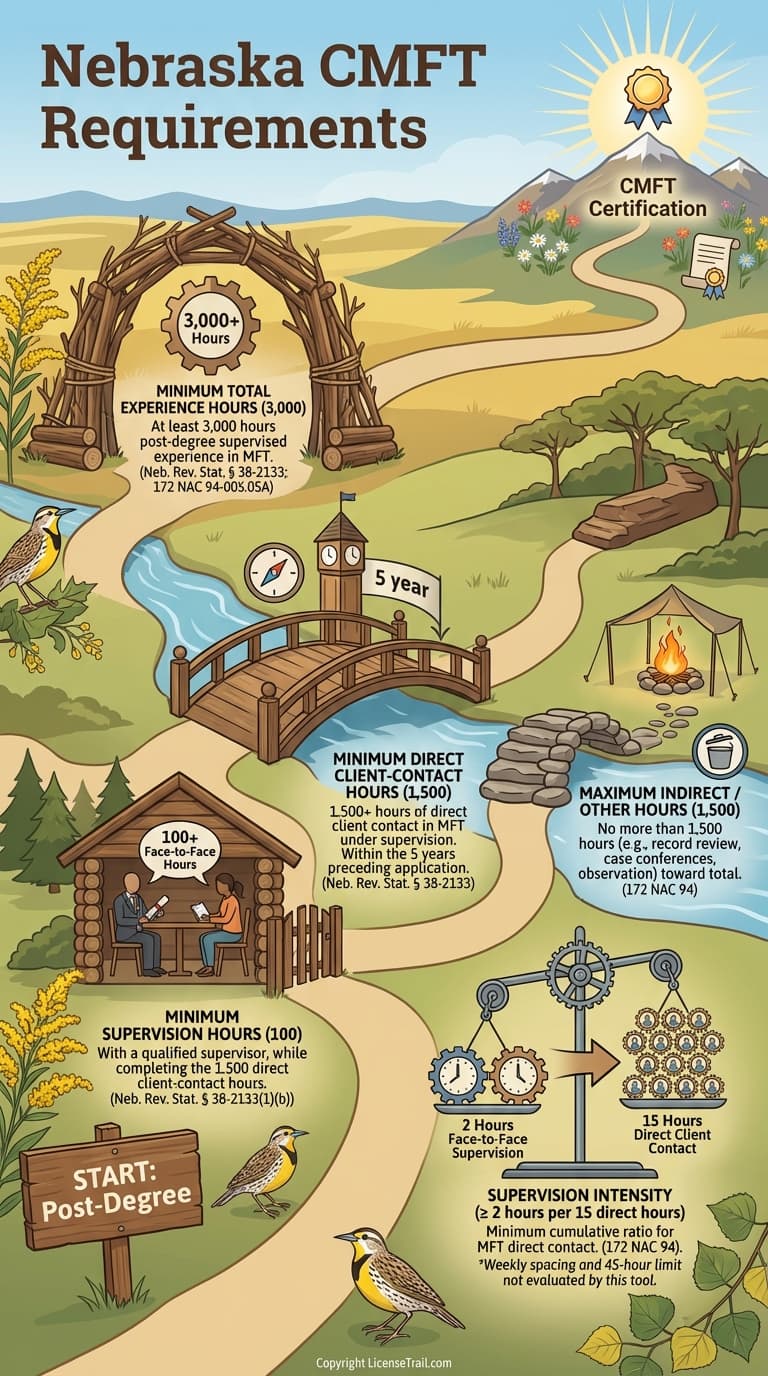
- CMFT post-degree MFT experience: 3,000 hours in marriage & family therapy under qualified supervisor; ≥1,500 direct-client MFT hours completed within 5 years of application
- CMFT supervision minimums: During the 1,500 direct-client hours: ≥100 supervisor-contact hours; supervision 1 hr/week or 2 hrs/2 weeks
- CMFT supervision ratio rule: 2 hrs face-to-face supervision per 15 hrs client contact; no more than 45 client-contact hours may accrue without supervision
- Exams: Pass Board-approved LMHP exam and the AMFTRB national MFT exam (national pass point)
License Details
Procedures
Becoming a Certified Marriage and Family Therapist (CMFT) in Nebraska involves both licensure as a mental health practitioner and an additional, title‑protected certification in marriage and family therapy. Nebraska uses a “composite” licensure system: you are licensed as a Mental Health Practitioner, and then you add a CMFT certification; this combination allows you to use titles such as “Certified Marriage and Family Therapist (CMFT)” and “Licensed Marriage and Family Therapist (LMFT).” (dhhs.ne.gov)
Below is a step‑by‑step breakdown of the requirements, with emphasis on hours and the state’s terminology.
1. Understand the Credentials Involved
Nebraska Department of Health and Human Services (DHHS), through the Board of Mental Health Practice, issues:
- Provisional Mental Health Practitioner (PLMHP) – used while you are accruing supervised hours.
- Licensed Mental Health Practitioner (LMHP) – core clinical license.
- Certified Marriage and Family Therapist (CMFT) – an associated certificate (title protection only; it does not expand scope of practice beyond what your license allows). (dhhs.ne.gov)
A person “who is licensed as a mental health practitioner and certified as a marriage and family therapist may use the title ‘Licensed Marriage and Family Therapist (LMFT)’.” (anyflip.com)
So to function as an MFT in Nebraska under the CMFT designation, you must:
- Qualify for and obtain LMHP (with PLMHP on the way), and
- Meet additional marriage and family therapy–specific education, experience, and exam requirements for the CMFT certificate.
2. Educational Requirements
2.1. Education for Mental Health Practitioner (LMHP)
To be “qualified to be a licensed mental health practitioner” you must hold: (nebraskalegislature.gov)
- A master’s, doctoral, or equivalent master’s degree, as determined by the Board,
- From an approved mental health program, with coursework “primarily therapeutic mental health in content,” and
- The degree must include a practicum or internship.
For practicums/internships completed after September 1, 1995, the law requires:
- At least 300 clock hours of direct client contact,
- Under supervision of a qualified physician, licensed psychologist, or licensed mental health practitioner. (nebraskalegislature.gov)
This practicum requirement is separate from (and in addition to) the 3,000 post‑degree supervised hours discussed below.
2.2. Education for Marriage and Family Therapy (CMFT)
For the CMFT certification, Nebraska law requires that an applicant: (nebraskalegislature.gov)
- Have a master’s or doctoral degree in marriage and family therapy from a program approved by the Board,
or - Have a graduate degree in a related field (e.g., social work, counseling, psychology, human development, family relations) plus graduate‑level coursework that the Board accepts as equivalent to a master’s degree in marriage and family therapy.
The regulations spell out what an “Approved Marriage and Family Therapy Program” must contain, including minimum graduate coursework (semester‑hour equivalents) in: (anyflip.com)
- Marriage and Family Studies – at least 9 semester hours
- Marriage and Family Therapy – at least 9 semester hours
- Human Development – at least 9 semester hours
- Professional Studies – at least 3 semester hours
- Research – at least 3 semester hours
- Practicum – at least 6 semester hours, including 300 hours of supervised direct client contact with individuals, couples, and families (no more than 150 hours with individuals)
3. Post‑Degree Supervised Experience for LMHP
To qualify for Licensed Mental Health Practitioner (LMHP), Nebraska law requires 3,000 hours of “supervised experience in mental health practice” after completion of the qualifying degree. (nebraskalegislature.gov)
The breakdown is:
- 3,000 total supervised hours in mental health practice, after the degree.
- Of these, 1,500 hours must be in “direct client contact” in a setting where mental health services are being offered.
- The remaining 1,500 hours are indirect but supervised activities and “include, but [are] not limited to, review of client records, case conferences, direct observation, and video observation.” (nebraskalegislature.gov)
In other words, for LMHP:
- 1,500 hours = direct client care (face‑to‑face clinical work)
- 1,500 hours = supervised, non‑direct activities (documentation, consultation, observation, etc.)
The statute further defines “supervised” for these 3,000 hours:
- Your work must be monitored by a:
- Qualified physician,
- Licensed clinical psychologist, or
- Certain certified/licensed mental health professionals (including a licensed mental health practitioner).
- Supervision must include evaluative face‑to‑face contact for at least 1 hour per week. (nebraskalegislature.gov)
Most applicants accumulate these hours while holding a Provisional Mental Health Practitioner (PLMHP) license, which is required for anyone who needs to earn the 3,000 hours of supervised experience. (law.justia.com)
4. Marriage and Family Therapy–Specific Experience for CMFT
Once you have the appropriate graduate degree, Nebraska law and regulations impose additional MFT‑specific experience and supervision requirements for the CMFT certification.
4.1. Total Marriage and Family Therapy Experience
Nebraska statute requires that an applicant for CMFT certification: (nebraskalegislature.gov)
- Provide evidence of at least 3,000 hours of experience in marriage and family therapy
- The hours must be accrued under a qualified supervisor,
- The experience must be post‑graduate (after receipt of the qualifying degree).
Regulations echo this: the applicant must have “received at least 3,000 hours of experience in marriage and family therapy under a qualified supervisor following receipt of the graduate degree.” (anyflip.com)
These 3,000 hours are in marriage and family therapy practice specifically, not just general mental health practice.
4.2. Direct‑Client Contact Requirement (MFT)
Within those 3,000 hours, state law specifies a direct‑client contact requirement: (nebraskalegislature.gov)
- At least 1,500 hours must be “direct‑client contact” in marriage and family therapy,
- These 1,500 direct hours must occur during the five years preceding the application for CMFT certification.
So, for the CMFT requirement:
- 3,000 hours = total post‑degree experience in MFT, of which
- 1,500 hours = direct‑client contact in MFT within the last five years.
4.3. Minimum Supervisor‑Supervisee Contact Hours and Frequency
The same statute requires a minimum volume and pattern of formal supervision tied to those client‑contact hours. Specifically, while completing the 1,500 direct‑client contact hours, you must have: (nebraskalegislature.gov)
- At least 100 hours of “supervisor‑supervisee contact hours” with a qualified supervisor, and
- Supervision must be provided at least 1 hour per week or 2 hours every 2 weeks.
In other words:
- Statutory minimum: 1,500 direct‑client hours + ≥100 hours of documented supervisory contact, on a weekly or bi‑weekly schedule.
4.4. Board Regulations: Supervision Ratio and No‑Gaps Rule
Nebraska’s regulations make the MFT supervision requirements more specific. Under 172 NAC 94, supervision for Marriage and Family Therapy certification must include: (anyflip.com)
- A minimum of 1,500 hours of direct client contact, and
- A cumulative ratio of 2 hours of face‑to‑face contact between the supervisee and a qualified supervisor for every 15 hours of the supervisee’s contact with clients, and
- A rule that no more than 45 hours of client contact may be accumulated without supervision.
Practically, this means:
- For every 15 hours of MFT direct‑client contact, you must log 2 hours of face‑to‑face supervision (individual or group, as permitted).
- Across 1,500 direct‑client hours, this ratio typically yields around 200 supervision hours, which is above the statutory minimum of 100 supervisor‑supervisee hours.
- You cannot go beyond 45 hours of client work between supervisory sessions, ensuring consistent oversight.
The Board’s regulations therefore operationalize the statutory floor (“at least” 100 supervisory hours) into a precise supervision ratio and scheduling rule.
5. Who Counts as a “Qualified Supervisor” for CMFT
For marriage and family therapy certification, Nebraska’s law and regulations define “qualified supervisor” in detail. (nebraskalegislature.gov)
A qualified supervisor for CMFT hours may be:
- A licensed mental health practitioner,
- A psychologist licensed to engage in the practice of psychology, or
- A licensed physician,
who also meets one of the following:
- Holds an Approved Supervisor designation from the American Association for Marriage and Family Therapy (AAMFT) or an equivalent organization approved by the Board, or
- Is a marriage and family therapist who:
- Has been in practice for at least five years, and
- Has completed at least a five‑hour supervision course provided, endorsed, or approved by AAMFT (or an organization with substantially similar standards), and
- Has themselves received supervision from an AAMFT Approved Supervisor at least one hour per month for at least one year after completing the supervision course. (regulations.justia.com)
This is in addition to the general supervisory requirements that apply to the 3,000 mental health practice hours for LMHP.
6. Required Examinations
Two kinds of exams are relevant:
-
Mental Health Practitioner Exam (for LMHP)
- To be licensed as an LMHP, you must “satisfactorily pass an examination approved by the board.” (nebraskalegislature.gov)
-
Marriage and Family Therapy Exam (for CMFT)
- For the CMFT, regulations require that you pass the national AMFTRB Marriage and Family Therapy examination, with at least the national pass point. (anyflip.com)
The Board also requires that individuals who, by their educational background, are eligible for CMFT certification must take and pass the appropriate certification exam as part of qualifying for LMHP. (nebraskalegislature.gov)
7. Putting It Together: Typical Sequence
Although there can be minor variations, a typical path to becoming a CMFT in Nebraska looks like this:
-
Complete an Approved Graduate Program
- Earn a master’s or doctoral degree in marriage and family therapy or a related field that meets both mental health practitioner and “Approved Marriage and Family Therapy Program” standards, including the 300‑hour practicum with direct client contact. (anyflip.com)
-
Obtain Provisional Licensure (PLMHP)
- Apply for PLMHP so you can legally accrue 3,000 hours of supervised experience in mental health practice required for LMHP. (law.justia.com)
-
Accrue 3,000 Hours of Supervised Mental Health Practice (for LMHP)
- 1,500 hours direct client contact,
- 1,500 hours supervised indirect activities (records review, case conferences, observations, etc.),
- With weekly evaluative face‑to‑face supervision by qualified supervisors. (nebraskalegislature.gov)
-
Accrue 3,000 Hours of Marriage and Family Therapy Experience (for CMFT)
- At least 3,000 post‑degree hours in marriage and family therapy under a qualified supervisor,
- Including at least 1,500 hours of direct‑client contact in MFT within the 5 years before applying,
- With supervision that:
- Provides at least 100 hours of supervisor‑supervisee contact under statute, and
- Meets the Board’s 2 hours supervision per 15 hours client contact ratio and no more than 45 client hours without supervision rule. (nebraskalegislature.gov)
In practice, many (but not all) of your LMHP hours can be structured so they also count toward the 3,000 MFT hours, provided the work is clearly marriage‑and‑family‑therapy in nature and supervised by a “qualified supervisor” for CMFT.
-
Pass the Required Exams
- Pass the LMHP exam approved by the Board, and
- Pass the AMFTRB national MFT exam with at least the national pass score. (nebraskalegislature.gov)
-
Apply for LMHP and CMFT Certification
- LMHP: Submit application, fees, transcripts, and verification of the 3,000 supervised mental health practice hours, then obtain the LMHP license. (nebraskamft.org)
- CMFT (172 NAC 94‑005.05):
- You must be licensed, or qualify for licensure and have applied, as a mental health practitioner,
- Submit proof of the qualifying MFT degree,
- Document 3,000 hours of supervised experience in marriage and family therapy after the master’s degree on the Board’s form,
- Provide official confirmation of your AMFTRB exam score,
- Attest to your moral character, and
- Pay the certification fee. (anyflip.com)
After DHHS approves both your LMHP and CMFT, you are recognized as a Certified Marriage and Family Therapist and may use the LMFT title in Nebraska (as long as you maintain both the license and associated certificate). (anyflip.com)
8. Core Hour Requirements at a Glance
To summarize the key hour requirements using Nebraska’s terminology:
For LMHP (general mental health license): (nebraskalegislature.gov)
- 300 hours of direct client contact in a supervised practicum/internship (as part of graduate program).
- 3,000 hours of supervised experience in mental health practice, post‑degree:
- 1,500 hours of direct client contact, and
- 1,500 hours of additional supervised experience (records review, case conferences, direct observation, video observation, etc.),
- With at least 1 hour per week of face‑to‑face evaluative supervision.
For CMFT (marriage and family therapy certification): (nebraskalegislature.gov)
- 3,000 hours of experience in marriage and family therapy under a qualified supervisor, post‑degree.
- At least 1,500 of those hours must be direct‑client contact in MFT, completed in the five years before application.
- Supervision requirements:
- Statute: At least 100 hours of supervisor‑supervisee contact, at a minimum of 1 hour per week or 2 hours every 2 weeks during the period you are accruing direct‑client hours.
- Regulations: For these direct‑client hours, a minimum cumulative ratio of 2 hours of face‑to‑face supervision for every 15 hours of client contact, and no more than 45 client‑contact hours may accrue without supervision.
Because Nebraska can and does update statutes, rules, and forms, it is important to confirm details with the Nebraska DHHS Mental Health and Social Work Practice webpage and the current text of Neb. Rev. Stat. §§ 38‑2122 and 38‑2133 and 172 NAC 94 when you are ready to apply. (dhhs.ne.gov)
Track your CMFT hours with confidence
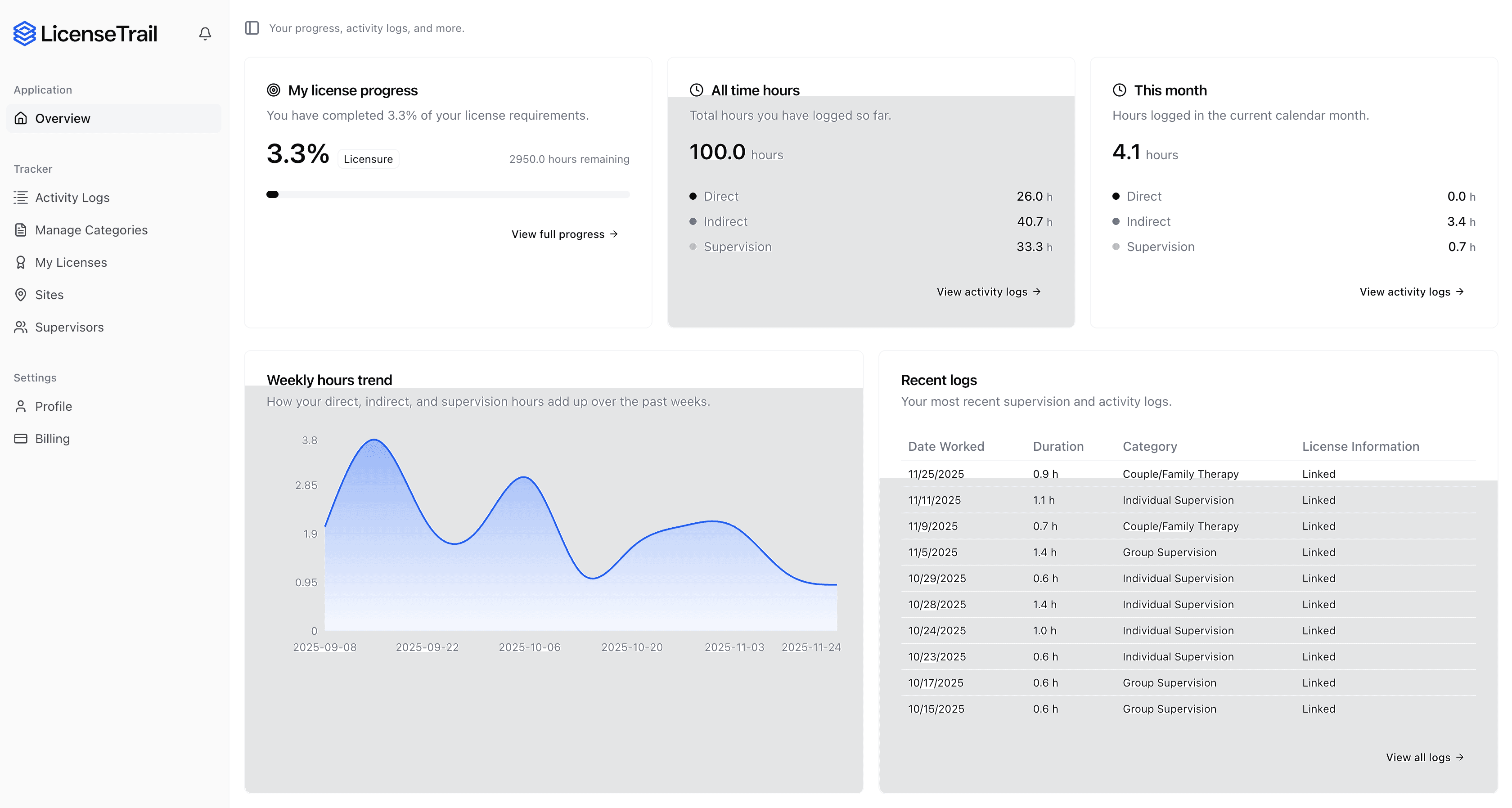
License Trail checks your direct, indirect, and supervision hours against Nebraska CMFT requirements continuously and flags mismatches before you submit.
 Start Tracking for Free
No credit card required · Free plan available
Is your spreadsheet hiding Nebraska CMFT risks?
Stop guessing if your categories match Nebraska Board of Mental Health and Social Work Practice requirements. License Trail checks your direct, indirect, and supervision hours continuously and flags mismatches before you submit.
Import or log
Bring your spreadsheet or start fresh
Upload your existing tracking spreadsheet and we'll map every hour into the right Nebraska Board of Mental Health and Social Work Practice categories automatically.
Verify against Nebraska
Catch mismatches before the board does
License Trail checks your direct, indirect, and supervision hours against Nebraska CMFT requirements continuously.
Export board-ready
One-click clean reports
Generate professional, board-ready reports for supervision meetings and Nebraska Board of Mental Health and Social Work Practice submissions in seconds.
No credit card required · Free plan available