
Nebraska LIMHP Requirements: Hours, Exams & Step-by-Step Guide
Stop guessing if your categories match Nebraska requirements. License Trail checks your direct, indirect, and supervision hours against LIMHP requirements continuously and flags mismatches before you submit.
No credit card required · Free plan available
Quick Requirements Overview
- Hold an LMHP (or PLMHP while accruing hours) as prerequisite to LIMHP
- Graduate degree (master’s/doctoral) in therapeutic mental health; for standard LIMHP path, program must be CACREP/COAMFTE/CSWE (or equivalent/approved)
- Pass a Board-approved exam (while licensed LMHP/PLMHP)
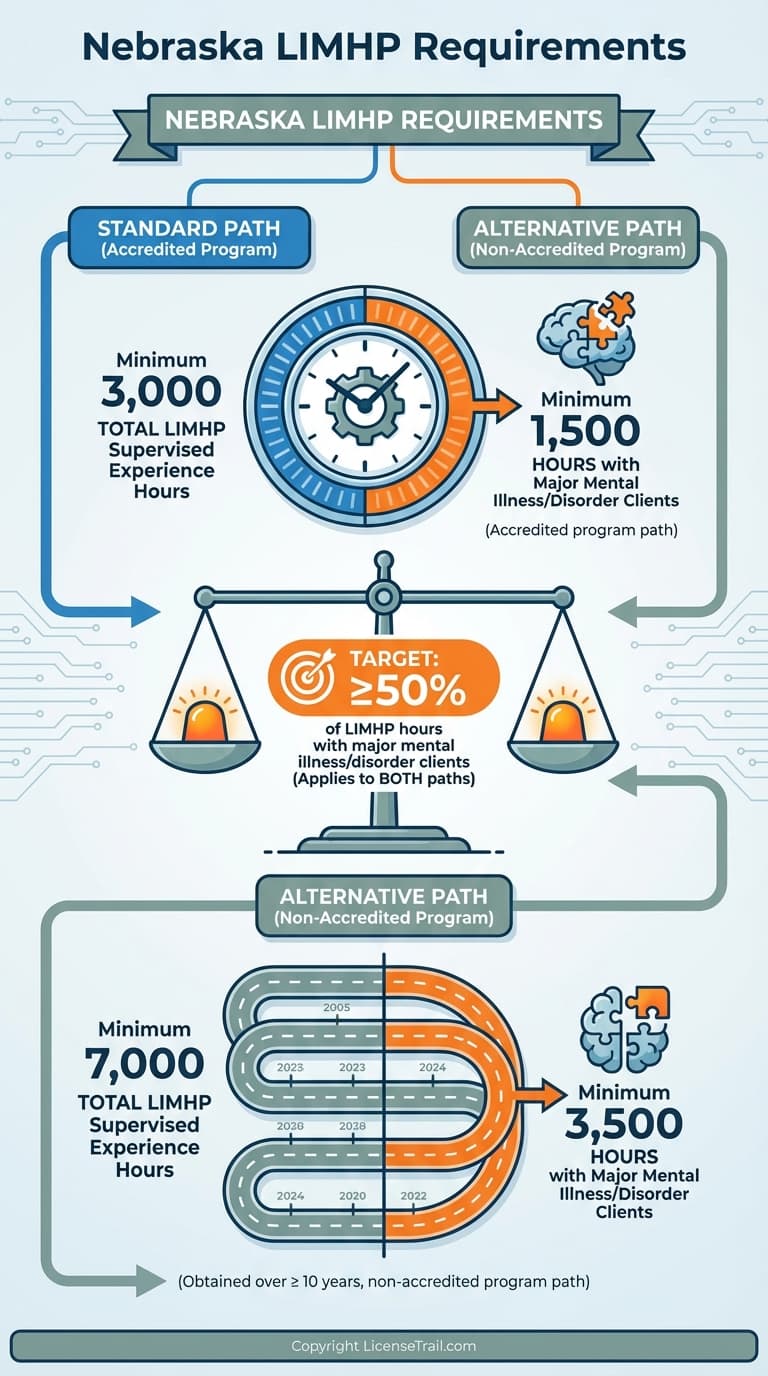
- Standard LIMHP experience: 3,000 supervised hours; ≥1,500 hours with clients diagnosed with major mental illness/disorder
- Alternate (non-accredited) path: 7,000 supervised hours over ≥10 years; ≥3,500 hours with major mental illness/disorder clients
- Supervisors for LIMHP hours: licensed physician, psychologist, or LIMHP
- Apply to DHHS with LIMHP application + Affidavit of Supervised Experience verifying required hours/client mix
- Renewal CE (24 months): 32 CE hours incl. 4 ethics and 6 hours on diagnosis/treatment of major mental disorders
License Details
Procedures
Licensure as a Licensed Independent Mental Health Practitioner (LIMHP) in Nebraska sits on top of Nebraska’s Mental Health Practitioner license (LMHP). The LIMHP credential is what allows you to independently diagnose and treat “major mental illness/disorders, without supervision or consultation,” under the Nebraska Department of Health and Human Services (DHHS) and the Board of Mental Health and Social Work Practice. (dhhs.ne.gov)
Below is a structured guide that keeps close to the statutory and regulatory language while translating it into a usable checklist.
1. Foundation: Licensed Mental Health Practitioner (LMHP)
To become an LIMHP, you must first meet the requirements for LMHP (or hold a PLMHP while you complete additional LIMHP hours). The key hour‑related requirements for LMHP are in Nebraska Revised Statute 38‑2122.
1.1 Education and Practicum
Nebraska law requires a qualifying graduate degree:
- A master’s, doctoral, or equivalent master’s degree in primarily therapeutic mental health from an approved educational program that includes a practicum or internship. (codes.findlaw.com)
- Practicums/internships completed after September 1, 1995 must include “a minimum of three hundred clock hours of direct client contact” under supervision of a qualified physician, licensed psychologist, or licensed mental health practitioner. (codes.findlaw.com)
These practicum hours are pre‑degree training and are separate from the post‑degree supervised hours for LMHP.
1.2 Supervised Experience Hours for LMHP
After the degree, Nebraska law defines the LMHP supervised experience as:
-
Total hours:
The applicant “has successfully completed three thousand hours of supervised experience in mental health practice.” (codes.findlaw.com) -
Type of hours (direct vs. other):
Of those 3,000 hours:- 1,500 hours must be “in direct client contact in a setting where mental health services were being offered.”
- The remaining 1,500 hours are to include, but not be limited to, activities such as review of client records, case conferences, direct observation, and video observation. (codes.findlaw.com)
In practice, this is often summarized as:
- 1,500 hours direct clinical work, plus
- 1,500 hours indirect/ancillary clinical activities.
-
Supervision definition and frequency:
For LMHP, “supervised” means the hours are:- Monitored by a qualified physician, a licensed psychologist, or a licensed mental health practitioner (or certain legacy credentials for older hours), and
- Include evaluative face‑to‑face contact for a minimum of one hour per week with the supervisor. (codes.findlaw.com)
-
Timing of hours:
The 3,000 hours must be accumulated after completion of the graduate degree. (codes.findlaw.com) -
Provisional license while you earn hours:
Anyone who needs these 3,000 supervised hours must hold a Provisional Mental Health Practitioner (PLMHP) license while accruing them. (codes.findlaw.com)
2. LIMHP: What the License Allows
The Nebraska DHHS describes the LIMHP credential as including diagnosis and treatment of major mental illness/disorders without supervision or consultation. (dhhs.ne.gov)
By contrast, an LMHP “does NOT include” diagnosing major mental illness or disorders except in consultation with an LIMHP, qualified physician, or licensed clinical psychologist. (dhhs.ne.gov)
This is why the LIMHP adds a second layer of experience requirements specifically tied to clients with major mental illnesses/disorders.
3. Core Statutory Requirements for LIMHP (Neb. Rev. Stat. 38‑2124)
Nebraska Revised Statute 38‑2124 is the controlling law for LIMHP qualifications. It creates two main pathways, depending on your degree program’s accreditation.
At a high level, the statute requires that an LIMHP applicant:
- Holds a qualifying graduate degree;
- Is already a licensed mental health practitioner (LMHP) or a provisional mental health practitioner (PLMHP) and has passed a board‑approved exam; and
- Has a specified number of supervised experience hours, a defined proportion of which must be with clients diagnosed under the major mental illness or disorder category. (law.justia.com)
3.1 Education Requirement for LIMHP
Under §38‑2124(1)(a)(i), the standard education route requires that you:
- Graduate with a master’s or doctoral degree from an educational program that is:
- Accredited by:
- The Council for Accreditation of Counseling and Related Educational Programs (CACREP),
- The Commission on Accreditation for Marriage and Family Therapy Education (COAMFTE),
- The Council on Social Work Education (CSWE), or
- Approved for art therapy by the American Art Therapy Association/Commission on Accreditation of Allied Health Education Programs; or
- Deemed by the Board to be equivalent in didactic content and supervised clinical experience to one of those accredited programs. (law.justia.com)
- Accredited by:
If your program is not accredited in that way, you may still qualify under the alternative (7,000‑hour) path described below.
3.2 LMHP or PLMHP License and Exam
The statute requires that an LIMHP applicant:
- Is licensed as an LMHP or PLMHP, and
- Has satisfactorily passed an examination approved by the Board pursuant to §38‑2122(3). (law.justia.com)
Regulations in 172 NAC 94‑003.04 reinforce this: to obtain an initial LIMHP license, the applicant must already hold a provisional or mental health practice license and provide evidence of passing the appropriate exam. (regulations.justia.com)
4. Supervised Experience for LIMHP: Hours and Types of Experience
This is the heart of the LIMHP requirement. Statute 38‑2124 sets two hour structures:
- A 3,000‑hour path (standard/“accredited program” path), and
- A 7,000‑hour path (alternative/“non‑accredited program” path).
Both are in addition to the LMHP‑level supervised experience, as interpreted in DHHS‑based guidance (more on that after we describe the statutory language).
4.1 Standard Path: 3,000 Hours with Major Mental Illness Focus
For graduates of qualifying accredited/equivalent programs under §38‑2124(1)(a), the statute requires that the applicant:
- Has “three thousand hours of experience supervised by a licensed physician, a licensed psychologist, or a licensed independent mental health practitioner,” and
- One‑half of those hours must be “comprised of experience with clients diagnosed under the major mental illness or disorder category.” (law.justia.com)
From an hours perspective this means:
-
Total LIMHP experience hours (standard path): 3,000
-
Client type requirement within those hours:
- At least 1,500 hours must be with clients who carry diagnoses under the major mental illness or disorder category (as defined by DSM/ICD categories adopted in practice).
- Up to 1,500 hours can be with other mental health clients who do not have a major mental illness or disorder diagnosis, or with major‑mental‑illness clients but in roles that do not fully meet the “major mental illness” experience category (depending on how the board interprets documentation).
-
Who can supervise these LIMHP hours:
- A licensed physician,
- A licensed psychologist, or
- A licensed independent mental health practitioner. (law.justia.com)
The statute does not further subdivide these 3,000 hours into “direct” vs. “indirect” categories the way it does for LMHP; instead, it focuses on the client population (major mental illness/disorder) and the type of supervisor.
4.2 Alternative Path: 7,000 Hours Over at Least 10 Years
If your degree program does not meet the accreditation/equivalence requirement of §38‑2124(1)(a)(i), you may qualify through the alternative hours requirement in §38‑2124(1)(b). In that case you must:
- Have 7,000 hours of experience
- The hours must be “obtained in a period of not less than ten years”
- They must be supervised by a licensed physician, licensed psychologist, or LIMHP, and
- One‑half of the 7,000 hours must consist of experience with clients diagnosed under the major mental illness or disorder category. (law.justia.com)
In concrete terms:
- Total LIMHP experience hours (alternative path): 7,000
- Time frame: At least 10 years to accrue them
- Client type requirement within those hours:
- Minimum 3,500 hours with clients diagnosed with major mental illness/disorders
- Up to 3,500 hours with other mental health clients
- Supervisors: Same as above (physician, psychologist, LIMHP). (law.justia.com)
Some secondary professional sources simplify this by saying an LIMHP must complete “at least 7,000 hours of postgraduate experience in a period of at least 10 years” with at least 3,500 hours with clients diagnosed under major mental illness/disorder; however, that is only the alternative statutory path and does not apply if you are on the 3,000‑hour accredited‑program route. (aamft.org)
4.3 Relationship Between LMHP and LIMHP Hours
Nebraska law draws a clear line between:
- The 3,000 hours of supervised experience in mental health practice required for LMHP under §38‑2122, and
- The 3,000 (or 7,000) hours of experience with a major‑mental‑illness component required for LIMHP under §38‑2124.
Board‑based guidance and licensure summaries explicitly state that hours used to qualify for one credential cannot be reused for another. For example, widely used DHHS‑based guidance for Nebraska social work and counseling licensure notes:
- The 3,000 LIMHP hours are completed while you hold a PLMHP or LMHP;
- “You cannot use hours of supervised experience that you previously used to qualify for other credentials.” (publichealthonline.org)
In practice this means:
- LMHP requirement: 3,000 supervised hours (1,500 direct / 1,500 indirect).
- LIMHP requirement (standard path): An additional 3,000 supervised hours focused on major mental illness/disorders (with at least 1,500 of those 3,000 hours with such clients).
- LIMHP requirement (alternative path): 7,000 supervised hours (3,500 with major mental illness/disorders) over at least 10 years, also separate from any hours counted toward LMHP.
Regulations for initial LIMHP licensure (172 NAC 94‑003.04) require submission of an affidavit signed by the supervisor verifying supervised experience set out in §38‑2124, which is treated as a distinct experience set from the LMHP hours. (regulations.justia.com)
4.4 Nature and Supervision of LIMHP Experience
The statute calls this simply “experience,” but other Nebraska regulations and guidance clarify that:
- It is “independent mental health practice” experience under the oversight of a supervising psychologist, physician, or LIMHP. (law.cornell.edu)
- The purpose of this supervision is to train the supervisee to achieve full licensure as an independent mental health practitioner; the supervisor holds oversight responsibility and must meet with the applicant in line with 172 NAC 94 standards. (law.cornell.edu)
Current DHHS application instructions and the Affidavit of Supervised Experience – LIMHP (referenced on the DHHS licensure page) specify the exact documentation and often the expected structure/frequency of supervision; those are periodically updated and should be consulted directly at the time you apply. (sps2019test-dhhs.ne.gov)
5. Application Mechanics for LIMHP
Regulations in 172 NAC 94‑003.04 outline what must be submitted to obtain an initial LIMHP license. In addition to already holding an LMHP or PLMHP and meeting the statutory requirements, you must provide: (regulations.justia.com)
- Completed application for LIMHP (DHHS form).
- Proof of license: Documentation that you currently hold a provisional mental health practitioner license or a mental health practitioner license.
- Examination verification:
- Evidence of passing the appropriate board‑approved examination (e.g., NCE, NCMHCE, or ASWB Clinical, depending on discipline). Scores must be sent directly from the testing vendor or another state licensing board.
- Affidavit of Supervised Experience – LIMHP:
- An affidavit (DHHS form) signed by your qualifying supervisor(s), verifying that you have completed the 3,000 or 7,000 hours specified by §38‑2124, including the required proportion with clients diagnosed under the major mental illness or disorder category. (regulations.justia.com)
The DHHS “Mental Health and Social Work Practice” licensure page also links directly to the LIMHP application and the Affidavit of Supervised Experience – LIMHP to be used for this purpose. (sps2019test-dhhs.ne.gov)
6. Ongoing Requirements: Continuing Education for LIMHP
Once licensed, Nebraska Administrative Code 172 NAC 94‑012 sets out continuing education (CE) requirements. For LIMHPs, the key points are: (regulations.justia.com)
- During each 24‑month renewal period, licensees must complete at least 32 hours of acceptable continuing education related to mental health practice.
- All license and certificate holders must complete at least 4 hours in ethics.
- Licensed independent mental health practitioners have an additional, license‑specific requirement:
- They must complete at least 6 hours of continuing education relating to diagnosis and treatment of major mental disorders during each 24‑month period.
This CE requirement reinforces that an LIMHP’s scope and expertise are anchored specifically in diagnosis and treatment of major mental disorders, in line with the experience requirements used to obtain the license.
7. Summary of Hours and “Type of Hours” by Credential
Putting the hour requirements into a single view, based on Nebraska statutes and board regulations:
1. LMHP (Licensed Mental Health Practitioner) – §38‑2122 (codes.findlaw.com)
- Education practicum (pre‑degree):
- At least 300 clock hours of direct client contact in practicum/internship.
- Post‑degree supervised experience:
- Total: 3,000 hours of supervised experience in mental health practice
- Composition:
- 1,500 hours of direct client contact
- 1,500 hours of indirect/ancillary clinical activities (e.g., record review, case conferences, direct and video observation)
- Supervision: Monitored by a qualified physician, psychologist, or LMHP, with at least 1 hour/week of evaluative face‑to‑face supervision.
- Must be post‑master’s/doctoral degree.
2. LIMHP (Licensed Independent Mental Health Practitioner) – §38‑2124 (law.justia.com)
- Prerequisites:
- Qualifying master’s/doctoral degree (accredited/equivalent)
- Current LMHP or PLMHP
- Passed board‑approved exam.
- Standard (accredited program) path:
- Total: 3,000 hours of supervised experience
- Client type requirement:
- At least 1,500 of those hours must be with clients diagnosed under the major mental illness or disorder category.
- Supervisors: Licensed physician, psychologist, or LIMHP.
- Cannot double‑count hours already used for another credential (per DHHS‑based guidance). (publichealthonline.org)
- Alternative (non‑accredited program) path:
- Total: 7,000 hours of supervised experience
- Time frame: Must be obtained in not less than 10 years.
- Client type requirement:
- At least 3,500 hours with clients diagnosed under major mental illness/disorders.
- Supervisors: Same as standard path (physician, psychologist, LIMHP).
These LIMHP hours are on top of the 3,000 supervised LMHP hours and are specifically structured to show extensive, supervised work with major mental illness or disorder diagnoses under the oversight of higher‑level clinicians.
Because statutes and regulations can change and DHHS periodically updates its forms and instructions, applicants should always cross‑check these requirements against the current versions of:
- Nebraska Revised Statutes §§38‑2122 and 38‑2124,
- Nebraska Administrative Code 172 NAC 94, and
- The DHHS “Mental Health and Social Work Practice” licensure page and LIMHP application packet.
Track your LIMHP hours with confidence
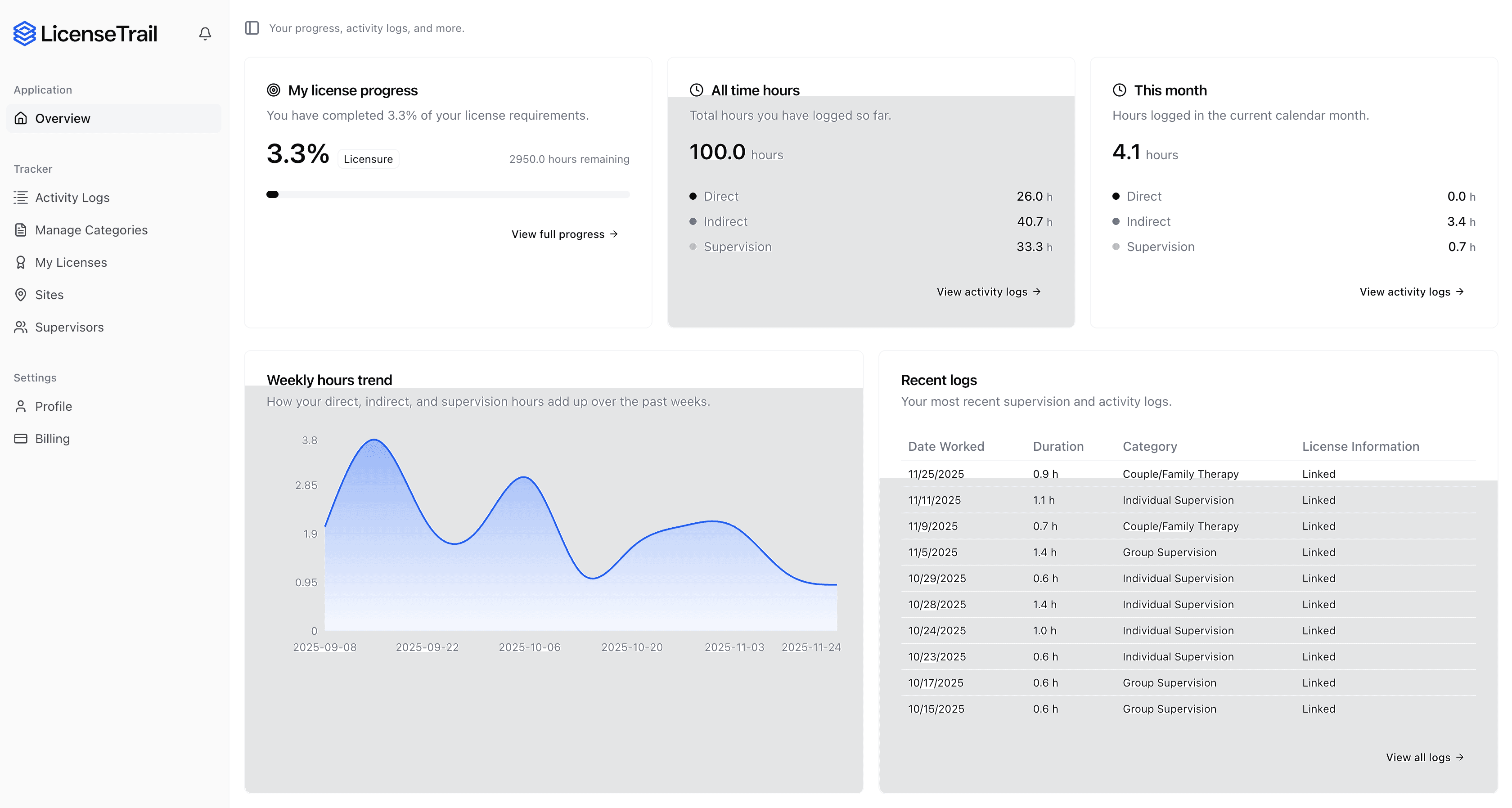
License Trail checks your direct, indirect, and supervision hours against Nebraska LIMHP requirements continuously and flags mismatches before you submit.
 Start Tracking for Free
No credit card required · Free plan available
Is your spreadsheet hiding Nebraska LIMHP risks?
Stop guessing if your categories match Nebraska Board of Mental Health and Social Work Practice requirements. License Trail checks your direct, indirect, and supervision hours continuously and flags mismatches before you submit.
Import or log
Bring your spreadsheet or start fresh
Upload your existing tracking spreadsheet and we'll map every hour into the right Nebraska Board of Mental Health and Social Work Practice categories automatically.
Verify against Nebraska
Catch mismatches before the board does
License Trail checks your direct, indirect, and supervision hours against Nebraska LIMHP requirements continuously.
Export board-ready
One-click clean reports
Generate professional, board-ready reports for supervision meetings and Nebraska Board of Mental Health and Social Work Practice submissions in seconds.
No credit card required · Free plan available