
Nebraska LMHP Requirements: Hours, Exams & Step-by-Step Guide
Stop guessing if your categories match Nebraska requirements. License Trail checks your direct, indirect, and supervision hours against LMHP requirements continuously and flags mismatches before you submit.
No credit card required · Free plan available
Quick Requirements Overview
- Governing authority: Nebraska Mental Health Practice Act (Neb. Rev. Stat. §§ 38‑2115–38‑2124) + DHHS regs 172 NAC 94 (Board of Mental Health Practice)
- Education: Master’s/doctoral (or equivalent) primarily therapeutic mental health + practicum/internship; if after 9/1/1995, 300 clock hours direct client contact in practicum/internship
- Provisional step required: Must hold PLMHP before accruing Nebraska hours; PLMHP expires on LMHP issuance or 5 years (max 2 provisional licenses)
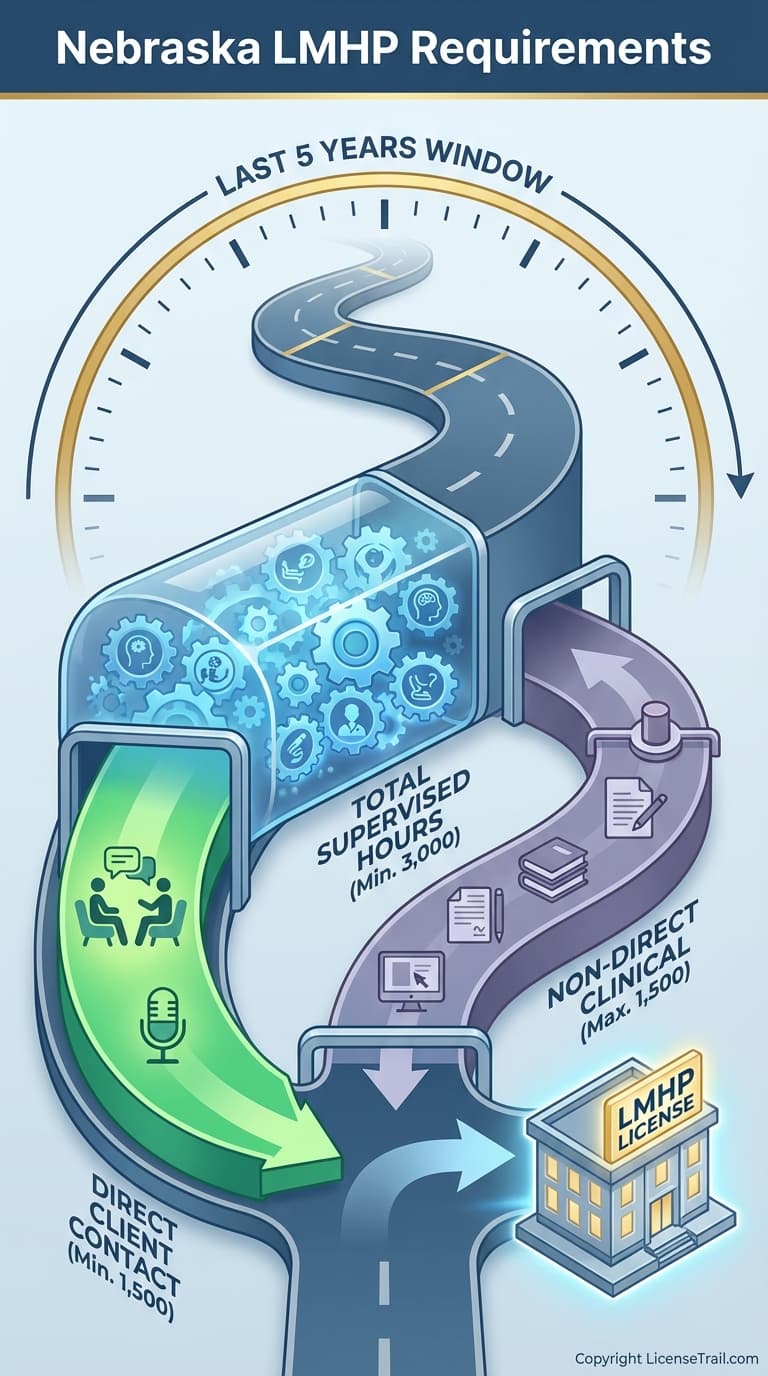
- Supervised experience: 3,000 post-degree hours total; 1,500 direct client contact + 1,500 indirect (e.g., record review, case conferences, observation)
- Supervision rules: Supervisor must be physician, psychologist, LMHP, or LIMHP (active/qualified); includes ≥1 hour/week evaluative face-to-face supervision
- Exam: Pass a board-approved national exam (varies by discipline: NCE/NCMHCE/CRC, ASWB Clinical, or AMFTRB)
- Application (LMHP): Submit DHHS application with official transcript, supervised-hours documentation (incl. proof PLMHP held for NE hours), official exam scores, and fees
- Scope note: LMHP practice excludes diagnosing major mental illness/disorder except in consultation with qualified professionals (e.g., physician/psychologist/LIMHP)
License Details
Procedures
Licensed Mental Health Practitioner (LMHP) licensure in Nebraska is governed by the Nebraska Mental Health Practice Act (Neb. Rev. Stat. §§ 38‑2115 to 38‑2124) and the Department of Health and Human Services (DHHS) regulations at 172 NAC 94, under the Board of Mental Health Practice. (law.justia.com)
The process is essentially:
- Complete the required graduate education and practicum.
- Obtain a Provisional Mental Health Practitioner (PLMHP) license.
- Accumulate 3,000 hours of supervised mental health practice with specific hour types.
- Pass an approved national exam.
- Apply for full LMHP licensure with DHHS.
Below is a step‑by‑step guide, with the hour requirements spelled out using the Board’s and Legislature’s own terminology.
1. Understand what “mental health practice” and “LMHP” mean in Nebraska
Nebraska law defines mental health practice as providing “treatment, assessment, psychotherapy, counseling, or equivalent activities” to individuals, couples, families, or groups for behavioral, cognitive, social, mental, or emotional disorders. (law.justia.com)
At the same time, mental health practice in this license category does not include diagnosing major mental illness or disorder except in consultation with a qualified physician, licensed psychologist, licensed independent mental health practitioner (LIMHP), or certain compact‑privileged professional counselors. (law.justia.com)
A mental health practitioner is simply “a person who holds himself or herself out as a person qualified to engage in mental health practice or a person who offers or renders mental health practice services.” (codes.findlaw.com)
The LMHP credential allows you to practice mental health independently within this scope, but without the independent authority to diagnose and treat major mental illness (that’s what the LIMHP covers).
2. Meet the graduate education and practicum requirements
Nebraska statute and regulations require graduate‑level preparation in therapeutic mental health:
- You must have a master’s degree, doctoral degree, or the equivalent of a master’s degree “that consists of course work and training which was primarily therapeutic mental health in content and included a practicum or internship and was from an approved educational program.” (law.justia.com)
- For practicums or internships completed after September 1, 1995, the law requires “a minimum of 300 clock hours of direct client contact under the supervision of a qualified physician, a licensed psychologist, or a licensed mental health practitioner.” (law.justia.com)
If your program is not accredited under the Mental Health Practice Act’s listed accrediting bodies, it must meet the equivalency standards for mental health programs in 172 NAC 94‑007 (including at least 60 semester hours in duration and other content criteria). (regulations.justia.com)
These educational requirements must be completed before you can count any experience toward LMHP licensure.
3. Obtain a Provisional Mental Health Practitioner (PLMHP) license
Nebraska law explicitly ties the supervised experience requirement to the provisional license:
“A person who needs to obtain the required three thousand hours of supervised experience in mental health practice as specified in section 38‑2122 to qualify for a mental health practitioner license shall obtain a provisional mental health practitioner license.” (law.justia.com)
To qualify for a PLMHP, you must: (law.justia.com)
- Hold the qualifying master’s/doctoral/equivalent degree described above.
- Apply before you begin earning the 3,000 hours of supervised experience.
- Pay the provisional mental health practitioner license fee to DHHS.
- You are not required by regulation to have a supervisor in place at the time you apply; the rules “shall not require that the applicant have a supervisor in place” for provisional licensure. (law.justia.com)
The PLMHP license:
- Expires when you receive your LMHP or five years after the date of issuance, whichever comes first. (law.justia.com)
- Requires that you inform all clients that you hold a provisional license, that you are practicing under supervision, and that you identify your supervisor; failure to disclose is grounds for discipline. (law.justia.com)
- Can be issued a second time if you do not finish the 3,000 hours under your first provisional license, but “no additional provisional licenses will be issued” beyond a second one. (regulations.justia.com)
DHHS’s own licensing page restates this plainly: a PLMHP “is a person who needs to obtain 3,000 hours of supervised experience in mental health practice in Nebraska.” (dhhs.ne.gov)
4. Complete the required supervised experience hours (this is where the hour types matter)
4.1 Total number of hours and when they can be earned
Nebraska statute requires that an LMHP applicant:
- Has “successfully completed three thousand hours of supervised experience in mental health practice… [which] shall be accumulated after completion of the master’s degree, doctoral degree, or equivalent of the master’s degree.” (law.justia.com)
Regulations then tie those hours to having held a provisional license at the time they were earned:
- For the LMHP, DHHS rules state you must document that you met “the requirements for supervised experience set out in Neb. Rev. Stat. § 38‑2122. If the hours were earned in Nebraska the applicant must have held a provisional mental health practitioner license at the time.” (regulations.justia.com)
Because a PLMHP expires in at most five years, you effectively have up to five years per provisional license (and at most two provisional licenses) to accumulate these 3,000 hours unless you start a new provisional period. (law.justia.com)
4.2 Required breakdown of the 3,000 hours
The statutes very specifically divide the 3,000 hours into direct and indirect experience:
-
Direct client contact (face‑to‑face clinical work)
The law states that of the three thousand hours of supervised experience in mental health practice, “fifteen hundred hours [must be] in direct client contact in a setting where mental health services were being offered.” (law.justia.com)In practical terms, these are in‑person or equivalent sessions where you are directly providing treatment, assessment, psychotherapy, or counseling to individuals, couples, families, or groups within a mental health service setting.
-
Other supervised (indirect) experience
The remaining 1,500 hours out of the 3,000 must be in non‑direct, but still supervised, professional activities. The statute provides examples, stating that these hours include, but are not limited to:- Review of client records
- Case conferences
- Direct observation
- Video observation (law.justia.com)
DHHS regulations reinforce this structure by specifying that for mental health practice supervision, there must be both:
- Supervised experience that is not considered direct client contact, including the kinds of activities above.
- Evaluative face‑to‑face contact for a minimum of 1 hour per week between supervisee and supervisor. (regulations.justia.com)
So, using the Board’s and Legislature’s exact structure, the core hours requirement is:
- 3,000 hours of supervised experience in mental health practice, all after completion of the qualifying graduate degree.
- Within those 3,000 hours:
- 1,500 hours of direct client contact in mental‑health service settings.
- 1,500 hours of other supervised experience (record review, case conferences, observation, etc.), which the regulations explicitly say “is not considered direct client contact” but still counts toward the 3,000. (law.justia.com)
4.3 What “supervised” means and supervision frequency
Nebraska law and regulations define supervision quite precisely:
-
For purposes of the 3,000 hours, “supervised” means you are monitored by:
- For hours completed after September 1, 1994:
- A qualified physician
- A psychologist licensed to engage in the practice of psychology
- Or a licensed mental health practitioner (law.justia.com)
- For hours completed after September 1, 1994:
-
Supervision must include “evaluative face‑to‑face contact for a minimum of one hour per week” between you and your supervisor. (law.justia.com)
Regulations at 172 NAC 94‑009.01 and 009.02 add more detail about what counts as supervised experience: (regulations.justia.com)
- Supervision must:
- Focus on raw data from your clinical work (via written materials, direct observation, or recordings).
- Be clearly distinguishable from your own personal psychotherapy or general consultation.
- Occur in a setting where mental health services are being offered, and where:
- You apprise the supervisor of client diagnoses and treatment.
- Cases and ethical principles are discussed.
- The supervisor provides oversight and guidance and periodically evaluates the therapeutic process and whether goals are being met.
- Not involve supervising more than six supervisees at a single face‑to‑face supervisory meeting.
In short, every direct and indirect hour must be accumulated while you are functioning under this type of structured, documented supervision in order to count toward the 3,000 hours.
4.4 Who qualifies as a supervisor for LMHP hours
Regulations define a “qualified supervisor” for the mental health practice license: (regulations.justia.com)
-
The supervisor must:
- Hold a current active credential.
- Not be currently under discipline (and at least one year must have passed since completion of any prior discipline).
-
For mental health practice (LMHP) supervision specifically, the supervisor must be one of the following (or hold a similar credential in another jurisdiction):
- Licensed physician
- Licensed psychologist
- Licensed independent mental health practitioner (LIMHP)
- Licensed mental health practitioner (LMHP)
These supervisor‑type requirements are in addition to the statutory supervision requirements described above.
5. Pass the required licensing examination
Nebraska law requires that an LMHP applicant “has satisfactorily passed an examination approved by the board.” (law.justia.com)
Regulations at 172 NAC 94‑010 spell out which exams are acceptable based on your degree area: (regulations.justia.com)
-
If your degree is in professional counseling or another mental‑health counseling field:
- National Counselor Examination (NBCC/NCE), or
- National Clinical Mental Health Counselor Examination (NBCC/NCMHCE), or
- Commission on Rehabilitation Counselor (CRC) exam, as applicable.
-
If your degree is in social work and you’re seeking LMHP plus master social work certification:
- ASWB Clinical Examination.
-
If your degree is in marriage and family therapy:
- Association of Marital and Family Therapy Regulatory Boards (AMFTRB) exam.
DHHS’s mental health licensing page notes that the examination required “is determined by the area of your degree and what type of credential(s) you apply for” and directs applicants to section 010 of the regulations. (dhhs.ne.gov)
Nebraska also uses an online jurisprudence exam in certain pathways (for example, when applying by reciprocity), but for standard LMHP by examination the critical exam requirement is the national test appropriate to your discipline. (dhhs.ne.gov)
6. Apply for the full LMHP license
Once you have:
- Completed the qualifying graduate degree and practicum,
- Held a PLMHP and accrued the 3,000 hours of supervised experience with the correct breakdown and supervision, and
- Passed the approved exam,
you can submit an application for an initial Mental Health Practitioner license (LMHP) to the DHHS Licensure Unit.
Under 172 NAC 94‑003.03, your application for an initial LMHP must include: (regulations.justia.com)
-
Documentation of education
- Official transcript verifying the qualifying graduate degree from an approved or equivalent mental health program (as described in 172 NAC 94‑003.01 and 94‑007).
-
Documentation of supervised experience
- Evidence that you have met the supervised experience requirements in Neb. Rev. Stat. § 38‑2122 (3,000 hours total, with the required breakdown).
- If hours were earned in Nebraska, proof that you held a PLMHP at the time those hours were accumulated.
-
Documentation of examination
- Official exam scores sent directly to DHHS from the examination entity or from another state licensing board or agency, showing you passed the required exam as specified in 172 NAC 94‑010.
-
Application form and fees
- A complete application on DHHS forms and payment of the LMHP license fee, as listed in the Title 172, Chapter 2 fee schedule. (dhhs.ne.gov)
Once DHHS verifies that you meet all statutory and regulatory requirements, the LMHP license is issued. Licenses are renewed biennially (September 1 of even‑numbered years) and require 32 hours of continuing education, including at least 4 hours in ethics, for each renewal period. (dhhs.ne.gov)
7. Hour requirements at a glance (using Nebraska’s own structure)
To summarize the experience component, using the state’s terminology:
- 3,000 hours of supervised experience in mental health practice, all post‑degree. (law.justia.com)
- Of those 3,000 hours:
- 1,500 hours must be direct client contact in settings “where mental health services were being offered.” (law.justia.com)
- 1,500 hours must be other supervised experience such as review of client records, case conferences, direct observation, or video observation—activities “not considered direct client contact” but explicitly recognized as supervised hours. (law.justia.com)
- Supervision must:
- Be provided by a qualified supervisor (licensed physician, psychologist, LMHP, or LIMHP) with an active credential. (regulations.justia.com)
- Include evaluative face‑to‑face contact at least 1 hour per week (in person or secure visual imaging). (regulations.justia.com)
These are the key hour‑type and supervision requirements defined by Nebraska’s Mental Health Practice Act and 172 NAC 94 for the LMHP license.
Track your LMHP hours with confidence
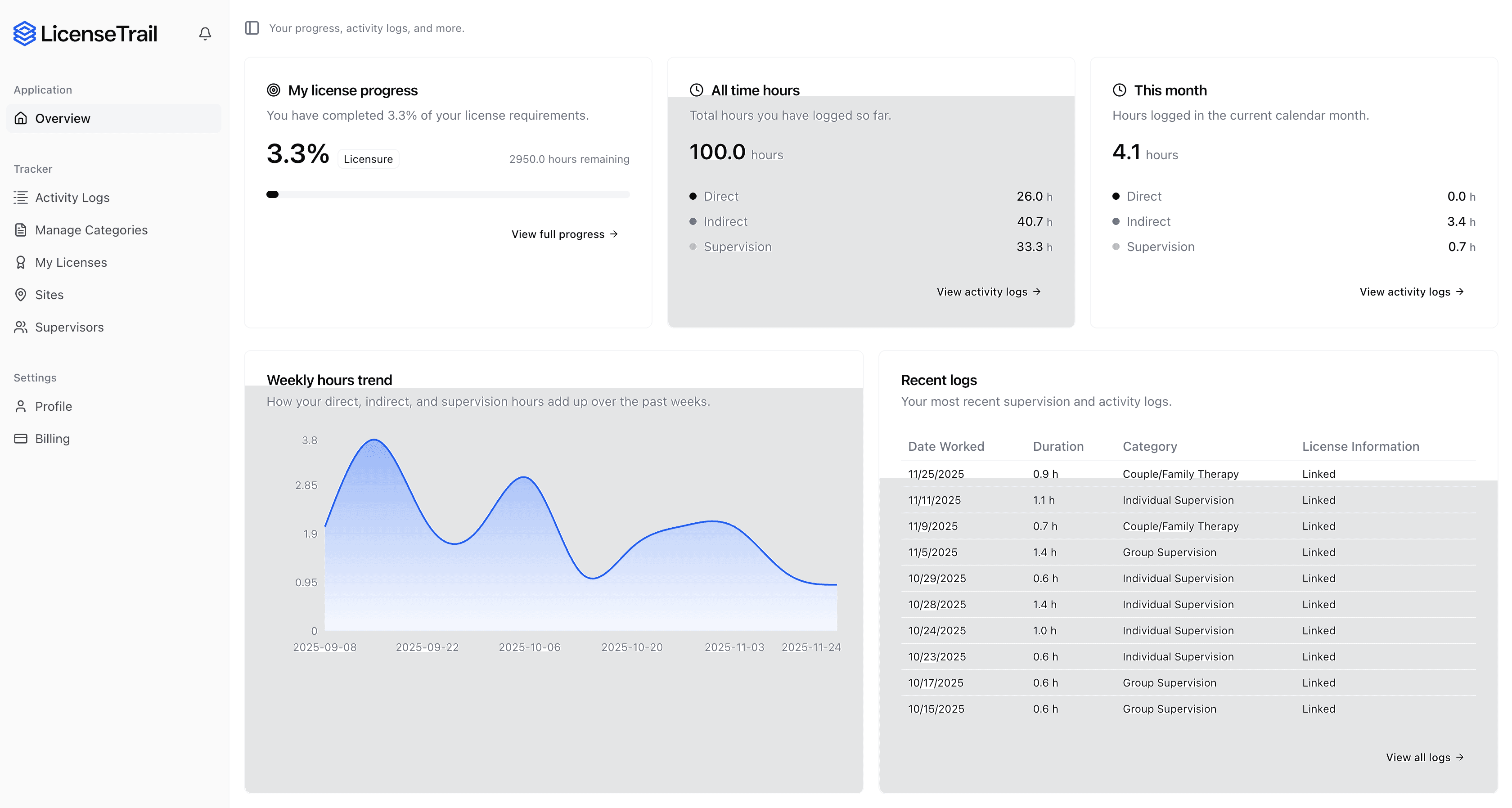
License Trail checks your direct, indirect, and supervision hours against Nebraska LMHP requirements continuously and flags mismatches before you submit.
 Start Tracking for Free
No credit card required · Free plan available
Is your spreadsheet hiding Nebraska LMHP risks?
Stop guessing if your categories match Nebraska Board of Mental Health and Social Work Practice requirements. License Trail checks your direct, indirect, and supervision hours continuously and flags mismatches before you submit.
Import or log
Bring your spreadsheet or start fresh
Upload your existing tracking spreadsheet and we'll map every hour into the right Nebraska Board of Mental Health and Social Work Practice categories automatically.
Verify against Nebraska
Catch mismatches before the board does
License Trail checks your direct, indirect, and supervision hours against Nebraska LMHP requirements continuously.
Export board-ready
One-click clean reports
Generate professional, board-ready reports for supervision meetings and Nebraska Board of Mental Health and Social Work Practice submissions in seconds.
No credit card required · Free plan available