
Nevada LSW Requirements: Hours, Exams & Step-by-Step Guide
Stop guessing if your categories match Nevada requirements. License Trail checks your direct, indirect, and supervision hours against LSW requirements continuously and flags mismatches before you submit.
No credit card required · Free plan available
Quick Requirements Overview
- Eligibility: Age 21+ and U.S. citizen or authorized to work in the U.S.
- Education: BSW (or MSW per statute) in social work from a CSWE-accredited/candidate program (foreign equivalent allowed with documentation).
- Application: Submit Board application, required fees, and fingerprints/background check.
- Exam: Pass ASWB Bachelors exam (BSW applicants) / ASWB Masters exam (MSW applicants).
- Pre-licensure hours: None for the standard BSW→LSW route.
- Legacy hours pathway: If already a pre-1995 associate in social work, must have 3,000 hours employment in NV as an associate + exam.
- Provisional option: Provisional license possible while awaiting the next exam; up to 9 months.
- Renewal CE: 30 CE hours per 2-year period: 4 ethics, 2 suicide prevention, 6 cultural competency/DEI, 10 field-of-practice, 8 elective/approved.
License Details
Procedures
Licensing as a Licensed Social Worker (LSW) with the Nevada State Board of Examiners for Social Workers is structured almost entirely around education, examination, and continuing education—not around pre‑licensure “practice hours” the way clinical licenses are.
Below is a step‑by‑step explanation focused on (1) what is actually required to become an LSW now, and (2) every place where Nevada law or regulation talks about hours and how those hours are defined.
1. What the LSW license is in Nevada law
Nevada’s regulations define a “licensed social worker” as a person licensed by the Board under NRS 641B.220 “to engage in the practice of social work as a social worker.” (law.cornell.edu)
The LSW is the entry‑level professional license. It is governed primarily by:
- NRS 641B.200 (preliminary qualifications) (nevada.public.law)
- NRS 641B.220 (social worker: qualifications) (nevada.public.law)
- NAC 641B.105 (examinations) (regulations.justia.com)
- NAC 641B.187 (continuing education hours) (law.cornell.edu)
2. Step‑by‑step: How to qualify for an LSW
Step 1 – Meet the preliminary statutory qualifications
Under NRS 641B.200, every applicant for any Nevada social work license must prove to the Board that they are:
- At least 21 years of age; and
- A U.S. citizen or lawfully entitled to remain and work in the United States. (nevada.public.law)
These are baseline conditions for all license levels.
Step 2 – Complete the qualifying education
NRS 641B.220(1) governs initial LSW licensure. The Board “shall grant a license to engage in social work as a social worker” to an applicant who:
- Meets the preliminary qualifications; and
- “Possesses a baccalaureate degree or master’s degree in social work” from:
- A Council on Social Work Education (CSWE)–accredited (or candidate) program, or
- A foreign program with equivalent degree and documentation required by NRS 641B.204. (nevada.public.law)
Key points:
- By statute, both a BSW and an MSW in social work fulfill the degree requirement for LSW. (nevada.public.law)
- The Board’s current “Licensure New Applicants” page, however, states that the LSW application form is “only for individuals with a bachelor’s degree in social work (BSW)” and provides a separate application track for Licensed Master Social Worker (LMSW) for MSW graduates. (socwork.nv.gov)
In practice today:
- BSW graduates apply for LSW.
- MSW graduates are generally directed to apply for LMSW, even though NRS 641B.220 would permit an MSW holder to qualify for LSW.
Step 3 – Submit fingerprints / background information
NRS 641B.202 requires that each applicant submit “a complete set of fingerprints” for criminal history checks via the Central Repository and FBI. (leg.state.nv.us)
The Board’s online LSW application system links to a “Fingerprint Waiver Document,” and fingerprints are part of the required package. (socwork.nv.gov)
Step 4 – Apply to the Board
The Board provides an online application portal titled “Application for Licensure: Licensed Social Worker” for BSW applicants. (socwork.nv.gov)
In broad terms, the application will require:
- Proof of age and legal work authorization (preliminary qualifications) (nevada.public.law)
- Official transcript showing your CSWE‑accredited BSW (or MSW, but MSWs are typically routed to LMSW) (nevada.public.law)
- Fingerprints / background check documentation (leg.state.nv.us)
- Fees as set in the Board’s fee schedule under NRS 641B.300 (application, initial license, etc.). (socwork.nv.gov)
Step 5 – Pass the required national examination
Nevada law requires that all social work applicants “pass an examination prescribed by the Board.” (nevada.public.law)
NAC 641B.105 is more specific:
- An applicant for licensure as a licensed social worker who holds a baccalaureate degree in social work must pass the ASWB Bachelors Examination.
- An applicant who holds a master’s degree in social work must pass the ASWB Masters Examination. (regulations.justia.com)
The exam is administered by the Association of Social Work Boards (ASWB); you register, test at a Pearson VUE or similar center, and ASWB sends results to Nevada.
Step 6 – (Optional) Provisional licensure while you test
NRS 641B.275 allows the Board to grant a provisional license to a person who:
- Is otherwise eligible under NRS 641B.220(1) and
- Applies to take the next available examination. (nevada.public.law)
For this provisional LSW:
- The Board sets the validity period by regulation.
- The statute caps it at no longer than 9 months for someone who has already finished their social work degree and is only waiting to take and pass the exam. (nevada.public.law)
3. Hour‑based requirements for LSWs: what actually exists
Nevada’s law and rules refer to three different kinds of “hours” that can touch an LSW:
- Pre‑licensure practice/employment hours (only in one legacy pathway)
- Post‑licensure continuing education hours (applies to all LSWs)
- Supervised postgraduate hours for higher‑level licenses, not for LSW
3.1 Pre‑licensure practice hours – none for new LSW applicants
For new applicants coming straight from an accredited BSW (or MSW) program, there is no requirement for pre‑licensure practice hours such as “1,500 hours of direct experience” or “1,500 hours of supervised experience.”
NRS 641B.220(1) lists only:
- Meeting preliminary qualifications (age and work authorization),
- Having the required degree in social work, and
- Passing the Board’s examination. (nevada.public.law)
No clinical or employment‑hour minimum is attached to that main route into the LSW license.
Legacy associate‑to‑LSW pathway (3,000 hours of employment)
NRS 641B.220(2) does recognize a second route: for someone already licensed as an associate in social work. In that case, the Board grants an LSW license if the associate:
- Meets the preliminary qualifications;
- Has a bachelor’s or master’s degree in a related field or equivalent coursework;
- “Completes 3,000 hours of employment in Nevada as an associate in social work”; and
- Passes the examination. (nevada.public.law)
However, NRS 641B.210 explicitly states that:
- The Board “shall not grant a license to engage in social work as an associate in social work to any person on or after June 19, 1995.” (nevada.public.law)
This means:
- The 3,000 hours of employment requirement only applies to a small, grandfathered group who were already licensed as associates prior to 1995 and may eventually transition to LSW.
- For contemporary applicants who are not already associates, this 3,000‑hour employment requirement does not apply.
Note that Nevada does not subdivide those 3,000 hours for associates into “direct client contact” vs. “supervised” hours the way it does for clinical internships—it simply requires “3,000 hours of employment” as an associate. (nevada.public.law)
3.2 Post‑licensure continuing education hours for LSWs
Once you are licensed, hour requirements do appear, in the form of continuing education (CE) needed for renewal.
Under NAC 641B.187:
- A licensee who is a licensed associate in social work, a licensed social worker or a licensed master social worker must complete at least 30 continuing education hours during each reporting period (Nevada uses a two‑year reporting cycle). (law.cornell.edu)
Those 30 hours are broken down as follows for LSW licensees:
-
Ethics – 4 hours
- Four hours must relate to ethics in the practice of social work, including topics such as professional boundaries, confidentiality, dual relationships, billing, fraud, telehealth, supervision, social media, sexual harassment, exploitation, job stress, social work laws and regulations, cultural competency and racial biases, mandated reporting, scope of practice, professional conduct, standards of care, or impaired professionals. (law.cornell.edu)
-
Suicide prevention – 2 hours
- Two hours must relate to evidence‑based suicide prevention and awareness or another Board‑approved course in suicide prevention and awareness, and must be completed every 2 years as part of the 30‑hour total. (law.cornell.edu)
-
Cultural competency / DEI – 6 hours
- NAC 641B.187, as amended following Assembly Bill 267 (2023), requires six hours relating to “cultural competency and diversity, equity and inclusion” every reporting period. (law.cornell.edu)
-
Field‑of‑practice content – 10 hours
- Ten hours must be in the field of practice of the licensee, unless the Board approves otherwise. (law.cornell.edu)
-
Remaining hours – 8 hours
- The remaining 8 of the 30 hours may be in any Board‑approved continuing education that maintains, improves, or enhances the licensee’s knowledge and competency in social work practice. (law.cornell.edu)
Distance learning / self‑directed CE hours
NAC 641B.189 describes acceptable forms of continuing education and allows workshops, online learning, academic courses, approved self‑directed learning and similar activities, so long as they provide independent verification of completion and are approved by the Board. (leg.state.nv.us)
Board‑linked guidance (for example, MyCASAT’s summary written for Nevada licensees) notes that an LSW “may take up to 15 hours of continuing education credits via distance learning/remote study courses, home study and/or self-directed learning programs during a two-year period,” based on NAC 641B.189. (mycasat.org)
Because that cap appears in secondary guidance rather than directly in the excerpted code, it is wise to check the Board’s current “Continuing Education Requirements” page before planning all 30 hours online.
3.3 Hours for higher‑level licenses (for context only)
Your question is about LSW, but Nevada’s hour‑based requirements are much more detailed at the independent (LISW) and clinical (LCSW) levels, which can help explain where numbers like “3,000 hours” or “2,000 hours of clinical psychotherapeutic work” come from:
- NRS 641B.230 requires “3,000 hours of supervised, postgraduate social work” for Independent Social Worker (LISW) licensure. (nevada.public.law)
- NRS 641B.240 requires “3,000 hours of supervised, postgraduate, clinical social work” for Clinical Social Worker (LCSW) licensure. (nevada.public.law)
- NAC 641B.188 (excerpted in the NAC chapter) further specifies that for LCSW:
- At least 2,000 of those 3,000 hours must be in psychotherapeutic methods and techniques with individuals, families, and groups,
- At least 1,000 hours must be supervised by a licensed clinical social worker approved by the Board. (leg.state.nv.us)
Those hour breakdowns, however, do not apply to LSW licensure itself.
4. Summary focused on your example about hours
Putting the Nevada board’s language together:
-
To become an LSW today (through the BSW → LSW route):
- There is no requirement for a fixed number of pre‑licensure practice hours such as “1,500 hours of direct experience and 1,500 hours of supervised experience.”
- The core requirements are:
- Age 21+ and legal work authorization (preliminary qualifications), (nevada.public.law)
- BSW in social work from a CSWE‑accredited or candidate program (or MSW, though MSWs are normally directed to LMSW), (nevada.public.law)
- Passing the ASWB Bachelors exam (or Masters exam if applying as an MSW), (regulations.justia.com)
- Fingerprints/background check and Board application with required fees. (leg.state.nv.us)
-
The only explicit “hours” tied directly to LSW status are:
- 3,000 hours of employment in Nevada as an associate in social work—but this applies only to the closed, legacy associate‑to‑LSW pathway that is not available to new applicants today. (nevada.public.law)
- 30 continuing education hours every 2 years for renewal, broken down into:
- 4 hours ethics,
- 2 hours suicide prevention and awareness,
- 6 hours cultural competency / diversity, equity, and inclusion,
- 10 hours in your field of practice,
- 8 hours in any other approved CE. (law.cornell.edu)
If you are mapping Nevada’s rules to an hours‑based template like “direct experience vs. supervised experience,” that template really belongs to the state’s post‑graduate internship for LCSW/LISW, not to the basic Licensed Social Worker (LSW) license, which relies instead on accredited education, examination, and structured continuing education.
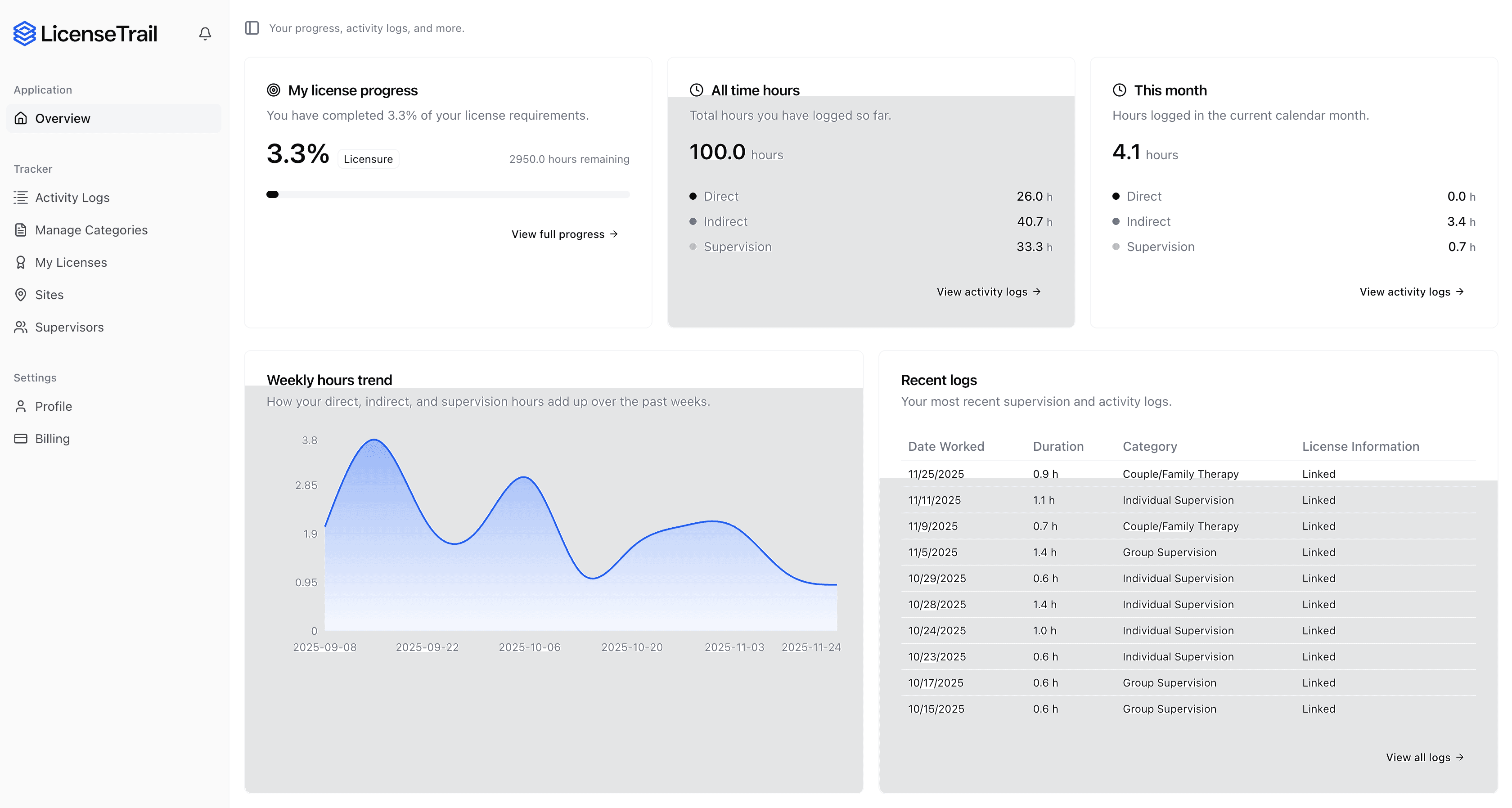
Track your LSW hours with confidence
License Trail checks your direct, indirect, and supervision hours against Nevada LSW requirements continuously and flags mismatches before you submit.
 Start Tracking for Free
No credit card required · Free plan available
Is your spreadsheet hiding Nevada LSW risks?
Stop guessing if your categories match Nevada Board of Examiners for Social Workers requirements. License Trail checks your direct, indirect, and supervision hours continuously and flags mismatches before you submit.
Import or log
Bring your spreadsheet or start fresh
Upload your existing tracking spreadsheet and we'll map every hour into the right Nevada Board of Examiners for Social Workers categories automatically.
Verify against Nevada
Catch mismatches before the board does
License Trail checks your direct, indirect, and supervision hours against Nevada LSW requirements continuously.
Export board-ready
One-click clean reports
Generate professional, board-ready reports for supervision meetings and Nevada Board of Examiners for Social Workers submissions in seconds.
No credit card required · Free plan available